Managing a panel of diabetes patients is a delicate balance of clinical expertise and logistical precision. The traditional model of “see you in three months” often fails to account for the dynamic nature of chronic disease, leading to reactive care, administrative overload, and missed opportunities for intervention. The result is a cycle of staff burnout, revenue leakage, and suboptimal patient outcomes.
To break this cycle, forward-thinking endocrinology and primary care clinics are shifting from routine check-ups to a proactive, system-driven approach. This modern workflow leverages a HIPAA-compliant Virtual Medical Assistant (VMA) to orchestrate appointments, manage data, and engage patients, transforming chaotic scheduling into a predictable and profitable system for chronic care.
Why Standard Scheduling Fails for Chronic Diabetes Care?
The one-size-fits-all appointment block is fundamentally mismatched with the needs of diabetes management. This rigidity creates friction for both the practice and the patient.
The challenge of personalized visit frequency vs. rigid appointment blocks
A patient with a new insulin start and an A1C of 11% requires a much different follow-up cadence than a stable patient with an A1C of 6.8%. Forcing both into the same 3- or 6-month schedule either neglects the high-risk patient or over-utilizes resources on the stable one.
Managing high-risk vs. low-risk patient cadences effectively
Without a system to stratify patients, it’s nearly impossible to ensure high-risk individuals are seen frequently enough for timely adjustments. This administrative gap can lead directly to poor glycemic control and preventable hospitalizations.
The administrative drain of coordinating annual exams (foot, eye, kidney)
Effective diabetes care requires at least four annual exams: A1C, foot, eye, and kidney. Manually tracking and scheduling these for hundreds of patients is an immense administrative burden that often falls on already-strained MAs, pulling them away from vital clinical tasks.
The True Cost of an Inefficient Diabetes Workflow: Revenue Leakage and Staff Burnout
An inefficient system isn’t just frustrating; it has tangible costs that impact your practice’s bottom line and the well-being of your team.
How missed appointments and poor follow-up impact A1C goals and clinical outcomes
When high-risk patients miss follow-ups or their appointments are scheduled too far out, clinicians lose the opportunity to titrate medications or address barriers to care. This directly correlates with poorer A1C control and a higher risk of long-term complications, which ultimately drives up healthcare costs for everyone.
The financial impact of under-coding: Leaving 99214 revenue on the table
Many diabetes follow-up visits—especially those involving medication changes or lasting over 30 minutes—qualify for a Level 4 visit (99214). However, rushed clinicians and inadequate pre-visit prep often lead to under-documentation and billing for a lower-paying 99213 code, resulting in significant lost revenue over time.
Overburdening MAs with administrative tasks instead of top-of-license clinical duties
Your Medical Assistants are a clinical asset. When they spend their days chasing down lab results, making reminder calls, and coordinating referrals, they aren’t performing top-of-license duties like patient education, screenings, and rooming. This misuse of skilled staff is a primary driver of burnout and turnover. A dedicated Virtual Medical Assistant can absorb these administrative tasks, liberating your in-house team to focus on patient care.
The VMA-Driven Workflow: A Step-by-Step System for Diabetes Appointment Management
Implementing a Virtual Medical Assistant transforms your diabetes care from a series of disjointed tasks into a seamless, proactive workflow.
Step 1 (Pre-Visit): Your VMA handles pre-appointment data sync and lab confirmations
Your VMA confirms that recent A1C, lipid panel, and microalbumin results are in the EMR before the appointment. They also ensure annual eye and foot exams are flagged if overdue. This pre-charting work means the clinician can open the patient’s chart and immediately focus on clinical decision-making.
Step 2 (Pre-Visit): Implementing risk-stratified scheduling and standing orders
Based on clinic-defined protocols, the VMA can manage a risk-stratified schedule. They reach out to high-risk patients (e.g., A1C >9%) to book more frequent follow-ups and can even queue up standing orders for labs needed before the next visit, ensuring no time is wasted. This process is a core component of an effective virtual medical assistant workflow.
Step 3 (Post-Visit): Ensuring seamless follow-up scheduling and referrals to CDCES
Before the patient even leaves the exam room (or ends the telehealth call), the VMA has already received the provider’s instructions and can schedule the next appointment based on the patient’s risk level. They handle the administrative work of sending referrals to ophthalmology or Certified Diabetes Care and Education Specialists (CDCES), closing the loop on care.
Before vs. After: From chaotic scheduling to a predictable, proactive system
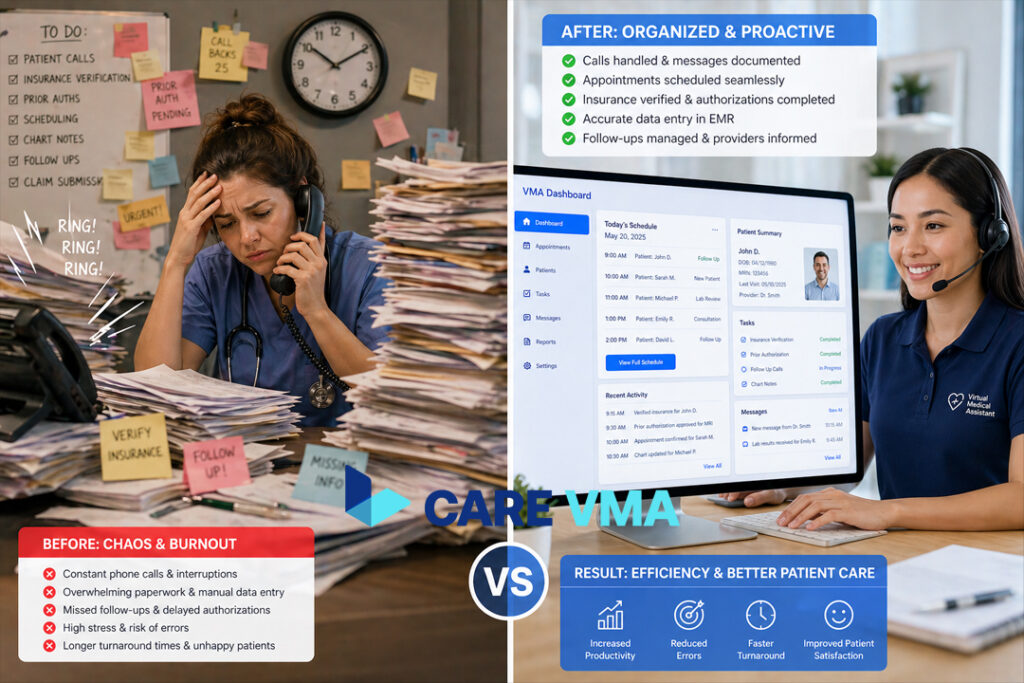
Before: MAs scramble to make calls between rooming patients, appointments are booked without considering clinical risk, and providers walk into exams unprepared. After: A VMA manages a predictable schedule, clinicians have all necessary data upfront, high-risk patients are managed closely, and the in-house team focuses exclusively on the patient in front of them.
Use Case: How a VMA Maximizes Your Telehealth Appointments for Diabetes
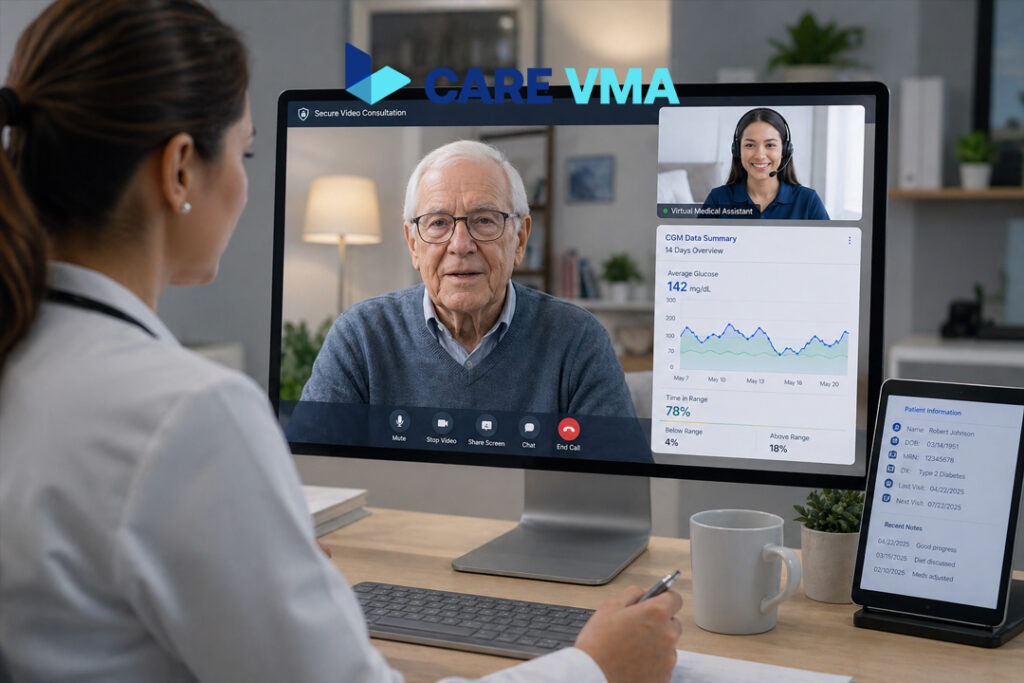
Telehealth is a powerful tool for diabetes management, but it can be derailed by technical issues and missing data. A Telehealth Virtual Assistant ensures every virtual visit is efficient and clinically productive.
Ensuring patient CGM and pump data (Glooko, Clarity) is synced 24 hours prior
The appointment “starts” the day before. Your VMA contacts the patient to confirm they have synced their CGM (Dexcom Clarity), pump (Glooko), or Freestyle Libre (Libreview) data. This single step prevents the most common telehealth bottleneck: spending the first 10 minutes troubleshooting data uploads instead of analyzing them.
Triaging technical issues before the clinician joins the call
The VMA joins the virtual visit link five minutes early to greet the patient, confirm their audio and video are working, and resolve any technical glitches. The clinician joins a call that is ready to begin immediately, maximizing their billable time. This simple buffer significantly improves both provider and patient satisfaction, showcasing key telehealth assistant benefits.
Scheduling short, 15-minute “bridge” appointments for insulin titration
Instead of waiting three months for a full follow-up, a VMA can schedule brief, 15-minute telehealth “bridge” appointments for patients needing insulin adjustments. This allows for more agile and responsive care, helping patients reach their A1C goals faster.
Reduce Patient No-Shows: Proactive Barrier Identification with Your Virtual Assistant
No-shows are rarely due to a lack of motivation; they are often caused by logistical barriers. A VMA moves beyond simple reminders to actively identify and help solve these problems.
Moving beyond automated reminders to personalized follow-up calls
While automated texts are useful, a personal call from your VMA is far more effective. They can confirm the appointment and verbally check if the patient anticipates any issues.
Using the “Is it getting harder to make it?” script to uncover transport/work conflicts
A VMA can be trained to use empathetic scripting. Instead of a simple reminder, they can ask, “We have you down for next Tuesday. I just wanted to check in and see, is it getting any harder for you to make it to these appointments?” This open-ended question can uncover barriers like a lack of transportation, a new work schedule, or childcare issues, allowing the practice to offer solutions like a telehealth option or rescheduling.
The VMA’s role in the 5-minute morning huddle to flag at-risk patients
Your VMA can provide a daily report for the morning huddle, flagging patients on the schedule who have a history of no-shows or who expressed uncertainty during a confirmation call. This allows the team to be prepared and potentially reach out one last time.
Calculating the ROI: How VMAs Lower the Administrative Cost of Diabetes Care
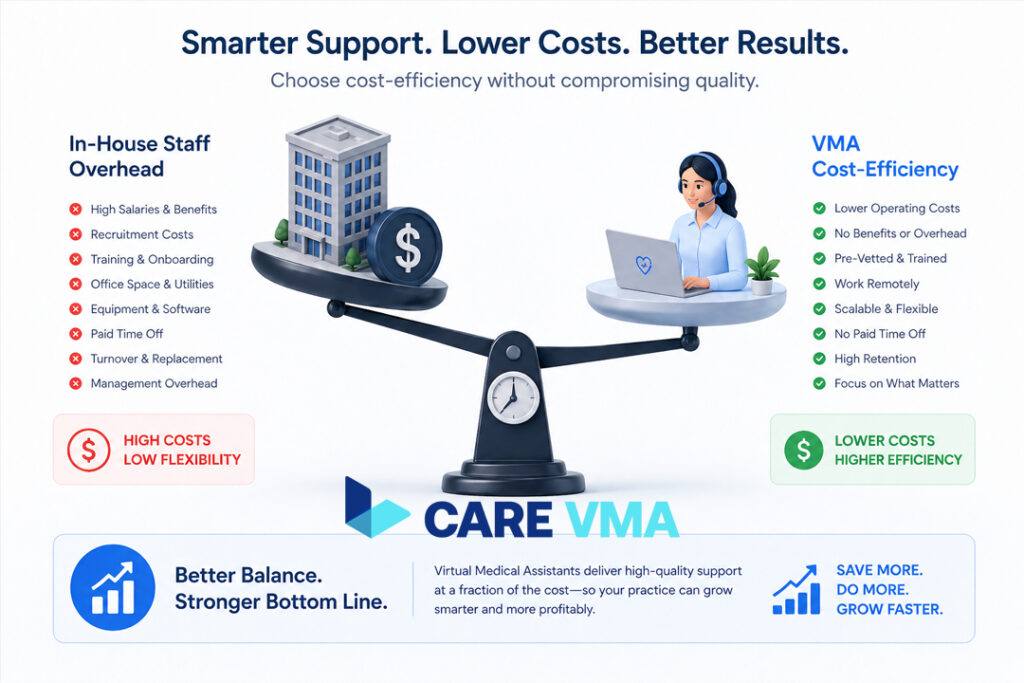
Integrating a VMA isn’t an expense; it’s an investment in efficiency that delivers a clear return. By delegating non-clinical tasks, you can transform your practice’s financial health.
Cost-analysis: VMA vs. in-house staff for non-clinical workflow tasks
When you factor in salary, benefits, payroll taxes, and physical office space, the fully-loaded cost of an in-house employee is often 1.5-2x their hourly wage. A VMA service eliminates this overhead. You pay only for the productive time spent on the specific administrative tasks required for your virtual chronic care management program.
Increasing billable time by offloading scheduling and data prep to a VMA
By having a VMA handle all pre-visit data gathering, lab checks, and scheduling, you free up clinicians to see more patients or spend more time on complex cases. This directly increases the practice’s billable hours and revenue-generating capacity.
Improving practice capacity without increasing physical headcount
A VMA allows you to scale your administrative support system without needing more desks, computers, or office space. You can effectively grow your patient panel and improve workflow efficiency within your existing physical footprint.
Assured Compliance and Professionalism: Integrating a HIPAA-Trained VMA Into Your Practice
Trust and security are non-negotiable in healthcare. A professional VMA service operates as a seamless and secure extension of your practice.
Data security protocols for remote EMR and patient data access
Care VMA’s assistants are rigorously trained and operate under strict security protocols. Access to your EMR is provided through secure, encrypted connections, and our entire infrastructure is designed to be fully compliant with HIPAA regulations. You can be confident that patient data is always protected, a cornerstone of our HIPAA-compliant virtual assistants.
Training VMAs on your clinic’s specific diabetes care protocols
Your VMA isn’t a generic assistant. They are onboarded and trained on your specific workflows, risk-stratification criteria, standing orders, and preferred communication style. They learn your practice’s unique approach to diabetes care to ensure they function as a true member of your team.
Ready to transform your diabetes care workflow from reactive to proactive? Schedule a free consultation with a Care VMA specialist today to discover how a Virtual Medical Assistant can improve your clinical outcomes and your bottom line.
FAQ: Implementing a VMA for Diabetes Patient Management
How does a VMA integrate with our existing EMR system?
Our VMAs are trained on all major EMRs (like Epic, Cerner, eClinicalWorks, and Athenahealth). They access your system remotely through a secure VPN, just like any remote employee. Onboarding includes familiarizing them with your specific EMR templates and workflows.
Can a Virtual Medical Assistant order labs or manage standing orders?
A VMA acts on the provider’s behalf under established protocols. They cannot sign orders, but they can “pend” or “queue” standing orders (e.g., A1C, urine microalbumin) for the provider to review and sign, which dramatically speeds up the pre-visit process.
What is the onboarding process for a VMA in a busy endocrinology or primary care clinic?
Our process is designed to be efficient. We start with a discovery call to understand your exact needs and workflows. We then match you with a VMA and conduct a focused onboarding where we document your protocols. Typically, a VMA can be integrated and handling core tasks within one to two weeks with minimal disruption to your practice.
Is a VMA more cost-effective for managing chronic care patients than hiring a full-time care coordinator?
For many clinics, yes. A VMA allows you to access specialized chronic care coordination skills without the cost and commitment of a full-time employee. You pay only for the hours you need, making it a scalable and flexible solution that is perfect for managing the variable administrative load of a diabetes patient panel.
How does Care VMA ensure its assistants understand the nuances of diabetes care and terminology?
Our VMAs undergo foundational training in medical terminology and chronic disease management. Furthermore, we provide specialty-specific training materials and work with your clinic during onboarding to ensure they are fluent in the specific terms, technologies (CGM, insulin pumps), and protocols essential to high-quality diabetes care.