A Telehealth Assistant is a trained remote professional who manages the administrative, technical, and logistical tasks of virtual care. By handling duties like patient scheduling, real-time EHR documentation, and technical troubleshooting, they allow healthcare providers to focus on clinical work, reduce burnout, and improve the overall patient experience.
Top 3 Benefits of a Telehealth Assistant:
- Reduces Administrative Burden: Frees clinicians from hours of paperwork.
- Lowers No-Show Rates: Proactive patient tech-checks and reminders reduce missed appointments by up to 30%.
- Improves Patient & Provider Satisfaction: Creates a seamless, frustration-free virtual care experience.
The Hidden Cost of an Inefficient Clinic
Stop letting administrative tasks dictate your clinical capacity. Clinicians are spending nearly half their day on administrative work, not patient care. This isn’t just inefficient—it’s unsustainable. The “digital friction” of modern healthcare—managing Electronic Health Records (EHRs), juggling appointments, and unexpectedly acting as tech support—is a primary driver of provider burnout and operational bottlenecks that directly impact your bottom line.
A Telehealth Assistant is not another tool to manage; they are an integral, remote team member designed to absorb this friction. They are the operational partners who restore your team’s focus to what matters most: delivering exceptional patient care.
This guide moves beyond a simple list of benefits. We will show you the actual day-to-day workflow of a practice powered by a Telehealth Assistant, demonstrating how to transform your clinic’s operations from theory into reality.
The Core Benefits: Re-architecting Your Practice for Efficiency
The value of a Telehealth Assistant extends across your entire practice. Let’s break down the specific, tangible benefits for your providers, your patients, and your financial outcomes.
For Healthcare Providers: Reclaim Your Time and Reduce Burnout
Is the EHR your last patient of the day? This is where most practices struggle, with clinicians losing hours to after-hours charting. A Telehealth Assistant helps end that cycle.
- Eliminate the Administrative Burden Operational Storytelling: Imagine a typical afternoon. A physician finishes their last virtual appointment, only to face two more hours of updating charts, signing off on notes, and processing referrals. This is a direct path to burnout. The VMA Workflow: A virtual medical scribe documents the visit in real-time. They listen to the patient-provider interaction, update the EHR, reconcile medications, and queue up prescriptions before the call even ends. The provider’s only job is to review and sign. The chart is closed moments after the visit.
- Eradicate “Tech Support” from Your Job Description Operational Storytelling: It’s a 15-minute follow-up appointment, but the first seven minutes are wasted helping a patient figure out their microphone and camera settings. The clinical time is cut in half, schedules get backed up, and both patient and provider are frustrated. The VMA Workflow: A “Tech Facilitator” VMA conducts a mandatory tech check with the patient 15-20 minutes before the appointment. They ensure the connection is stable and the audio/video is perfect. When the provider joins the call, the patient is waiting and ready, allowing the full appointment time to be dedicated to care.
- Increase Clinical Capacity & Scalability The VMA Workflow: By streamlining the patient intake process (known as “virtual rooming”) and offloading documentation, providers can save 5-10 minutes per appointment. This reclaimed time allows practices to either shorten appointment slots to see more patients per day or spend more quality time with existing ones. This directly translates to increased patient throughput and higher revenue without compromising the quality of care. For a deeper look at this process, see our guide on the virtual medical assistant workflow.

For Your Patients: A More Accessible and Supportive Care Experience
For many patients, the technology behind telehealth can be confusing and intimidating. A Telehealth Assistant makes it feel personal, professional, and easy.
- Bridge the Digital Divide for All Patients Operational Storytelling: An elderly patient with a chronic condition needs a follow-up but struggles to log into the patient portal. They get frustrated, give up, and ultimately miss their appointment, creating a gap in their care. The VMA Workflow: The assistant provides clear, one-on-one guidance via a pre-visit phone call. They walk the patient through every step, from clicking the link to enabling their camera, ensuring every patient can confidently and easily access their virtual visit.
- Improve Medication & Treatment Adherence The VMA Workflow: A Telehealth Assistant often acts as a virtual patient care coordinator, managing post-visit follow-ups. They call patients to confirm they understood the treatment plan, check if prescriptions were filled, and schedule the next appointment. This systematic approach closes the care loop and has been shown to improve treatment adherence by 15-25%.
- Ensure Continuity of Care The VMA Workflow: It sounds simple, but this is often overlooked. When a referral to a specialist is needed, a VMA manages the entire process. They handle the referral documentation, coordinate with the specialist’s office, and ensure the follow-up appointment is booked before the patient ends their virtual visit. This proactive coordination prevents patients from getting lost in the system and ensures a seamless transition of care.
For Your Practice: Stronger Clinical and Financial Outcomes
A smooth workflow isn’t just about satisfaction—it’s about the financial health and long-term resilience of your practice.
- Drastically Reduce No-Show Rates The VMA Workflow: The combination of automated reminders with the personal touch of a live, pre-visit tech check is incredibly powerful. A patient who has confirmed their appointment and tested their technology is far less likely to be a no-show. Clinics using this model regularly see a 22-30% reduction in missed appointments, protecting your revenue and keeping your schedule full.
- Optimize Revenue Cycle Management (RCM) The VMA Workflow: An assistant trained in billing support can handle the tedious prior authorization process before a service is rendered. They also ensure documentation is complete and accurate for clean claim submission, which significantly reduces denials and accelerates payment cycles.
- Enable Proactive Care Models (like RPM) The VMA Workflow: If your practice uses Remote Patient Monitoring, an “RPM Assistant” is essential. They monitor incoming data from patient devices (like blood pressure cuffs or glucose meters), flag anomalies based on provider-set parameters, and conduct routine check-in calls. This allows for early intervention, improves management of chronic diseases, and is a key part of modern, proactive healthcare.
Feeling overwhelmed? Many practices are now using Telehealth Virtual Assistant services to identify and solve these exact bottlenecks.
The Workflow in Action: A Day in a VMA-Powered Clinic
This is where theory becomes reality. Instead of a list of tasks, here is a step-by-step look at how a Telehealth Assistant integrates into a single patient journey, creating efficiency at every touchpoint.
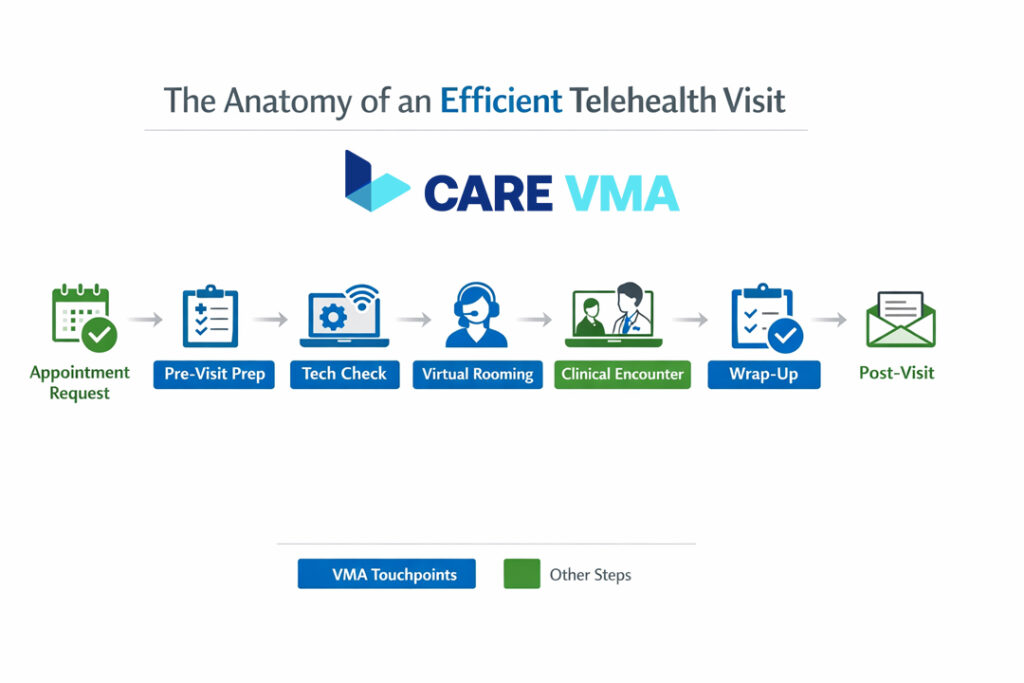
From Patient Call to Closed Chart: The Telehealth Assistant Workflow
- Step 1: The Appointment Request: A patient calls to book a visit. The VMA answers, navigates the schedule, completes the booking, and sends an automated confirmation with a secure link to the virtual waiting room.
- Step 2: Pre-Visit Preparation (24 hours before): The VMA handles insurance verification and initiates any required prior authorizations, ensuring no billing surprises.
- Step 3: The Tech Check (15 minutes before): The VMA, acting as a Tech Facilitator, calls the patient to test their link, audio, and video, troubleshooting any issues to guarantee a smooth start.
- Step 4: Virtual Rooming (5 minutes before): The VMA joins the virtual room with the patient, confirms their identity, reviews their chief complaint, reconciles their medication list, and updates the initial portion of the EHR note.
- Step 5: The Clinical Encounter: The provider joins the call. The VMA transitions to a Virtual Scribe role, documenting the History of Present Illness (HPI), exam, and plan in the EHR in real-time.
- Step 6: The Wrap-Up: As the provider concludes the consultation, the VMA prepares e-prescriptions for the provider’s final sign-off, schedules the follow-up visit, and confirms the patient understands the next steps.
- Step 7: Post-Visit: The provider leaves the call. The patient’s chart is already 95% complete. The provider takes under two minutes to review, sign, and close the encounter, then moves on to the next patient without any lingering administrative work.
This level of seamless integration is the key to real efficiency. See a live demo of the Care VMA platform to understand how our assistants plug directly into your existing workflow.
How to Successfully Integrate a Virtual Team Member
Integrating a remote team member can seem daunting, but with the right partner, it’s a streamlined process. Here are answers to the most common questions:
- “How do I ensure HIPAA compliance?” This is a critical concern, and the answer lies in professionalism and process. Reputable services like Care VMA operate on secure, encrypted platforms and provide assistants who are fully trained and certified in HIPAA protocols and data security. All Protected Health Information (PHI) is handled within a controlled, monitored environment, just as it would be in your physical office.
- “Will a VMA work with my existing EHR?” Yes. A core competency of a professional Telehealth Assistant is adaptability. Care VMA assistants are trained on major EHR platforms (like Epic, Cerner, and Athenahealth) and have a proven process for quickly mastering the specifics of your clinic’s system during onboarding.
- “How much time does it take to get started?” The process is designed to be efficient and minimally disruptive. A typical onboarding includes a Discovery Call to understand your needs, a Workflow Mapping session to define the VMA’s role, and Assistant Matching. Most practices can go live with their new virtual team member in just one to two weeks.
Conclusion: The Future of Practice Management is Here
A Telehealth Assistant is not an expense; it’s an investment in operational efficiency, provider well-being, and a superior patient experience. By absorbing the administrative and technical friction that bogs down modern clinics, you free your highly-skilled clinical team to do what they were trained to do: practice medicine.
Ready to Build a More Efficient, Resilient Practice?
Stop letting administrative drag limit your practice’s potential. Let’s build a workflow that puts patient care first and gives your providers their time back. Schedule a free, no-obligation consultation with one of our workflow specialists today to discover how a Care VMA Telehealth Assistant can be tailored to your clinic’s exact needs.