The market for general virtual assistants is crowded, competitive, and often a race to the bottom on price. But what if you could sidestep the competition and build a career in a stable, recession-resistant industry that values expertise over hourly rates? That industry is healthcare. A standard Virtual Assistant (VA) manages emails and schedules; a Virtual Medical Assistant (VMA) becomes a vital part of a clinical operations team, solving complex administrative problems that directly impact patient care and a practice’s bottom line.
This is not a guide about generic admin tasks. This is a professional roadmap to transition your existing administrative skills into a high-demand, high-value career as a specialized Virtual Medical Assistant. We’ll show you the exact workflows, compliance knowledge, and skills you need to become an indispensable partner to modern medical practices.
The New Frontline: Why Healthcare Needs You (More Than Any Other Industry)
While most VA guides point you toward online coaches or e-commerce stores, they miss the biggest opportunity: the administrative crisis in healthcare. Private practices are drowning in paperwork, patient calls, and complex scheduling, leading to widespread physician burnout and pulling skilled in-clinic staff away from what matters most—the patient in front of them.
This is where a VMA becomes not just an “assistant,” but a remote Clinical Operations Partner. You are the first line of defense against administrative chaos, enabling the clinic to run more efficiently and deliver better care. This specialization creates career stability and commands higher pay because you are solving mission-critical problems.
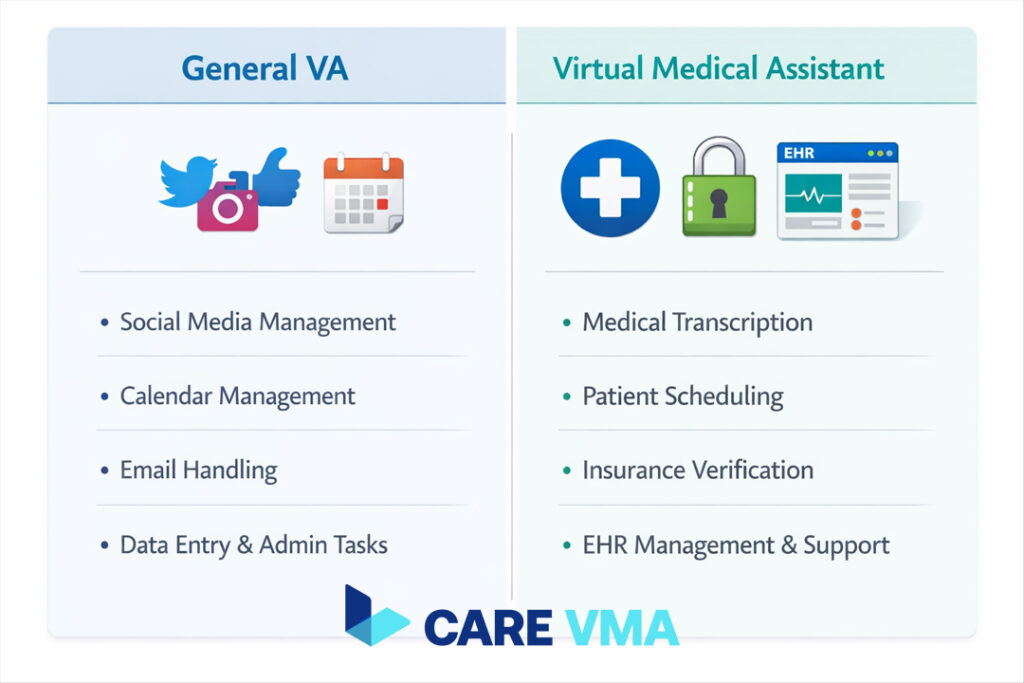
Here’s how the roles differ in the real world:
| Factor | General Virtual Assistant | Virtual Medical Assistant (VMA) |
|---|---|---|
| Core Tasks | Manages generic calendars, posts on social media, answers general emails. | Manages multi-provider EHR schedules, handles sensitive patient inquiries, processes digital intake forms. |
| Environment | Works for any industry (coaching, real estate, e-commerce). | Operates within a regulated healthcare environment, requiring strict compliance. |
| Key Skill | Organization. | HIPAA-compliant organization and communication. |
| Value Proposition | Completes tasks to save time. | Solves operational problems to improve efficiency, patient experience, and revenue. |
| Pay Scale | $15 – $25 per hour. | $35 – $60+ per hour. |
Phase 1: Building Your Foundational VA Business (The Right Way)
Before you can specialize, your business foundation must be solid and built with the healthcare industry in mind. Getting these non-negotiables right from the start establishes your professionalism and protects you from liability.
Business Structure & Legalities
While many freelancers start as a Sole Proprietor, forming a Limited Liability Company (LLC) is a smart move in healthcare. You will be handling Protected Health Information (PHI), and an LLC creates a legal separation between your business and personal assets, offering critical liability protection.
Essential Tools & Tech Stack
Your tech stack must prioritize security above all else. While general tools are useful, you must use HIPAA-compliant platforms for any task involving patient data.
- General Productivity: Google Workspace or Microsoft 365 for documents and internal planning. A project management tool like Asana or Trello to manage your own business tasks.
- HIPAA-Compliant Communication: Secure, encrypted email (like ProtonMail or a HIPAA-compliant version of Google Workspace). Secure messaging apps for client communication.
- HIPAA-Compliant File Sharing: Secure cloud storage solutions designed for healthcare.
Setting Your Rates
Specialized VMAs command higher rates because they handle greater responsibility and require specific knowledge. While general VAs compete in the $15-$25/hour range, professional VMAs should set their rates between $35 to $60+ per hour.
Consider offering a monthly retainer package (e.g., 20 hours per month for a set fee). This provides predictable income for you and ensures dedicated support for the clinic, which is essential for managing ongoing clinical workflows.
Phase 2: The Skill Bridge: From General Admin to Clinical Expert
You likely already have 80% of the foundational skills needed. This phase is about building the critical 20% that transforms you from a general administrator into a sought-after Virtual Medical Assistant. The key is to learn how to apply your existing skills within a clinical context.
This is where most aspiring VAs get stuck. It sounds simple, but this transition is often overlooked.
- If you can manage a calendar… you can learn to manage a multi-provider Electronic Health Record (EHR) schedule. This involves more than just booking slots. You’ll use color-coding for different appointment types (e.g., new patient, follow-up, procedure), manage time blocks for surgeries, and ensure there are no overlaps in a complex clinical day.
- If you can handle emails… you can manage a patient inquiry inbox. You’ll learn to differentiate between non-clinical questions you can answer (e.g., appointment changes, directions to the clinic) and clinical questions that must be routed to a nurse or doctor (e.g., “Is this symptom normal?”).
- If you are good at data entry… you can master patient registration in an EHR. This requires precision in collecting and entering key data points like demographics, insurance information, and medical history from digital intake forms. A single error can lead to a denied insurance claim.
Core VMA Skills to Develop
To truly bridge the gap, focus on these three areas:
- Understanding Basic Medical Terminology: You don’t need to be a clinician, but you must understand terms related to scheduling, common conditions, and specialties. Knowing the difference between a “referral” and a “consultation” is crucial.
- Mastering an EHR/EMR System: Become proficient in navigating at least one major EHR platform. Many, like Practice Fusion, offer free demo versions. Familiarity with systems like Epic, Cerner, or Athenahealth is a massive advantage. Our guide to EHR/EMR management is a great place to start.
- HIPAA 101: Your #1 Responsibility: The Health Insurance Portability and Accountability Act (HIPAA) is the federal law that protects sensitive patient health information. Understanding its rules is not optional.
HIPAA Alert: Your commitment to HIPAA compliance and data security is your biggest selling point. Never use personal email, standard file-sharing services (like a personal Google Drive), or unsecured messaging apps to transmit any patient information. This is the fastest way to lose a client, break the law, and destroy your professional reputation.
The VMA in Action: A Real-World Clinical Workflow
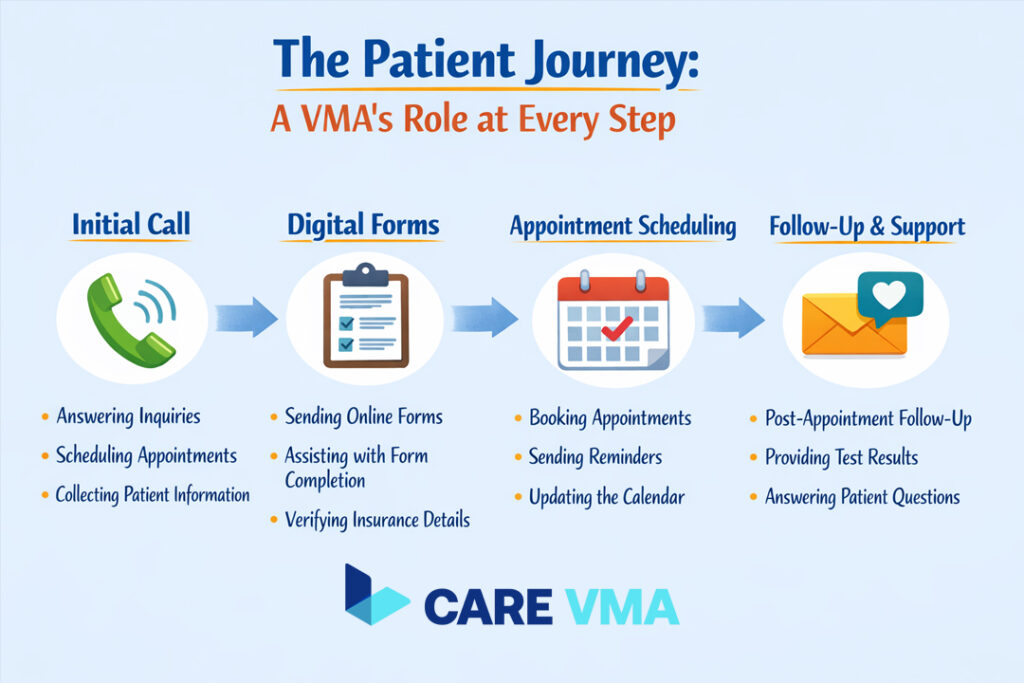
Let’s move from theory to practice. Here is exactly how a VMA integrates into a clinic’s daily operations by managing the patient journey.
The Patient Lifecycle, Managed by a VMA:
- The First Call (New Patient): A potential patient calls the clinic. The VMA answers, provides information, gathers initial demographic data securely, and schedules the first appointment directly in the clinic’s EHR system.
- Pre-Appointment Coordination: Days before the visit, the VMA sends a secure link to digital intake forms. They then perform insurance verification and prior authorization, a critical task that saves the clinic hours of administrative work and prevents billing issues. Finally, they send an automated appointment reminder to reduce no-shows.
- Day of Appointment: Before the patient arrives, the VMA ensures all digital paperwork is complete and attached to the patient’s chart in the EHR. This allows the in-clinic staff and the physician to be fully prepared, reducing patient wait times and creating a smooth check-in process.
- Post-Appointment Follow-Up: If the doctor recommends a follow-up visit, the VMA can reach out to the patient to schedule it. They can also manage the process of sending outgoing referrals to other specialists, ensuring a closed loop of communication.
Clinical Insight: Feeling overwhelmed by the workflow? That’s a sign of a high-value service. Clinics desperately need professionals who can manage this entire process. A fully trained Virtual Medical Assistant can take this burden off the in-house team, allowing them to focus entirely on in-person patient care.
Finding Your First Healthcare Clients
Forget generic freelance sites like Upwork or Fiverr. High-value medical practices are looking for professional partners, not the lowest bidder. You need a targeted strategy.
- Target Local Private Practices: Focus on small to mid-sized specialty clinics in areas like dermatology, dentistry, physical therapy, or mental health. These practices are large enough to be busy but often too small to have a large, dedicated administrative team.
- Pitch Solutions, Not Tasks: Your pitch isn’t “I can manage your calendar.” It’s “I can reduce your patient no-show rate by implementing a proactive reminder and confirmation system” or “I can free up 10 hours of your front-desk staff’s time each week by handling insurance verifications remotely.”
- Network on LinkedIn: Connect with Practice Managers, Office Managers, and Physicians in your target specialty. Don’t pitch immediately. Share valuable content about administrative efficiency, engage with their posts, and establish yourself as a knowledgeable professional before reaching out with a tailored solution.
- Partner with a Specialized Agency: The most direct path to vetted clients and professional training is through a specialized VMA agency like Care VMA Health. We provide the training, HIPAA-compliant technology, and access to clinics that are actively seeking skilled remote support.
Your Career as a Virtual Medical Assistant
This isn’t just a job; it’s a career path with significant growth opportunities. As you build experience and expertise, you can advance into more complex and higher-paying roles.
- VMA Level 1: Front Office Operations: Mastering patient scheduling, communication, and intake.
- VMA Level 2: Clinical & Billing Support: Expanding into roles like a virtual medical scribe (assisting with documentation during telehealth visits) or supporting the medical billing process.
- VMA Level 3: Remote Practice Management: Evolving into a remote Operations Consultant, where you help clinics optimize their entire administrative workflow, implement new technologies, and improve overall efficiency.
Becoming a Virtual Medical Assistant is your opportunity to build a professional, respected, and high-demand career. You get to solve real-world problems for an industry that needs you now more than ever, all while building a business on your own terms.
Ready to build a professional, high-demand career in healthcare? Care VMA Health provides the training, technology, and access to clients you need to succeed. Schedule your free consultation today to see if our program is the right fit for you.
Frequently Asked Questions (FAQ)
Do I need a medical degree or clinical certification to become a VMA?
No. A Virtual Medical Assistant handles administrative and operational tasks, not clinical duties. While a background in healthcare is helpful, your core qualifications are strong administrative skills, tech-savviness, and a commitment to learning healthcare-specific workflows and HIPAA regulations.
What is the difference between a VMA and a remote medical receptionist?
A virtual medical receptionist primarily focuses on managing phone calls and scheduling appointments. A VMA has a broader scope, often including the entire front-office workflow: patient intake, insurance verification, referral management, and EHR data management.
How much can I realistically earn as a Virtual Medical Assistant?
Entry-level VMAs with strong foundational skills often start in the $30-$35/hour range. With experience and specialization in areas like medical billing support or scribing, experienced VMAs can command rates of $50-$60/hour or more, especially when working with specialty practices.