Cardiology is a demanding specialty where every minute counts. Yet, many cardiologists find their time consumed not by complex patient cases, but by a relentless barrage of administrative tasks. From charting late into the night to wrestling with prior authorizations, the clerical burden can be overwhelming, pulling focus away from patient care and contributing to burnout. But what if you could reclaim over 20 hours of that lost time every week?
A dedicated Virtual Medical Assistant (VMA) for cardiology is not just an assistant; it’s a strategic partner in optimizing your practice. By delegating administrative and clinical documentation tasks to a remote, HIPAA-compliant professional, you can shift your focus back to where it matters most: your patients.
The Cardiology Crisis: When Administrative Work Overwhelms Patient Care
The modern cardiology practice is a hotbed of administrative complexity. The pressure to provide exceptional care is constantly at odds with the time required to manage documentation, data, and insurance hurdles. This friction creates significant bottlenecks that impact efficiency, revenue, and physician well-being.
Beyond the Exam Room: The Unseen Hours of “Pajama Time” Charting

For many cardiologists, the end of the clinic day is the beginning of several more hours of work. This “pajama time” is spent catching up on Electronic Health Records (EHR), finishing SOAP notes, and signing off on charts. This consistent after-hours work is a leading cause of burnout, stealing personal time and diminishing professional satisfaction. It’s a grueling cycle that makes a healthy work-life balance feel impossible.
The Data Deluge: Managing Complex EKG, Echocardiogram, and Lab Reports
Cardiology is uniquely data-intensive. EKG tracings, echocardiogram reports, stress test results, and complex lab panels all generate critical information that must be accurately entered into the EHR. Manually transcribing these findings is not only time-consuming but also carries the risk of data entry errors that can lead to claim denials and impact patient care.
The Revenue Bottleneck: Navigating Prior Authorizations for Cardiac Procedures
Many essential cardiac procedures, from stress tests to catheterizations, require stringent prior authorizations from insurance companies. This process is a notorious administrative bottleneck, involving lengthy phone calls, extensive paperwork, and frustrating follow-ups. Delays can postpone critical patient care and disrupt the practice’s revenue cycle, creating a gridlock that affects both patients and providers.
What is a Virtual Medical Assistant for Cardiology? A 4-Step Workflow
A Virtual Medical Assistant from Care VMA is a trained healthcare professional who integrates remotely and securely into your practice’s daily operations. They are specialists in handling the unique administrative and documentation demands of a cardiology clinic. The workflow is designed to be seamless, offloading tasks from the physician without disrupting patient interaction.
Step 1: Real-Time, Remote Scribing During Patient Consultations
Your VMA connects securely to the exam room via an audio/video stream. As you consult with the patient, your VMA acts as a virtual medical scribe, documenting the HPI, ROS, physical exam, and your care plan directly into the EHR in real-time. By the time the patient leaves, the note is 95% complete, just awaiting your final review and signature.
Step 2: Accurate Entry of Diagnostic Data into Your EHR
Instead of spending time typing numerical values and interpretive findings, you can simply review the diagnostic reports. Your VMA takes over the task of transcribing EKG results, echocardiogram measurements, lab values, and other critical data into the structured fields of the EHR, ensuring accuracy and saving you valuable time during and between appointments. This meticulous process helps in overcoming the cardiology EHR documentation burden.
Step 3: Proactive Pre-Visit Chart Preparation and Insurance Verification
Your VMA prepares for upcoming appointments by performing “chart scrubbing.” This involves reviewing the patient’s history, ensuring all recent labs and diagnostic reports are in the chart, and confirming that referrals are in place. They also handle pre-visit insurance verification and prior authorizations, so you can walk into the exam room fully prepared and confident that all administrative requirements are met.
Step 4: End-to-End Management of Referrals and Authorizations
For any procedures or specialist consultations you order, your VMA manages the entire outbound referral and authorization process. They handle the paperwork, communicate with insurance companies, and track the status of each request, freeing up your in-house staff to focus on patient-facing activities.
Before & After: Visualizing a More Efficient Cardiology Clinic Workflow
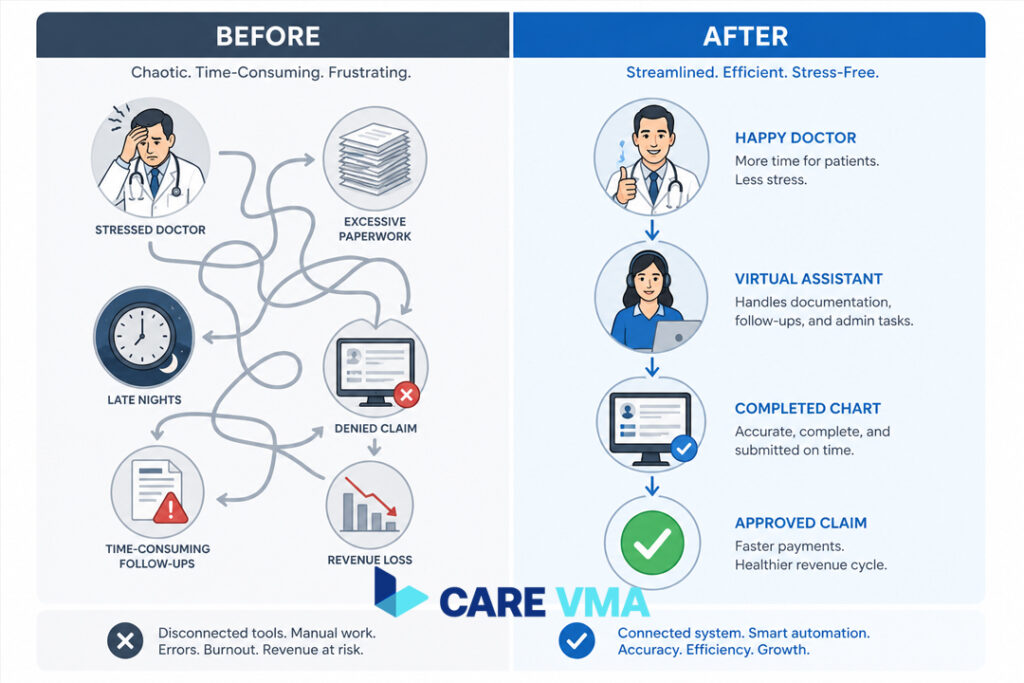
Integrating a VMA fundamentally transforms the operational flow of a practice, shifting the burden of administrative work away from the physician.
The Old Workflow: Physician-Led Data Entry and Administrative Gridlock
The cardiologist is the central hub for everything: seeing the patient, documenting the visit, entering diagnostic data, and often initiating the authorization process. This leads to longer patient encounters, significant after-hours charting, and a constant feeling of being behind schedule.
The New Workflow: Physician-Led Diagnosis, VMA-Powered Administration
The cardiologist’s role is refined to its highest value: diagnosing and treating the patient. The VMA works in parallel to handle all documentation and administrative tasks. The physician focuses on the patient, not the computer screen, leading to shorter encounter times, completed charts by day’s end, and a smoother-running clinic.
The Financial Impact: Calculating the ROI of a Cardiology VMA
A Virtual Medical Assistant is not a cost center; it is an investment that delivers a significant return by optimizing time, resources, and revenue.
Boosting Patient Capacity: See More Patients Without Extending Clinic Hours
By reclaiming 5-10 minutes per patient on documentation, a cardiologist can comfortably see two or more additional patients per day. Over a month, this increased capacity directly translates to a substantial boost in revenue, far exceeding the cost of the VMA service and contributing to effectively scaling a cardiology practice.
Reducing Overhead: Lowering the Cost of In-House Administrative Staff
A virtual medical assistant eliminates the overhead costs associated with a full-time in-house employee, such as benefits, payroll taxes, office space, and equipment. You get specialized support without the associated financial and logistical burdens.
Improving Revenue Cycle: Minimizing Claim Denials from Inaccurate Data
With a VMA dedicated to accurate data entry and proactive authorization management, your practice can significantly reduce claim denials caused by clerical errors or missing pre-approvals. This leads to faster reimbursement, improved cash flow, and a healthier bottom line.
Beyond Time Savings: Strategic Benefits of an Optimized Workflow
The advantages of integrating a VMA extend far beyond the 20+ hours saved each week. They create a more sustainable and rewarding practice environment.
Eliminating Physician Burnout and Improving Work-Life Balance
By eliminating “pajama time” charting, cardiologists can truly disconnect at the end of the day. This restoration of personal time is critical to combat exhaustion and reduce physician burnout, fostering long-term career satisfaction.
Enhancing Patient Focus and Improving Face-to-Face Interaction Time

When a physician isn’t distracted by a computer screen, they can maintain eye contact, listen more attentively, and build stronger rapport with their patients. This improved face-to-face interaction enhances the patient experience, builds trust, and can even lead to better clinical outcomes.
Security and Trust: Is a Virtual Assistant HIPAA Compliant?
Entrusting patient data to a remote team member is a significant decision, and security is paramount. At Care VMA, we are built on a foundation of trust and compliance.
Our Commitment to End-to-End Encryption and Data Security
All our virtual assistants operate on secure, encrypted platforms. We adhere to stringent protocols to ensure every piece of Protected Health Information (PHI) is handled with the utmost confidentiality, fully in line with HIPAA regulations.
Vetted Professionals Trained in Cardiology-Specific Terminology
Our VMAs are not general administrators. They are healthcare professionals who undergo rigorous vetting and receive specialized training in cardiology terminology and workflows. They understand the nuances of cardiac documentation, ensuring the notes they scribe are accurate, detailed, and clinically relevant.
FAQ: Key Questions for Cardiology Practice Managers
How quickly can a Care VMA integrate with our existing cardiology EHR system?
Our VMAs are proficient with all major EHR systems, including those tailored for cardiology like Epic, Cerner, and Athenahealth. The onboarding process is typically swift, with a new VMA often ready to integrate into your workflow within a few days to a week.
Is the VMA trained to understand the nuances of cardiac-specific documentation?
Absolutely. Our training program includes modules specifically on cardiology terminology, common procedures (e.g., TEE, cardiac catheterization), and the specific data points required for thorough cardiac charting. They know the difference between LVEF and RVSP and where each belongs in the chart.
What is the pricing model compared to hiring a full-time in-office scribe?
Our VMA services are typically offered on a subscription or hourly basis, which provides more flexibility and is significantly more cost-effective than hiring a full-time employee. You avoid costs like benefits, insurance, and payroll taxes, resulting in savings of up to 60%.
Can the VMA directly handle communications with insurance providers for prior authorizations?
Yes. Our VMAs are trained to manage the entire prior authorization lifecycle. They can initiate requests, provide necessary clinical documentation, follow up on pending cases, and see the process through to approval, freeing your team from time-consuming phone calls.
Ready to reclaim your time and transform your practice? Schedule a free, no-obligation consultation today to discover how a Care VMA can be tailored to the specific needs of your cardiology clinic.