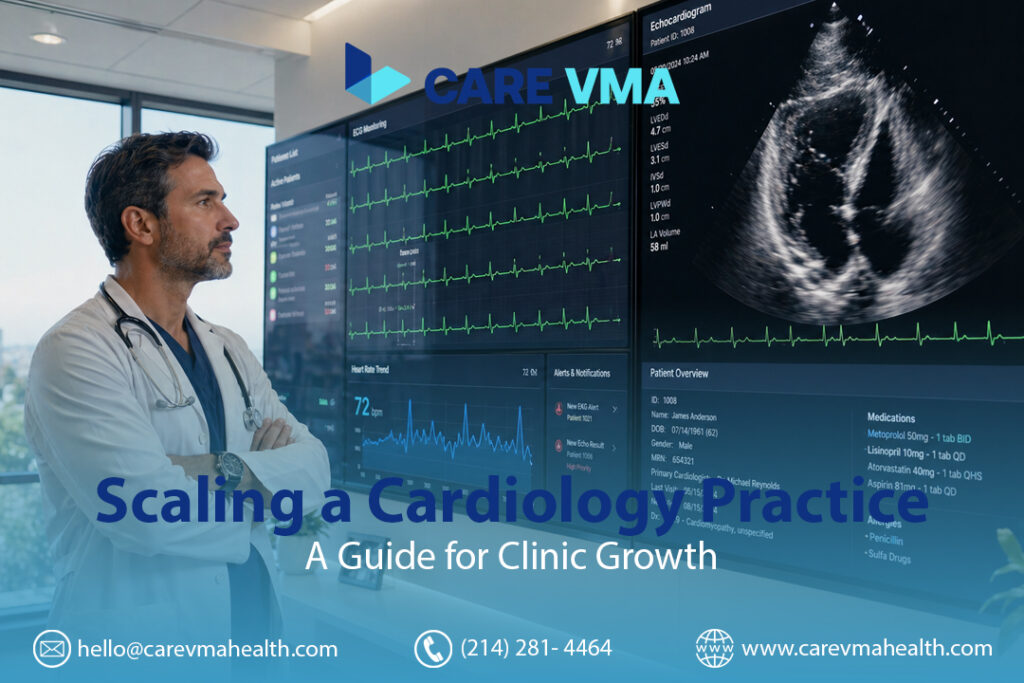
Scaling a cardiology practice is about more than just increasing patient volume. It requires building a robust system that supports growth without compromising the quality of care or the financial health of your clinic. Moving from a small practice to a comprehensive cardiology center involves strategic planning around legal structures, operational workflows, digital infrastructure, and patient acquisition.
This guide provides a complete roadmap for scaling your cardiology practice, tailored to the complexities of the US healthcare landscape, including payer systems and EHR mandates.
Strategic and Legal Foundations: Preparing Your Practice for Sustainable Growth

The first step in scaling is to ensure your business and clinical models are ready for expansion. This means upgrading your legal structure and diversifying your revenue streams.
- Implications of Upgrading Your Practice: To offer comprehensive specialist services, you may need to evolve your legal and operational structure. This involves ensuring you have the necessary specialist staffing (e.g., multiple cardiologists, electrophysiologists, or interventional cardiologists) and that your business entity (like an LLC or S-Corp) can support a larger-scale operation with increased liability and complex financial flows.
- Diversifying Services as a Revenue Engine: Increase your revenue per patient by establishing in-house diagnostic capabilities. This not only improves patient convenience but also captures revenue that would otherwise be lost to outside labs and imaging centers. Key ancillary services include:
- Echocardiography (Cardiac Ultrasound)
- Treadmill Stress Testing
- Holter and Ambulatory Blood Pressure Monitoring (ABPM)
- In-house lab for lipid panels and cardiac biomarkers.
Redesigning Operational Efficiency for Higher Patient Volume
Scaling will inevitably fail if your operations remain manual and overly dependent on individual staff members. Systematizing your workflows is critical.
- Optimizing the Patient Journey: Your patient flow, from scheduling to follow-up, must be seamless. This starts with implementing a 24/7 integrated scheduling system that works with your EHR. For practices dealing with Medicare, ensuring your workflow accommodates specific payer requirements is crucial for reimbursement. This is an area where a Virtual Medical Receptionist can transform your front-office operations, managing appointment setting, reminders, and patient intake without adding to your in-house staff’s burden.
- Why the Care Team Model is Crucial for Specialist Productivity: A cardiologist’s time is your most valuable asset. The care team model offloads administrative and routine clinical tasks from specialists to trained medical assistants or nurses. This allows cardiologists to operate at the top of their license, focusing solely on diagnosis, treatment planning, and complex procedures.
- Workflow Example: Before vs. After Implementing a Care Team:
- Before: The cardiologist spends 10-15 minutes per patient on pre-charting, reviewing basic history, and entering routine data into the EHR.
- After: A Virtual Medical Assistant (VMA) handles all pre-visit preparations, including charting, lab review, and initial history intake. The cardiologist enters the exam room with all necessary information, ready to engage directly with the patient. This simple change can allow for 2-3 extra patient slots per day, significantly boosting revenue and patient access. Learn more about how VMAs improve clinic efficiency.
Mandatory Digital Transformation: Leveraging Your EHR as a Competitive Advantage
In compliance with the HITECH Act, using a certified Electronic Health Record (EHR) system is mandatory. However, simply having an EHR is not enough; you must leverage it for a competitive edge.
- Criteria for Choosing a Cardiology-Specific EHR: A generic EHR won’t suffice. Your system must feature robust integration for diagnostic imaging (DICOM/PACS viewer), allowing cardiologists to view echocardiograms, ECGs, and angiograms directly within the patient’s chart during a consultation.
- Scaling Beyond Your Walls with Telehealth and RPM: Expand your reach with telehealth services for stable follow-up patients. Implement Remote Patient Monitoring (RPM) using wearable devices to track heart rhythms, blood pressure, and weight for patients with chronic conditions like heart failure or hypertension. A Telehealth Virtual Assistant can manage the administrative side of your virtual care program, ensuring smooth scheduling and technical support for patients.
- Preventing Financial Leaks with Automated Billing: An EHR integrated with your billing system can automatically generate claims based on services rendered (CPT codes) and diagnoses (ICD-10 codes). This automation minimizes human error, reduces claim denials, and accelerates your revenue cycle.
Revenue Cycle Management (RCM) in a Complex Payer Ecosystem

Growth requires capital and healthy cash flow. A poorly managed revenue cycle is the fastest way to undermine a scaling practice.
- Measuring Financial Health: Monitoring Key RCM Metrics: You cannot manage what you do not measure. Regularly track key performance indicators (KPIs) like Days in Accounts Receivable (A/R), Clean Claim Rate, and Denial Rate. High Days in A/R means cash is trapped with payers, stalling your growth. This is where understanding revenue cycle management’s impact is crucial.
- Pre-Investment ROI Analysis: Before purchasing an expensive piece of equipment like a new-generation echocardiography machine, conduct a break-even analysis. Calculate the patient volume required to cover the monthly payment and operational costs to ensure the investment is financially viable.
- The Key to Payer Contracts: Fulfilling Accreditation Standards: To secure and maintain profitable contracts with private insurance and government payers, your clinic must meet stringent quality and safety standards. Achieving accreditation from bodies like The Joint Commission or AAAHC demonstrates this commitment and is often a prerequisite for participation in payer networks. Delegating the tedious paperwork for this to a virtual assistant can be a game-changer.
Marketing and Patient Acquisition Strategies to Build Clinical Authority
A specialty practice like cardiology thrives on trust and authority. Your marketing should reflect this.
- Dominating Local Search: When a potential patient searches for “cardiologist near me,” your practice needs to be at the top of Google and Google Maps. A strong Local SEO strategy, including optimized Google Business Profile and positive patient reviews, is non-negotiable.
- Trust-Based Educational Marketing: Position your practice as a thought leader. Use your blog and social media to publish educational content about symptoms, preventive care, and new treatment options (e.g., “5 Early Signs of Heart Disease You Shouldn’t Ignore”). This builds trust long before a patient needs an appointment.
- Proactive Community Outreach: Don’t wait for patients to find you. Organize community screening events, such as free blood pressure checks or cholesterol screenings at local health fairs, corporate wellness events, or community centers. This directly connects you with high-risk patient populations.
Checklist for Scaling Readiness
- [ ] Legal: Is your business entity structured for growth and increased liability?
- [ ] Staffing: Have you implemented a care team model with a dedicated Clinic Manager to separate managerial and clinical duties?
- [ ] Technology: Is your cardiology-specific EHR fully integrated with your diagnostic and billing systems?
- [ ] Financial: Are your claims and billing processes automated to minimize denials? Have you considered a Medical Billing Virtual Assistant to streamline this?
- [ ] Quality: Is your clinic accredited to ensure long-term, favorable contracts with payers?
By systematically addressing these pillars, your cardiology practice can grow efficiently, expand its service offerings, and maintain patient safety and financial stability as its top priorities.
FAQ: Key Questions for Practice Owners During the Scaling Process
Is it mandatory to have multiple specialists to scale my cardiology practice?
While not legally mandatory to start, scaling effectively often requires a multi-specialist team to offer a comprehensive service line (e.g., non-invasive, interventional, EP). This diversification attracts a wider patient base and more complex referral cases, which are key to significant growth.
How can a Virtual Medical Assistant directly reduce claim denials?
A VMA trained in medical billing and coding can drastically reduce denials by ensuring accuracy from the start. They perform meticulous insurance verification and prior authorization before services are rendered, ensure correct ICD-10/CPT codes are used, and scrub claims for common errors before submission, significantly improving your clean claim rate.
What is the single most impactful first step to improve operational efficiency?
The most impactful first step is offloading administrative tasks from your clinical team. Start by hiring a Virtual Medical Assistant to manage scheduling, patient reminders, and EHR data entry. This immediately frees up your in-house staff and cardiologists to focus on patient-facing activities, providing an instant boost in productivity and morale.
Besides adding more patients, what is the most effective revenue model for a cardiology practice?
One of the most effective models is building a robust ancillary services program (in-house diagnostics like echo, stress tests) combined with chronic care management (CCM) and remote patient monitoring (RPM) programs for patients with chronic conditions. These create recurring, predictable revenue streams that are less dependent on one-time consultation fees.