
Medical Disclaimer: This article is for business informational purposes only and does not constitute medical advice or a substitute for professional healthcare consultation.
You entered the medical field to treat patients, yet you likely spend more time wrestling with paperwork than practicing medicine. It is a common reality for modern practitioners to feel buried under a mountain of administrative tasks, facing phones that never stop ringing and an inbox that never empties. This operational bottleneck does more than just cause stress; it creates a dangerous ripple effect. It leads to severe practitioner burnout, plummeted patient satisfaction scores due to long wait times, and significant revenue leakage from missed appointments or billing errors.
The strategic solution to reclaiming your time and profitability lies in adopting a Healthcare Virtual Assistant (HVA). A Healthcare Virtual Assistant is a professional trained in HIPAA compliance who provides remote administrative, clinical, and technical support to medical practices. By handling non-clinical duties such as scheduling, insurance verification, and EHR management, they help streamline workflow, increase operational efficiency, and maximize your practice’s revenue potential.
Why Your Practice Is Losing Potential: The Hidden Costs of Admin Burden

Your practice is likely operating well below its capacity, not because of a lack of medical expertise, but due to administrative friction. When high-value staff members, such as physicians and nurses, spend hours on data entry or phone tag, the opportunity cost is massive. Recent data suggests that for every hour of patient care, physicians spend nearly two hours on electronic health record (EHR) and desk work. This imbalance restricts your capacity to see new patients and degrades the quality of care for existing ones.
Impact on Staff Efficiency and Productivity
When in-house staff are multitasking between front-desk duties and clinical support, errors inevitably occur. A fragmented focus results in slower room turnover and delayed patient intake. By delegating these repetitive tasks, you allow your on-site team to operate at the top of their license.
Burnout Risk and High Employee Turnover
The administrative burden is a primary driver of the workforce crisis in healthcare. Constant pressure to manage paperwork leads to exhaustion. Addressing this is critical, as you can see in our analysis on How Medical Virtual Assistants Reduce Burnout in US Healthcare Practices?. Reducing this load is not just about efficiency; it is about retaining your best talent.
Revenue Leakage from Suboptimal Management
Missed calls are missed revenue. Improperly verified insurance leads to claim denials. Without a dedicated focus on these backend processes, your practice loses money every single day. According to the American Medical Association, administrative complexity is a leading cause of waste in the US healthcare system, costing billions annually. Administrative Simplification is no longer optional; it is a financial necessity.
How a Healthcare Virtual Assistant Maximizes Your Practice Potential?

To truly maximize your practice potential, you must view the HVA not as a replacement, but as a specialized extension of your workforce. The benefits can be categorized into three strategic pillars.
Pillar 1 – Simplifying Administrative Tasks & Improving Efficiency
Efficiency is achieved when tasks are routed to the most cost-effective resource capable of handling them. An HVA takes over:
- Scheduling and Appointment Management: Proactive confirmation calls to significantly reduce no-show rates.
- Patient Communication: Handling incoming calls, triage, emails, and routine inquiries instantly.
- Data Entry and EHR/EMR Management: Ensuring patient charts are updated in real-time.
- Insurance Verification and Billing Support: Preventing denials before they happen.
- Technical Support for Telemedicine: Setting up virtual rooms and troubleshooting patient connection issues.
For a deeper dive into front-office optimization, read about Streamlining Patient Interactions with Virtual Receptionists.
Pillar 2 – Enhancing Patient Engagement and Satisfaction
In an era of consumer-driven healthcare, patient experience is a key differentiator. An HVA ensures:
- 24/7 Availability: Patients can get answers or book appointments outside of standard office hours.
- Reducing Phone Wait Times: No patient likes being put on hold; HVAs ensure calls are answered promptly.
- Reminders and Education: Sending personalized care instructions or medication reminders.
- Patient Portal Navigation: Guiding less tech-savvy patients through your digital portals.
Pillar 3 – Boosting Revenue and Cost Savings
The financial argument for an HVA is compelling. By shifting roles to a virtual model, practices often see:
- Overhead Cost Reduction: Savings of up to 70% compared to hiring a full-time, in-house employee with benefits and office space requirements.
- Revenue Cycle Management (RCM) Optimization: Faster billing cycles and higher collection rates.
- Reducing Missed Appointments: Filling gaps in the schedule efficiently.
- Scalability: The ability to increase support hours during busy seasons like flu season without long-term contracts.
Understanding the financial backend is crucial, as detailed in our guide on How Revenue Cycle Management Impacts Practices.
Implementation Guide: Integrating a Virtual Assistant into Your Practice
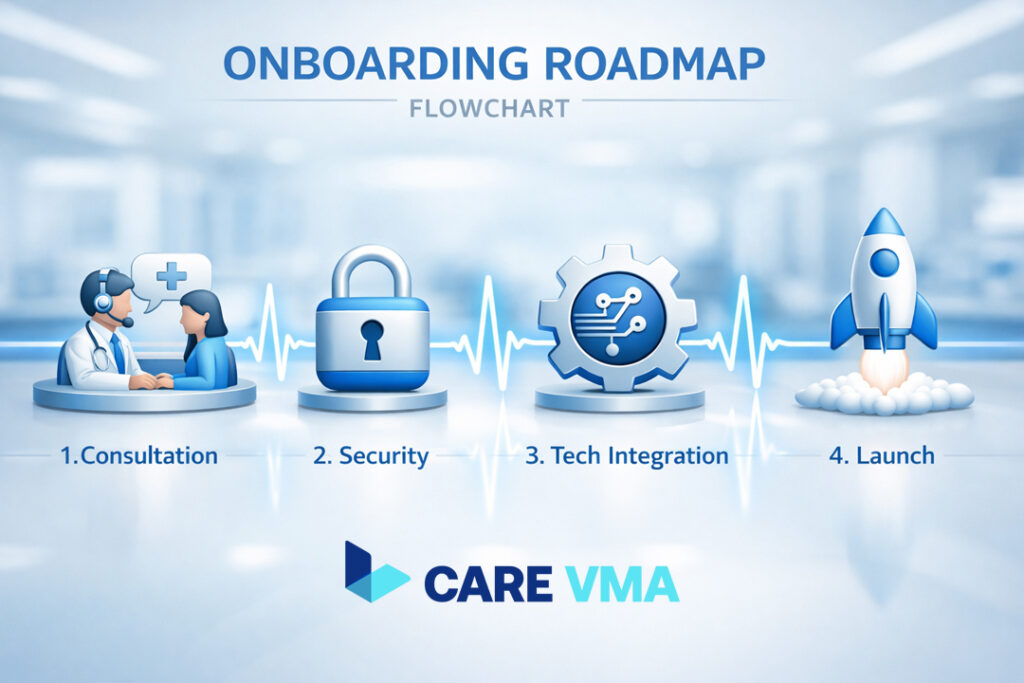
Transitioning to a hybrid staffing model requires a strategic approach. Care VMA provides a structured implementation pathway to ensure success from day one.
Step 1: Define Clear Roles and Responsibilities
Before hiring, conduct a task audit. Identify high-volume, low-complexity tasks that distract your core team. Use a checklist to categorize these into front-office (scheduling), back-office (transcription), or billing duties.
Step 2: Ensure HIPAA Compliance and Data Security
Security is non-negotiable. Unlike freelance marketplaces, specialized agencies ensure compliance. You must verify that your VMA partner utilizes secure VPNs, encrypted communication channels, and has signed Business Associate Agreements (BAA). For more on regulatory standards, refer to the HHS Health Information Privacy guidelines.
Step 3: Technology Integration with Existing Systems
Your HVA must seamlessly interface with your current tech stack. Whether you use Epic, Cerner, or Kareo, the integration phase involves setting up secure access credentials and defining workflow protocols within your EHR & Practice Management Software.
Step 4: Open Communication and Comprehensive Training
Treat your remote staff as part of the team. Establish daily huddles via video conferencing and provide access to your practice’s standard operating procedures (SOPs).
Step 5: Monitor Performance and Continuous Improvement
Establish Key Performance Indicators (KPIs) such as call answer rates, claims processed per hour, or patient satisfaction scores to measure ROI objectively.
FAQ (Common Questions from Medical Practitioners)
Is my patient data safe with a virtual assistant?
Yes, with the right service provider like Care VMA. We implement strict security protocols, HIPAA training, and confidentiality agreements to ensure all patient data is protected according to industry standards.
How long does it take to integrate a VMA into our practice?
The process is fast and efficient. Generally, after the initial consultation and understanding of your workflow, a VMA can be integrated and productive within a few weeks, with full support from our account managers.
Can a virtual assistant work with my specific EHR system?
Absolutely. Our virtual assistants have experience with various leading EHR/EMR platforms. During the onboarding process, we ensure your VMA receives specific training for the system you use.
Conclusion & Next Steps
Investing in a healthcare virtual assistant is not merely about outsourcing labor; it is about optimizing your most valuable resources: your time and your medical expertise. This is a strategic move to build a practice that is efficient, profitable, and, most importantly, patient-centered. By removing the administrative friction, you return to the core reason you entered medicine: to heal.
Ready to Refocus on Patients Instead of Administration? Schedule a free 15-minute consultation with our team to analyze your practice’s unique needs and discover how Care VMA can help you maximize your potential today.