The administrative burden in cardiology is reaching a crisis point. According to the American College of Cardiology (ACC), over 75% of cardiologists spend more than two hours per day on EHR documentation. This overwhelming task often spills into personal time, creating a phenomenon known as “pajama time”—hours spent charting late into the evening, long after the last patient has gone home. This isn’t just an inconvenience; it’s a primary driver of physician burnout and a direct threat to practice efficiency and profitability.
The solution lies not in working harder, but in fundamentally transforming the documentation workflow. A cardiology-specific Virtual Medical Assistant (VMA) is designed to lift this administrative weight, allowing cardiologists to reclaim their time, focus on high-value patient care, and prevent the burnout that plagues the specialty.
The Cardiology Documentation Crisis: Why 75% of Cardiologists Chart After Hours

The sheer volume and complexity of cardiology data create a documentation challenge unlike any other specialty. This isn’t just about writing notes; it’s about synthesizing a vast amount of fragmented information under immense time pressure, leading to significant personal and professional consequences.
Quantifying the Burden: From “Pajama Time” to Professional Burnout
The statistics are stark. With nearly half of their day spent in the EHR, it’s no surprise that between 25% and 44% of cardiologists report symptoms of professional burnout. When physicians are forced to choose between patient care and administrative tasks during the day, documentation is inevitably pushed to after-hours. This chronic overtime erodes work-life balance and directly contributes to the alarming rates of burnout that can ultimately impact patient care quality. For many, this administrative overload is a key factor in reconsidering their career path, posing a significant risk to practice stability and continuity of care.
The Impact on Your Practice: Reduced Patient Face-Time and Revenue Leakage
The consequences of this documentation overload extend beyond the individual clinician. Every hour spent on administrative tasks is an hour not spent with patients or on revenue-generating activities. Studies show that cardiologists spend only about 27% of their day in direct patient care. This reduction in face-time can weaken the physician-patient relationship and limit the practice’s capacity to see more patients.
Furthermore, rushed or incomplete documentation leads to significant financial leakage. Missed “reading fees” for interpreting ECGs, Holter monitors, or stress tests, along with improperly coded procedures, result in denied claims and lost revenue that can cripple a practice’s financial health.
Why Generic EHRs and Scribes Fail Cardiology’s Unique Demands?
Many practices have tried to solve the documentation problem with generic solutions like standard-issue EHRs or general medical scribes, only to find they fall short. Cardiology’s unique demands require a purpose-built approach.
Data Fragmentation: Synthesizing ECGs, Echocardiograms, and Stress Test Results
A cardiologist’s note is a synthesis of data from multiple, often non-integrated, sources: ECGs, echocardiograms, Holter monitor reports, stress test results, and cardiac CTs. Most EHRs act as passive repositories, forcing physicians to constantly switch between windows and manually piece together the clinical picture. This fragmented process is inefficient, time-consuming, and increases the risk of overlooking critical data points.
The Complexity of Comorbidities and Longitudinal Tracking
Cardiology patients are often high-acuity, presenting with multiple complex comorbidities like heart failure, atrial fibrillation, and chronic kidney disease. Documenting their care requires meticulous longitudinal tracking that standard EHR templates simply cannot accommodate. A meaningful note must tell a story over time, a task that becomes incredibly burdensome when done manually for a large patient panel.
Navigating Strict Payer Scrutiny and “Medical Necessity” Requirements
Payer scrutiny is exceptionally high in cardiology. Every procedure, especially high-cost diagnostics, requires explicit justification of “medical necessity” within the documentation. Failing to clearly link a patient’s symptoms to a specific test or procedure is one of the fastest ways to receive a claim denial. This requires a level of detail and compliance that generic solutions are not equipped to handle, placing the full burden of audit-readiness on the physician’s shoulders. Effectively managing insurance verification and prior authorization is a specialized skill that is crucial for financial success.
What is Cardiology-Specific Virtual Medical Assistance?
A Virtual Medical Assistant (VMA) for cardiology is a remote, highly trained professional who manages the complete administrative and documentation workflow unique to a cardiology practice. Unlike a simple scribe, they handle prior authorizations, referral management, billing preparation, and the synthesis of complex diagnostic data (ECG, Holter, Echo) directly into the EHR, ensuring each note is compliant and audit-ready.
This specialized support system is designed to integrate seamlessly into your practice. A cardiology VMA from Care VMA understands the specific terminology, billing modifiers, and payer requirements of your specialty, transforming them from a simple data entry clerk into a strategic partner in practice efficiency.
The VMA Workflow Transformation: A Real-World Cardiology Scenario
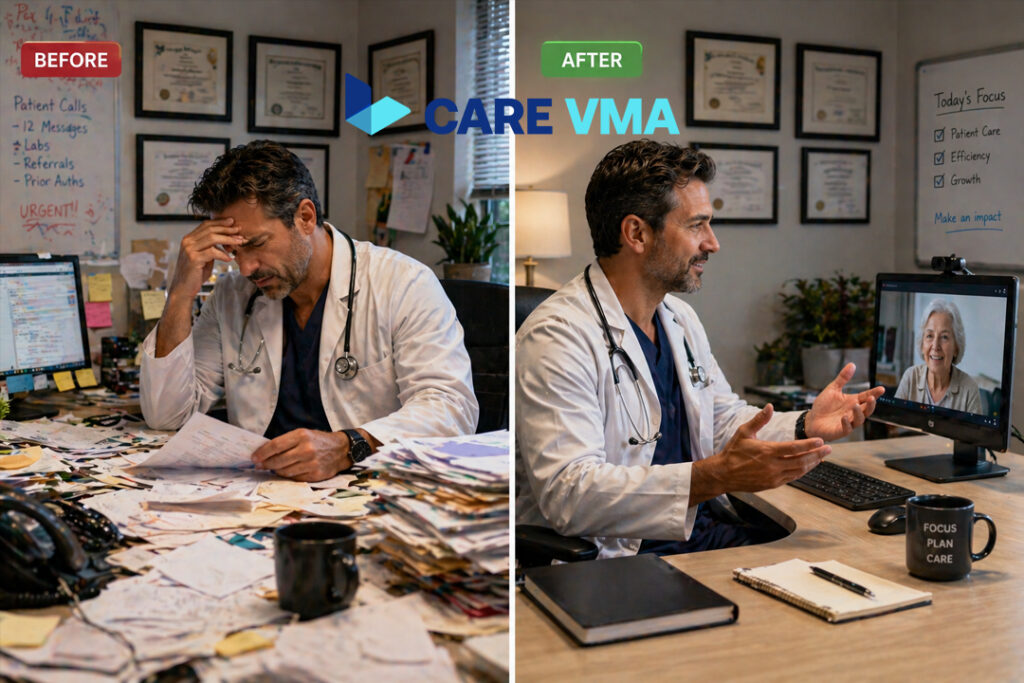
The difference between a practice struggling with documentation and one optimized with a VMA is best illustrated by a direct comparison.
Before Care VMA: A Fragmented Documentation Process
- Cardiologist manually locates and reviews new Echo results in a separate system.
- Jumps between EHR windows to update patient history and medication lists.
- Spends 15-20 minutes per patient post-visit creating a “stand-alone” note to meet compliance standards.
- Delegates prior authorization for a cardiac CT, leading to back-and-forth communication and delays.
After Care VMA: An Integrated and Efficient Workflow
- The VMA pre-populates the patient chart with summarized Echo findings before the encounter begins.
- During the visit, a highly-trained virtual medical scribe documents the encounter in real-time, capturing the full narrative.
- Post-visit, the VMA finalizes the note, queues up orders, and initiates the prior authorization for the cardiac CT.
- The cardiologist reviews and signs off on a complete, accurate, and compliant chart in under 2 minutes.
This optimized process is a key strategy for practices looking to understand how medical virtual assistants reduce burnout by eliminating the most frustrating administrative bottlenecks.
Calculating the Financial Return: The Tangible ROI of a Cardiology VMA
Implementing a VMA is not an expense; it’s an investment with a clear and measurable return. By tackling the root causes of inefficiency, a VMA drives significant financial improvements across the practice.
From Lost “Reading Fees” to Captured Revenue
With a VMA ensuring that every test interpretation is documented and coded correctly, practices can eliminate the revenue leakage from missed “reading fees.” Accurate and timely chart completion means that all billable services are captured, leading to a direct increase in monthly revenue.
Cost Savings: Reducing Overtime and In-House Administrative Overhead
A VMA reduces the need for physician overtime spent on charting and can often be more cost-effective than hiring additional in-house administrative staff. By outsourcing these complex tasks to a specialized remote professional, you lower overhead costs associated with salaries, benefits, and physical office space.
Growth Opportunity: Increasing Patient Capacity by Reclaiming 2+ Hours Per Day
What could your practice achieve with an extra two hours per cardiologist per day? That reclaimed time can be used to see more patients, develop new service lines, or focus on strategic growth initiatives. This newfound capacity is often the most significant component of a VMA’s ROI, directly enabling you to follow a strategic guide to scaling a cardiology practice.
Ensuring Security and Expertise: Our Commitment to HIPAA and Professional Standards
Trust and security are paramount. Entrusting patient data and clinical workflows to a third party requires absolute confidence in their security protocols and professional expertise.
Rigorous HIPAA Compliance and Secure Data Handling Protocols
At Care VMA, all our Virtual Medical Assistants are fully trained in HIPAA regulations. We operate through secure, encrypted platforms to ensure that all patient health information (PHI) is handled with the utmost confidentiality and integrity, giving you and your patients complete peace of mind.
Specialized Training in Cardiology Terminology and Billing Modifiers
Our VMAs are not generalists. They undergo specific training in cardiology terminology, common procedures, and the complex billing modifiers required by payers. This specialized knowledge ensures that documentation is not only clinically accurate but also financially optimized to prevent denials and audits.
How to Integrate a Virtual Medical Assistant Into Your Cardiology Practice
Getting started with a VMA is a straightforward, structured process designed to minimize disruption and maximize impact from day one.
- Step 1: Complimentary Workflow Assessment: We begin by analyzing your current documentation and administrative processes to identify the most significant bottlenecks and opportunities for improvement.
- Step 2: VMA Matching and System Onboarding: We match you with a VMA whose skills and experience align perfectly with your practice’s specific needs. We then handle the complete onboarding and integration with your EHR system.
- Step 3: Go-Live and Continuous Performance Optimization: Your VMA begins supporting your practice. We monitor performance closely and work with you to continuously refine workflows for optimal efficiency and results.
Ready to eliminate “pajama time” and reclaim control of your practice? Schedule a complimentary workflow assessment with Care VMA today and discover how a specialized Virtual Medical Assistant can transform your cardiology practice.
Frequently Asked Questions for Cardiology Practice Leaders
How does a VMA handle complex cardiac data from different sources like ECGs and Holter monitors?
Our VMAs are trained to access and synthesize data from various diagnostic systems. Before an appointment, they will review these sources, extract key findings (e.g., ejection fraction from an Echo, arrhythmias from a Holter), and summarize them in the patient’s chart for your review, saving you valuable search time.
Can your VMAs manage prior authorizations for specific cardiology procedures and medications?
Yes. This is a core function. Our VMAs handle the entire prior authorization process, from submitting initial requests with the required clinical documentation to following up with payers. This removes a major administrative headache and prevents treatment delays.
What is the typical onboarding time for a cardiology practice of our size?
Onboarding is typically completed within one to two weeks. Our structured process includes workflow assessment, EHR integration, and VMA training specific to your practice’s protocols, ensuring a smooth and efficient transition.
How does the VMA model compare to hiring an in-person scribe or using an ambient AI tool?
A cardiology VMA offers a more comprehensive solution. While an in-person scribe or AI tool focuses solely on real-time documentation, a VMA manages the entire administrative lifecycle—including pre-charting, prior authorizations, referral coordination, and billing preparation—providing a far greater ROI and deeper impact on overall practice efficiency.