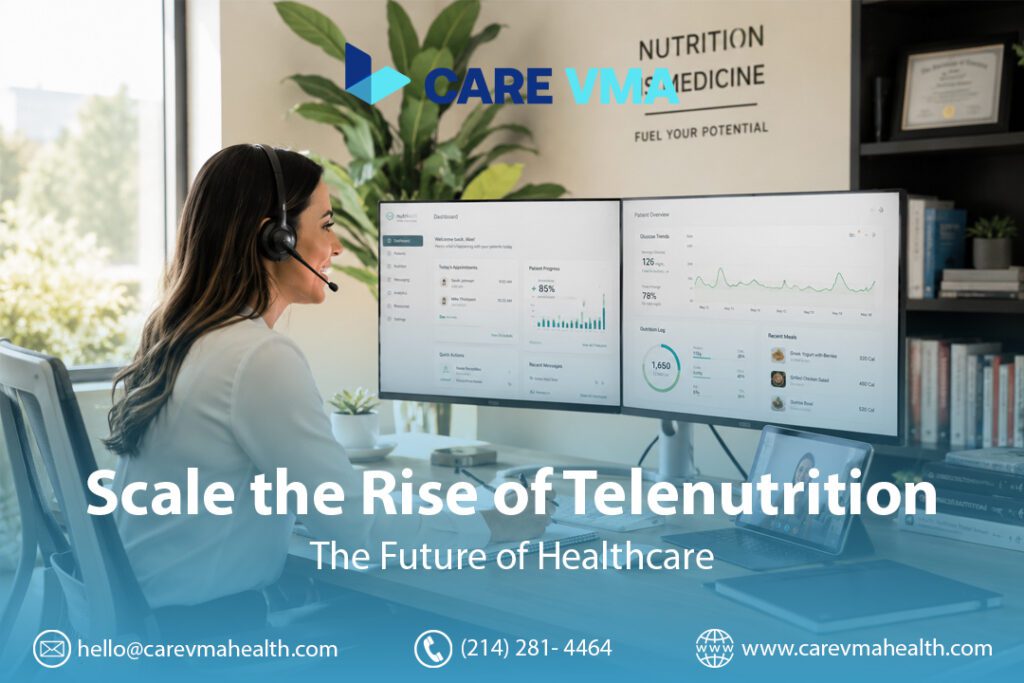
The digital health landscape has shifted. For Registered Dietitians (RDNs), the “Rise of the Telenutrition” has opened doors to national patient bases and specialized chronic care. However, many practitioners find that scaling a virtual practice creates a “Scaling Paradox”: more patients unfortunately result in “Admin Trauma” rather than increased profit.
While software is essential, it isn’t the complete solution. To scale sustainably, RDNs must move beyond pure automation toward human-centric operations.
Why Growth Often Leads to Practitioner Burnout?
Most RDNs start their virtual journey thinking that a robust tech stack (Healthie, Nutrium, or Practice Better) will handle the workload. But as patient volume increases, a “Secretarial Shift” occurs. Elite dietitians often lose 15+ hours a week to non-billable tasks like food log entry, chasing insurance pre-authorizations, and manual scheduling.
This operational stagnation happens because software alone cannot solve the human-in-the-loop requirements of high-touch chronic care. When practitioners spend more time on data entry than counseling, it leads to significant burnout in healthcare practices. To break this trap, you need an operational engine that operates your software for you.
Navigating the Complexity of Virtual Chronic Care Management (CCM)
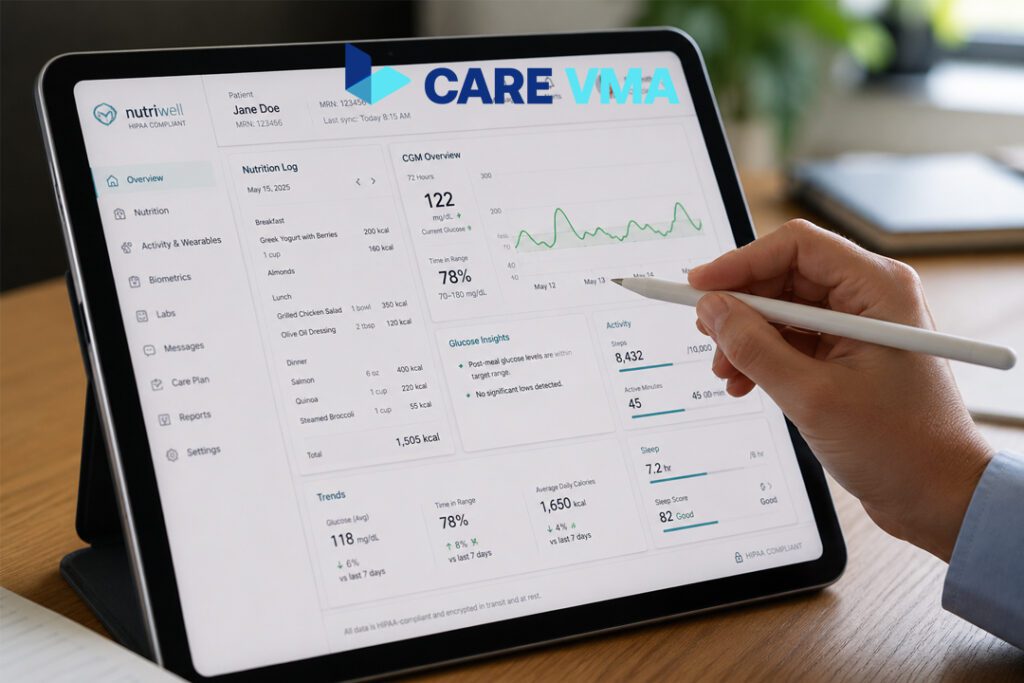
Managing chronic conditions like Diabetes, Obesity, and Renal Care in a virtual setting requires more than just a monthly Zoom call. It involves complex data and regulatory navigation.
Managing High-Touch Data
Scaling requires coordinating Remote Patient Monitoring (RPM) data from wearables like Dexcom (CGM) and Fitbit. Converting this raw data into actionable clinical insights for an EMR is a manual burden that software cannot fully automate.
Telehealth Parity and Multi-State Licensing
The administrative burden of maintaining compliance and understanding varying telehealth parity laws across US state lines is a full-time job. Ensuring your practice stays compliant requires meticulous record-keeping and credentialing management.
Medical Coding for Nutrition
Accurate billing for complex cases is the lifeblood of a growing clinic. Without expert oversight, manual errors in CPT coding lead to denied claims and leaked revenue.
What is a Virtual Medical Assistant (VMA) for Dietitians?
Definition: A specialized, HIPAA-compliant remote professional trained in clinical nutrition workflows who handles EMR management, insurance verification, and patient coordination. Unlike a general VA, a VMA understands RDN terminology and US healthcare regulations.
Core Responsibilities:
- Insurance Management: Handling pre-authorizations and medical billing support.
- Clinical Documentation: Managing patient intake and documenting food logs in the EMR.
- Data Synchronization: Coordinating wearable data (RPM/CGM) for clinical review.
- Patient Coordination: Managing scheduling, referrals, and proactive follow-ups.
Why Your Practice Needs a VMA, Not Just More Automation?
AI and automation are excellent for simple triggers, but they fail when a situation requires human judgment—such as calling an insurance company to dispute a denied claim for Medical Nutrition Therapy (MNT).
A Virtual Medical Assistant acts as the “Invisible Engine” of your practice. Instead of you buying another app to solve a problem, a VMA operates your existing tech stack (Healthie, Nutrium, etc.), allowing you to transition from a “Data Entry Clerk” back to a “Clinical Expert.” This human-in-the-loop advantage ensures that patient care remains personalized while the administrative machine runs in the background.
A Streamlined Telenutrition Workflow
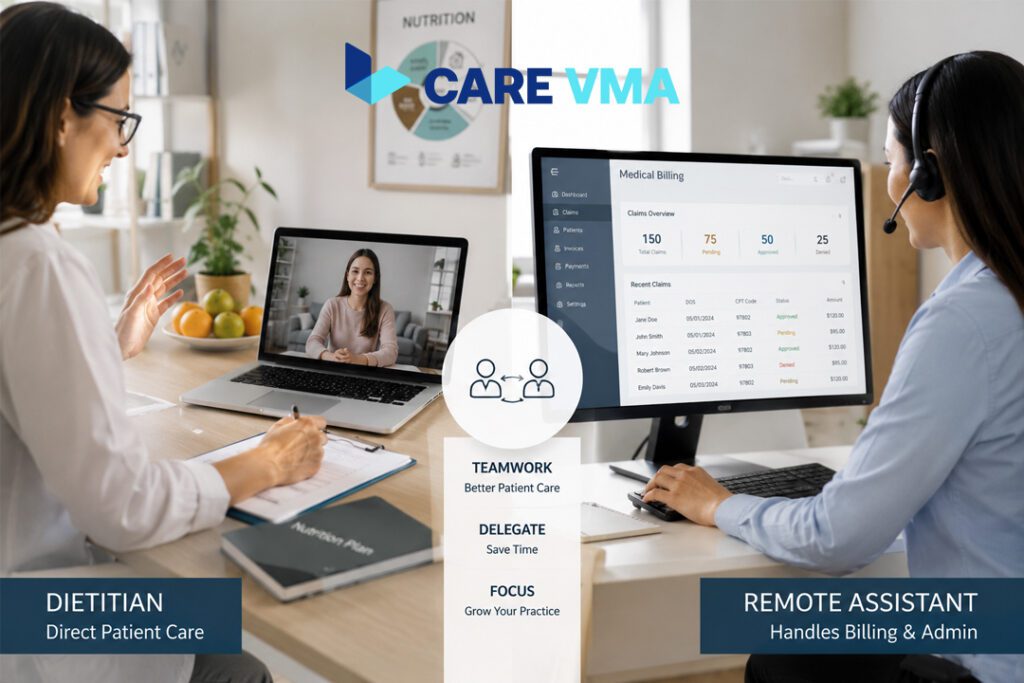
How does delegating to a Care VMA actually look in practice? Here is the blueprint for a streamlined workflow:
- Phase 1 (Pre-Consult): Your VMA performs insurance verification and manages digital intake forms, ensuring you have all the data before the session starts.
- Phase 2 (Post-Consult): While you move to the next patient, the VMA enters food logs into the EMR and coordinates RPM data from the patient’s wearables.
- Phase 3 (Ongoing): The VMA handles patient retention through proactive follow-up calls and manages the Chronic Care Management (CCM) documentation required for reimbursement.
Use Case: A virtual nutrition clinic recently delegated their insurance pre-authorizations to a Care VMA. By removing this 2-hour daily task, the RDN was able to add 3 additional billable slots per day, resulting in a 25% increase in monthly revenue without working extra hours.
ROI Analysis: The Cost of In-House Admin vs a Specialized VMA
For private practices, the margin is everything. Hiring a full-time in-house administrative assistant in the US involves high overhead, including benefits, taxes, and office space.
By contrast, a specialized VMA offers a significantly higher ROI:
- The Billable Hour Boost: Every hour a VMA works on admin is an hour you can spend on $150+ billable counseling sessions.
- Reducing Leaked Revenue: Professional billing support minimizes denied insurance claims by ensuring every code is accurate before submission.
- Scalability: You can scale VMA hours up or down based on your patient volume, maintaining a lean and profitable operation.
The Non-Negotiables of Remote Nutrition Support
When mendelegating patient data, security is paramount. Care VMA prioritizes HIPAA compliance and data integrity through:
- BAA Essentials: We sign Business Associate Agreements (BAA) to ensure legal and clinical accountability.
- Encrypted Handling: All patient interactions and data entries are performed within your encrypted EMR environment.
- Clinical Accuracy: Our assistants are trained in CMS regulations and RDN-specific terminology, ensuring that your documentation is audit-proof.
FAQ: Strategic Questions for Decision-Makers
How do I manage 50+ virtual nutrition patients without admin staff? Transitioning from a solo practitioner to a VMA-supported model is the only way to handle high volume. A VMA takes over the “heavy lifting” of intake and billing, allowing you to focus purely on the clinical sessions.
Is it legal to use a virtual assistant for dietitian billing in the US? Yes, provided the assistant is HIPAA-compliant and a BAA is in place. Care VMA specializes in US healthcare regulations to ensure all billing processes meet legal standards.
Can a VMA handle medical coding for nutrition? Absolutely. Unlike general virtual assistants, our VMAs are trained in specific nutrition CPT codes and ICD-10 requirements for conditions like Diabetes and Chronic Kidney Disease.
What tasks can a virtual nutritionist assistant do besides scheduling? Beyond scheduling, they manage EMR documentation, synchronize wearable data (RPM), handle insurance verification, and conduct patient outreach for retention.
Ready to scale without the burnout? Don’t let administrative tasks cap your practice’s growth. Book a Free 15-Minute Operational Audit to identify how a Care VMA can increase your billable hours and streamline your telenutrition workflow today.