For decades, medical practices have operated within a strict binary: you either pay for an expensive human answering service or risk losing patients to the “black hole” of a digital voicemail. However, as we navigate the healthcare landscape of 2026, both legacy options are showing their age.
With rising labor costs and increasing patient expectations for immediate gratification, the choice between “expensive” and “ineffective” is no longer a viable strategy for growth.
The High Cost of “The Dead Zone”: Why Traditional Patient Access is Failing
The “Dead Zone” occurs the moment a patient calls your office and realizes no one is available to help them. Whether they encounter a generic voicemail or a bored call center agent who can’t answer clinical questions, the result is the same: Patient Leakage.
Understanding Patient Leakage: The $500 Phone Call
In the US healthcare market, missing a single call isn’t just an administrative oversight—it’s a massive financial hit. Research into the average cost of missed calls in healthcare shows that losing one new patient can cost a practice between $200 and $500 in lost lifetime value (LTV). If your practice misses just five calls a week, you are looking at over $100,000 in annual revenue leakage.
The Psychology of the Hang-up
Modern healthcare consumers behave like retail shoppers. If they reach a voicemail, 67% of patients will hang up without leaving a message and call the next provider on their Google search results. They don’t want to leave a recording; they want a resolution.
Live Medical Answering Service: High Overheads and the Hidden Risk of Human Error
Many practices attempt to solve this by hiring a live medical answering service. While this provides a “human touch,” it introduces a new set of variables that can jeopardize clinical quality.
The Training Gap
Traditional BPO (Business Process Outsourcing) centers suffer from high turnover rates. Often, the agent answering your patient’s call has only had a few hours of training on your specific specialty. This leads to misspelled clinical terms, incorrect medication names in messages, and immense patient frustration.
Transparent Pricing vs Per-Minute Bloat
Traditional answering services often lure practices in with low base rates, only to hit them with “per-minute” charges that fluctuate wildly. This makes your monthly operational overhead unpredictable and difficult to scale.
Medical Voicemail: The Status Quo That Increases Malpractice Risk
Voicemail is the “free” option, but its hidden costs are the highest.
The Triage Failure
A standard voicemail cannot distinguish between a patient calling for a routine prescription refill and a post-op patient reporting symptoms of a pulmonary embolism. When urgent clinical symptoms are buried under a pile of administrative requests, the risk of a delayed response—and a subsequent malpractice claim—skyrockets.
HIPAA Compliance Pitfalls
Standard digital mailboxes are rarely secure enough for the transmission of Protected Health Information (PHI). Without end-to-end encryption and a signed Business Associate Agreement (BAA), every message left on a standard voicemail system is a potential liability. Checking your HIPAA compliant virtual receptionist checklist is essential to ensure you aren’t leaving your practice vulnerable.
Introducing the “Third Option”: Why Care VMA Disrupts the Legacy Comparison
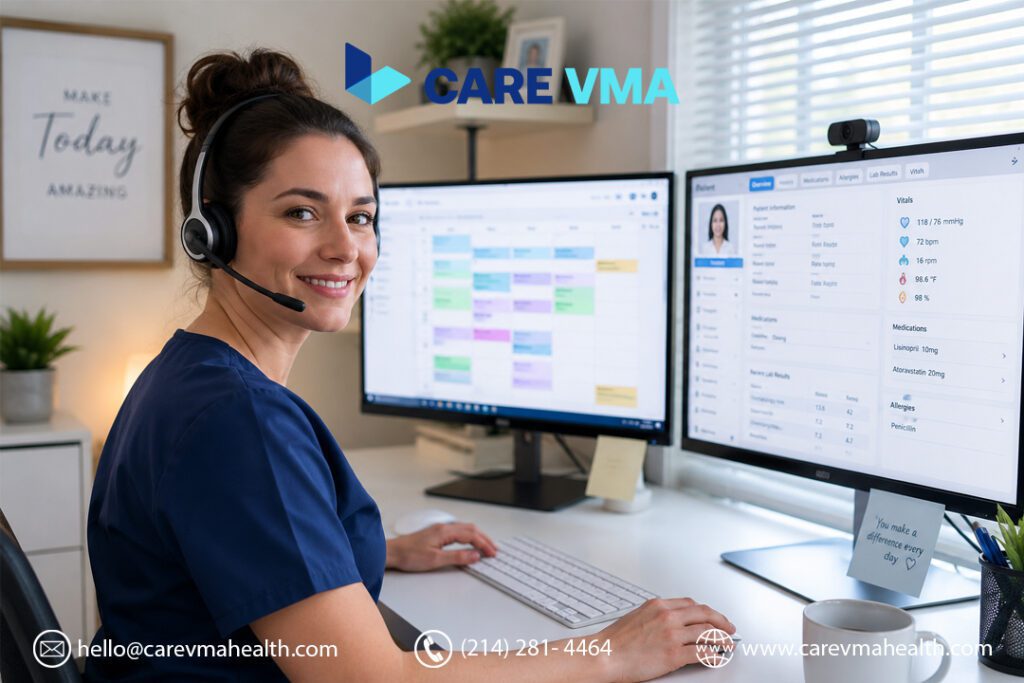
The binary choice is officially shattered. Care VMA introduces a specialized Virtual Medical Receptionist—a solution that combines the clinical intelligence of a trained professional with the 24/7 availability of automation.
Shattering the Binary
You no longer have to choose between the high cost of a human agent and the silence of a tape recorder. Care VMA provides a dedicated assistant who understands your workflow, speaks the language of your specialty, and integrates directly with your office hours.
The Hybrid Advantage: Medical Intelligence 24/7
Unlike a generic call center, our assistants are trained specifically for after-hours patient call routing. They don’t just “take a message”; they follow your specific clinical protocols to ensure every call is handled with the correct level of urgency.
EHR-Integrated Workflow: Visualizing the Data Journey
The biggest “Gap Opportunity” in modern practice management is the elimination of manual data entry.
- From Dial-tone to Dashboard: Care VMA doesn’t just email you a transcript. Our assistants route patient data directly into Epic, Athena, or Nextech.
- Eliminating Transcription Errors: By utilizing specialized Telephone Triage Remote protocols, we ensure 100% accuracy in capturing patient complaints and refill requests, placing them exactly where your clinical staff needs them.
Is your front desk overwhelmed by a “voicemail backlog” every morning? See how a virtual assistant receptionist can cut call wait time and reclaim your staff’s productivity.
Use Case: Real-World Triage for Specialty Clinics
Scenario A (The Urgent Case): A post-op orthopedic patient calls at 2:00 AM with significant swelling. Instead of a voicemail that won’t be heard until 8:00 AM, the Care VMA assistant identifies the “red flag” and follows the pre-set protocol to alert the on-call physician immediately.
Scenario B (The Routine Request): A patient calls for a prescription refill. The assistant verifies the pharmacy on file and enters the request directly into the EHR task bucket for the nurse’s review, bypassing the front-desk phone lines entirely.
ROI Comparison: Live Answering vs Voicemail vs Care VMA
| Feature | Voicemail | Live Answering Service | Care VMA (Virtual Assistant) |
|---|---|---|---|
| Cost | Low | High (Per-minute) | Optimized / Fixed |
| Patient Leakage | High (67%+ hang up) | Moderate (due to wait times) | 0% (Immediate response) |
| EHR Integration | None | Manual Entry Required | Full Real-Time Integration |
| Clinical Accuracy | N/A | Variable / Low | High (Medically Trained) |
| Staff Burnout | Increases (Morning backlog) | Minimal change | Significant Reduction |
By switching to a VMA model, clinics typically reduce their operational communication overhead by 60% while simultaneously increasing their revenue retention through zero missed leads.
Which System is Best for Your Practice?
- Voicemail: Best for non-clinical businesses; high clinical and financial risk for healthcare.
- Live Answering Service: High empathy but prone to human error and high, unpredictable costs.
- Care VMA (Virtual Medical Assistant): The optimal choice for modern, HIPAA-compliant, EHR-integrated, 24/7 patient triage and revenue retention.
HIPAA Security & The BAA Guarantee
Security is not optional in US healthcare. Care VMA provides End-to-End Encryption for all patient data transmissions. More importantly, we provide a BAA-Ready Solution, ensuring that your practice meets all federal standards for data privacy—something “off-the-shelf” automated systems or generic call centers often fail to guarantee.
Frequently Asked Questions (FAQ)
Why do patients hang up on medical voicemail? Patients feel their health concerns are urgent. A voicemail implies a delay in care, leading them to call a competitor who provides an immediate human response.
Is a live answering service worth the cost for a small clinic? For most small clinics, the “per-minute” bloat of a live service makes it cost-prohibitive. A Virtual Medical Assistant offers a more predictable, high-value alternative with better EHR integration.
How to ensure HIPAA compliance with automated answering? Ensure the provider signs a BAA, uses encrypted data transmission, and stores no PHI on unencrypted servers. Care VMA includes these safeguards as standard.
Can a virtual assistant route calls directly to my EHR? Yes. Unlike traditional services, Care VMA assistants are trained to navigate EHR systems like Athena and Epic to input data directly.
What is the fastest way to handle after-hours urgent patient calls? A specialized remote triage assistant who can immediately identify “red flag” symptoms and follow a customized escalation protocol.
Ready to Eliminate Patient Leakage?
Stop losing patients to the “Dead Zone.” Schedule a 15-minute Workflow Audit with a Care VMA Specialist today.