For many modern practices, the “after-hours” experience is a chaotic blend of automated menus and exhausted on-call physicians. When a patient calls at 2 AM, the difference between a routine refill request and a post-surgical complication can be the difference between a restful night and a malpractice lawsuit.
Traditional call forwarding is “plumbing”—it moves a call from point A to point B without any regard for context. To thrive, practices must move toward intelligence-first routing: a logic-based system where every call is filtered through clinical protocols before it ever touches a provider’s phone.
The “2 AM Refill” Crisis: Why Traditional After-Hours Routing Fails Modern Practices

The Hidden Cost of “Dumb” Call Forwarding
Standard answering services often operate on a “pass-through” model. Because their staff lacks clinical training, they escalate everything to the on-call doctor to avoid liability. This leads to profound physician burnout, as doctors are woken up for non-urgent tasks like prescription refills or basic scheduling. When a provider is interrupted five times a night for routine inquiries, their clinical decision-making during the day suffers.
Clinical Liability and the “Robotic Menu” Trap
Complex IVR (Interactive Voice Response) systems often frustrate patients in crisis. A patient experiencing early signs of a stroke or a post-op infection doesn’t want to “Press 4 for the operator.” These “robotic traps” can lead to patients hanging up or failing to signal the urgency of their condition, creating significant malpractice vulnerabilities for the practice.
Logic-Based Triage: How Smart Medical Call Filtering Works
After-hours patient call routing is a logic-based workflow that filters incoming medical inquiries based on clinical urgency. Unlike standard forwarding, Care VMA utilizes a Telephone Triage Remote specialist to act as the “brain” of the operation.
The process follows a strict 4-step protocol:
- Verify Identity: The VMA cross-references the caller with the clinic’s EHR to understand their medical history.
- Apply Protocols: Symptoms are assessed against practice-specific triage scripts (e.g., Schmitt-Thompson protocols).
- Route Dynamically: Routine tasks are diverted to the morning queue, while true emergencies are escalated via secure, encrypted channels.
- Document Instantly: Every interaction is logged directly into the patient’s chart, ensuring the morning staff has full context.
The Human-Intelligence Gap: Why Your Routing Needs a “Brain”
Moving from Data Tickets to Medical Empathy
Many VoIP-only solutions treat calls as “data tickets.” However, medicine requires empathy. A Virtual Medical Assistant provides the human judgment necessary to distinguish between a “worried well” parent and a genuine pediatric emergency. They can calm a panicked patient while simultaneously executing a high-stakes clinical decision tree.
EHR-Integrated Routing vs. Standalone Call Logs
The biggest failure of traditional services is the “Monday Morning Scramble.” When call logs exist in a separate silo, the front desk must spend hours manually data-entering notes. With an intelligent VMA-led system, virtual patient triage and intake happens in real-time within your EHR, meaning your staff starts the day with zero documentation backlog.
Real-World Scenarios: After-Hours Workflow Implementation
Case Study A: The Pediatric Fever Call
- Traditional Response: The answering service sends a vague text: “Parent calling about baby with fever.” The doctor wakes up, calls back, and finds out the baby just needs a dose of Tylenol.
- Care VMA Response: The VMA verifies the baby’s weight in the EHR, checks the last dosage administered, follows the clinic’s specific fever protocol, advises the parent on the correct dose, and schedules a follow-up for 8 AM. The doctor sleeps through the night.
Case Study B: Post-Operative Surgical Triage
For surgical practices, identifying early signs of complications is critical. A VMA trained in surgical protocols can identify “red flag” symptoms (like specific pain levels or site discharge) that require immediate surgeon intervention, while handling “normal” recovery questions independently.
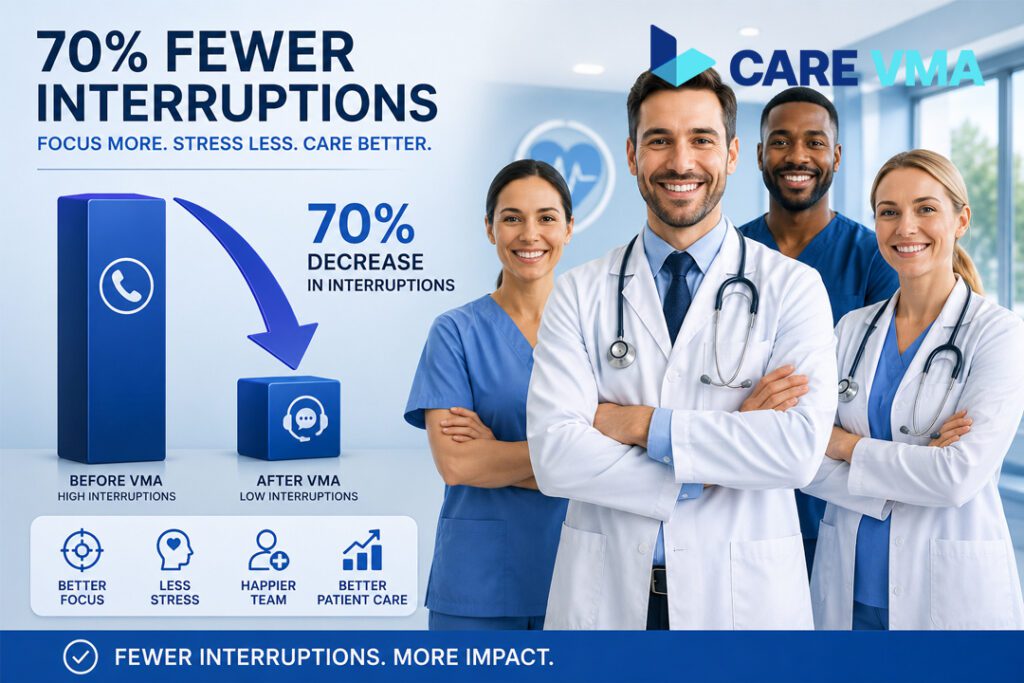
The ROI of Intelligent Routing: Reducing Interruption by 70%
Physician Retention and the End of On-Call Burnout
Specialized routing acts as a “safety net.” By filtering out 70% of non-urgent noise, practices can significantly improve physician retention. Doctors who feel protected by their administrative workflows are less likely to seek employment elsewhere or suffer from clinical exhaustion.
Operational Efficiency: Eliminating the “Morning Scramble”
There is a direct financial benefit to having a VMA clean up the after-hours queue before the clinic doors even open. By the time the first physical staff member arrives, the schedule is confirmed, refills are queued for approval, and urgent messages are already flagged for the provider.
HIPAA Compliance and Data Integrity in After-Hours Care
Any routing involving Protected Health Information (PHI) must be covered under a signed Business Associate Agreement (BAA). Care VMA ensures that all HIPAA compliance and data security standards are met by using encrypted endpoints and secure communication apps. Using standard SMS or non-medical answering services to transmit patient names and symptoms is a high-risk violation that can lead to massive federal fines.
Frequently Asked Questions
Does after-hours call routing require a BAA for HIPAA compliance? Yes. Any service that handles, routes, or documents PHI (Patient Health Information) is legally required under HIPAA to have a signed Business Associate Agreement (BAA) in place to protect the practice from liability.
Can a VMA distinguish between a true emergency and a routine inquiry? Absolutely. Unlike automated systems, a VMA uses practice-approved clinical protocols and real-time EHR access to determine if a patient needs an immediate ER referral, an on-call doctor escalation, or a next-day appointment.
How do I sync after-hours call logs directly into my EHR? Care VMA assistants work directly within your existing EHR system via secure remote access. They document the encounter in real-time, just as an in-house staff member would, eliminating the need for manual data transfer.
What is the safest way to route patient calls to the on-call doctor? The safest method is through a dedicated, encrypted medical communication app or a secure paging system. Care VMA avoids standard SMS to ensure all communication remains HIPAA-compliant and audit-ready.
How much does an intelligent after-hours service cost compared to RN triage? A VMA-led model is significantly more cost-effective than US-based RN triage while providing a higher level of EHR integration and administrative support than a basic answering service.
Book Your After-Hours Workflow Audit – Request a Custom Routing Map today.