For modern medical practices, the decision to outsource front-desk operations is often driven by the need for efficiency. However, the phrase “HIPAA-trained” has become a ubiquitous marketing buzzword that frequently masks significant liability gaps. In a regulatory landscape where the Office for Civil Rights (OCR) can levy fines exceeding $50,000 per violation, a superficial “claim” of compliance is a catastrophic financial risk.
To achieve true operational security, practice managers must move beyond software features and perform a deep-dive audit of their staffing partners. This guide provides a zero-liability framework for vetting a HIPAA compliant virtual receptionist to ensure your patient data remains as secure as it would be in a physical office.
Beyond the Marketing Claim: The High Cost of Hidden Non-Compliance in Virtual Staffing
The “Vetting Crisis” in virtual staffing stems from a misunderstanding of what what HIPAA compliance actually entails for remote workers. Many agencies provide assistants who use secure software but operate in unverified environments, creating a massive liability gap.
- The Financial Stakes: Analyzing the impact of OCR fines and the long-term reputation loss on small to mid-sized practices.
- The Liability Gap: Identifying where traditional answering services fail the Business Associate Agreement (BAA) test. If your provider cannot produce a signed, legally binding BAA that covers their specific remote workforce, the legal burden of any breach falls entirely on your clinic.
Why HIPAA Compliance for Virtual Receptionists Is More Than Just Secure Software
Navigating the Legal Nuances of Business Associate Agreements (BAA)
A BAA is not a “terms and conditions” checkbox. It is a legal instrument that shifts and defines responsibility. Essential clauses every clinic owner must require before granting EHR access include specific indemnification for data breaches and clear protocols for incident reporting.
The Complexity of Remote PHI Handling in Offshore Environments
Managing data sovereignty is critical when assistants operate outside the U.S. Compliance requires that Protected Health Information (PHI) is never “stored” locally. Using a specialized service like Care VMA ensures that your virtual medical receptionist acts only as a conduit, entering data through secure tunnels directly into your EHR without leaving a digital footprint on the remote device.
Essential HIPAA Compliant Virtual Receptionist Checklist (Step-by-Step)
Use this checklist to audit your current or prospective virtual staffing partner:
1. Administrative Safeguards
- [ ] Vetting Documentation: Are background checks conducted and documented annually?
- [ ] Training Logs: Does the VMA undergo annual HIPAA recertification?
- [ ] Internal Audit Trail: Can the provider show logs of who accessed what data and when?
2. Technical Safeguards
- [ ] Endpoint Encryption: Is the remote hardware encrypted with AES-256 bit standards?
- [ ] Multi-Factor Authentication (MFA): Is MFA mandatory for all EHR and VoIP logins?
- [ ] Secure VoIP: Does the phone system use TLS/SRTP encryption to prevent wiretapping?
3. Physical Safeguards
- [ ] The “Physical Audit”: Does the provider conduct regular webcam audits of the VMA’s workspace?
- [ ] Zero-Storage Policy: Is there a strict prohibition against physical note-taking (paper/pens) in the remote workspace?
Performing a “Zero-Liability” Operational Audit: The Remote Workspace Reality
A common failure point in remote staffing is the lack of control over the home office. To maintain clinic workflow optimization, the remote environment must be as controlled as your local facility.
Home Office Environment Standards
A compliant VMA must work in a private, door-locked environment. Unauthorized individuals (family members or roommates) must not have visual or auditory access to PHI. This is a non-negotiable standard for all Care VMA professionals.
Network Security Requirements
Relying on standard home Wi-Fi is a risk. Audit your partner for:
- Mandatory VPN Usage: All data must be tunneled through a business-grade VPN.
- ISP Reliability: Redundant internet connections to prevent dropped calls, which can lead to fragmented (and therefore non-compliant) data entry.
Real-World Workflow: Secure EHR Access and Patient Data Entry
The Use Case: Synchronous Prescription Refills
- Before: A patient calls a traditional answering service. The service takes a message (storing PHI on their server) and faxes it to the clinic. A staff member later enters it into the EHR. This “fragmented” entry increases exposure risks.
- After: A Care VMA receptionist answers the call via a secure tunnel. They verify the patient’s identity directly in Athena or eClinicalWorks and log the refill request in real-time. The PHI never stays with the VMA; it moves from the patient’s voice directly into the secure EHR environment.
This level of integration is a key reason why many practices choose a virtual vs in-person receptionist, as it combines high-level security with immediate operational output.
The Care VMA 5-Layer Compliance Framework: More Than Just a Service
At Care VMA, we don’t just “claim” compliance; we engineer it into every layer of our service:
- Layer 1: Proprietary VMA Screening: Only the top 2% of applicants pass our rigorous HIPAA competency exams.
- Layer 2: Zero-Knowledge Data Architecture: Our VMAs work entirely within your secure cloud environment.
- Layer 3: Mandatory BAA: We sign a comprehensive BAA for every engagement, assuming our share of the liability.
- Layer 4: Continuous Physical Monitoring: Regular, unannounced workspace audits ensure a private, secure environment.
- Layer 5: Incident Response: We maintain active liability insurance and a documented protocol for any potential data threats.
Implementation ROI: How Compliance Accelerates Throughput
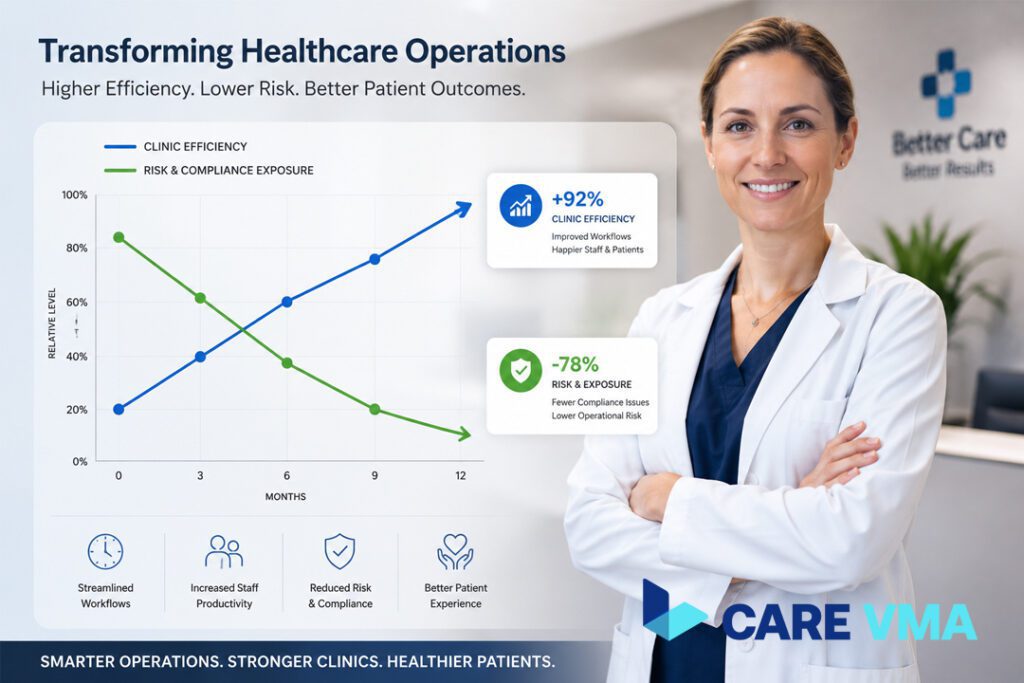
Standardized compliance frameworks actually reduce onboarding time by roughly 40%. When your HIPAA compliant virtual assistant is pre-vetted and audit-ready, you eliminate the friction of technical setup and legal back-and-forth. This “audit-ready” status provides the peace of mind necessary to scale your practice without the looming threat of regulatory inquiries.
Schedule a Zero-Liability Compliance Consultation
Don’t gamble with your practice’s reputation. Ensure your virtual front desk is backed by the industry’s most rigorous security framework. Book a Demo with Care VMA Today
FAQ
Is a virtual receptionist allowed to access my EHR?
Yes, provided they are covered under a signed Business Associate Agreement (BAA) and use encrypted, audited access points that comply with HIPAA’s Technical Safeguards.
What happens if my virtual assistant causes a data breach?
Without a BAA and proof of administrative safeguards, the legal and financial liability falls entirely on your practice. A partner like Care VMA mitigates this through rigorous operational oversight and documented protocols.
Does a virtual medical assistant need a separate BAA?
Absolutely. Any entity that handles Protected Health Information (PHI) on your behalf is a “Business Associate” under HIPAA and must sign a BAA.
How do I monitor HIPAA compliance for staff working offshore?
Compliance is monitored through regular physical workspace audits, digital logs of EHR access, and periodic re-training certifications to ensure the VMA remains updated on U.S. healthcare laws like the HITECH Act.
What encryption tools should a medical VMA use?
At minimum, VMAs should use AES-256 bit encryption for data at rest and TLS 1.2 or higher for data in transit, combined with secure, business-grade VoIP and VPN solutions.