For many practice managers, the word “HIPAA” brings a sense of dread. It feels like a complex, intimidating rulebook filled with legal jargon, designed to catch you out. The administrative burden seems heavy, and the threat of million-dollar fines for a simple mistake is very real.
But what if we reframed it? Stop thinking of HIPAA as a checklist and start seeing it as an operational system—a workflow designed to protect the single most important asset your practice has: patient trust.
HIPAA compliance is the process healthcare organizations and their business partners follow to protect the privacy, security, and integrity of Protected Health Information (PHI). Governed by the U.S. Department of Health and Human Services (HHS), it’s not just about avoiding penalties; it’s about building a secure, efficient practice that patients feel confident choosing.
This guide translates the legal requirements into the day-to-day reality of your clinic. We’ll move beyond theory and give you the operational framework you need to make compliance a natural part of your workflow.
Why HIPAA Compliance is Non-Negotiable for Your Practice?
The stakes for non-compliance are higher than ever. It’s not just about potential fines; a data breach can permanently damage your reputation and erode patient loyalty. The Office for Civil Rights (OCR), the enforcement arm of the HHS, is actively investigating violations, and the penalties reflect the severity of the issue.
| Tier | Level of Negligence | 2026 Fine Range (per violation) |
|---|---|---|
| Tier 1 | No Knowledge | $145 – $73,011 |
| Tier 2 | Reasonable Cause | $1,461 – $73,011 |
| Tier 3 | Willful Neglect (Corrected) | $14,602 – $73,011 |
| Tier 4 | Willful Neglect (Not Corrected) | $73,011 – $2,190,294 |
Beyond the financial risk, strong HIPAA protocols are a sign of operational excellence. They demonstrate a commitment to professionalism and patient care that builds a foundation of trust essential for long-term success.
The 4 Core HIPAA Rules, Translated for Clinic Operations
HIPAA can feel overwhelming, but it boils down to four main rules. Here’s what they actually mean for your team’s daily tasks.
The Privacy Rule: The “Who, What, When” of Sharing PHI
This rule establishes the ground rules for how Protected Health Information (PHI) can be used and disclosed. It empowers patients with rights over their own data, like the right to access their medical records.
[🏥 Clinic Workflow Example]:A patient’s spouse calls your front desk asking for their partner’s recent lab results. The Privacy Rule dictates your response. Your receptionist must first verify that there is a signed consent form on file authorizing disclosure to that specific person. Without it, they must politely decline, explaining they can only share the information directly with the patient to protect their privacy. This simple, scripted interaction is the Privacy Rule in action.
The Security Rule: The “Digital Locks” on Your Electronic PHI (ePHI)
The Security Rule focuses exclusively on protecting electronic PHI (ePHI)—the data you create, store, and transmit in your EHR, billing software, and email. It requires three types of safeguards.
[🏥 Clinic Workflow Example]:A physician needs to check a patient’s chart on a tablet while moving between exam rooms. At that moment, all three Security Rule safeguards are active:
- Administrative: Your practice policy requires the physician to have completed annual security training.
- Physical: The tablet is set to auto-lock after 60 seconds of inactivity, preventing unauthorized viewing if left unattended.
- Technical: The physician uses a unique password and Multi-Factor Authentication (MFA) to log into the EHR, ensuring only they can access the data.
The Breach Notification Rule: Your “What-If” Action Plan
This rule requires you to notify affected individuals, the HHS, and sometimes the media if a data breach of unsecured PHI occurs. Having a clear, documented response plan is a core component of compliance.
The Omnibus Rule: Why Your Vendors Are Your Responsibility
This crucial update extended direct HIPAA liability to “Business Associates”—any third-party vendor that handles PHI on your behalf. This includes your billing company, IT provider, document shredding service, and even your answering service. If they cause a breach, you are both held responsible.
Who Needs to be HIPAA Compliant? (And What It Means for You)
Understanding who is bound by HIPAA rules is the first step to securing your data. It falls into two categories.
Covered Entities
These are the primary healthcare organizations on the front lines. If you’re a healthcare provider, health plan, or healthcare clearinghouse, you are a Covered Entity. This is your core responsibility.
Business Associates
This is where the risk often hides. A Business Associate is any vendor that performs a function involving the use or disclosure of PHI. This can include:
- Billing and Coding Services
- IT and Managed Service Providers (MSPs)
- Cloud Storage and EHR Vendors
- Practice Management Consultants
- Virtual Assistant Services
Choosing a Business Associate, like a Virtual Medical Assistant, requires careful vetting. A compliant VMA is not just an admin resource; they are trained to operate as a secure extension of your team, understanding the gravity of handling PHI.
The Operational Framework: Your 7-Step HIPAA Compliance Checklist
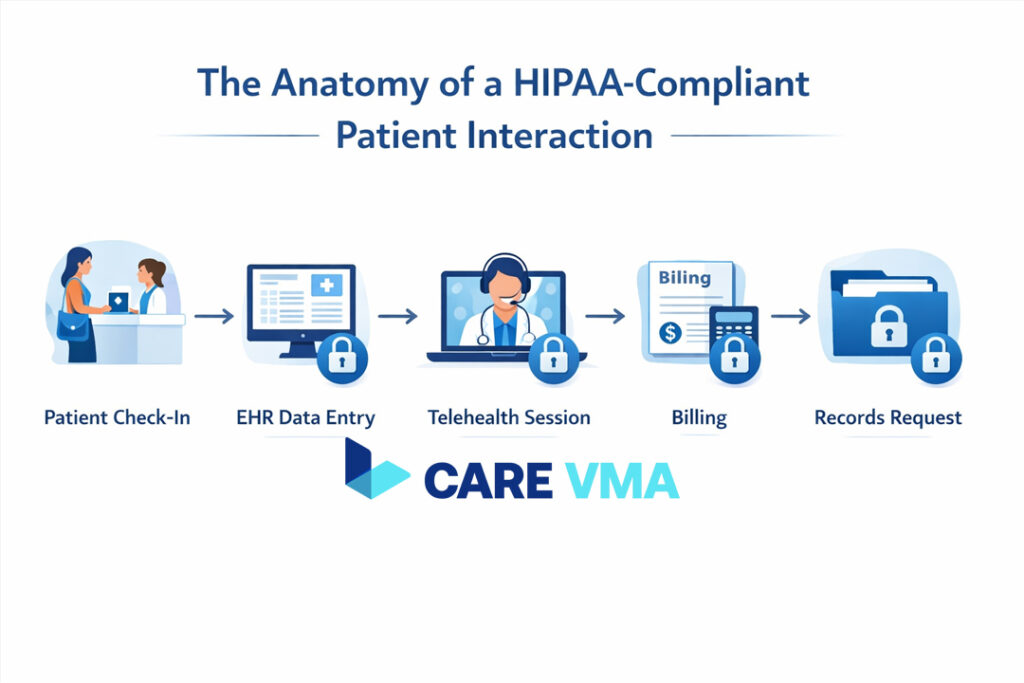
Forget abstract legal requirements. Here is an actionable framework to build compliance directly into your practice’s daily operations.
1. Appoint Your Privacy & Security Officers
These aren’t just titles; they are active roles. Your Privacy Officer handles policies related to PHI use and patient rights, while the Security Officer focuses on ePHI and cybersecurity. In a small practice, one person can hold both roles, but their duties must be clearly defined.
2. Conduct a Real-World Risk Analysis
An IT scan isn’t enough. You need to map out how information flows through your clinic. Where are the touchpoints?
- Patient check-in (iPad vs. paper forms)
- Verbal conversations in the hallway
- Fax machines and printers
- Staff accessing the EHR from home
- Patient records left on a desk
Identify where PHI exists and what the real-world risks are to that data, then create a plan to mitigate them.
3. Implement Your Safeguards (Role-by-Role)
This is where most practices struggle. Don’t just list policies; assign them.
- Administrative Safeguards:
- Practice Manager: Schedules annual HIPAA training for all staff.
- All Staff: Must sign a confidentiality agreement upon hiring.
- Physical Safeguards:
- Front Desk Staff: Applies privacy filters to computer screens facing the waiting room. Turns over clipboards to hide patient names.
- Clinical Staff: Ensures exam room doors are closed when discussing PHI with patients.
- Technical Safeguards:
- All Staff: Must use unique, complex passwords and MFA to access all systems.
- IT Partner/Security Officer: Ensures all data is encrypted, both on servers and during transmission.
4. Train Your Team for Clinic Scenarios
A yearly slideshow isn’t effective training. Role-play real situations. What do you do when a patient emails a request for their records? How do you handle a request for information over the phone? Scenario-based training makes compliance an active skill, not a passive memory.
5. Master the Business Associate Agreement (BAA)
A BAA is a legally required contract that ensures your vendors will protect the PHI you entrust to them. Never sign a service agreement with a vendor who handles PHI without a BAA in place. This includes your medical billing virtual assistant and anyone else with access to your systems.
6. Document Everything
Create a simple compliance binder or digital folder. It should contain your risk analysis, policies and procedures, training logs, and copies of all BAAs. If the OCR ever audits you, this documentation is your proof of ongoing compliance efforts.
7. Prepare for 2026: Key Security Updates Coming Your Way
The HHS is continually updating the Security Rule to combat modern cybersecurity threats. To stay ahead, practices should be focused on:
- Mandatory MFA: Moving from a suggestion to a requirement for accessing ePHI.
- Mandatory Encryption: Encryption for data at rest and in transit is becoming a baseline expectation.
- Continuous Risk Assessment: Shifting from a once-a-year check to an ongoing process of monitoring for new threats.
Beyond the Checklist: How to Automate Compliance and Reduce Admin Burden
Running a practice is demanding. The administrative load of manual compliance—tracking paperwork, double-checking procedures, and constant worry—can lead to burnout. This is where building a secure operational system becomes a game-changer.
Consider a common, high-risk task: Insurance Verification.
- Manual Workflow: Your front desk staff member spends hours on the phone with insurers. They write down sensitive policy numbers on a notepad, which sits on their desk. They then manually enter this information into the EHR, creating potential for typos. The notepad is eventually thrown away, but not always in a secure shred bin. Each step introduces a risk of human error and potential exposure of PHI.
- VMA-Assisted Workflow: A trained, HIPAA-compliant Virtual Medical Assistant from Care VMA handles the entire process. They operate from a secure system, accessing insurer portals through encrypted connections. They use secure software to verify eligibility, and the data is transferred directly into your EHR via a secure integration. The process of insurance verification and prior authorization is faster, more accurate, and eliminates the physical security risks of paper notes.
Your Path to Confident Compliance Starts Today
HIPAA doesn’t have to be a source of stress. By viewing it as an operational framework for protecting patient trust, you can transform it from a legal burden into a system for excellence. A systematic approach, documented procedures, and scenario-based training are the keys to reducing risk and improving clinic efficiency.
Building this system takes time and expertise. If you’re feeling overwhelmed by the administrative load of maintaining compliance, let’s talk.
Feeling overwhelmed? Schedule a free, no-obligation consultation to see how a Care VMA Health Virtual Assistant can help you build a secure, efficient, and HIPAA-compliant practice workflow.