Hiring the wrong remote support doesn’t just waste money—it creates more work for you and puts your practice at risk. The choice between a Virtual Medical Assistant (VMA) and a general Administrative Assistant isn’t about preference; it’s about precision, compliance, and operational security. One integrates into your clinical workflow; the other supports your business operations. Understanding the difference is critical.
A Virtual Medical Assistant (VMA) is a healthcare specialist trained in clinical workflows, EMR systems, and HIPAA regulations, specifically designed to handle tasks involving Protected Health Information (PHI). A general Administrative Assistant is a non-clinical professional who manages business-related tasks like scheduling meetings or booking travel. Choosing the wrong one can lead to operational bottlenecks and serious compliance violations.
At-a-Glance: Specialist vs Generalist
| Feature | Virtual Medical Assistant (VMA) | General Administrative Assistant |
|---|---|---|
| Primary Role | Clinical & Administrative Support | Business & General Support |
| HIPAA/BAA | HIPAA-trained, operates under a BAA | Not HIPAA-trained, no BAA |
| Key Tools | EMR/EHR (Epic, Athena, etc.), Patient Portals | G-Suite, MS Office, Slack, Social Media |
| Core Tasks | Prior Authorizations, Charting, Insurance Verification | Calendar Management, Travel Booking, Invoicing |
| When to Hire | To reduce physician admin time & handle PHI | To manage non-clinical tasks & business logistics |
Why Your Clinic is Overwhelmed?
Is your team drowning in EMR alerts, prior authorization phone tag, and an endless stream of patient portal messages? Do your physicians spend hours on charting after the last patient has gone home—the dreaded “pajama time”?
This isn’t a staffing problem; it’s a workflow problem. The administrative burden on U.S. healthcare practices is immense, pulling skilled clinicians away from patient care and overwhelming front-desk staff. The solution isn’t just to “hire someone remote.” It’s about strategically integrating the right kind of remote support that understands the high-stakes environment of a medical clinic.
The Virtual Medical Assistant (VMA) – Your Clinical Operations Force Multiplier
A VMA is far more than a remote receptionist. They are a trained extension of your clinical team, equipped to work securely within your EMR and handle tasks that directly impact patient care and your revenue cycle.
This is where most practices see the biggest operational lift.
What a VMA Actually Does: A Day in a Real Clinic Workflow
Imagine this workflow, seamlessly handled by a remote professional:
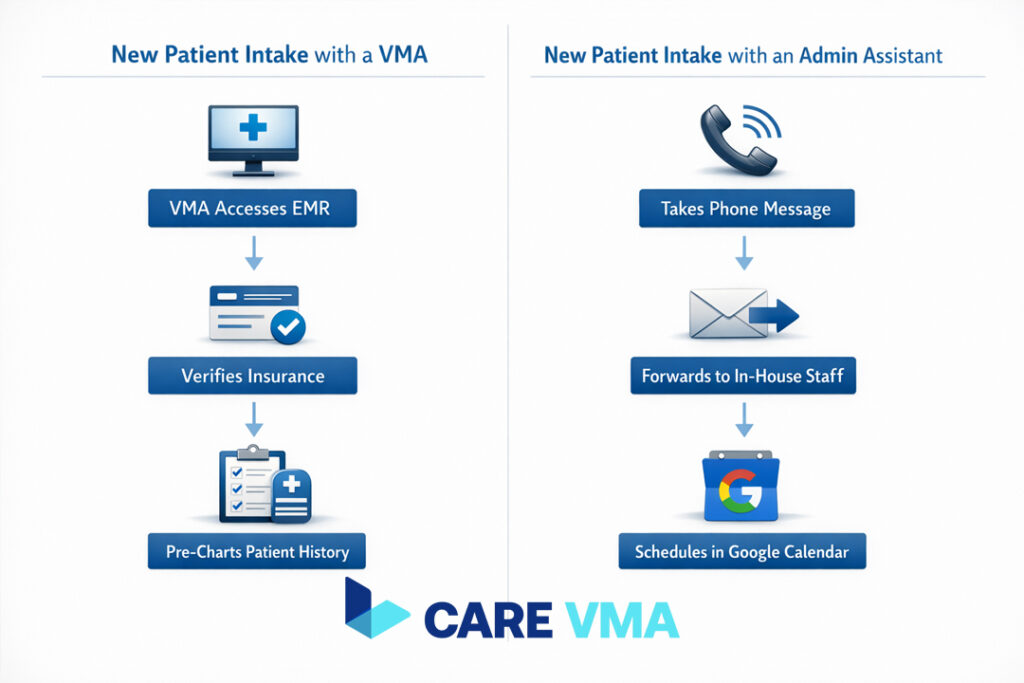
- 8:00 AM (Pre-Visit Prep): Your VMA logs into your EMR (e.g., Athena, Epic). They review the day’s schedule, prep patient charts, flag missing lab results, and verify insurance eligibility for every appointment. Your on-site staff can now focus entirely on arriving patients.
- 11:30 AM (Live Telehealth Support): A physician is conducting a telehealth visit. The VMA joins the secure call as a virtual medical scribe, charting the encounter in real-time. This allows the physician to maintain eye contact and focus on the patient, not on typing notes.
- 2:00 PM (Prior Authorization Battle): A patient needs an urgent MRI, but the insurer requires a lengthy prior authorization. Your VMA spends the next 90 minutes on the phone with the insurance company, navigating phone trees and providing the necessary clinical documentation to secure approval.
- 4:30 PM (Closing the Loop): Before logging off, the VMA clears the patient portal inbox, processing prescription refill requests, answering non-clinical patient questions, and sending out appointment reminders for the next day.
A VMA doesn’t just complete tasks; they manage entire clinical-administrative loops, freeing up your most valuable resources: your providers and your in-house staff.
Core VMA Competencies:
- HIPAA & BAA Proficiency: Understands the rules of handling PHI and operates under a legally required Business Associate Agreement (BAA).
- EMR/EHR Fluency: Trained to navigate major systems without needing extensive hand-holding.
- Medical Terminology: Accurately understands and documents clinical language, reducing the risk of dangerous errors.
- Revenue Cycle Knowledge: Knows the process for insurance verification, prior authorization, and denial management.
The Administrative Assistant – Your Business Operations Support
A general administrative assistant is a valuable asset, but their domain is fundamentally different. They are the right tool for the job when a task does not—and should not—involve patient data.
How an Admin Assistant Supports the Business of the Clinic
While your VMA handles the clinical side, a remote admin assistant can focus on business growth and logistics:
- Managing the lead physician’s complex calendar for speaking engagements and booking travel for a medical conference.
- Processing invoices from vendors and ordering new office supplies.
- Updating the non-clinical sections of the clinic’s website or scheduling social media posts.
- Organizing business documents in a shared drive like Google Drive or Dropbox.
The key distinction is clear: a general admin assistant works on the business, while a VMA works in the clinical operations of the business. Their tasks exist entirely outside the EMR and the patient record.
Using an Admin Assistant for a VMA’s Job
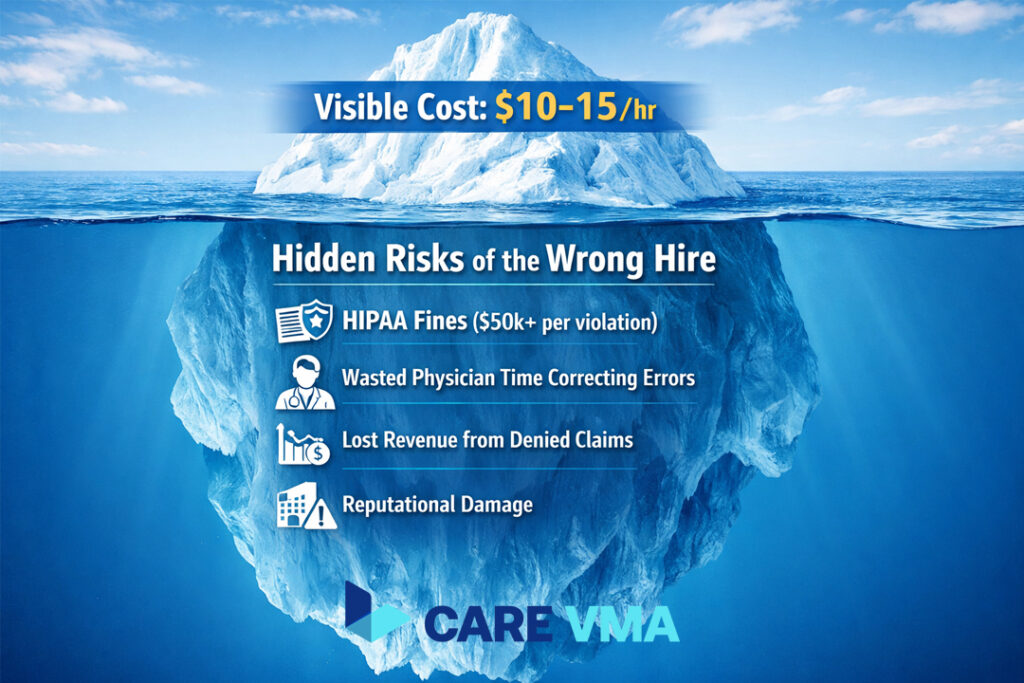
Framed in operational terms, this is the “$10/hr VA who costs you $10,000.”
Scenario 1: The Critical EMR Error
An untrained admin assistant is asked to transcribe a physician’s audio note. They mishear “Metformin” as “Melatonin.” The error is entered into the patient’s chart. Best case? The physician has to spend unpaid time finding and correcting the mistake. Worst case? The incorrect information contributes to a clinical risk down the line. This single error erodes data integrity and physician trust.
Scenario 2: The Unintentional HIPAA Breach
A general admin assistant, working from a personal, unsecured laptop, downloads a patient list to “clean it up” in Excel. This single action—moving PHI to an unsecured environment—is a data breach. The consequences can be catastrophic: mandatory patient notifications, potential OCR investigations and fines, and irreversible damage to your practice’s reputation. A professional Virtual Medical Assistant service provides a secure, compliant infrastructure to prevent this.
Which Assistant Does Your Clinic Need?
Still unsure? Use this checklist. Your answers will point you directly to the right solution for your current operational bottlenecks.
Hire a Virtual Medical Assistant (VMA) if you checked any of these:
- [ ] Our physicians spend more than 90 minutes a day on charting after hours.
- [ ] Our revenue is impacted by delayed or denied prior authorizations.
- [ ] Our on-site staff are too busy to manage the constant patient calls and portal messages.
- [ ] We need someone who can help with chart prep and understand medical notes.
- [ ] The tasks require access to our EMR/EHR system.
Hire a General Administrative Assistant if you checked any of these:
- [ ] Our primary need is managing non-clinical schedules and business travel.
- [ ] We need help with marketing, social media, or basic bookkeeping (not medical billing).
- [ ] The tasks absolutely do not involve accessing patient charts or any form of PHI.
The Strategic Option: The Hybrid Model
Many high-efficiency clinics use both. A full-time VMA team manages the high-volume, complex clinical admin work. At the same time, a part-time remote admin assistant supports the practice owner with business development and personal scheduling. This hybrid approach optimizes both clinical efficiency and business growth.
Integrating a VMA Without Disrupting Your Practice
This isn’t about just hiring a person; it’s about upgrading your clinic’s operational system. The right VMA partner doesn’t just provide staff—they provide a fully managed, secure, and compliant solution that integrates from day one.
At Care VMA Health, we remove the anxieties around security, onboarding, and management. Our VMAs are pre-trained, HIPAA-certified professionals ready to plug into your workflow. Adopting this model allows you to:
- Reclaim Physician Time: Cut administrative work by up to 15 hours per provider per week, eliminating “pajama time” and reducing burnout.
- Secure Your Patient Data: Rest easy knowing all remote work is performed by trained professionals on a secure platform under a BAA.
- Improve Your Bottom Line: Accelerate prior authorizations, reduce claim denials, and increase patient capacity by improving your clinic workflow optimization.
Frequently Asked Questions (FAQ)
Can a general VA access my EMR if they sign an NDA?
No. An NDA is not sufficient for handling PHI. Any vendor or individual accessing patient data must be operating under a formal Business Associate Agreement (BAA) as required by HIPAA. A VMA provider will supply this.
What is a Business Associate Agreement (BAA)?
A BAA is a legal contract between a healthcare provider and a third-party service provider (the “business associate”). It requires the associate to properly safeguard PHI and outlines the liability for any data breaches.
How much time can a VMA realistically save a physician?
Most practices report saving 10-15 hours per week per physician by delegating tasks like charting, scribing, and clearing the EMR inbox. This reclaimed time can be used to see 2-4 more patients per day or focus on practice growth.
Is it difficult to onboard a VMA?
With a professional service like Care VMA Health, onboarding is streamlined. We handle the training on security protocols and general workflows, so you only need to provide training specific to your practice’s unique processes.
Ready to See How a VMA Fits Your Workflow?
Stop letting administrative overload dictate your schedule and put your practice at risk. The solution is to build a smarter, more efficient operational system with specialized support.
Schedule a free, no-obligation operational consultation with our specialists today. We’ll help you identify your biggest administrative bottlenecks and build a clear plan to solve them with a compliant, expert VMA.