Is your front desk phone constantly ringing? Are your physicians spending more time on data entry than with patients? This isn’t just a busy day; it’s a symptom of operational drag. The relentless administrative burden is a leading cause of staff burnout and clinic inefficiency. But what if you could offload 80% of these tasks to a highly-trained professional without adding to your office headcount?
A Virtual Medical Assistant (VMA) is a remote, HIPAA-trained healthcare professional who provides administrative, clinical, and patient-facing support to medical practices. From an off-site location, they use secure digital tools to manage tasks like appointment scheduling, EHR updates, medical billing, and patient communication, allowing your in-house team to focus entirely on patient care.
This guide moves beyond simple definitions to give you an operational blueprint for integrating a VMA into your clinic.
What a VMA Is Not: Clearing Up Common Misconceptions

Before we dive into the operational specifics, it’s crucial to understand what a Virtual Medical Assistant is not. This clarity helps set the right expectations and ensures you’re evaluating the right solution for your practice.
- Not Just a Generic “Virtual Assistant”: A VMA is a specialized professional with healthcare training, fluent in medical terminology and HIPAA regulations. Unlike a general VA, they understand the complexities of EHR/EMR management and the importance of patient data security.
- Not an AI Chatbot: Our VMAs are real, thinking humans capable of handling complex, nuanced tasks that require empathy and critical thinking—like managing a distressed patient’s call or chasing a complex insurance denial. They provide a human touch that AI cannot replicate.
- Not a Replacement for In-House Staff: A VMA is an extension of your team. They augment your on-site staff by handling remote tasks, allowing your nurses and medical assistants to perform at the top of their licenses with hands-on patient care.
The Core Functions: How a VMA Streamlines Your Clinic’s Operations
A VMA integrates into your practice not as a person in a specific chair, but as a system that absorbs specific functions. By categorizing their tasks, you can see exactly where they create efficiency.
1. The Administrative Backbone: Your Remote Front & Back Office
Imagine your day starting with a pre-screened schedule and an organized digital front desk. This is the primary goal of administrative VMA support. They handle the high-volume, repetitive tasks that clog your front-desk and back-office workflows.
- Appointment & Calendar Management: Your VMA manages all booking requests, confirmations, rescheduling, and cancellations. This drastically reduces front-desk call volume and frees your on-site staff to engage with patients arriving for their appointments. It’s a key part of an effective patient scheduling workflow.
- Insurance Eligibility Verification: Workflow Example: Your VMA verifies coverage for all patients 48 hours in advance, flagging any issues directly in the EHR. Your team can address authorization problems before the patient arrives, eliminating billing surprises and front-desk delays.
- Medical Billing & Claims Management: A VMA can handle submitting claims, posting payments, and following up on denied or rejected claims. This persistent follow-up is critical for improving your revenue cycle velocity.
- Referral Coordination: They manage the entire lifecycle of incoming and outgoing referrals, ensuring no patient gets lost in transition and that all necessary documentation is sent and received.
2. Clinical Support Engine: Reducing the Physician’s Documentation Burden
The single greatest source of physician burnout is the Electronic Health Record (EHR). A clinical-focused VMA, often called a virtual medical scribe, is designed to give providers back their most valuable asset: time.
- Live Medical Scribing: Your VMA joins the patient visit remotely (via a secure, HIPAA-compliant audio/video stream) and documents the entire encounter directly into the EHR in real-time. This frees the physician to maintain eye contact and focus completely on the patient.
- Patient Intake & Chart Preparation: Before the visit, your VMA calls patients to gather or update their medical history, reconcile medication lists, and document the chief complaint. The physician walks into the exam room with a fully prepared, actionable chart.
- Prescription Refill Requests: The VMA processes refill requests according to clinic protocols, verifies pharmacy information, and queues them up in the EHR for final physician approval, saving hours of tedious “click work.”
3. Patient Communication Hub: Enhancing the Patient Experience
Every missed call is a potential loss in revenue and patient trust. A VMA acts as your communications hub, ensuring every patient is heard and their needs are addressed promptly and professionally.
- Phone Triage & Messaging: They act as the first line of response for incoming calls, handling non-urgent scheduling and billing questions while routing clinically significant issues to the appropriate in-house staff according to your protocols.
- Post-Visit Follow-Ups: Your VMA can call patients after procedures to check on their recovery, answer non-clinical questions, and ensure they have scheduled their follow-up appointments.
- Lab Result Notification: Following provider instructions, the VMA can communicate normal lab results to patients, closing the loop on their care episode faster.
Is your clinic’s biggest bottleneck administrative or clinical? Identifying your primary pain point is the first step. Our free workflow analysis can help you pinpoint which VMA role will deliver the biggest and fastest impact. Learn More
The Tangible ROI: How a VMA Impacts Your Bottom Line and Team Morale
A Virtual Medical Assistant isn’t an expense; it’s a strategic investment in operational excellence. The returns are visible not just in your finances, but in the well-being of your team and the satisfaction of your patients.
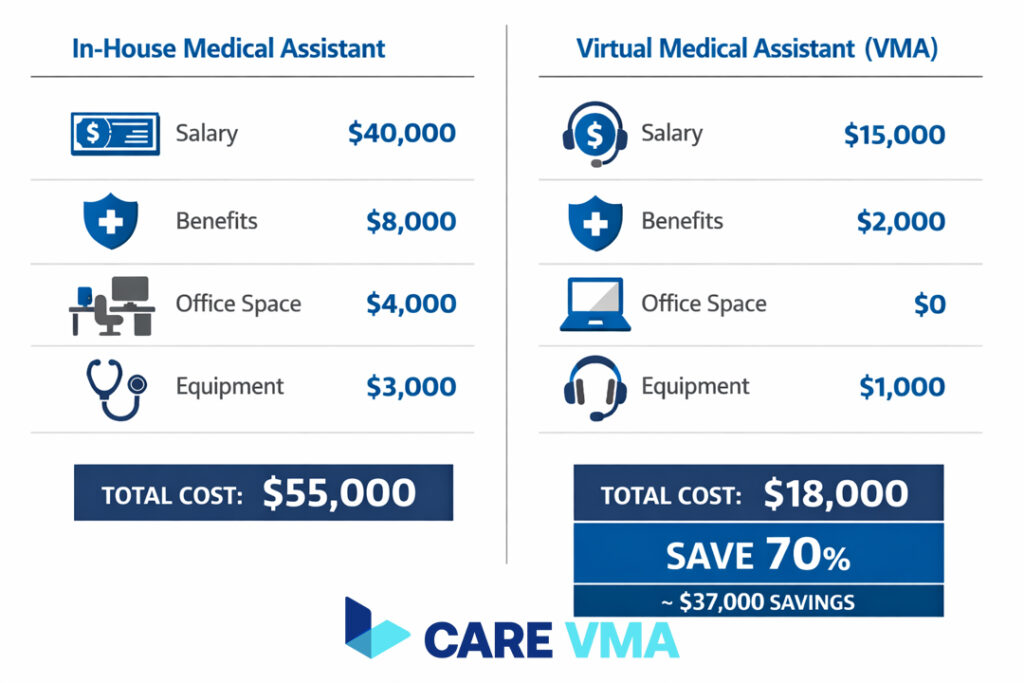
- Drastically Reduce Operational Costs (by 50-70%): A VMA model eliminates the overhead associated with an in-house hire. There are no costs for additional office space, hardware, benefits, or payroll taxes. The savings are direct and immediate.
- Decrease Physician Burnout & Increase Patient Face-Time: By offloading an estimated 10-15 hours of administrative work per week, you allow doctors to be doctors. This directly combats physician burnout, improves job satisfaction, and reduces costly staff turnover.
- Boost Clinic Efficiency and Patient Throughput: With a streamlined front-desk and pre-prepared patient charts, you can significantly reduce patient wait times. This smoother workflow may even allow you to accommodate more patients per day without adding stress to your team.
- Improve Revenue Cycle & Reduce Claim Denials: Proactive insurance verification and diligent follow-up on denied claims lead to faster payments, fewer write-offs, and a healthier financial bottom line for the practice.
The Integration Blueprint: A 4-Step Guide to Onboarding Your VMA
Integrating a VMA isn’t about giving a stranger a password. It’s a structured process designed for security, compliance, and seamless assimilation into your existing workflow. This is how to get it right.
- Step 1: The Discovery & Workflow Audit: We begin by mapping your current administrative and clinical workflows. We work with your team to identify the highest-impact, highest-friction tasks that are ideal for delegation. This isn’t about offloading random work; it’s about surgically targeting bottlenecks.
- Step 2: Secure Access & HIPAA Protocol: Security is paramount. We guide you on providing secure, role-based, and auditable access to your EHR and Practice Management System. All VMAs operate under a strict Business Associate Agreement (BAA) and use encrypted, secure connections, ensuring total HIPAA compliance.
- Step 3: The Communication Playbook: Clear communication is the foundation of a successful hybrid team. We help you establish simple, efficient communication channels (e.g., a dedicated Slack channel, secure EHR messaging) and protocols for daily huddles, task management, and escalation.
- Step 4: Phased Delegation & Training: Your VMA doesn’t start by drinking from a firehose. They begin with a small, manageable set of tasks. As they master your clinic’s specific protocols and preferences, their responsibilities expand. This ensures a smooth, non-disruptive transition for your staff and patients.
Is a Virtual Medical Assistant Right for Your Practice?
A VMA is a powerful operational tool, but it delivers the best results for practices experiencing specific, identifiable challenges. Consider a VMA if you find yourself answering “yes” to any of these questions:
- Is your front-desk staff constantly juggling ringing phones, patient check-ins, and administrative backlogs?
- Are your physicians and clinical staff consistently finishing charts and paperwork after clinic hours?
- Are claim denials, accounts receivable aging, and prior authorizations negatively impacting your cash flow?
- Is high staff turnover due to administrative stress and burnout a recurring problem?
- Do you want to scale your practice or add new services without the high overhead of new full-time hires?
Your Next Step to a More Efficient Practice
Stop letting administrative drag dictate your clinic’s potential. It’s time to reclaim your team’s time, empower your staff to focus on patient care, and build a more resilient, efficient practice.
Schedule a free, no-obligation consultation with a Care VMA Health workflow specialist today. We’ll help you build a custom VMA implementation plan tailored to solve your unique operational challenges and achieve your practice’s goals.
Schedule Your Free Operational Consultation
Frequently Asked Questions (FAQ)
What are the qualifications of a Care VMA Health assistant?
Our VMAs are healthcare professionals, many with backgrounds as registered nurses or certified medical assistants. They undergo rigorous vetting and receive extensive training in HIPAA compliance, U.S. healthcare standards, and various EHR platforms.
How do you ensure patient data is secure and HIPAA compliant?
We operate under strict HIPAA protocols. Every VMA signs a Business Associate Agreement (BAA), works through encrypted networks (VPNs), and is trained to handle Protected Health Information (PHI) with the highest level of security. Access to your systems is role-based and auditable.
Can a VMA work with my specific EHR system (e.g., Epic, Athenahealth, eClinicalWorks)?
Yes. Our VMAs are proficient with all major EHR and Practice Management Systems. During onboarding, we ensure they are fully trained on your specific instance and workflows.
What’s the difference between a Human VMA and an AI assistant?
A Human VMA provides critical thinking, empathy, and complex problem-solving skills that AI cannot. While AI is useful for simple, repetitive tasks like sending automated reminders, a human VMA can manage a nuanced conversation with an anxious patient, troubleshoot a complex billing issue, or adapt to a provider’s unique dictation style.
How much does a Virtual Medical Assistant cost?
A VMA typically costs 50-70% less than a full-time, in-house employee when you factor in salary, benefits, payroll taxes, and overhead. Our pricing is straightforward and transparent, providing a significant and measurable return on investment.