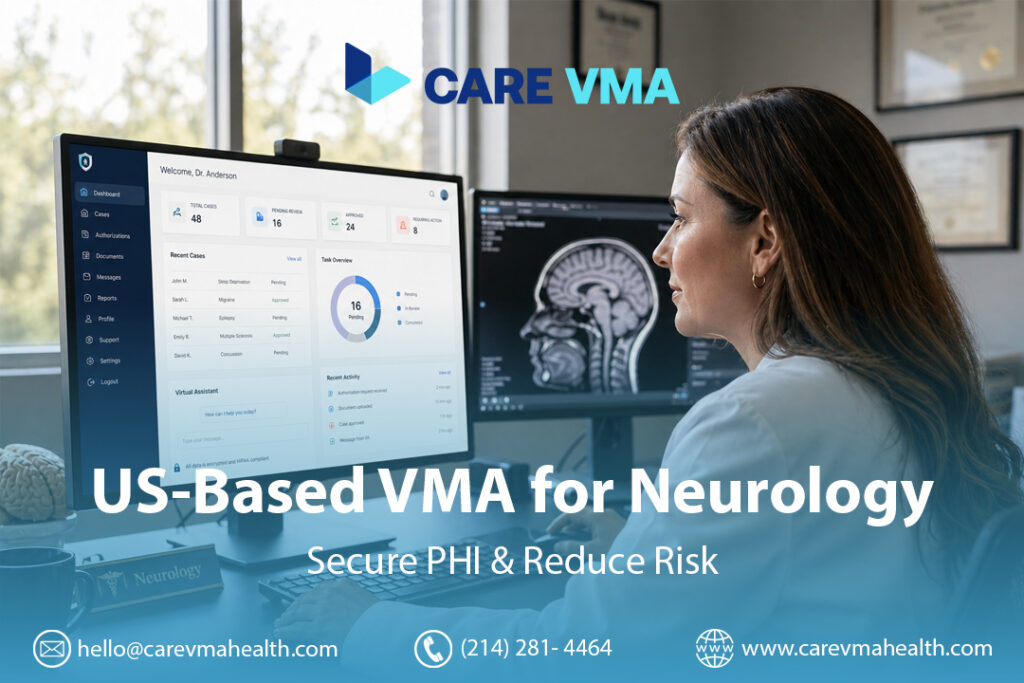
Hiring a US-based Management Virtual Medical Assistant (VMA) for a neurology clinic involves more than just delegating tasks; it requires establishing a robust framework for Protected Health Information (PHI) security. Neurology practices handle sensitive, longitudinal data—including neuroimaging (MRIs), EEG traces, and chronic care records—that demand higher-than-average security standards.
The complexity of these records means that a standard administrative approach is insufficient. To maintain the integrity of your practice, you must implement a strategy that prioritizes HIPAA compliance and data security at every touchpoint.
The Neurology Security Crisis: Why MRI Reports and EEG Traces Require Enhanced Protection
The Vulnerability of Longitudinal Data
Unlike acute care, neurology often involves decade-long patient histories. These records contain evolving narratives of neurodegenerative diseases or chronic seizure management. A leak or a data overwrite doesn’t just violate HIPAA; it destroys the clinical roadmap for the patient. Protecting this data is a core component of any guide to neurology practice modernization.
Managing High-Stakes Diagnostics
Handling neuro-imaging (MRI, CT, PET) and electrophysiological data via unsecured channels is a significant liability. Traditional email is a failure point for neurological diagnostics. A Management VMA must be trained to utilize specialized, encrypted platforms to ensure that large diagnostic files are moved without exposure.
The Legal Necessity of a BAA: Why US Jurisdiction is Your Clinic’s Best Defense
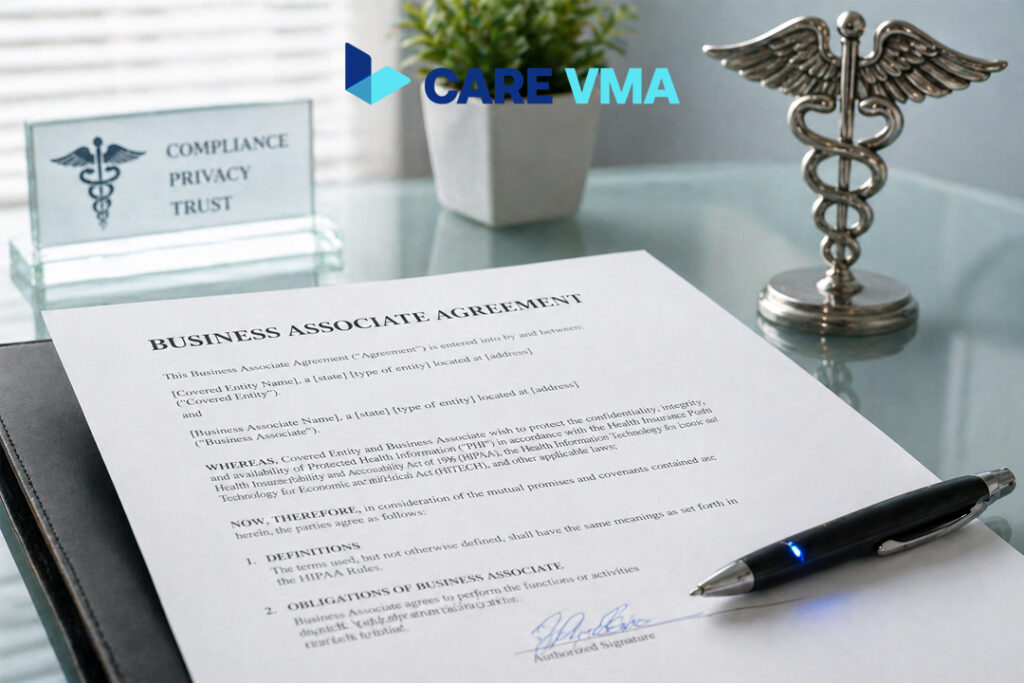
Beyond the Paperwork
A Business Associate Agreement (BAA) is legally mandatory under HIPAA. However, its power depends on jurisdiction. A US-based VMA (or their agency) acts as a “Business Associate” subject to the same federal oversight as your clinic. This provides enforceable legal recourse and ensures the VMA is committed to federal privacy standards.
Cyber Liability Insurance
Hiring US-based staff ensures they are directly subject to the jurisdiction of the Department of Health and Human Services (HHS). This makes it significantly easier to pursue insurance claims compared to offshore staff. Verify that your VMA partner carries specific cyber liability insurance to share the financial burden of data protection.
Implementing a “Zero Trust” Architecture for Remote Neuro-Administrative Management
To safely integrate remote staff, clinics should adopt a “Zero Trust” environment where no user or device is trusted by default.
- Role-Based Access Control (RBAC): Use the “Minimum Necessary” standard. A VMA should only access modules required for their role—such as prior authorization for neurology drugs—without having full access to unrelated clinical files.
- Secure Remote Access: Access should occur via a dedicated Virtual Private Network (VPN) or Virtual Desktop Infrastructure (VDI), ensuring data never resides on the VMA’s local machine.
- Managed Device Protocol: “Bring Your Own Device” (BYOD) is a failure point. A professional Management VMA uses company-issued, managed devices with full-disk encryption (BitLocker/FileVault) and remote wipe capabilities.
Use Case: Streamlining Neuro-Imaging Coordination Without Security Leaks
The Workflow Challenge: A neurology clinic needs to coordinate a follow-up MRI for a multiple sclerosis patient, involving the imaging center, the insurance provider, and the patient.
The Secure Solution: By utilizing Care VMA’s specialized Lab & Imaging Coordination Service, the Management VMA utilizes encrypted portals like Nuance PowerShare or Ambra instead of email. They handle the referral and the diagnostic result retrieval within the secure confines of the EMR.
The Result: Reduced turnaround time for results with zero PHI exposure and improved patient satisfaction.
Data Integrity in Chronic Care: Preventing Overwrites in Complex Neurology Notes
Neurology patients often have complex, multi-layered notes. A VMA plays a critical role in virtual chronic care management by ensuring data integrity during record updates.
- Maintaining the Clinical Narrative: VMA training must include protocols to ensure old records are not accidentally overwritten or incorrectly merged during EMR updates.
- Audit Trails: Modern practices should periodically monitor VMA activity logs to detect unusual access patterns early, providing an extra layer of oversight for sensitive patient populations.
The ROI of Security: How US-Based Professionalism Reduces Breach Liability
Investing in a high-tier US Management VMA is a proactive financial strategy.
- Cost Efficiency: The average cost of a HIPAA breach can exceed $200k. Comparing this to the investment in a secure, US-based VMA reveals that “cheap” offshore options often carry hidden, catastrophic costs.
- Operational Continuity: In the event of personnel transitions, a professional VMA agency utilizes a “Kill Switch” protocol, revoking all access (EMR, VPN, Billing) within minutes to prevent data kidnapping.
Featured Snippet: 5 Essential Security Requirements for Hiring a Neurology VMA
- Verify US-Based Physical Residency: Ensures federal HHS jurisdiction and enforceable legal standing.
- Managed, Encrypted Devices: Confirm the VMA operates on hardware with BitLocker or FileVault enabled.
- Zero Trust Network: Establish access via a dedicated VPN or Virtual Desktop Infrastructure (VDI).
- Specialized Neuro-Data Training: Mandate annual HIPAA certification with a focus on neuro-imaging and diagnostic data.
- Robust BAA Execution: Ensure a clear contract with explicit breach-reporting obligations is signed.
Why Care VMA is the Trusted Partner for Specialty Neurology Practices
At Care VMA, we understand that neurology is a high-stakes specialty. Our VMAs are not just administrative helpers; they are trained professionals operating within a security-first culture. We provide the technical infrastructure and the legal safeguards necessary to protect your patients’ most sensitive data.
Whether you need assistance with complex scheduling and patient intake or high-level clinical coordination, we offer a solution that balances efficiency with ironclad security.
Ready to secure your practice and streamline your workflows? Book a Consultation with Care VMA Today
FAQ
Does a US-based VMA cost significantly more than offshore options?
While the hourly rate may be higher, the ROI is found in liability reduction. A single security breach from an offshore worker can cost hundreds of thousands of dollars and carry no legal recourse. US-based VMAs provide the security that protects your practice’s long-term financial health.
How do you handle the transfer of large neuro-imaging files securely?
Our VMAs are trained to avoid email for PHI. We utilize encrypted, HIPAA-compliant image-sharing portals (such as Ambra or Nuance) and direct EMR integrations to move diagnostic data securely.
What happens to my data if the VMA contract is terminated?
We implement a “Kill Switch” protocol. All access to your EMR, VPN, and communication portals is revoked instantly. Since we use VDI/VPN technology, no clinical data ever resides on the VMA’s local hardware.
Is a BAA alone enough to satisfy HIPAA for a remote worker?
No. A BAA is the legal foundation, but it must be supported by technical safeguards like MFA, encrypted devices, and secure networks to truly satisfy HIPAA’s Security Rule.