For a busy primary care practice, the telephone is both a lifeline and a liability. It’s the primary connection to your patients but also a constant source of interruption, administrative burden, and potential clinical risk. While a standard medical answering service for primary care might seem like a simple solution to handle after-hours calls, it often creates more problems than it solves—from garbled messages to missed emergencies.
The fundamental issue is that your practice doesn’t just need calls to be answered; it needs patient interactions to be managed. This requires a solution that operates not as a disconnected message-taker, but as an integrated part of your clinical team. It’s time to look beyond answering services and discover how a Virtual Medical Assistant (VMA) provides a seamless, intelligent, and secure extension of your front office.
What is a Virtual Medical Assistant for Primary Care?
A Virtual Medical Assistant (VMA) is a remote, highly-trained professional integrated directly into your practice’s workflow, operating as a core team member. Unlike a traditional answering service that only takes messages, a VMA manages patient scheduling, pre-authorizations, EHR data entry, and intelligent call triage directly within your systems, ensuring continuity of care and operational efficiency.
The Critical Flaw in Standard Answering Services for a Busy Primary Care Office
Traditional answering services operate on a simple model: take a message and pass it on. But primary care is anything but simple. This disconnect leads to critical flaws that can impact patient safety, staff morale, and your bottom line.
Why a generic message-taker can’t distinguish between a routine check-up call and a potential cardiac event.
Standard operators follow generic scripts. They are not clinically trained to recognize the subtle language that signals a medical emergency. To them, a patient reporting “pressure in their chest” might be documented with the same priority as a patient needing a flu shot appointment. This lack of clinical nuance introduces unacceptable risks.
The communication gap: How disconnected call logs create data entry nightmares for your front desk staff every morning.
Answering services typically send a list of messages via email or a separate portal. This means your staff starts each day with a mountain of manual data entry—transcribing call notes into the EHR, checking for duplicates, and trying to decipher vague messages. This administrative bottleneck delays patient care and pulls staff away from patients in the office.
The problem of one-size-fits-all scripts that don’t adapt to your practice’s specific protocols.
How does your practice handle refill requests for controlled substances? What is the specific escalation protocol for your on-call physician rotations? A standard answering service cannot manage this complexity. Their rigid scripts fail to accommodate your unique workflows, leading to confusion for patients and frustration for your providers. Adopting modern primary care practice efficiency strategies requires a more dynamic solution than a static script can offer.
The True Cost of Inefficient Call Handling: Patient Experience, Staff Burnout, and Revenue Leaks
The consequences of a poor call management system extend far beyond simple annoyance. They create tangible costs that erode your practice’s health.
Quantifying the impact of “phone tag” on patient satisfaction and retention.
When patients can’t get a clear answer or have to wait for a call back for a simple request, their satisfaction plummets. A game of “phone tag” to book an appointment can be the final straw that sends a patient looking for a new provider. Each lost patient represents a significant loss of long-term revenue.
How administrative overload on your clinical staff leads to burnout and compromises patient-facing time.
Your skilled nurses and medical assistants should be focused on patient care, not data entry or chasing down vague messages. When they are constantly pulled into administrative tasks stemming from an inefficient answering service, their primary duties suffer. This administrative overload is a direct contributor to the front-desk burnout in medical clinics that is plaguing the healthcare industry.
Mapping revenue loss from missed appointment opportunities and scheduling errors.
Every call that is mishandled, dropped, or results in a vague “please call back” message is a potential missed appointment. A standard service that can’t schedule directly into your EHR is actively leaking revenue. Scheduling errors from manual data entry lead to double-bookings or empty slots, further impacting your bottom line.
Real-World Workflow: Managing After-Hours Calls (Answering Service vs. Care VMA)
Let’s examine a critical after-hours scenario to see the difference between a basic service and an integrated VMA.
Before (Standard Service):
A patient calls at 9 PM with chest pain and shortness of breath. The operator, following a generic script, takes a message: “Pt has chest pain.” They send this note via an unsecure text message to the on-call physician. The physician receives a vague, non-urgent-looking note with no context. Meanwhile, the patient’s chart isn’t updated, so when they potentially arrive at the ER, the hospital has no record of the interaction. The full details are only logged when staff arrives the next morning.
After (Care VMA):
A patient calls with the same symptoms. The Care VMA, operating as your trained Virtual Medical Receptionist, immediately recognizes keywords like “chest pain” and “shortness of breath” based on your practice’s exact triage protocols. Following your escalation path, the VMA identifies it as an emergency, escalates the call directly to the on-call physician through a secure, HIPAA-compliant app, and documents the entire initial interaction in the patient’s EHR in real-time. The continuity of care is preserved, and patient safety is prioritized.
The Solution: A Dedicated Care VMA Trained for Primary Care Workflows
The answer isn’t a better answering service; it’s a new model of support. A Care VMA is not a call center agent but a dedicated team member who becomes an expert in your practice’s operations.
Moving from message-taking to proactive task management.
A Care VMA goes beyond passive message-taking. They actively manage tasks that bog down your team, from handling prescription refills to scheduling multi-step appointments. This proactive approach is the key difference when you compare the limitations of a medical call center vs. a virtual receptionist who is fully integrated.
How a VMA integrates directly with your EHR (Epic, Athena, eClinicalWorks) for seamless operations.
Our Virtual Medical Assistants are trained on all major EHR platforms. They are given secure, role-based access to work directly within your system, just like an in-house employee. This eliminates the morning data entry logjam, ensures real-time updates to patient charts, and dramatically improves operational efficiency.
The power of a dedicated assistant who understands your team, your doctors, and your patients.
With Care VMA, you get a dedicated assistant who learns the nuances of your practice—which doctor prefers which type of appointment slot, which patients need extra follow-up, and how to handle specific scheduling requests. This level of personalized support is impossible for a pooled answering service to provide.
Unlocking True ROI: How a VMA Reduces Operational Costs and Boosts Efficiency
Cost-Benefit Analysis: Comparing the flat rate of a VMA vs. the loaded cost of an in-house administrative employee.
Hiring a full-time employee comes with a “loaded cost”—salary, benefits, payroll taxes, sick leave, and training. A VMA provides specialized support at a predictable flat rate, saving you over 60% on average compared to the loaded cost of an in-house hire, without sacrificing quality.
How optimizing your schedule and reducing no-shows by 15-20% directly impacts your bottom line.
Because a VMA can handle proactive appointment reminders and follow-ups, your no-show rate plummets. A VMA can also strategically manage your schedule in real-time, filling last-minute cancellations. Reducing your no-show rate by just a few percentage points can add tens of thousands of dollars back to your annual revenue.
Reallocating your skilled in-house staff to higher-value, patient-facing tasks.
By offloading the administrative burden of call management, scheduling, and data entry to your VMA, you free up your in-house clinical staff. Your nurses can spend more time on patient care, your front desk can provide a better in-person experience, and your practice can operate at the top of its license.
Beyond Answering: 3 High-Value Tasks a VMA Handles That a Call Service Can’t
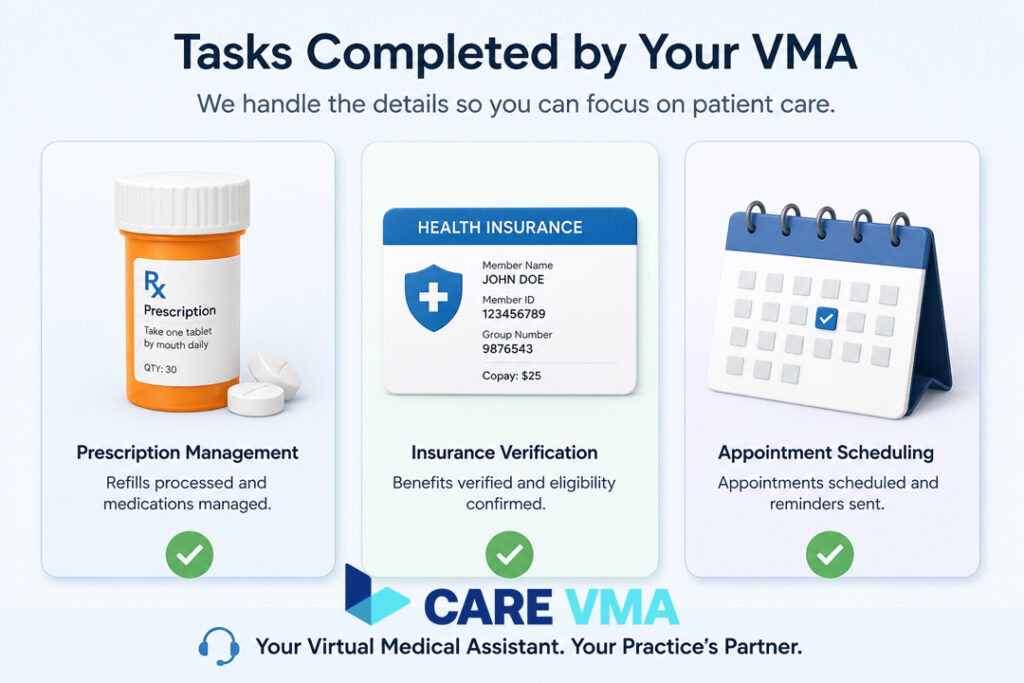
A true VMA elevates your practice by managing tasks that a basic answering service would never touch.
Managing prescription refill requests according to physician protocols.
Your VMA can manage incoming refill requests directly within the EHR, queuing them up for physician approval based on your specific protocols, saving your team hours of phone time each week.
Handling insurance verification and pre-authorizations.
Stop losing money on denied claims. A VMA can perform insurance verifications before appointments and manage the time-consuming process of prior authorizations, ensuring you get paid for the services you provide.
Proactive appointment reminders and follow-up scheduling.
A VMA doesn’t just schedule the initial appointment; they ensure the patient journey is complete. They manage automated and manual reminders to reduce no-shows and conduct post-visit follow-ups to schedule necessary future care.
Ironclad Security and Compliance: Our Commitment to Protecting Your Practice
Patient privacy is paramount. We build our services on a foundation of security and trust, ensuring your practice and your patients are always protected.
We Sign a Business Associate Agreement (BAA) from Day One.
We are fully HIPAA compliant and will always sign a BAA before handling any Protected Health Information (PHI). This is a non-negotiable part of our commitment to being a true partner in patient care.
Comprehensive HIPAA training and secure communication protocols as standard practice.
Every Care VMA undergoes rigorous and ongoing HIPAA training. All communication and data handling are conducted through encrypted, secure channels, eliminating the risks associated with unsecure texts and emails used by less sophisticated services.
Ready to stop firefighting calls and start building a more efficient, profitable, and patient-centric practice?
Schedule a Free Consultation Today to Discover the Care VMA Difference
FAQ: Key Questions for Primary Care Decision-Makers
How is a Care VMA different from a service like Stericycle or SAS?
We provide a dedicated team member integrated into your workflow, not a shared pool of call center agents. Your VMA learns your specific processes, whereas call centers follow generic scripts. This dedicated model allows for true task management and workflow integration, not just message-taking.
Can your VMAs schedule directly into our specific EHR system?
Yes. We are proficient with all major EHR platforms, including Epic, Athena, Cerner, and eClinicalWorks. During our structured onboarding process, we configure secure access to work as a seamless extension of your front desk.
What is the onboarding and training process like for a new VMA?
We have a structured 2-week process where we map your key workflows (call handling, scheduling, refills) and train your dedicated VMA to your exact specifications before they go live. This ensures they are fully prepared to operate as a core member of your team from day one.
How do you handle complex on-call schedules and physician rotations?
Your VMA manages this through a shared, real-time portal or by integrating with your existing scheduling software. You can update schedules instantly, and your VMA ensures the correct on-call physician is always contacted according to your specific protocols.