Why are you still staring at an EHR screen at 9 PM while your family is asleep? This is the reality for countless physicians trapped by administrative overload. Hiring a top-notch medical virtual assistant (VMA) is a strategic plan to reclaim your time, reduce burnout, and refocus on patient care. A VMA is a remote, highly trained professional who handles the administrative and clinical documentation tasks that consume a significant portion of your day.
The administrative burden in modern medicine is unsustainable. Data from the American Medical Association (AMA) shows that for every hour of patient-facing time, physicians spend nearly two additional hours on EHR and desk work. This is more than just an inconvenience; it is a direct threat to patient safety and your practice’s financial health. Care VMA provides a streamlined solution, connecting your practice with elite, HIPAA-compliant virtual assistants who understand the language of healthcare and the urgency of your mission.
The Anatomy of a Top-notch Medical Virtual Assistant
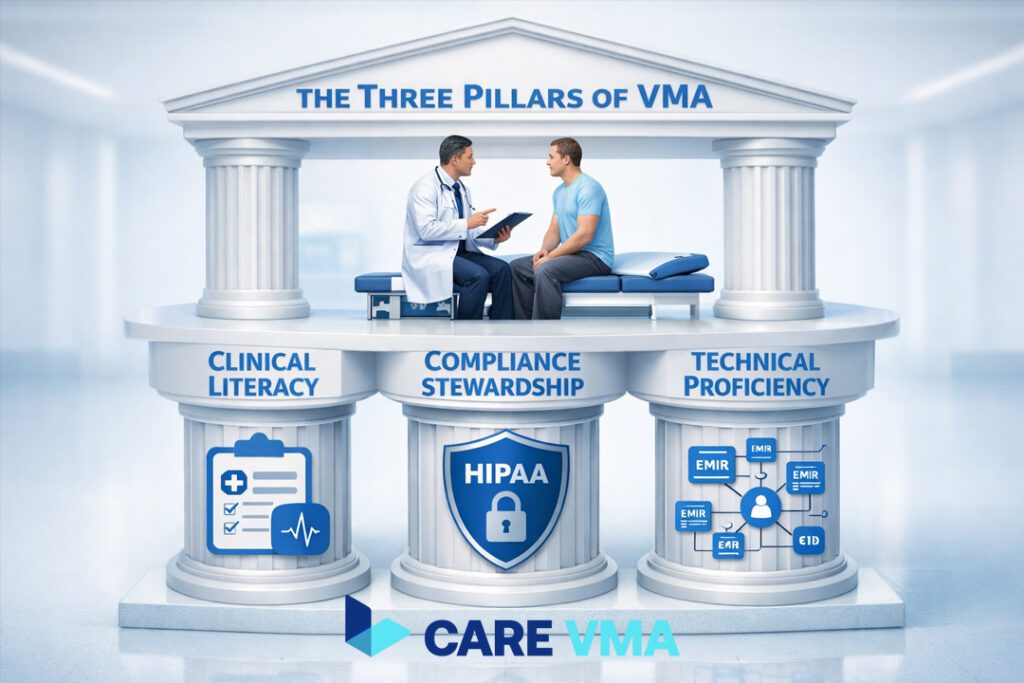
Not all virtual assistants are created equal. A premier medical virtual assistant is built on three foundational pillars that ensure seamless integration and absolute security for your practice. Understanding these components is the first step in making an informed hiring decision.
First is Clinical Literacy. Your VMA must be fluent in medical terminology, from understanding complex diagnoses to accurately documenting SOAP notes and managing CPT & ICD-10 coding. This proficiency prevents errors in peer-reviewed documentation and ensures that patient records are precise, which is critical for care coordination and continuity.
Second is Compliance Stewardship. This is non-negotiable. A top-tier VMA operates within a fortress of security protocols governed by the HIPAA/HITECH Act. They must understand the sanctity of Protected Health Information (PHI) and work with organizations that sign a Business Associate Agreement (BAA), legally guaranteeing the protection of your patient data. This expertise is central to maintaining trust and avoiding costly violations.
Third is Technical Proficiency. The modern clinic runs on technology. An elite VMA possesses deep knowledge of EHR interoperability, with experience navigating systems like Epic, Cerner, and Athenahealth. Their role extends to managing the patient portal, orchestrating telehealth appointments, and supporting your practice’s Revenue Cycle Management (RCM) to ensure financial stability. This technical skill ensures they become a productive team member from day one.
The Care VMA 5-Step Integrity Vetting
How do you guarantee you are hiring from the top 2% of available talent? At Care VMA, we have engineered a rigorous 5-step vetting process designed to identify and onboard only the most qualified medical virtual assistants. This process is our commitment to providing your practice with an asset, not just an assistant.
Our process begins with comprehensive background checks and credential verification, ensuring every candidate has a clean record and the qualifications they claim. Next, candidates undergo stringent medical knowledge testing, evaluating their understanding of clinical workflows and terminology. We then assess their technical skills through simulated tasks on major EHR platforms. The fourth step involves intensive HIPAA and data security training, culminating in a certification test. Finally, candidates complete soft-skill assessments to ensure they possess the communication and problem-solving abilities necessary for a remote healthcare environment. This meticulous process ensures that any VMA from Care VMA is ready to handle the complex demands of your practice, including insurance verification and prior authorization.
Beyond Cost: The “Eye-Contact Dividend” in Modern Practice
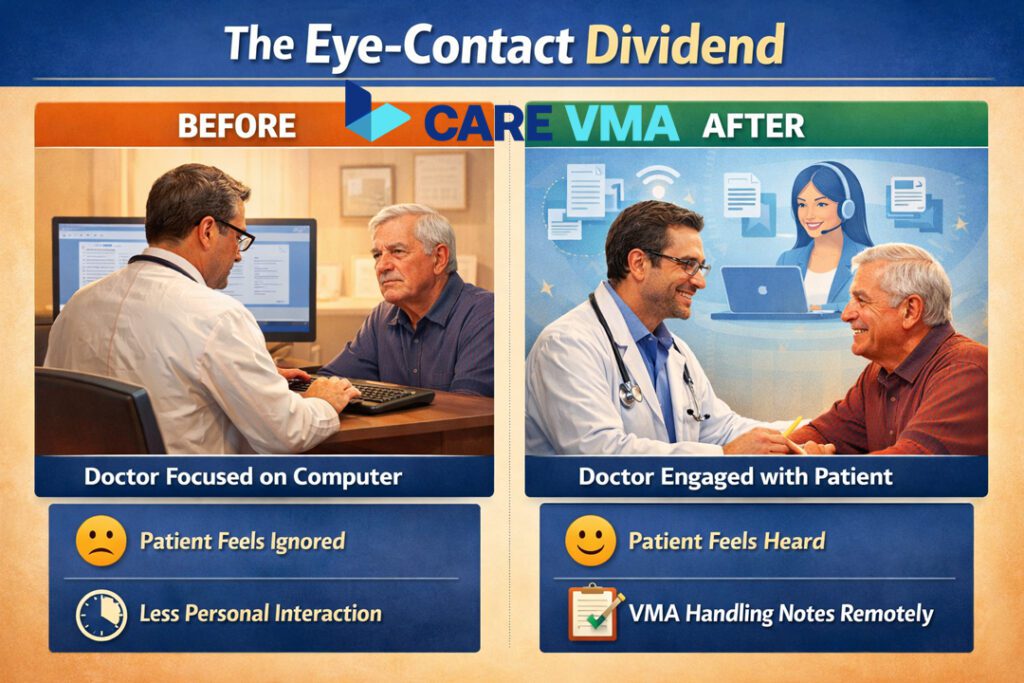
The most significant return on investment from hiring a VMA is not measured in dollars saved, but in the quality of human connection restored. We call this the “Eye-Contact Dividend.” When a physician is liberated from the screen, the entire dynamic of the exam room changes. You are no longer dividing your attention between the patient’s story and the blinking cursor of an EHR.
With a virtual medical scribe from Care VMA handling real-time medical scribe synchronization, you can maintain direct eye contact, listen actively, and show empathy. This seemingly small change has a profound impact. Patients feel heard and valued, which directly improves patient satisfaction scores (HCAHPS) and treatment adherence. Furthermore, a focused physician is less likely to make documentation errors, leading to more accurate SOAP notes and a reduction in potential medical errors. This shift from “physician vs. screen” to “physician with patient” is the future of efficient, compassionate healthcare.
FAQs for the Modern Practitioner
Navigating the integration of a VMA into your practice naturally comes with questions. Here are answers to some of the most common inquiries from physicians.
How do I ensure a VMA doesn’t commit a HIPAA violation?
Ensuring compliance is a shared responsibility, and it starts with your VMA provider. At Care VMA, every assistant operates under a strict Business Associate Agreement (BAA). Our security infrastructure includes encrypted VPNs, secure data centers, access controls, and regular audit logs. We provide continuous training on HIPAA compliance and data security to ensure our team is always ahead of potential threats, protecting your practice and your patients’ PHI.
Can a VMA handle prior authorizations for complex procedures?
Absolutely. This is one of the most impactful tasks a VMA can take off your plate. Our trained VMAs are skilled in managing the entire prior authorization (PA) process. They navigate payer portals, compile necessary clinical documentation, complete submission forms, and perform follow-ups to secure approvals efficiently. This frees up your in-house staff and accelerates the patient’s access to care.
What is the ROI of a medical virtual assistant vs. a local hire?
The return on investment is multifaceted. Financially, hiring a VMA can reduce staffing-related overhead-such as benefits, office space, and equipment-by up to 70%. Operationally, the ROI is seen in reclaimed time. By delegating administrative tasks, a physician can see more patients or finish their day on time, directly impacting revenue and reducing the conditions that lead to physician burnout. The most critical ROI, however, is the improvement in work-life balance and the renewed focus on patient care.
Conclusion: Your Path Away From Burnout
Every day spent drowning in administrative tasks is another day closer to burnout. The current model is unsustainable for physicians and detrimental to patient care. Integrating a top-notch medical virtual assistant is no longer a luxury; it is a strategic necessity for the modern medical practice. It is a direct investment in efficiency, security, and the restoration of the physician-patient relationship.
You became a doctor to heal people, not to be a data entry clerk. It is time to delegate the administrative burden and reclaim your role as a clinician. Let Care VMA provide the support system your practice needs to thrive in 2026 and beyond.
Book Your Practice Audit – Let’s Recover 10 Hours of Your Week with a Virtual Medical Assistant.