The silent weight on every medical practice manager is the ever-growing mountain of administrative tasks. This is more than just paperwork; it is a state of administrative fatigue that seeps into your team, causing clinician burnout and stretching resources thin. This exhaustion creates a frustrating paradox: the more time your staff spends on digital noise like charting and scheduling, the less time they have for the human-to-human connection that defines quality patient care. It feels like a battle you cannot win, directly impacting both your team’s morale and your patients’ experience.
A Healthcare Virtual Assistant (HVA) is a remote, medically trained professional who handles clinical administrative tasks like EHR documentation, patient triage, and schedule management. By integrating an HVA, healthcare facilities can enhance operational efficiency while ensuring patient satisfaction through more responsive, HIPAA-secure communication. This is the strategic solution to reclaim your practice’s focus, transforming administrative burdens into a streamlined workflow that prioritizes patient outcomes.
Understanding the Role of a Healthcare Virtual Assistant in the Modern Medical Ecosystem
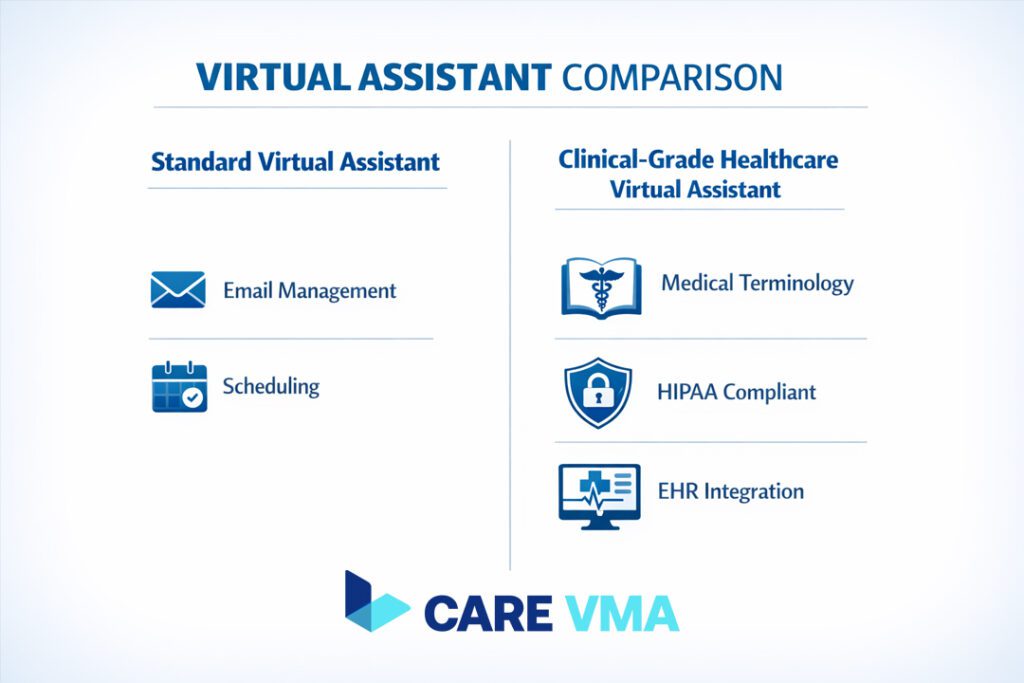
It is crucial to distinguish between a general virtual assistant and a clinical-grade Healthcare Virtual Assistant. While a standard VA can manage emails and calendars, a clinical-grade VMA operates as an integral part of your care delivery team. These professionals are not simply administrators; they are trained in the language of medicine. They possess a deep understanding of complex medical terminology, are proficient in ICD-10/CPT medical coding for accurate billing, and are rigorously trained in healthcare regulations.
A Care VMA is not a replacement for your in-house staff. Instead, they function as a powerful support engine, working behind the scenes to orchestrate the complex flow of information that modern healthcare demands. This dedicated support in areas like clinical documentation and insurance verification frees your on-site team from repetitive tasks, allowing them to practice at the top of their license and dedicate their full attention to the patients in front of them. You can explore the key differences and advantages to see how this specialized role fits within a clinical setting.
Standard VA
- General administrative skills
- Basic software proficiency
- Unfamiliar with medical compliance
- Cannot handle clinical data
Clinical-Grade VMA (Care VMA)
- Trained in medical terminology
- Proficient in EHR/EMR systems
- Full HIPAA & HITECH Act training
- Manages PHI securely
The Care VMA Solution: Bridging the Gap Between Efficiency and Patient Empathy
True innovation in healthcare technology is not just about speed; it is about enhancing the human connection. Care VMA was built on this principle, creating the “Continuity Loop” to bridge the gap between a brief office visit and the patient’s continuous care journey. Our VMAs act as a clinical liaison, ensuring that communication and support do not end when the patient leaves your office. This is particularly vital for services like virtual chronic care management, where consistent engagement directly impacts health outcomes.
We solve three critical gaps often overlooked by other systems:
- The Digital Divide: We recognize that not all patients are tech-savvy. Our VMAs are trained with specific empathy scripts to guide elderly or technologically hesitant patients through processes via simple phone calls, ensuring no one is left behind.
- Beyond-HIPAA Security: While HIPAA compliance is the baseline, it is not the ceiling. We add a layer of enterprise-grade security aligned with the NIST Cybersecurity Framework, ensuring every piece of Protected Health Information (PHI) is encrypted and shielded against emerging threats.
- Emotional Intelligence: Our system is designed to detect emotional cues in patient communication. If a patient expresses distress or frustration, the interaction is seamlessly escalated to an on-site staff member for immediate, human-led intervention.
This focus on operational excellence addresses a core problem highlighted by the American Medical Association (AMA): the significant administrative burden, often called “pajama time,” that contributes heavily to clinician burnout. By offloading these tasks, we help restore the work-life balance essential for a healthy practice.
Transforming Clinical Workflow Through Secure EHR Integration
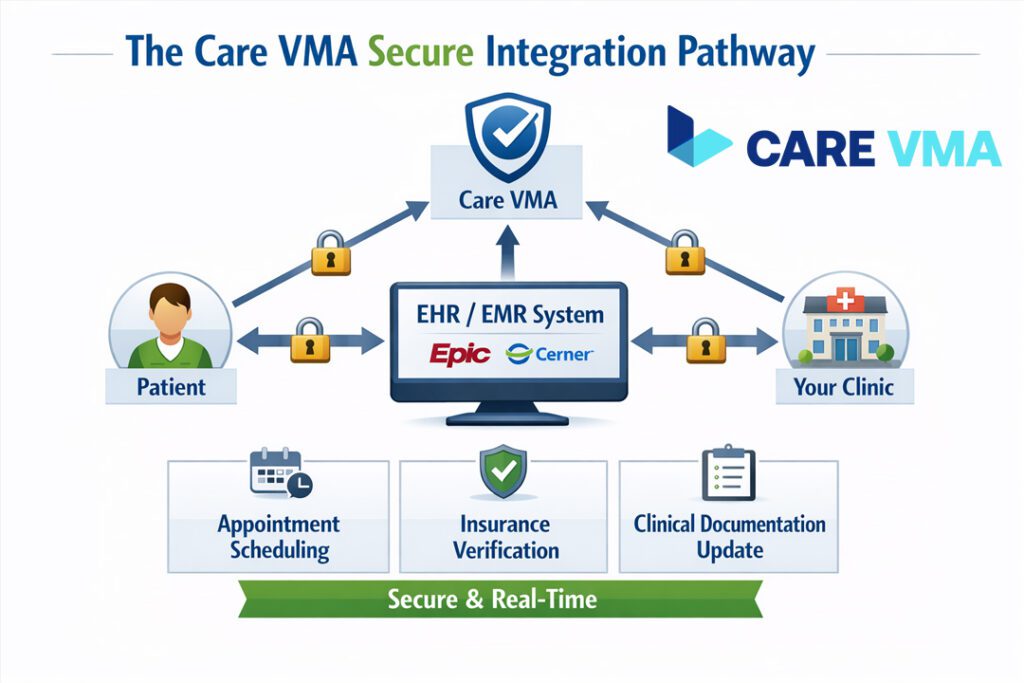
The backbone of a modern medical practice is its Electronic Health Record (EHR) or Electronic Medical Record (EMR) system. However, its effectiveness hinges on seamless data entry and accessibility. Care VMA specializes in secure EHR/EMR interoperability with major platforms like Epic, Cerner, and Athenahealth. This is not just about access; it is about creating a synchronized, real-time workflow orchestration that eliminates the risks of manual data entry errors.
Our integration process is designed with the sanctity of PHI as its highest priority. Every data point exchanged between our VMA and your EHR is encrypted and logged, adhering to the strictest protocols of the HITECH Act. This real-time synchronization means that when a VMA updates a patient’s chart, verifies insurance, or schedules a follow-up, the information is instantly and accurately reflected in your system. This level of secure EHR and EMR management streamlines your entire revenue cycle management (RCM) and clinical documentation processes, leading to fewer claim denials and a healthier bottom line.
Frequently Asked Questions from Medical Practices
Is using a Healthcare Virtual Assistant legally and privately secure?
Yes, absolutely. Security is foundational to our service. We operate under strict Business Associate Agreements (BAA) that legally bind us to protect your data with the same rigor as your own practice. Our entire operation is built on full compliance with the Health Insurance Portability and Accountability Act (HIPAA) and the HITECH Act. Furthermore, Care VMA employs enterprise-level security protocols, including SOC2 Type II compliance, to safeguard all medical records.
How does a virtual assistant handle patients who are not tech-savvy?
Care VMA ensures technology is an enabler, not a barrier. Our assistants are trained with specialized empathy scripts to patiently guide individuals, particularly elderly patients, through communication on their preferred platform, whether it is a simple phone call or a digital portal. Our goal is to improve patient communication and customer service for everyone, regardless of their comfort with technology, ensuring no patient is excluded from receiving timely care and information.
Will integrating a VMA make our healthcare service feel less human?
Quite the opposite. The primary goal of a VMA is to automate the “digital noise” and administrative tasks that currently pull your clinical staff away from patients. By handling the background workflow—from symptom triaging queries to managing referrals—our VMAs free up your nurses, medical assistants, and physicians. This gives them significantly more time for meaningful, face-to-face interactions, restoring the deeply human side of medicine that improves the overall patient experience and boosts Patient NPS (Net Promoter Score).
Conclusion & Next Steps
In today’s healthcare landscape, operational efficiency and patient satisfaction are not separate goals; they are two sides of the same coin. Adopting a Healthcare Virtual Assistant is a decisive, strategic step to combat the moral injury that stems from administrative overload and to elevate your standard of care. It is an investment in the well-being of your staff and a commitment to providing a responsive, empathetic experience for your patients.
Restore the joy in running your medical practice. Transform your patient experience with Care VMA today. Schedule your Clinical Workflow Audit now to see the potential time and cost savings.