The US healthcare landscape is currently navigating a perfect storm: a chronic labor shortage, declining reimbursements, and an administrative burden that forces many doctors into hours of unpaid “pajama-time” documentation. For private practices and specialty clinics, scaling under these conditions requires a fundamental shift in operations.
Forward-thinking providers are no longer looking for local hires to fill administrative gaps; instead, they are integrating specialized Remote Admin Assistants to handle the heavy lifting of clinic operations.
The “Pajama-Time” Crisis: Why Traditional Administrative Models are Draining Clinical Revenue

Traditional staffing models are becoming a liability. When a physician spends 2 hours on administrative tasks for every 1 hour of patient care, the clinic isn’t just losing time—it’s losing revenue.
The Rising Cost of In-House Staffing and the US Labor Shortage
Recruiting medical secretaries in the US has become prohibitively expensive. Between rising hourly wages, healthcare benefits, and high turnover rates, the cost of an in-house hire can be double their base salary. This financial strain often prevents clinics from hiring the necessary support, leading to a bottleneck in patient intake and billing.
How Administrative Overload Directly Impacts Patient No-Show Rates
Administrative fatigue often leads to a reactive rather than proactive workflow. When front-desk staff are overwhelmed by phone calls and filing, appointment reminders and insurance pre-verifications fall through the cracks. This directly contributes to high no-show rates, which clinic workflow optimization strategies identify as a primary cause of lost clinical revenue.
Beyond General Virtual Assistants: The Value of a HIPAA-Compliant Clinical Partner
Many providers are hesitant to outsource because they equate “virtual assistants” with generalists who lack clinical context. However, a specialized Virtual Medical Assistant is not a generalist; they are a clinical partner trained specifically for the US healthcare environment.
Virtual Medical Assistant vs In-House Secretary: A 12-Month ROI Comparison
When evaluating the virtual medical assistant vs in-house staff model, the ROI is clear. Remote admins eliminate the need for office space, hardware, and payroll taxes. Most practices report a 40-60% reduction in administrative overhead within the first year, allowing that capital to be reinvested into medical technology or clinic expansion.
Specialized Training: Why Generalist VAs Fail in a Clinical Setting
A generalist VA does not understand the difference between a PPO and an HMO, nor do they know how to navigate the specific documentation requirements of a cardiology vs. a dermatology clinic. Specialized remote admins come pre-trained in medical terminology and the nuances of the US insurance landscape, ensuring they can hit the ground running on day one.
What is a Remote Medical Admin Assistant?
A Remote Medical Admin Assistant (VMA) is a specialized healthcare professional who handles non-clinical tasks—such as EMR management, insurance verification, and patient scheduling—from a secure, remote location. Unlike general virtual assistants, they are trained in US healthcare regulations and HIPAA protocols to ensure data integrity and operational efficiency.
Reclaiming Clinical Focus: How Remote Admins Optimize Your Daily Workflow
The core value of integrating a remote admin is the restoration of the “physician-centric workflow.” By delegating the digital paperwork, doctors can return to 100% patient-facing time.
Seamless EHR/EMR Integration: Navigating Athena, Epic, and eClinicalWorks
A high-level Virtual Medical Assistant acts as an extension of your hands within the EHR. Whether it’s updating patient records in Epic or managing schedules in AthenaHealth, these professionals are proficient in the systems that power modern medicine, reducing the “clicks” required by the provider.
Managing the Prior Authorization Maze to Speed Up Claims Submission
Prior authorizations are the leading cause of delayed care and administrative frustration. Remote admins proactively manage this “maze,” contacting payers and documenting medical necessity long before the patient arrives, which significantly reduces claim denials.
Proactive Patient Coordination: From Check-In to Follow-Up
Patient experience (PX) improves when communication is seamless. Remote admins handle the entire patient journey: verifying insurance 48 hours before the visit, managing digital intake forms, and coordinating specialist referrals post-visit.
Efficiency in Action: Reducing Physician Burnout Through Workflow Automation
- The Scenario: A mid-sized specialty clinic was struggling with a 20% no-show rate and 4 hours of daily “pajama-time” documentation per physician.
- The VMA Intervention: The clinic integrated two Care VMA remote assistants to manage insurance verification and proactive patient calling 48 hours in advance.
- The Result: Within 90 days, the clinic saw a 15% increase in patient volume due to better scheduling and a 100% elimination of after-hours administrative work. By understanding how medical virtual assistants reduce burnout, the clinic was able to retain its providers and scale its operations.
Operational Security: Managing PHI with Encrypted Tunneling and Audit Trails
Security is the biggest barrier to remote adoption. However, modern remote workflows are often more secure than traditional paper-based offices.
Technical Safeguards: How Care VMA Ensures HIPAA Compliance
Care VMA utilizes encrypted VPN tunneling and Multi-Factor Authentication (MFA) to ensure that Protected Health Information (PHI) never leaves the provider’s secure ecosystem. Every action taken by a remote admin is logged in a transparent audit trail.
Background Checks and Continuous Compliance Certification
Security isn’t just technical; it’s human. All remote admins undergo rigorous background checks and continuous HIPAA training to stay updated on the latest HHS regulations.
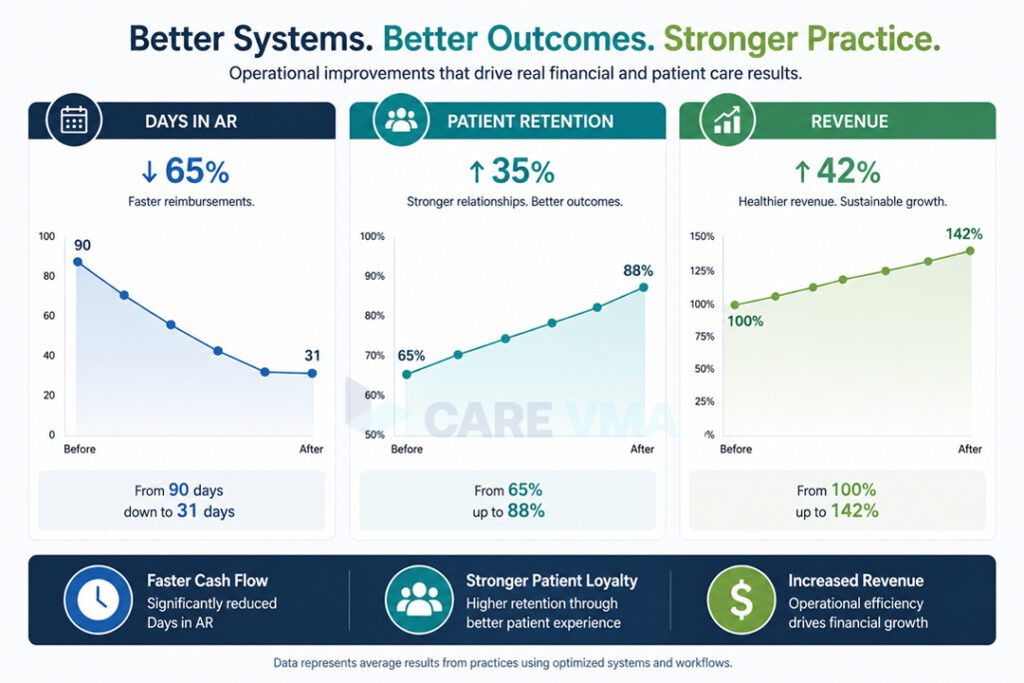
Measuring the Business Outcome: Days in AR and Patient Retention Metrics
Improving Patient Experience (PX) Through Faster Response Times
When a patient calls and speaks to a person immediately rather than being put on hold, satisfaction scores rise. Remote admins ensure that no call goes unanswered and no prescription refill request sits in a queue.
Scalability: Adding Support Without Increasing Office Footprint or Overhead
With remote admins, you can double your administrative capacity without renting a larger office or buying more desks. This “elastic” staffing model allows clinics to scale up during peak seasons and maintain lean operations year-round.
Transition Strategy: Integrating a Remote Admin into Your Existing Team
Successful integration doesn’t happen by accident; it requires a strategic approach to task delegation.
Identifying the Right Tasks for Outsourcing
Start by auditing where your in-house team is struggling. Is it the phones? Insurance? Referral tracking? Identifying these bottlenecks allows you to deploy a remote admin where they will have the highest impact on your ROI.
The Discovery Call: Auditing Your Practice for Maximum Efficiency
The final step in scaling is a practice audit. By reviewing your current workflows, you can determine how a remote partner can best fit into your existing team structure to maximize productivity.
Ready to eliminate “pajama-time” and scale your practice? Get Your Free Practice Efficiency Audit with Care VMA Today
FAQ
Is it safe for a remote admin assistant to access our EMR/EHR?
Yes. Access is managed through secure, encrypted VPN tunneling and multi-factor authentication (MFA). Care VMA ensures that every action is logged in an audit trail, maintaining full transparency and data security according to HIPAA standards.
How do I train a virtual assistant on my clinic’s specific procedures?
Care VMA handles the foundational medical training. We then facilitate a structured onboarding process where your remote admin learns your specific practice preferences, software nuances, and communication style.
What is the actual ROI in the first year?
Most practices see a 40-60% reduction in administrative overhead compared to a full-time in-house hire. When combined with reduced “no-shows” and faster billing cycles, the ROI typically manifests within the first 3-4 months.
Can they handle complex insurance verifications and prior authorizations?
Absolutely. Our VMAs are specifically trained in the complexities of the US insurance landscape, including navigating payer portals and documenting medical necessity to reduce claim denials.
Are your assistants specifically certified for HIPAA compliance?
Yes. Beyond initial certification, our staff undergoes continuous HIPAA training and regular security audits to stay updated on the latest HHS regulations.