Running a GI practice is operationally dense in ways that primary care medicine is not. Between colonoscopy prep coordination, payer-specific advance notification requirements, post-procedure follow-up chains, and the chronic disease management load that comes with a high IBD patient panel — your administrative surface area is large, and it grows every time you add a patient.
What we consistently see when gastroenterologists come to Care VMA is a practice where clinical staff are spending hours each week on tasks that have nothing to do with scoping, diagnosing, or managing complex GI conditions. Prep instruction calls get fielded by nurses who should be assisting in procedures. Prior authorization delays for colonoscopies push scheduled patients back by days. And when phone volume peaks on Monday morning, the front desk either falls behind — or burns out.
This article breaks down exactly what a Virtual Medical Assistant (VMA) can handle in a gastroenterology practice, why GI-specific workflows create a disproportionate administrative burden, and how to deploy VMA support in a way that maps to real GI workflow complexity — not just in theory, but on the day a colonoscopy patient hasn’t received their prep kit and a prior auth is pending with two different payers.
When Your Day Is Defined by Prep Calls and Authorization Delays — Not Patient Care
Here’s a pattern we recognize immediately in GI practices: the clinical complexity is high, but a significant portion of what’s consuming your team’s time each day isn’t clinical at all.
The Hidden Volume Problem in GI
A gastroenterology practice managing 15 to 30 procedures per week is not just a high-patient-volume practice — it’s a high-coordination-volume practice. Each colonoscopy or endoscopy generates a pre-procedure workflow that typically includes insurance eligibility verification, prior authorization or advance notification submission, prep instruction distribution, dietary restriction reminders, and patient confirmation calls. That’s before the procedure happens.
After the procedure, the workflow continues: pathology result tracking, post-procedure care instruction delivery, lab result routing, and follow-up scheduling — often tied to Crohn’s monitoring programs, colorectal surveillance intervals, or Barrett’s esophagus management. For a practice running 100 to 150 procedures per month, this chain repeats across every single patient on the schedule.
The administrative burden is not proportional to the number of providers. A two-physician GI practice running 25 procedures per week carries an administrative load that would challenge a front desk team twice its size — particularly when you factor in the ongoing coordination needs of a chronic GI patient panel.
What Happens When Admin Volume Exceeds Staff Capacity
When administrative load exceeds your team’s capacity, specific failure points appear: authorization delays push procedures back, prep instructions arrive too late or to the wrong patient, no-show rates rise when confirmation calls aren’t consistently made, and lab results sit unreviewed in an EHR task queue while the physician is in the procedure room.
These aren’t workflow inconveniences. They’re revenue leakage, patient safety risks, and staff burnout drivers — often stacked on top of each other in the same week. The physician burnout patterns that appear in GI practices almost always trace back to a combination of procedure documentation burden and a front desk that’s stretched past its capacity. Understanding physician burnout solutions in this specialty context matters precisely because the triggers in gastroenterology are structural, not individual.
What a VMA Does in a Gastroenterology Practice: The Functions That Matter
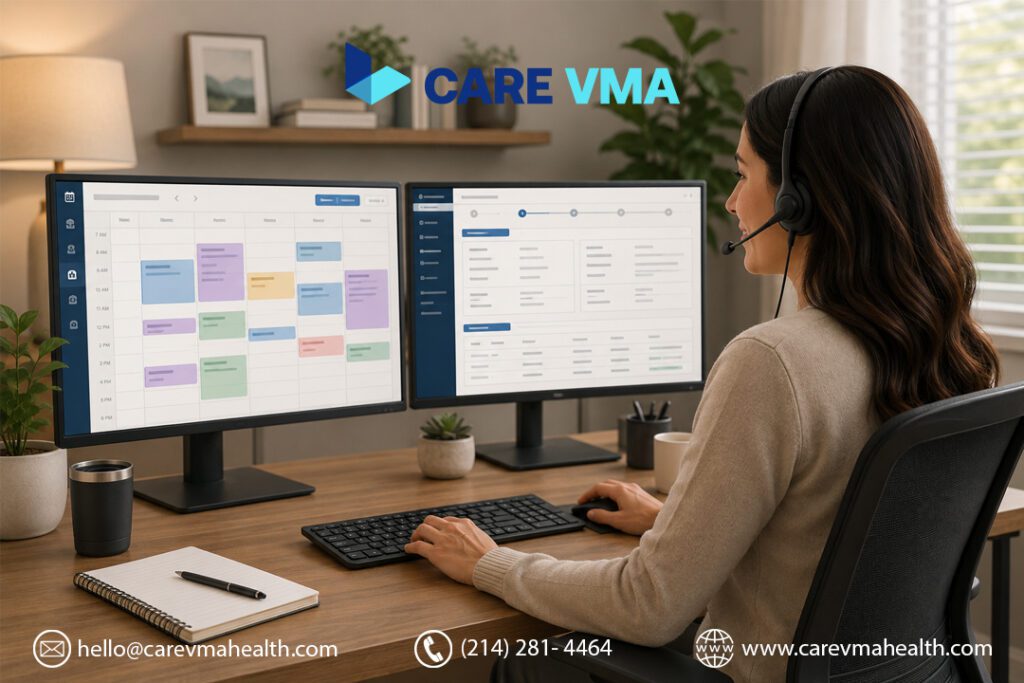
A Virtual Medical Assistant (VMA) in a gastroenterology practice is a trained, HIPAA-compliant remote professional who integrates directly into your existing workflows and EHR system. The role is not administrative generalism — it’s specialty-aligned operational support built around the specific tasks that create the most friction in a GI workflow.
Prior Authorization and Advance Notification Management
This is one of the highest-volume, highest-complexity administrative tasks in any GI practice. VMAs handle submission of prior authorizations across payers, manage payer-specific advance notification requirements — including those introduced for endoscopy services under major commercial plans where advance notification has replaced traditional prior authorization — track authorization statuses, and follow up on denials or pending reviews. For practices managing mixed payer panels, structured managing prior authorization workflows alone can recover multiple hours of physician and clinical staff time each week.
Colonoscopy and Endoscopy Prep Coordination
Patient preparation is where a significant number of GI no-shows and procedure complications begin — and where non-clinical staff time gets consumed most unnecessarily. VMAs send prep kits and instructions, make confirmation calls at 48 and 24 hours before the procedure, verify that patients acknowledge dietary restrictions, and flag cases where prep instructions haven’t been confirmed. Consistent pre-procedure communication protocols reduce no-show rates and procedure cancellations in ways that ad hoc reminder systems simply don’t.
Scheduling and Patient Flow Management
GI scheduling is not linear. Surveillance colonoscopies follow 3-, 5-, and 10-year intervals tied to pathology findings. Follow-up appointments depend on procedure outcomes. VMAs maintain scheduling timelines built around those clinical intervals, manage recall workflows for patients overdue for repeat screenings, fill cancellation slots from maintained waitlists, and coordinate multi-provider scheduling when surgical referrals or nutrition consults are needed.
EHR Documentation and Chart Management
After procedures, documentation needs to be updated with findings, post-procedure instructions need to be distributed, and pathology tracking needs to be managed through to report finalization and patient communication. A VMA trained in EHR documentation — or a dedicated Virtual Medical Scribe role — takes this burden off clinical staff and ensures chart accuracy from intake through post-procedure follow-up. VMAs work inside your existing EHR platform, whether that’s Athenahealth, eClinicalWorks, or Modernizing Medicine’s gGastro.
Insurance Verification and Billing Support
GI billing has its own layer of complexity: CPT bundling rules for upper and lower GI endoscopies performed on the same date, ICD-10 specifics for conditions including GERD, Crohn’s disease, ulcerative colitis, and colorectal cancer surveillance, and payer-specific coverage distinctions between screening and diagnostic colonoscopies. VMAs handle pre-visit insurance eligibility verification, assist with coding accuracy reviews, and support denial management by following up with payers on contested claims — particularly important given the CPT coding and reimbursement rules for GI procedures that have continued to evolve with bundling updates and ICD-10 refinements.
Why GI Practices Carry a Disproportionate Administrative Burden
Not every medical specialty creates equal administrative complexity. Gastroenterology is consistently among the highest-burden specialties for administrative work — and that’s a direct function of how the clinical work itself is structured, not a management failure.
Procedure-Heavy Caseloads Create Pre- and Post-Admin on Every Visit
Unlike a primary care visit that requires a standard intake and a follow-up note, a colonoscopy generates a pre-procedure workflow, an intra-procedure documentation requirement, and a post-procedure follow-up chain. Multiply that across 100 to 150 procedures per month in a mid-volume GI practice and the administrative workload becomes substantial — regardless of how many front desk staff the practice employs. The math works against lean staffing models in ways that are unique to procedure-heavy specialties.
IBD and Chronic GI Conditions Require Ongoing Coordination
Patients managing Crohn’s disease, ulcerative colitis, or Barrett’s esophagus require coordination across specialties, ongoing lab monitoring, medication management support, and scheduled surveillance procedures. This population generates recurring administrative activity — referral tracking, lab follow-up, medication prior authorization, and care plan communications — that compounds over time.
There is also a revenue recognition opportunity here that most GI practices are leaving on the table. Patients with qualifying chronic GI conditions may be eligible for monthly Chronic Care Management (CCM) billing — but only if the practice has the documentation infrastructure to track the required 20 or more minutes of non-face-time care management per month. VMAs can support the patient communication tracking and care plan documentation that makes CCM billing operationally viable for gastroenterology practices that haven’t previously built this program.
Payer Rules for GI Endoscopy Are Uniquely Complex
The advance notification requirements introduced by major commercial payers for GI endoscopy services — where advance notification replaced traditional prior authorization for diagnostic and surveillance colonoscopies under commercial plans in most states — added a layer of administrative process that applies specifically to gastroenterology. Keeping up with payer-by-payer variation in advance notification versus prior authorization requirements, applicable CPT codes, submission deadlines, and the distinction between screening procedures (typically excluded) and diagnostic or surveillance procedures (subject to advance notification) is a dedicated operational task. It is not something a front desk coordinator can reliably manage while also answering phones and checking in patients.
The Operational Reality: What Practices Are Losing Without Structured VMA Support
In our experience working with independent and group GI practices, the financial and operational cost of under-resourced administrative workflows isn’t always visible on a month-end financial report — but it is measurable and consistent.
Claim Denials and Undercoding in GI Billing
GI billing errors tend to cluster around a few recurring patterns: missing modifier documentation for the diagnostic versus screening colonoscopy distinction, incorrect bundling of upper and lower GI procedures performed on the same date of service, and delayed or incomplete pathology documentation that affects post-procedure coding accuracy. Each of these results in denied claims, delayed reimbursement, or underpayment — and most are preventable with structured pre-billing review and dedicated billing support. The practices we work with that implement VMA-supported billing review consistently see improvement in first-pass claim acceptance rates within the first 60 to 90 days.
No-Show Rates and Wasted Procedure Slots
A missed colonoscopy slot carries a different financial impact than a missed office visit. An unoccupied 45-minute endoscopy slot affects downstream scheduling, occupies an endoscopy suite and nursing support staff that cannot be reallocated on short notice, and often involves preparation materials that were already dispensed. The pattern we observe across high-volume GI practices is that no-show rates fall meaningfully when structured confirmation workflows are consistently executed — and that consistent execution is exactly what a dedicated VMA delivers, compared to front desk staff juggling five tasks simultaneously.
Physician Time Consumed by Non-Clinical Communications
Most of the patient questions that arise during the afternoon after a morning colonoscopy — “Can I eat normally now?” “When will my biopsy results come back?” “What should I expect this week?” — are not clinical questions requiring physician judgment. They are patient education inquiries that a trained VMA handles completely using practice-defined protocols. When there is no administrative support layer to triage these communications, they reach the physician inbox directly — consuming attention during clinical hours and extending the documentation workload into the evening.
How to Deploy a VMA in Your GI Practice: A Workflow-Aligned Framework
The question GI practice managers ask us most often is not whether VMA support would help — it’s how to deploy it without creating more coordination overhead than it solves. The following framework reflects how Care VMA actually onboards VMAs into gastroenterology practices.
Step 1: Audit Your Current Admin Bottlenecks by Volume and Impact
Before assigning tasks to a VMA, identify where your practice is losing the most time and where the downstream impact of errors is highest. In GI practices, this audit typically reveals two to three priority areas: prior authorization and advance notification management, pre-procedure patient preparation coordination, and billing accuracy and denial follow-up. Start VMA deployment at those points, not across every administrative function simultaneously.
Step 2: Match VMA Role to Your EHR and Workflow Infrastructure
VMAs operate inside your existing EHR — whether that’s Athenahealth, eClinicalWorks, Modernizing Medicine’s gGastro, or another specialty-specific platform. Care VMA’s Virtual Medical Assistants are trained on the EHR systems used in your practice during the onboarding process, which means no duplicate data entry, no shadow systems, and no retraining your clinical team on new software. The VMA becomes an extension of your existing workflow, not an addition to it.
Step 3: Establish Communication Protocols for Patient-Facing Tasks
Patient-facing tasks — prep instruction calls, appointment confirmations, post-procedure follow-up messages, lab result communications — require clear scripts and escalation pathways before a VMA can execute them independently. VMAs follow practice-defined templates for routine patient communications and escalate any question involving clinical judgment to the appropriate provider. This boundary is established through structured workflow design at the outset, not discovered through trial and error.
Step 4: Build a Measurable 60-Day Review Cycle
After the first 60 days, review operational metrics with your VMA and practice manager: no-show rate changes, authorization turnaround time, billing denial rates, and hours of front desk and clinical staff time recovered. This gives your practice a data-grounded picture of return on investment and a baseline for expanding VMA scope into additional functions as the engagement matures.
Common Mistakes GI Practices Make When Managing Admin Without VMA Support
Most of the operational problems we diagnose in gastroenterology practices share the same root cause: administrative tasks are distributed across clinical staff who are primarily trained and hired for non-administrative functions.
Delegating prep instruction calls to nurses. Nurses in GI practices carry critical clinical responsibilities — assisting with procedures, managing sedation recovery, coordinating clinical handoffs. When prep calls fall on nursing staff, clinical capacity is consumed by tasks a trained VMA handles in a fraction of the time, with equal or greater consistency.
Managing prior authorization tracking through shared spreadsheets or unassigned EHR task queues. Authorization status tracking across multiple payers and multiple procedure types requires dedicated ownership. Without it, authorizations get missed, procedures get delayed, and patients in need of diagnostic or surveillance procedures experience avoidable waits — with clinical consequences in cases involving colorectal cancer surveillance or IBD management.
Not billing CCM on qualifying IBD patients. A GI practice with a significant Crohn’s or ulcerative colitis patient panel has a monthly reimbursement opportunity — Chronic Care Management billing — that most practices are not capturing because they haven’t built the documentation infrastructure required. VMAs can support the patient outreach, care plan documentation, and time-tracking that makes CCM billing viable. This is not a marginal improvement; for a practice with 30 to 50 qualifying chronic GI patients, the monthly revenue difference is meaningful.
Underestimating the complexity of referral management. Gastroenterology practices receive inbound referrals from primary care providers and generate outbound referrals to colorectal surgeons, oncologists, hepatologists, and nutritional support teams. Managing both directions — tracking referral receipt, confirming consultation scheduling, following up on specialist reports to close the loop in the patient chart — is a workflow that benefits significantly from dedicated VMA attention. When it’s managed reactively by whoever is available, records fall through, and continuity of care suffers.
Scaling Your GI Practice with VMA Support: Beyond Staffing Relief
For practices that have stabilized core administrative operations with VMA support, the next layer of value is controlled expansion — increasing procedure volume, building revenue programs, and improving quality metrics without proportional cost increases.
Adding Procedure Volume Without Adding Headcount
The most common capacity ceiling in a growing GI practice is not clinical — it’s administrative. When prep coordination, authorization, patient scheduling, and post-procedure follow-up require more staff hours than your current team provides, procedure volume gets capped by administrative capacity rather than clinical capability. A VMA removes that ceiling by absorbing the administrative load of additional procedure volume, allowing your clinical team to focus on what they were trained to do.
Building a Structured Chronic Disease Management Program
Patients managing IBD, Barrett’s esophagus, and chronic hepatitis in a GI practice represent a population that benefits from structured care coordination — and in many cases, generates monthly CCM billing revenue when that coordination is properly documented. Building this program requires consistent patient outreach, care plan documentation, and coordination with other treating providers. VMA support makes it operationally viable without requiring a new hire or additional clinical staff hours.
Improving Quality Metrics Through Proactive Patient Outreach
Gastroenterology practices participating in value-based contracts or MIPS performance programs benefit from proactive outreach to patients overdue for colorectal cancer screening. VMAs can manage recall lists, send outreach messages through patient portals, document patient responses, and ensure that eligible patients are scheduled before reporting windows close. This directly contributes to quality metric performance — and it’s the kind of consistent, protocol-driven outreach that administrative staff rarely have capacity to sustain alongside day-to-day front desk operations.
Making the Decision: When Is the Right Time for a GI Practice to Add a VMA?
The right time is nearly always before the breaking point. The pattern we see consistently is that practices arrive at a decision after a staff departure creates a coverage gap, a billing audit is triggered by a pattern of claim denials, or a physician reaches a point where documentation load is extending deep into personal time. By that point, the operational damage has already accumulated.
If your practice is experiencing any of the following, evaluating VMA support now — before the next staffing disruption — is the strategically sound decision:
- Prior authorization or advance notification delays are pushing procedure schedules back by more than 48 hours regularly
- Your colonoscopy no-show rate is running above 10 to 12 percent
- Front desk staff are fielding prep instruction calls during peak check-in windows
- Billing denials tied to GI-specific coding errors are occurring more than once per week
- A physician is spending more than two hours daily on documentation, patient portal messages, or administrative coordination tasks
Care VMA’s fully managed, HIPAA-compliant Virtual Medical Assistants are built specifically for specialty practices operating under the kind of workflow pressure gastroenterology generates. If you want to see what a GI-aligned VMA deployment looks like before making a commitment, schedule a free consultation with the Care VMA team. We’ll map your current workflow, identify where VMA support would have the highest operational impact, and give you a realistic picture of what the first 60 days look like.
Frequently Asked Questions
Can a VMA handle colonoscopy prep coordination without clinical training? Yes. Prep instruction calls follow a practice-defined script covering dietary restrictions, preparation steps, timing, and what to do if a patient has questions outside the protocol. VMAs are trained on your practice’s specific prep materials and execute confirmation calls consistently. Any question involving clinical judgment — symptoms, medical concerns, procedure modifications — is escalated immediately to clinical staff. The VMA function is coordination and communication, not clinical assessment.
How does a VMA manage payer-specific advance notification requirements for GI endoscopy? VMAs are trained on payer-specific requirements for your patient population during onboarding. For commercial plan members subject to advance notification requirements — as distinct from traditional prior authorization — the VMA submits the required procedure information through payer portals or by phone, tracks confirmation status, and flags any cases requiring provider-level escalation, such as peer-to-peer review requests. Payer-specific workflows are built into the VMA’s operating protocol from the beginning of the engagement.
Are Care VMA’s VMAs trained in GI-specific EHR platforms? Yes. Our VMAs are trained on the EHR platforms used in your practice, including Athenahealth, eClinicalWorks, and Modernizing Medicine’s gGastro. EHR-specific training is part of the onboarding process and ensures that the VMA integrates into your existing workflow rather than requiring parallel systems or manual workarounds.
Can a VMA support CCM billing documentation for IBD patients? VMAs support the documentation and patient communication infrastructure that enables Chronic Care Management billing — including tracking non-face-time care coordination minutes, documenting patient interactions in the EHR, and supporting care plan updates between visits. Clinical documentation and billing authorization remain with the treating physician. The VMA provides the operational infrastructure that makes the program viable to run consistently.
What happens when a patient asks a clinical question during a VMA-handled communication? Clear escalation protocols are built into every VMA’s workflow from day one. Patient questions involving clinical judgment — symptoms, medication concerns, procedural questions that fall outside the defined prep protocol — are immediately routed to the appropriate clinical staff member. VMAs do not make clinical assessments. Every patient communication pathway includes a defined escalation route that is established during the onboarding process.