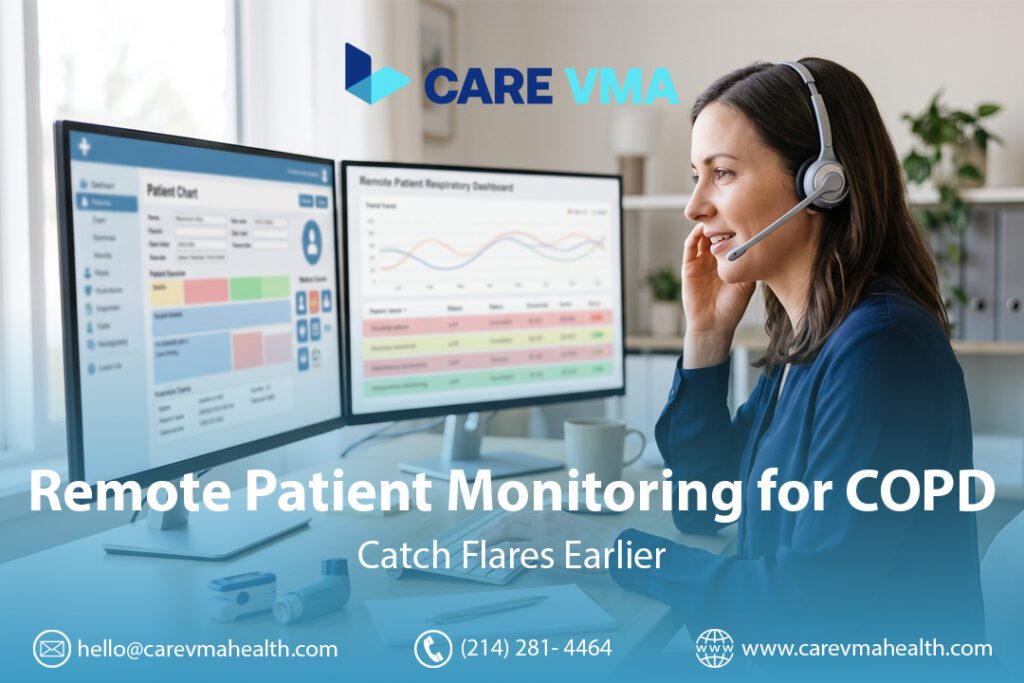
A COPD patient in your program sends in a resting oxygen saturation of 91% this morning. Her baseline is 92. Nothing alerts, nobody calls, and the reading goes into the chart as stable. What the oximeter cannot tell you is that she used her rescue inhaler six times yesterday, her sputum turned green two days ago, and she slept sitting up in a recliner last night.
That gap is where most COPD monitoring programs quietly fail. They are built around the device that is easiest to ship, then configured with the alert logic borrowed from heart failure or hypertension, and they end up watching the one number that often moves last.
This article walks through how to run remote patient monitoring for COPD so that it actually supports COPD exacerbation early detection. You will see what pulse oximeter remote monitoring can and cannot tell your team, how to standardize readings patients take at home, why a short daily symptom check carries more early warning than the saturation number, and how to choose between RPM and RTM billing for respiratory patients.
We build and staff these workflows for independent pulmonology, primary care, and multispecialty practices. The physician sets every threshold and makes every clinical call. The protocol decides how quickly the right information gets in front of them.
The Oximeter Said 91%. The Patient Was Three Days Into a Flare.
A four-provider primary care practice in western Pennsylvania launched COPD monitoring with 45 patients in October. Each patient received a cellular pulse oximeter and a printed sheet that said to check oxygen once a day. The alert rule was a flat floor of 88%, the same for everyone.
For six weeks, the dashboard was mostly quiet. Then the practice tallied its December numbers and found that seven enrolled patients had gone to urgent care or the ED for COPD flares that month. In five of those seven, the saturation readings in the days before the visit had never crossed the alert line.
When the nurse called those patients afterward, the stories lined up. More coughing. Thicker, darker sputum. Reaching for the rescue inhaler before breakfast instead of once a day. One patient said he had been “waiting to see if it got bad enough to bother anybody.”
The oximeters worked. The program was measuring the wrong thing first.
What Remote Patient Monitoring for COPD Actually Tracks
Remote patient monitoring for COPD is the regular collection of oxygen saturation, pulse, and patient-reported symptoms from home, reviewed by the care team against thresholds and baselines the physician sets for each patient, so that a developing exacerbation can be treated in the office or at home instead of the emergency department. A program that works pairs a device with a short conversation. Both halves matter, for different reasons.
Resting Oxygen Saturation and Pulse
The pulse oximeter is the backbone device because it is cheap, simple, and transmits physiologic data automatically, which is what RPM billing requires. It reports oxygen saturation and pulse rate. A rising resting pulse alongside a slipping saturation tends to tell a clearer story than either number alone.
A Daily Symptom Check
Three or four questions, asked the same way every day, catch the changes patients notice before any device does: more breathlessness than usual, a change in sputum amount or color, a new or worse cough, and poor sleep because of breathing. Some practices use a validated questionnaire on a weekly cadence and a shorter daily check in between.
Rescue Inhaler Use
How many times the patient reached for the rescue inhaler in the last 24 hours is one of the most useful numbers in the whole program, and it costs nothing to collect. Patients answer it honestly when asked plainly. They rarely volunteer it.
Optional Devices for Selected Patients
Home spirometry, peak flow meters, and activity trackers have a place for some patients, usually those whose physicians want lung function trends or who are coming out of pulmonary rehab. They also add training time and adherence risk. Most practices do better starting with the oximeter and the symptom check, then adding devices patient by patient.
Pulse Oximeter Remote Monitoring: What the Number Can and Cannot Tell You
Oximetry earns its place in a COPD program, but only when your team understands its limits. Three of them shape how alerts should be configured and how readings should be interpreted.
Why One Floor Value Misfires in COPD
Many COPD patients live at a resting saturation that would be concerning in a healthy adult, and their physicians may deliberately target a lower range for them. A single floor applied to everyone creates two problems at once. Patients who sit near the line every day generate alerts nobody acts on, and patients with a comfortable baseline can lose several points and still look “normal” against the floor.
What matters for most COPD patients is movement away from their own steady state. A patient who has read 95 every morning for a month and now reads 91 has changed far more than one who reads 89 every day and still reads 89.
Measurement Errors Patients Create at Home
Most strange readings we review trace back to how the reading was taken. Cold fingers after walking in from the car. Dark nail polish or acrylic nails. A hand moving while the patient talks on the phone. A reading grabbed in the first few seconds before the number settles, or taken right after climbing the stairs to the bathroom.
Smoking adds another wrinkle. Carbon monoxide in the blood can make a saturation reading look better than the patient’s true oxygen status, so a current smoker’s “fine” number deserves less trust than it appears to.
Accuracy Varies Across Patients
Pulse oximeters are known to overestimate saturation in some patients with darker skin pigmentation, and the device industry is under pressure to close that gap. For your program, the practical takeaway is simple: never let a reassuring saturation number override a worrying symptom answer. The symptom check is the safeguard that works for every patient on your panel.
COPD Exacerbation Early Detection Starts With Questions
If there is one operational lesson from the COPD programs we support, it is this. The earliest warning usually arrives in the patient’s own words, a day or more before it shows up on the oximeter.
Patients describe it in plain terms. “I’m coughing up more.” “It’s gone yellow.” “I needed my puffer twice before lunch.” “I didn’t sleep, I couldn’t get comfortable.” None of those statements trip a device alert. All of them are things a trained reviewer can capture in under two minutes with the same scripted questions every morning.
The catch is that COPD patients are often the last people to raise their hand. Many have lived with breathlessness for years and recalibrated what feels normal. Some worry that calling will land them back in the hospital. A script that asks specific questions (“How many times did you use your rescue inhaler since yesterday morning?”) gets honest answers that “How are you feeling?” never will.
A two-pulmonologist practice in Arizona saw this play out after it added a daily three-question check to its existing oximetry program. In the first winter with the new check, roughly two-thirds of the patients its nurse treated for early flares were flagged by symptom answers while their saturation was still inside their usual range. The nurse’s comment to us was that the oximeter had become the confirming signal, and the questions had become the early one.
This is also why quarterly visits alone struggle with COPD. A flare can build and peak inside the gap between appointments, a pattern we break down in our piece on how quarterly visits miss deterioration between appointments.
The Steady-State Method: A Daily COPD Monitoring Protocol
The protocol we build into COPD programs is organized around one idea: every reading is judged against that patient’s own steady state, and every reading travels with the patient’s answers. It runs in five steps, and the first one happens before alerts are ever switched on.
Step 1: Set the Steady State
For the first 10-14 days after enrollment, the patient takes readings and answers the symptom check while the team watches without alerting, unless something on the physician’s emergency list appears. At the end of that window, the physician reviews the pattern and signs off on that patient’s baseline saturation, usual rescue inhaler use, and individual alert thresholds.
Do not set a baseline during or right after a flare. Patients enrolled at discharge need their steady state reset once they have recovered, which is easy to forget and causes weeks of misleading alerts.
Step 2: Standardize the Reading
Every patient gets the same routine, taught on a first-week call and repeated on the instruction card. Sit and rest for five minutes. Warm the hands if they are cold. Use the same finger each day, free of polish. Rest the hand still at chest level. Wait until the number stops changing, then record that steady value.
Patients on home oxygen need one more detail recorded every time: whether the reading was taken on room air or on oxygen, and at what flow rate. A 92 on two liters and a 92 on room air are entirely different readings, and the physician’s thresholds will differ for each.
Step 3: Ask Before You Interpret
The symptom questions and the rescue inhaler count are collected with the reading, never as a separate weekly task. A saturation number with no symptom answers attached is incomplete data, and the reviewer treats it that way.
If the physician has given the patient a written action plan with standby medication, the script also asks whether the patient has started it, and when. That single question tells your nurse more about where a flare stands than any device reading.
Step 4: Sort by Protocol
A named reviewer works through the morning queue at a fixed time and places each patient into one of three groups, using only the criteria in the physician-signed protocol. The reviewer is matching answers and readings to written rules, which keeps the work consistent no matter who is on shift.
Clinician Now
Any reading or answer the protocol lists as urgent goes straight to the nurse or physician by phone. Typical triggers are a drop from baseline combined with worse breathlessness, or a symptom the physician has flagged as urgent by itself. Anything the protocol defines as an emergency, such as severe breathlessness at rest or new confusion, gets a 911 instruction first and a clinician notification immediately after.
Same-Day Callback
A change in sputum, rising rescue inhaler use, or a saturation drift with no other symptoms gets a call before noon. The reviewer confirms how the reading was taken, repeats it with the patient on the phone if needed, and either clears the patient against the protocol or moves them up.
Watch List
Gradual drift that has not crossed a threshold, missed readings, and patients who report feeling “a bit worse” without meeting any criteria go on a short list the nurse reviews twice a week. In COPD, this list is where next week’s flare often shows up first.
Step 5: Close the Loop
Every clinician decision (an action plan started, a same-day visit, a medication change, no change) is documented in the EHR with the time spent and whether the contact was a real-time conversation. The reviewer then confirms the patient understood the instruction and schedules a follow-up check the next morning instead of waiting for the next routine reading.
For practices running this without enough hands, this daily sort and callback work is exactly what Care VMA’s remote patient monitoring support is designed to carry: a dedicated, HIPAA-trained VMA who coaches patients on the reading routine, runs the symptom script every morning, logs rescue inhaler counts, and hands your nurse a short summary with the patient’s baseline beside today’s numbers, so the clinical call takes minutes instead of a half hour of chart digging.
For the general mechanics of building a review cadence, our RPM workflow guide for clinics covers the setup steps that apply across conditions.
Where COPD Monitoring Programs Lose Patients and Revenue
Most COPD programs we are asked to review were launched in a hurry, often as an add-on to an existing heart failure or hypertension program. The same four problems show up again and again.
Copying the Heart Failure Setup
Heart failure programs revolve around the daily scale. COPD has no equivalent single metric, and a program that imports heart failure logic tends to over-trust the oximeter and under-collect symptoms. Build the COPD protocol from the symptom check outward, with the device as supporting evidence.
Alerting on Every Low Reading
A floor value that ignores individual baselines floods the queue with patients who are stable at a low number. Within a month, reviewers start clearing alerts on reflex, and the one that matters gets cleared with the rest. Personal baselines and drift rules fix most of this.
Losing the Oxygen Context
Readings from patients on home oxygen are close to meaningless without the flow rate attached. If your platform has no field for it, have the reviewer add it to the note on every callback until it does.
Choosing RPM or RTM by Habit
Practices often default to RPM because that is what they already bill for other conditions, even when the patient’s main monitored data is inhaler use or symptoms rather than physiologic readings. The two programs cover different data, have different day-count rules, and in general cannot be billed by the same practitioner for the same patient in the same period. Decide per patient at enrollment, when the choice is cheap to make. Our comparison of RPM vs RTM and when each one applies walks through the decision.
Running COPD Monitoring Through Respiratory Season
COPD programs do not carry an even workload. Volume, callbacks, and flares tend to cluster in the colder months and during poor air quality stretches, and practices that staff for an average month get caught short exactly when the program matters most.
Staff for the Surge Before It Starts
Look back at last year’s flare visits by month and plan reviewer coverage for the heaviest stretch, with a named backup for every day of the week. Move the morning review earlier during respiratory season if your physicians’ schedules allow, so same-day callbacks still land before clinic fills up.
Use Short-Duration Billing for Post-Exacerbation Windows
The weeks after a flare or a hospital stay are when monitoring is most valuable and when patients are least likely to log 16 days. Since January 2026, RPM includes a device code for 2-15 days of data (99445) and a 10-minute management code (99470), and RTM has parallel short-duration options for respiratory monitoring. That makes a focused post-exacerbation monitoring window billable where it often was not before.
Prepare Patients for Air Quality Days
On days when local air quality alerts or extreme heat are forecast, a short outreach call to the highest-risk patients reminds them of their action plan and checks that their rescue inhaler is not running low. It is a small task that tends to head off avoidable visits, and it gives patients a reason to trust the program.
What to Settle Before Your First COPD Patient Gets an Oximeter
A COPD program succeeds on the conversation around the device far more than on the device itself. Before enrollment starts, settle five things: a signed protocol with per-patient baselines and thresholds, a standard reading routine every patient is taught, a daily symptom script that includes rescue inhaler use, a named reviewer with a fixed review time and a backup, and a per-patient decision on RPM or RTM.
It is worth being direct about where a virtual medical assistant fits. A VMA can coach the reading routine, run the symptom script, document answers and rescue inhaler counts, sort the queue against your written protocol, and make the follow-up calls. A VMA does not decide whether a patient is having an exacerbation, does not start or change treatment, and does not replace a clinician on Clinician Now calls. If your practice cannot yet guarantee a nurse or physician during the morning review window, that is the first gap to close.
Size matters too. A practice monitoring a dozen COPD patients can often run this with an existing MA and 20 protected minutes each morning. Once the panel grows, and especially once respiratory season arrives, the callback volume usually outruns anyone’s spare time.
If you are planning a COPD monitoring program, or running one that relies mostly on oximeter alerts, book a free consultation with the Care VMA team. We will look at your current setup with you and map where a daily symptom check and a dedicated VMA would make the biggest difference.
Frequently Asked Questions
These are the COPD monitoring questions practice managers and pulmonologists bring to us most often.
What oxygen saturation should trigger an alert for a COPD patient?
There is no single number that fits every COPD patient. Many programs alert on a drop from the patient’s own documented baseline rather than a fixed floor, combined with symptom changes, and the supervising physician should set each patient’s thresholds in a signed protocol.
Can pulse oximetry alone detect a COPD exacerbation early?
Usually not on its own. Symptom changes such as more breathlessness, more or discolored sputum, and higher rescue inhaler use often appear before saturation falls, so the most useful programs pair the oximeter with a short daily symptom check.
Should a COPD patient be billed under RPM or RTM?
It depends on what is being monitored. RPM covers automatically transmitted physiologic data such as oxygen saturation, while RTM covers therapeutic data such as respiratory status and inhaler adherence, and the same practitioner generally cannot bill both for one patient in the same period. Confirm the choice with your billing team at enrollment.
How should patients take a pulse oximeter reading at home?
Seated after five minutes of rest, with warm hands, the same polish-free finger each day, the hand still at chest level, recording the number once it stops changing. Patients on home oxygen should note whether they were on oxygen and at what flow rate.
Can a virtual medical assistant monitor COPD patients?
A VMA can coach patients on readings, run the daily symptom script, document results, and route anything urgent to your clinical staff following the physician’s written protocol. Clinical assessment and treatment decisions stay with your nurses and physicians.
Which COPD patients benefit most from home monitoring?
Practices commonly start with patients who have had a recent exacerbation or hospital stay, frequent flares, or home oxygen, since those groups tend to need the closest follow-up. Your physicians should define the enrollment criteria.