
The psychiatric intake process is the cornerstone of effective mental healthcare. It’s a comprehensive clinical evaluation, often lasting up to 90 minutes, designed to establish a patient’s baseline, ensure safety, and formulate a viable treatment plan. But for many practices, this critical first step is also a significant operational bottleneck, bogged down by administrative tasks that consume valuable clinician time, delay patient access to care, and drive burnout. The challenge isn’t the clinical work; it’s the sheer volume of documentation, coordination, and data entry that surrounds it.
This is where the paradigm is shifting. By delegating the administrative framework of the intake process to specialized virtual medical assistants, psychiatric practices can transform this bottleneck into a highly efficient workflow. This allows clinicians to offload the clerical burden and dedicate their expertise exclusively to what matters most: the patient.
The Operational Bottleneck: Why the Psychiatric Intake Process Is More Complex and Costly Than You Think
While essential, the traditional psychiatric intake process is fraught with administrative inefficiencies. It’s not a single event but a series of interconnected tasks that, when handled manually, create a cascade of hidden costs and operational friction. This administrative overload directly impacts your practice’s bottom line, your clinicians’ well-being, and your ability to serve patients effectively.
Quantifying the Hidden Costs of Manual Documentation and Coordination
Every minute a psychiatrist, nurse, or social worker spends on administrative tasks is a minute not spent on billable clinical care. Consider the time spent manually transcribing patient registration data, chasing down signed consent forms, scoring screening tools like the PHQ-9, and pre-populating EHR fields. These activities, while non-clinical, are mandatory—and they add up. This administrative drag translates directly to lost revenue potential and increased overhead.
The Impact of Administrative Overload on Clinician Burnout and Patient Throughput
Clinician burnout is a critical issue in mental healthcare, and a heavy administrative burden is a primary contributor. When highly-trained professionals are forced to act as data entry clerks, it leads to frustration and exhaustion. This not only affects morale but also limits patient throughput. A practice burdened by inefficient intake workflows can see fewer new patients, leading to longer waitlists and creating a barrier to care in the community. Many practices are now exploring how medical virtual assistants reduce burnout by taking these repetitive tasks off their clinicians’ plates.
Navigating the Multidisciplinary Maze: Scheduling Nurses, Social Workers, and Psychiatrists
A comprehensive intake often involves coordinating schedules for multiple professionals—a psychiatric nurse for medical history, a social worker for psychosocial assessment, and the psychiatrist for the final diagnosis. This complex scheduling is a significant administrative challenge, prone to errors and communication gaps that can delay the intake and create a fragmented experience for the patient.
Your Step-by-Step Guide to a VMA-Optimized Psychiatric Intake Workflow (Featured Snippet)
Imagine an intake process where clinicians can walk into an appointment with all the preliminary data collected, organized, and pre-populated in the EHR. This isn’t a future ideal; it’s the reality for practices that leverage a Virtual Medical Assistant (VMA). Here is a step-by-step guide to how it works.
- Step 1: VMA Manages Pre-Assessment & Documentation Before the patient ever speaks to a clinician, your VMA handles the entire administrative foundation. This includes managing patient registration, ensuring all HIPAA and consent forms are digitally signed and archived, and distributing links to screening tools like the PHQ-9 and GAD-7. The patient completes these forms at their convenience, and the VMA ensures the results are correctly filed in their chart.
- Step 2: VMA Pre-populates the Biopsychosocial Framework (The “4 Ps”) Based on the screening tools and registration information, the VMA can begin to structure the clinical note. They can pre-populate the Biopsychosocial Assessment section, organizing the data within the “4 Ps” framework (Predisposing, Precipitating, Perpetuating, and Protective factors) so the clinician has a structured starting point for their interview.
- Step 3: VMA Acts as a Real-Time Scribe During the Mental Status Examination (MSE) During the clinical interview, a Virtual Medical Scribe can join the telehealth session to perform real-time documentation. As the clinician conducts the MSE, the scribe accurately captures observations on appearance, behavior, speech, mood, and thought process directly into the EHR. This frees the clinician to maintain eye contact and build rapport with the patient, rather than typing.
- Step 4: VMA Organizes Risk Assessment Data for Immediate Triage Decisions The VMA ensures that all data relevant to risk assessment—such as answers from specific screening questions or historical records—is flagged and clearly presented for the clinician. This allows for quick, informed triage decisions regarding suicidal or homicidal ideation.
- Step 5: VMA Drafts the Provisional Diagnosis, Treatment Plan, and Safety Plan Following the clinician’s verbal summary and instructions at the end of the session, the VMA drafts the provisional diagnosis, the initial treatment plan, and the patient’s safety plan. The clinician then simply needs to review, edit, and sign off on the completed note, saving a significant amount of post-session documentation time.
Use Case: Transforming a 90-Minute Intake into a 45-Minute Focused Clinical Evaluation
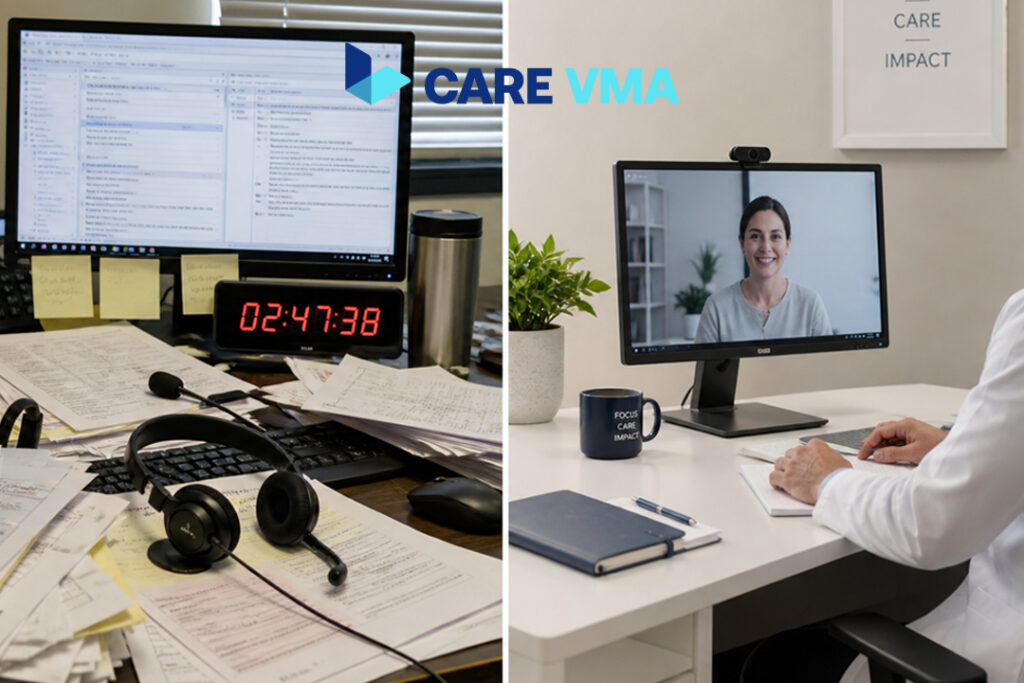
A mid-sized telepsychiatry practice was struggling with long intake sessions and clinician burnout. Their initial assessments consistently took 90 minutes, with clinicians reporting that at least 30-45 minutes were spent on documentation and administrative checks.
Before Care VMA: A Fragmented Workflow with Redundant Data Entry
Clinicians were responsible for the entire process. They spent the first 15 minutes of the session gathering information that was already in the registration forms and the last 30 minutes on post-session documentation. Data entry errors were common, and patient throughput was capped by the sheer length of each intake slot.
After Care VMA: An Integrated System Where Clinicians Focus Solely on the Patient
By implementing a Care VMA, the practice delegated all pre-assessment tasks and real-time scribing. Clinicians now start their sessions with a fully prepared chart. During the 45-minute clinical evaluation, a virtual scribe handles all documentation. The clinician’s only task after the session is to review and sign the note drafted by their VMA.
The Result: Doubling Clinician Capacity for Initial Assessments
By cutting the total intake time from 90 minutes to a 45-minute focused clinical session, the practice effectively doubled its capacity for new patient assessments. Clinician satisfaction soared as they were able to focus on high-level clinical work. Patient satisfaction also improved due to shorter wait times and more engaged, present clinicians.
The Financial Case: Calculating the ROI of Delegating Intake Administration
Implementing a virtual medical assistant is not an expense; it’s an investment in operational efficiency that yields a tangible return. By shifting administrative tasks from high-cost clinicians to a cost-effective VMA, you unlock financial benefits that go far beyond the subscription fee.
Cost-Benefit Analysis: VMA Subscription vs. In-House Administrative Hours
Compare the hourly rate of a psychiatrist or a psychiatric nurse practitioner to the cost of a VMA subscription. Every hour of administrative work delegated is a direct cost saving. More importantly, it frees up that clinical hour to be used for a billable activity, such as a follow-up appointment or another new patient intake, effectively turning a cost center into a revenue-generating opportunity.
How Optimized Scheduling Directly Reduces Patient No-Show Rates
VMAs can implement automated appointment reminders and confirmations, a simple but powerful tool for reducing no-shows in mental health practices. A well-managed schedule with proactive patient communication ensures your appointment slots remain filled and productive, protecting your practice from lost revenue.
Unlocking New Revenue by Freeing Up Psychiatrists for Billable Activities
The most significant ROI comes from increased capacity. When the intake process is cut in half, a clinician who could previously handle four new patients a day can now handle eight. This ability to see more patients directly translates to practice growth and increased revenue, all without needing to hire additional clinical staff or expand your physical office space.
Beyond Efficiency: Enhancing Clinical Accuracy and Compliance
While efficiency is a major benefit, using a VMA for psychiatric intakes also enhances the quality and integrity of your clinical documentation. A structured, delegated process introduces checks and balances that reduce errors and ensure consistency.
Eliminating Documentation Errors in the MSE and Biopsychosocial Assessment
A dedicated virtual scribe is trained to capture clinical details accurately and without bias. This reduces the risk of transcription errors or omissions that can occur when a clinician is simultaneously interviewing, diagnosing, and typing. The result is a more precise and reliable clinical record for every patient.
Ensuring Every Legal Disclosure and Consent Form is Signed and Archived
Compliance is non-negotiable. A VMA-driven workflow automates the process of sending, tracking, and archiving all necessary legal forms, from HIPAA disclosures to informed consent. This creates a clear, auditable trail and ensures your practice remains fully compliant, minimizing legal and financial risk.
Creating a Consistent, Auditable Trail for Every Patient Intake
By standardizing the intake process across all clinicians, you create a consistent documentation standard. This is invaluable for quality assurance, training, and audits. Every patient record follows the same high-quality format, making peer review and compliance checks simple and straightforward.
Seamless Integration and Uncompromising Security: Our Commitment to Your Practice
Adopting a new system can be daunting, which is why we prioritize seamless integration and robust security. Our goal is to augment your existing workflow, not disrupt it.
Full HIPAA Compliance and Training for All Virtual Medical Assistants
Every Care VMA undergoes rigorous training in HIPAA compliance and data security. We understand the sensitivity of psychiatric records and are committed to upholding the highest standards of patient privacy. Our systems and protocols are designed to protect your data and your practice.
How We Integrate with Your Existing EHR and Practice Management Software
Our virtual assistants are proficient in a wide range of top EHR and practice management systems used in mental health. We work with your practice to establish secure, role-based access to your systems, ensuring our VMAs function as a natural extension of your in-house team without requiring you to change the software you already use and trust.
Is Your Practice Ready to Redefine its Psychiatric Intake Process?
If your clinicians are losing valuable time to administrative tasks and your practice is struggling to keep up with patient demand, it’s time to consider a new approach. The traditional, manually-intensive psychiatric intake process is no longer sustainable.
By leveraging a HIPAA-compliant Virtual Medical Assistant from Care VMA, you can reclaim clinician time, reduce burnout, enhance documentation quality, and double your capacity for new patient assessments. Stop letting administrative friction be the bottleneck to your practice’s growth and clinical excellence.
Schedule a free consultation today to discover how Care VMA can design a streamlined psychiatric intake workflow tailored to your practice’s specific needs.
FAQ
How can a Virtual Medical Assistant handle the sensitivity of a psychiatric intake while remaining HIPAA compliant?
Care VMAs are fully trained professionals who operate under strict HIPAA protocols and sign Business Associate Agreements (BAAs). All communication and data handling are done through secure, encrypted channels. Their role is purely administrative and scribing; they do not provide clinical advice or make diagnostic judgments, ensuring a clear boundary is maintained while protecting sensitive patient information.
What specific tasks during the Biopsychosocial Assessment and MSE can a VMA perform versus what must be done by the licensed clinician?
The clinician is solely responsible for all clinical work: asking questions, interpreting patient responses, making observations, and formulating a diagnosis. The VMA’s role is to support this process. They can pre-populate the assessment template with existing data, and during the MSE, act as a real-time scribe to document the clinician’s observations as they are stated. The VMA manages the data, allowing the clinician to focus on the patient.
How does a Care VMA integrate with specialized mental health EHRs to manage intake forms like the PHQ-9 and GAD-7?
Our VMAs are trained on a wide variety of EHRs. They can manage intake forms in two primary ways: by sending a secure link to the patient from your EHR’s patient portal or by using a secure third-party forms tool and then manually entering the scored results into the correct fields within the patient’s chart, ensuring the data is ready for clinician review.
What is the typical onboarding process for training a VMA on our clinic’s specific psychiatric intake protocols?
The onboarding process is collaborative. We start with a discovery call to understand your existing workflow, your specific EHR, and your documentation preferences. We then assign a dedicated VMA who you will meet. We document your protocols step-by-step and conduct training sessions. The process typically involves a ramp-up period where we work closely with your team to refine the workflow, ensuring the VMA becomes a seamless and efficient part of your practice.