
For therapists and mental health practice owners, the mission is clear: provide exceptional clinical care. Yet, the path to achieving this is often cluttered with administrative tasks that drain time, energy, and revenue. Between client sessions, you’re fielding intake calls, verifying insurance, managing schedules, and chasing down billing errors. This operational drag doesn’t just hinder growth; it directly impacts your clinical focus and can lead to burnout.
The solution lies not in working harder, but in working smarter. Integrating a specialized, HIPAA-compliant Virtual Medical Assistant (VMA) is a strategic move to reclaim your time, professionalize your operations, and create a seamless experience for your clients from the very first call. This guide will walk you through why a specialized VMA is essential and how to integrate one into your therapy practice.
What is a HIPAA-Compliant Virtual Assistant for a Therapy Practice?
A HIPAA-compliant virtual assistant for a therapy practice is more than just a remote administrator; they are a trained professional who becomes an integral part of your operational team. They handle sensitive Patient Health Information (PHI) securely and understand the unique administrative and ethical nuances of a mental health setting.
Core Responsibilities: From Client Intake Coordination to Insurance Verification
While a general VA might manage a calendar, a specialized VMA manages the entire client administrative journey. Their core responsibilities are designed to offload the tasks that interrupt your clinical workflow:
- Client Intake and Onboarding: Professionally handling initial inquiries, gathering demographic information, and ensuring intake forms are completed before the first session.
- Insurance Verification & Prior Authorization: Proactively verifying benefits and obtaining necessary authorizations to prevent claim denials and surprise bills for your clients.
- Scheduling and Calendar Management: Managing new appointments, reschedules, and cancellations directly within your EHR.
- Appointment Reminders and Follow-up: Reducing no-show rates through systematic, professional communication.
- Billing Support: Assisting with invoicing, payment processing, and following up on outstanding claims.
The Critical Difference: Why a General VA Puts Your License and Practice at Risk
Hiring a general virtual assistant without a healthcare background is a significant risk. They lack the fundamental training in HIPAA privacy and security rules, making your practice vulnerable to data breaches and severe legal penalties. A general VA may not understand the critical importance of a Business Associate Agreement (BAA) or the “minimum necessary” principle when accessing PHI. This oversight doesn’t just compromise client trust—it can jeopardize your license.
The Administrative Bottleneck: Identifying What’s Holding Your Practice Back

If you feel like you’re constantly pulled in multiple directions, you’re likely facing an administrative bottleneck. These operational hurdles silently chip away at your practice’s efficiency and profitability.
The True Cost of Handling Intake Calls Between Client Sessions
Every intake call you answer between sessions is a hidden cost. It breaks your clinical focus, delays note-taking, and projects an image of being rushed to potential new clients. Missed calls are even more costly—they often mean a potential client simply calls the next therapist on their list. A dedicated Virtual Medical Receptionist ensures every call is answered professionally, capturing new clients and providing a polished first impression.
How Unverified Insurance and Billing Errors Lead to Lost Revenue
Incorrectly verified insurance or small billing errors can lead to rejected claims, creating a cascade of unpaid services and time-consuming rework. This lost revenue is often preventable. Delegating these tasks to a VMA specializing in medical billing ensures accuracy from the start, protecting your practice’s financial health and freeing you from chasing payments.
The Operational Drag of Manual Scheduling and Appointment Reminders
Manually scheduling appointments, sending reminders, and following up on confirmations is a repetitive task that consumes hours every week. This time could be converted into billable clinical hours. Automating and delegating this process to a VMA streamlines your calendar, improves client communication, and significantly boosts your bottom line.
The Clinical Impact: When Inefficient Operations Affect Patient Care
Administrative chaos doesn’t stay confined to the back office; it inevitably spills over into the clinical experience, affecting both your clients and your own well-being.
Reducing Client Drop-Off During the Onboarding Phase
A clunky, disorganized onboarding process is a major reason potential clients drop off before their first session. Long response times, confusing paperwork, and uncertainty about insurance coverage create friction and anxiety. A streamlined intake process managed by a VMA makes clients feel valued and cared for, ensuring they successfully transition from initial inquiry to active patient.
The Burnout Factor: How Administrative Overload Undermines Your Clinical Focus
The constant pressure of managing administrative duties on top of a full clinical caseload is a leading cause of therapist burnout. This administrative overload steals the mental energy and emotional bandwidth required to be fully present with your clients. By offloading these tasks, you can reduce compassion fatigue and refocus on the clinical work you love. In fact, many practitioners find that learning how medical virtual assistants reduce burnout is the first step toward building a more sustainable practice.
The Solution: Integrating a Specialized Virtual Medical Assistant into Your Workflow
A Care VMA is not just an extra pair of hands; they are a strategic partner trained to operate as the professional front office your practice needs to scale.
More Than an Answering Service: A Strategic Partner Trained in Mental Health Nuances
Our VMAs undergo rigorous training that goes beyond basic administration. They are educated on the specific terminology, privacy requirements, and sensitive nature of a mental health practice. They understand the importance of an empathetic and professional tone when speaking with potential clients who may be in distress, and they follow strict protocols for handling crisis-related calls.
How Care VMA Provides Assistants for EHRs like SimplePractice and TherapyNotes
We eliminate the technology learning curve. Our Virtual Medical Assistants are proficient in the leading EHR platforms used by therapists, including SimplePractice, TherapyNotes, and others. They can integrate directly into your existing systems to manage schedules, update client information, and handle billing tasks, ensuring a smooth and efficient workflow from day one.
Use Case: Transforming the Client Intake Workflow for a Group Therapy Practice
To understand the impact, let’s look at a common scenario.
Before Care VMA: Missed Calls, Inconsistent Data Entry, and Scheduling Chaos
A growing group practice was losing potential clients daily. Therapists were answering calls between sessions, leading to missed calls being sent to a generic voicemail. Data entry was inconsistent, insurance wasn’t verified until after the first session, and the schedule was a mess of double-bookings and last-minute cancellations. The administrative chaos was actively preventing them from scaling.
After Care VMA: A Seamless, Professional Workflow from First Call to First Session
After partnering with Care VMA, the practice implemented a dedicated virtual assistant. Now, every call is answered live by a trained professional. The VMA performs a consistent intake screening, gathers all necessary information, and enters it correctly into TherapyNotes. Insurance benefits are verified within 24 hours, and clients receive a welcome email with a link to their intake paperwork. The practice’s show rate increased by over 25% within the first two months.
Step-by-Step: The Optimized Intake Process Managed by Your VMA
- First Contact: The VMA answers the call, follows a custom script to screen for fit, and answers non-clinical questions about fees and availability.
- Data Collection: Client demographic and insurance information is collected and entered directly into the EHR.
- Insurance Verification: The VMA contacts the insurance provider to confirm coverage, copays, and deductibles.
- Scheduling & Onboarding: The VMA schedules the first appointment and sends the new client a secure, automated link to complete their onboarding forms. This entire psychiatric patient intake process is managed without the therapist lifting a finger.
- Confirmation: A reminder is sent 48 hours before the appointment, personally confirmed by the VMA.
The Tangible ROI: A Cost-Benefit Analysis for Your Therapy Practice
Investing in a VMA isn’t an expense; it’s a direct investment in revenue generation and operational efficiency.
Calculating Your Breakeven Point: Converting Admin Hours into Billable Clinical Hours
Consider this: if you spend just 5 hours per week on administrative tasks, that’s 20 hours a month of non-billable time. If your session rate is $150, that’s $3,000 in potential lost revenue every month. By delegating those 20 hours to a VMA for a fraction of that cost, you can add even one or two extra client sessions per week. The VMA pays for itself and generates a profit.
Improving Your Appointment Show Rate Through Proactive VMA Follow-Up
No-shows are a silent killer of revenue. A VMA implements a systematic process of appointment reminders and confirmations via phone, text, or email based on client preference. This personal, professional touch dramatically reduces no-show rates, stabilizing your income and keeping your schedule full. A key strategy involves understanding the factors behind missed appointments and reducing no-shows in mental health through proactive, empathetic communication.
Our Security Framework: Beyond the Business Associate Agreement (BAA)
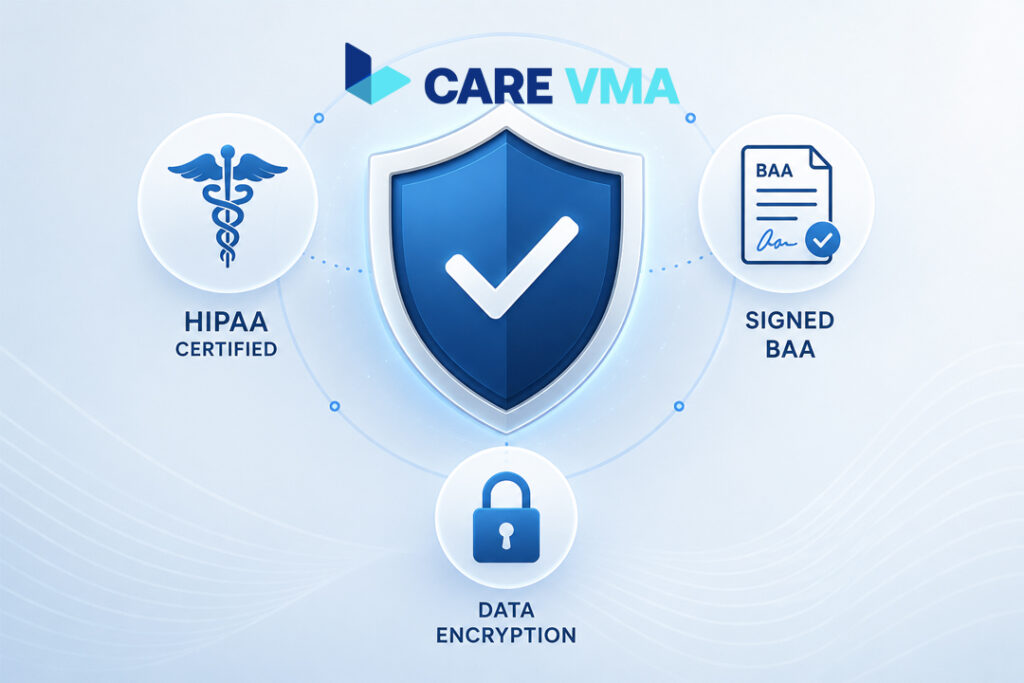
At Care VMA, HIPAA compliance is our foundation, not an afterthought. We understand that protecting your clients’ data is paramount to protecting your practice.
Mandatory HIPAA Certification and Continuous Training for Every VMA
Every Care VMA signs a Business Associate Agreement (BAA) before they begin. But we go further. Each assistant must complete mandatory HIPAA certification and participates in continuous training to stay current on privacy and security regulations. You can have confidence knowing your practice is supported by HIPAA-compliant virtual assistants who are experts in their field.
Enforcing the “Minimum Necessary” Principle within Your EHR
We work with you to establish role-based permissions within your EHR. Your VMA will only have access to the specific information required to perform their duties, such as scheduling and billing, without ever accessing sensitive clinical notes. This enforces the “minimum necessary” principle, a core tenet of HIPAA.
Secure Communication Protocols for All Patient Health Information (PHI)
All communication and data handling are conducted through encrypted, secure channels. We utilize secure email, password management systems, and other protocols to ensure that PHI is protected at all times, whether it’s at rest or in transit.
Is Your Practice Ready for a Virtual Medical Assistant?
If administrative tasks are limiting your growth, causing you stress, or impacting your clinical work, the answer is yes.
The Ideal Profile for Solo Practitioners Ready to Scale
You’re a solo therapist with a growing waitlist, but you’re at capacity. You know you could see more clients if you weren’t spending your evenings and weekends on paperwork and phone calls. A VMA can provide the administrative support you need to open up more clinical slots and transition smoothly into the next phase of your practice’s growth.
How We Support Group Practices Overwhelmed by Administrative Volume
Your group practice is thriving, but your intake process is strained. The administrative volume is overwhelming your team, leading to errors and a poor client experience. A Care VMA can act as a centralized administrative hub, standardizing your intake, scheduling, and billing workflows across all clinicians for maximum efficiency.
Next Steps: Schedule a Consultation to Map Your Custom Workflow
Stop letting administrative bottlenecks dictate the potential of your practice. Take the first step toward a more streamlined, profitable, and clinically-focused operation.
Schedule a free consultation with Care VMA today. We’ll help you map out a custom workflow and demonstrate exactly how a dedicated, HIPAA-compliant virtual assistant can transform your therapy practice.
Frequently Asked Questions from Therapy Practice Owners
How does a Care VMA handle sensitive or crisis-related calls from potential clients?
Our VMAs are trained to identify keywords and tones that may indicate a crisis. They follow a strict protocol to immediately and calmly transfer the caller to a licensed professional or a designated emergency contact (like 911 or a crisis hotline), ensuring the individual gets the appropriate level of care without delay.
Can your VMAs work directly within my existing EHR and practice management software?
Absolutely. Our assistants are proficient with major EHR systems used in mental health, including SimplePractice, TherapyNotes, and more. During onboarding, we ensure they are fully trained on your specific setup and workflows to ensure seamless integration.
What is the onboarding process and how long until a VMA is integrated with my practice?
Our onboarding process is designed to be efficient and thorough. It typically takes 1-2 weeks. We start with a discovery call to understand your needs, then map your workflows, set up system access with “minimum necessary” permissions, and introduce you to your dedicated VMA.
How do you ensure VAs understand the specific terminology and privacy needs of a mental health practice versus a general medical office?
Our training is specialized. Unlike agencies that serve all medical fields, we provide specific training modules on mental health terminology, the heightened privacy concerns (e.g., substance use records, psychotherapy notes), and the importance of an empathetic communication style appropriate for therapy clients.