
The telehealth boom has permanently changed private psychiatry. To scale effectively between now and 2026, practice owners must move beyond a traditional mindset and adopt a digital-first strategy. This means navigating a complex and shifting regulatory environment, eliminating operational drag, and creating a seamless virtual patient experience. The key isn’t working harder; it’s delegating smarter. This blueprint outlines how a specialized Virtual Medical Assistant (VMA) is the cornerstone of sustainable growth for the modern psychiatric practice.
The Growth Paradox: Why Your Telepsychiatry Practice Is Working Harder, Not Smarter
As your patient panel grows, so does the administrative weight required to support it. Many psychiatrists find themselves trapped in a growth paradox: more patients lead to more non-billable work, capping revenue and causing burnout. This is a direct threat to the scalability of your practice.
The Administrative Drag of Virtual Care: Managing Digital Intake, Pharmacy Callbacks, and Insurance Verification
The promise of telehealth was efficiency, but the reality often involves a mountain of digital administrative tasks. Time spent on hold with pharmacies for prior authorizations, manually verifying insurance benefits for new telehealth patients, and chasing down incomplete digital paperwork directly consumes hours that should be spent on clinical care. This administrative drag is the single biggest barrier to increasing patient volume.
How Patient Churn from “Onboarding Friction” Silently Kills Your Revenue
Your potential new patient has found you online, but their journey is just beginning. If your onboarding process involves downloading, printing, signing, scanning, and emailing PDF forms, you are creating “onboarding friction.” This friction is a silent revenue killer. For every ten potential patients who inquire, losing two or three because the intake process was too cumbersome is a significant, yet preventable, loss of income. As practices grapple with this, many find that a focus on reducing physician burnout becomes critical for long-term success.
Navigating the High-Stakes Regulatory Landscape of 2025-2026

Compliance is non-negotiable and requires constant vigilance. Several key regulatory deadlines and shifts are on the horizon that every telepsychiatry practice must prepare for.
Staying Compliant with the Ryan Haight Act Extension (Until Dec 2026)
The DEA has extended the COVID-19 telehealth flexibilities, allowing the remote prescription of controlled substances without a prior in-person visit until December 31, 2026. This provides a temporary window for practices to operate, but it’s crucial to have a long-term strategy in place for when this extension expires or is replaced by a permanent rule, such as the proposed Special Registration for Telemedicine.
The Operational Lift of Interstate Expansion via the IMLC
Growing your practice across state lines is a powerful strategy, made easier by the Interstate Medical Licensure Compact (IMLC). However, managing compliance, patient communications, and pharmacy logistics across multiple states adds a significant layer of operational complexity. Each new license requires dedicated administrative oversight to remain in good standing.
Preparing for the Medicare Telehealth “Cliff” in 2026
Many Medicare telehealth flexibilities, including the use of a patient’s home as an approved originating site, are currently set to expire in late 2026. Practices that serve a Medicare population must monitor these changes closely and be prepared to adapt their workflows, potentially re-introducing in-person requirements for certain services.
What is a Virtual Medical Assistant (VMA) for Psychiatry?
A Virtual Medical Assistant for Psychiatry is a remote, HIPAA-trained professional specializing in the administrative and operational tasks specific to a mental health practice. They handle patient scheduling, insurance verification, prior authorizations, pharmacy communications, and digital patient onboarding, freeing psychiatrists to focus exclusively on clinical, billable hours. These specialized assistants understand the unique demands of a psychiatric practice, from handling sensitive patient information to navigating the complexities of mental health billing.
The VMA Workflow Transformation: A Before-and-After Scenario for Your Practice
Integrating a specialized VMA isn’t just about outsourcing tasks; it’s about re-engineering your practice for efficiency and growth. A telehealth virtual assistant from Care VMA can fundamentally change your daily operations.
Before VMA: The 15-Hour Administrative Week
- Scenario: You or your staff spend hours manually verifying insurance eligibility and benefits for 10 new telehealth patients each week.
- Scenario: You are personally on hold with CVS or Express Scripts, navigating phone trees to get a prior authorization approved for a critical medication.
- Scenario: You lose 3 out of 10 qualified patient leads because they abandoned the clunky PDF intake forms on your website.
After VMA: Reclaiming Your Billable Hours
- Workflow Example: Your VMA handles all insurance pre-verification and prior authorizations before the first appointment is even confirmed, ensuring you know the patient’s coverage status upfront.
- Workflow Example: Your VMA manages all EPCS follow-ups, liaising with pharmacies to confirm receipt and resolve any issues, saving you from frustrating phone calls.
- Workflow Example: Your VMA ensures automated intake forms are sent and completed via a patient portal, following up with patients as needed and dramatically reducing drop-off rates.
The Financial Case: Calculating the ROI of a Specialized Mental Health VMA
Delegating administrative work isn’t an expense; it’s an investment with a clear and measurable return.
Cost Analysis: The True Price of Non-Clinical Tasks on a Psychiatrist’s Hourly Rate
Calculate your billable hourly rate. Now, consider how many hours you spend each week on non-billable administrative tasks. If a psychiatrist whose time is worth $300/hour spends 10 hours a week on admin, that’s $3,000 of lost potential revenue. A VMA performs these tasks at a fraction of the cost, creating immediate financial leverage. Exploring the full benefits of hiring a virtual medical assistant reveals a powerful strategy for boosting your bottom line.
Revenue Uplift: How Seamless Onboarding and Reduced Churn Directly Impact Your Bottom Line
By fixing the “leaky bucket” of patient onboarding, a VMA directly increases your practice’s revenue. If your VMA helps retain just two additional patients per week who would have otherwise dropped off, the additional revenue generated over a year can far exceed the cost of the service.
Beyond Scheduling: High-Value Use Cases for a VMA in a Niche Practice
The true power of a specialized VMA lies in their ability to support the specific needs of your niche practice.
Supporting an Adult ADHD Practice: Managing Controlled Substance Prescription Refills and Follow-ups
A VMA can manage the high-volume administrative work associated with an ADHD practice. They can track patient follow-up appointments, manage refill requests, handle pharmacy communications for controlled substances (EPCS), and ensure compliance with state-specific PMP (Prescription Monitoring Program) requirements.
Scaling a Perinatal Psychiatry Service: Coordinating with OB-GYN Offices and Labs
For a perinatal practice, care coordination is key. Your VMA acts as a central hub, managing referrals from OB-GYN offices, ensuring lab results are received and attached to the patient’s chart, and coordinating care between multiple providers, presenting a professional and organized front for your practice.
Streamlining a Hybrid Model: Coordinating In-Person “Micro-Office” Evaluations with Telehealth Follow-ups
If you use a hybrid model, your VMA can manage the complex logistics. They schedule the initial in-person evaluations at your micro-office, coordinate all telehealth follow-ups, and ensure a seamless transition for the patient between the two care settings.
The Trust Factor: Ensuring HIPAA Compliance and Professionalism in a Virtual Setting
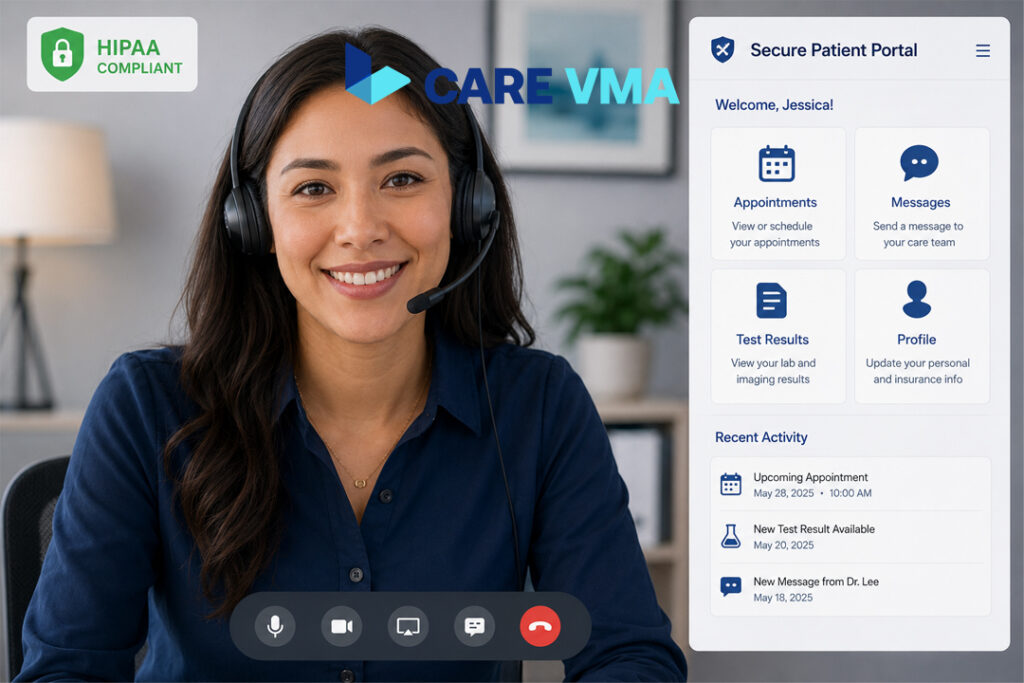
Entrusting patient data and communication to a remote team member requires absolute confidence in their security protocols and professionalism.
Vetting for HIPAA Training and BAA (Business Associate Agreement) Guarantees
Never compromise on compliance. Reputable VMA services like Care VMA ensure all assistants are thoroughly trained in HIPAA regulations and will sign a Business Associate Agreement (BAA). This is a legal requirement that guarantees they will protect patient health information to the same standard as your own practice. Working with HIPAA-compliant virtual assistants is the only way to safeguard your practice and your patients.
How a VMA Enhances Patient Trust Through Professional, Prompt Communication
A dedicated VMA creates a better patient experience. When patients receive prompt, professional, and helpful responses to their scheduling or billing questions, it builds trust and confidence in your practice. This level of service is a key differentiator that improves patient retention.
Your Next Step: Integrating a Care VMA into Your Psychiatric Practice
Getting started is a strategic, phased process designed for a seamless transition.
- Step 1: Identifying Your Biggest Administrative Bottlenecks Where does your practice lose the most time? Is it insurance verification, pharmacy calls, or patient intake? Pinpointing your biggest pain point is the first step.
- Step 2: A Phased Onboarding Process for Your VMA Start by delegating one or two key bottleneck tasks. Your VMA will learn your specific workflows and EHR system. As they master these, you can progressively delegate more responsibilities.
- Step 3: Measuring Success – Key Performance Indicators (KPIs) for Your Practice’s Growth Track metrics like time saved per week, reduction in patient drop-off rate, and time-to-first-appointment. These KPIs will clearly demonstrate the VMA’s impact on your practice’s health and profitability.
Ready to stop working harder and start working smarter? A specialized Virtual Medical Assistant is the key to unlocking scalable, sustainable growth for your psychiatric practice.
Schedule a free consultation with Care VMA today to discover how our HIPAA-compliant, psychiatry-focused virtual assistants can help you reclaim your time and grow your practice.
FAQ for Psychiatric Practice Owners
How does a Virtual Medical Assistant handle EPCS (Electronic Prescribing of Controlled Substances) tasks compliantly?
A VMA operates as your agent. They can prepare the prescription for you within the EHR, but the psychiatrist must always be the one to review, approve, and digitally sign/transmit the prescription. The VMA manages the administrative follow-up with the patient and pharmacy.
What is the typical cost of a specialized mental health VMA compared to a full-time, in-office hire?
A VMA service typically costs significantly less than a full-time employee. With a VMA, you avoid expenses like payroll taxes, benefits, insurance, and office space. You pay only for the productive hours you need, making it a more flexible and cost-effective solution.
Can a VMA manage patient communications across multiple state licenses obtained through the IMLC?
Yes, absolutely. This is a key strength of using a VMA. They can serve as a central administrative point of contact, aware of the specific regulations or network providers for patients in different states where you are licensed.
My EHR is SimplePractice (or ICANotes). Is your VMA service compatible with it?
Care VMA assistants are trained on all major EHR platforms used in psychiatry, including SimplePractice, ICANotes, Valant, and more. During onboarding, they will learn the specific workflows of your chosen system.
What’s the implementation timeline for getting a VMA fully integrated into my practice’s workflow?
Basic integration for tasks like scheduling and insurance verification can happen within the first week. A full integration, where the VMA manages more complex workflows, typically takes 2-4 weeks as they become fully proficient with your practice’s unique needs and processes.