Prior authorization for specialty neurology drugs is no longer just an administrative task—it’s a high-stakes operational challenge that directly impacts your practice’s revenue, staff morale, and patient outcomes. While necessary, the process has become a significant bottleneck, consuming valuable clinical hours and delaying critical treatments. This guide explores the unique complexities of neurology PAs and presents a modern, strategic solution to transform this burden into a streamlined, efficient workflow.
The High-Stakes Challenge of Prior Authorization in Neurology
In neurology, prior authorization (PA) is a constant. Due to the high cost of disease-modifying therapies (DMTs), CGRP inhibitors, and new amyloid-targeting infusions, payers have erected complex barriers to approval. For practice managers and neurologists, this means a relentless cycle of paperwork, long hold times, and frustrating denials that stall both patient care and the revenue cycle. Simply managing this process in-house is no longer a sustainable strategy; it’s a direct drain on your most valuable resources.
How Inefficient PA Workflows Are Costing Your Neurology Practice
The true cost of a broken PA process extends far beyond the administrative line item. It permeates every aspect of your practice, creating hidden financial drains and operational friction that can stifle growth and lead to staff burnout.
Calculating the Hidden Cost: Staff Hours Lost on PA Paperwork and Phone Calls
Consider the hourly rate of your clinical nurse or lead medical assistant. When they spend hours each week navigating payer portals, compiling clinical notes for an Ocrevus submission, or sitting on hold to check a status, you are paying a premium for administrative work. This is time that could be dedicated to patient education, care coordination, and other high-value, patient-facing tasks. An inefficient PA process diverts your most skilled team members away from their primary purpose, creating a significant hidden labor cost and contributing to the risk of physician and staff burnout.
The Revenue Cycle Bottleneck: Delayed Payments for High-Cost Neurology Drugs
When a PA for a high-cost drug like Leqembi or Tysabri is delayed or denied, your revenue cycle grinds to a halt. The service has been rendered or the medication has been prescribed, but reimbursement is locked behind an administrative wall. These delays can create significant cash flow problems, making financial planning difficult and straining the practice’s resources. Each pending PA represents thousands of dollars in uncaptured, aging revenue.
When Approvals Lag: The Impact on Patient Treatment Timelines
For a patient with newly diagnosed MS or debilitating migraines, a delay of days or weeks to start therapy is not just an inconvenience—it’s a period of continued suffering and uncertainty. Lengthy PA processes can lead to patient frustration, a higher likelihood of missed follow-up appointments, and a erosion of trust. In a competitive healthcare landscape, a streamlined patient experience is paramount.
Why PAs for MS, Migraine, and Alzheimer’s Drugs Are Uniquely Complex?
Neurology PAs are notoriously difficult due to the specific and evolving clinical criteria set by payers. Unlike general medications, these drugs require a deep understanding of nuanced diagnostic evidence and payer-specific formularies.
Navigating “Fail First” Step Therapy for CGRP Inhibitors and DMTs
Payers frequently mandate that patients “fail” one or more older, less expensive medications before they will approve a newer therapy. For a migraine patient, this could mean documenting inadequate responses to topiramate or beta-blockers before a CGRP inhibitor like Aimovig is approved. For an MS patient, it may involve proving a prior DMT was ineffective or caused intolerable side effects. Successfully navigating this requires meticulous documentation of a patient’s treatment history.
Compiling the Necessary Clinical Evidence: From MRIs for Ocrevus to PET Scans for Leqembi
Submitting a PA for a modern neurology drug is about telling a complete clinical story backed by hard evidence. This isn’t just a prescription; it’s a case file. Approval for Ocrevus demands recent MRI results demonstrating disease activity, while a submission for Leqembi requires PET scan or CSF test results confirming amyloid plaques. Forgetting to attach a single piece of required documentation almost guarantees a denial, forcing your team to start the process all over again.
Decoding Payer-Specific Criteria and Ever-Changing Formulary Lists
The approval criteria for a given drug can vary dramatically between Aetna, Cigna, and a local Blue Cross plan. Furthermore, these formulary lists and clinical policies are updated frequently. A practice must dedicate significant resources just to stay current, a challenge that grows with every new insurance plan you accept. This constant state of flux is a primary driver of incorrect submissions and subsequent denials, making the modernization of your neurology practice essential for survival.
A Modern Solution: The VMA-Driven Prior Authorization Workflow
The answer to this complexity isn’t hiring more staff; it’s adopting a smarter, more specialized workflow. By outsourcing this critical function to a dedicated expert, you can remove the burden from your clinical team entirely and achieve superior results.
A Virtual Medical Assistant (VMA) for prior authorization is a dedicated remote specialist who manages the entire PA lifecycle for your practice. This isn’t a general admin; it’s a trained professional who lives and breathes the nuances of medical necessity documentation and payer requirements. The streamlined process involves:
- Submitting accurate requests via portals like CoverMyMeds, ensuring every field is correct from the start.
- Assembling and attaching all required clinical documentation, from MRIs and lab results to detailed chart notes.
- Proactively tracking submission status with payers, eliminating the need for your staff to spend time on hold.
- Managing the denial and appeal process with precision, drafting letters of medical necessity and conducting peer-to-peer appeals when required.
A specialized VMA service acts as a true extension of your team, focused exclusively on securing approvals quickly and efficiently.
Use Case: Securing Prior Authorization for a Disease-Modifying Therapy (DMT)
The difference between a traditional and a VMA-driven workflow is best illustrated with a common scenario.
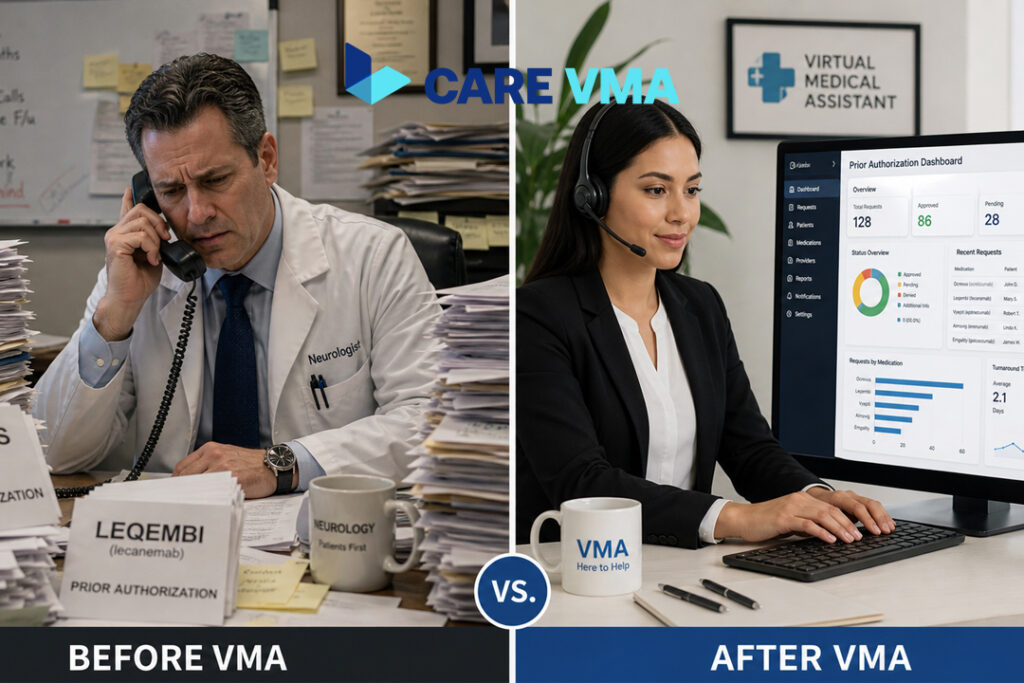
- Before: The Internal Scramble An on-site nurse spends 4 hours compiling notes from the EMR, scanning documents, and filling out the online form. The front desk staff makes multiple phone calls to the insurer to check the status. The submission is ultimately delayed by a day because a crucial lab result was missing from the initial packet, leading to patient anxiety and a stalled treatment plan.
- After: The Dedicated VMA Workflow The neurologist puts in the order. The task is assigned to your dedicated Virtual Medical Assistant. The VMA verifies all payer criteria, compiles the complete packet including all required clinicals, submits the PA, and provides a status update to your team by the end of the day. No clinical staff time is required, and the process moves forward without interruption.
- The Outcome: Reduced Approval Time & Zero Strain on Your Clinical Team. The approval is secured faster, often on the first submission. Your nurse is free to manage patient care, and your practice avoids a costly revenue cycle delay.
The Tangible ROI: How Outsourcing Neurology PAs Impacts Your Bottom Line
Partnering with a VMA for prior authorizations is not an expense; it is an investment in operational excellence with a clear and measurable return.
Workflow Optimization: Freeing Up Your Neurologists and Nurses for Patient-Facing Care
The most significant ROI comes from reclaiming your clinical team’s time. By offloading the administrative burden of PAs, you empower your nurses and MAs to operate at the top of their licenses, focusing on tasks that directly improve patient care and satisfaction.
Cost Efficiency: Lowering Administrative Overhead vs. Hiring a Full-Time PA Specialist
Hiring a full-time, in-house PA specialist comes with a high salary, benefits, payroll taxes, and overhead. A medical billing virtual assistant or PA specialist provides access to specialized expertise at a fraction of the cost of a full-time employee, allowing you to scale support up or down based on your practice’s needs.
Missed Appointment Reduction: Getting Patients on Therapy Faster
When patients receive quick approval for their prescribed therapy, they are more engaged, satisfied, and confident in your practice. This positive experience reduces the likelihood of no-shows for follow-up and infusion appointments, protecting a critical revenue stream.
Trust and Compliance: Integrating a HIPAA-Trained VMA Into Your Practice

Entrusting patient data and critical administrative tasks to a remote team member requires a foundation of security and trust. This is where a professional VMA service provider stands apart.
Our Commitment to Data Security and Patient Privacy
At Care VMA, all our virtual assistants operate from secure environments and undergo rigorous, continuous training on HIPAA regulations. We utilize encrypted communication channels and secure access protocols to your EMR, ensuring that patient privacy is protected at every stage of the prior authorization process.
VMAs Trained Specifically on Neurology Medication Criteria
We don’t provide generic administrative support. Our VMAs are trained on the specific, complex criteria associated with neurology’s most common high-cost drugs. They understand the clinical documentation needed for everything from MS infusions to Alzheimer’s therapies, ensuring your submissions are not just complete, but compelling.
FAQs: For Neurology Practice Decision-Makers
How does a Virtual Medical Assistant handle a complex PA denial and appeal for a drug like Tysabri or Leqembi?
Our VMAs are trained in the entire denial management lifecycle. Upon receiving a denial, they first analyze the reason provided by the payer. They then work systematically to gather the additional required evidence, draft a comprehensive letter of medical necessity citing clinical guidelines, and manage the formal appeals process. For cases requiring a peer-to-peer review, they coordinate scheduling between the physician and the insurance medical director to ensure a successful outcome. This expertise in denial management and prevention is key to overturning negative decisions.
What is the typical onboarding process for integrating a VMA into our clinic’s EMR and workflow?
Our onboarding is designed to be seamless and minimally disruptive. The process typically takes 1-2 weeks and involves a kickoff call to understand your specific workflows, granting secure, role-based access to your EMR/PM system, and establishing clear communication protocols. We create a customized workflow document and train your VMA on your practice’s specific preferences before they begin handling live cases.
Can a VMA service help reduce the time my clinical staff spends on hold with insurance companies?
Absolutely. This is one of the most immediate benefits. Your VMA takes over all proactive and reactive communication with payers. They handle the hold times for status checks, clarifications, and follow-ups, freeing your on-site staff from this time-consuming and frustrating task. Your team’s phone lines remain open for patient calls.
Is using a VMA for prior authorizations more cost-effective than hiring another in-house administrative staff member?
For the vast majority of practices, yes. With a VMA, you pay only for the productive time you need without the associated costs of salary, benefits, payroll tax, sick days, training, and office space. This allows you to access a highly specialized skill set with greater flexibility and a significantly lower total cost of ownership compared to a full-time hire.
Stop letting prior authorizations dictate your practice’s efficiency and profitability. Take control with a specialized, cost-effective solution.
Book a free consultation with Care VMA today to discover how a dedicated Virtual Medical Assistant can eliminate your PA backlog and accelerate your revenue cycle.