Running a medical practice in 2026 feels less like practicing medicine and more like managing a data entry firm. If you feel like your highly trained clinical team is drowning in a sea of EHR clicks, insurance hold music, and paperwork, you are not alone. Most practice managers are facing a breaking point where rising labor costs meet shrinking reimbursements, creating a financial “pincer maneuver” that threatens the very viability of independent care.
Here is the thing: your in-house staff is likely exhausted. They are juggling patient vitals with prior authorizations, leading to a toxic cycle of burnout and turnover. The traditional model of hiring more local staff to solve administrative bloat is no longer sustainable. It is time to look at the numbers and the workflows through a different lens.
The primary difference between a Virtual Medical Assistant (VMA) and in-house staff lies in their location and scope of work. A VMA is a remote professional specializing in digital administrative tasks like EHR charting, billing, and scheduling, whereas in-house staff handle physical patient interactions, such as taking vitals and assisting in clinical procedures. For most modern practices, the most efficient solution is a hybrid model that utilizes both to maximize ROI and patient care quality.
This guide provides a transparent 2026 cost-benefit analysis to help you decide which path secures the future of your practice.
Head-to-Head: VMA vs In-House Staff at a Glance
At first glance, the choice might seem like a simple budget line item. However, the reality involves complex layers of scalability, security, and the “human touch” required in a clinical setting.
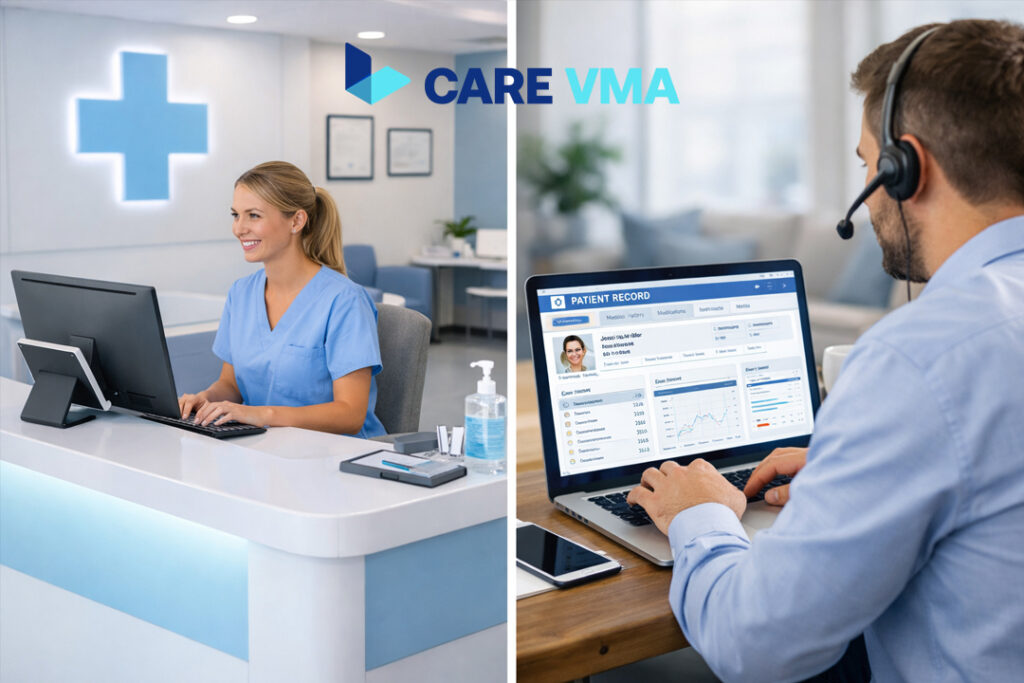
- Cost: VMA is 40% to 60% lower with no benefits or taxes; In-house has a higher base salary plus benefits, PTO, and employment taxes.
- Primary Tasks: VMA handles admin, billing, scribing, and triage; In-house handles vitals, rooming, physical procedures, and front desk reception.
- Availability: VMA offers flexible hours, including 24/7 or multi-time zone support; In-house is generally restricted to standard clinic hours.
- Overhead: VMA requires zero physical space or equipment; In-house requires desks, PCs, office space, and breakroom facilities.
- Scalability: VMA is high; you can add or reduce hours easily; In-house is low, requiring weeks or months for hiring and training.
- HIPAA & Security: VMA uses encrypted VPNs and signed BAAs; In-house relies on physical office security and standard HIPAA protocols.
The True Cost of In-House Staff in 2026: Beyond the Salary
Most practice owners look at a $22-per-hour salary and think that is the cost of the employee. In reality, that is just the tip of the iceberg. What most people do not realize is that the “fully loaded” cost of an on-site medical assistant is often 1.5 to 2 times their base pay.
When you factor in the rising costs of employer-sponsored health insurance, workers’ compensation, FICA taxes, and the specialized training required for high-acuity practices, the financial burden becomes significant. Furthermore, in-house staff are prone to the “distraction tax.” Every time a front-desk person has to stop a billing task to greet a walk-in or manage a physical file, productivity drops.
- Basic Salary + Employment Taxes: The non-negotiable floor of on-site hiring.
- Health Insurance & Benefits: A rapidly inflating cost center in 2026.
- Paid Time Off (PTO) & Sick Leave: Costly gaps that require expensive temp coverage.
- Recruitment & Training: The hidden cost of high turnover in the healthcare sector.
- Physical Overhead: The square footage required for a desk and equipment in a high-rent medical building.
- Burnout Risk: When staff juggle clinical and admin tasks, their error rate in billing and documentation inevitably climbs.
The ROI of a Virtual Medical Assistant: More Than Just Savings
It is easy to focus on the 60% savings, but the real value of a VMA is the specialized focus they bring to your Revenue Cycle Management and clinical documentation. Imagine a world where your doctor finishes their last patient and actually goes home, rather than spending three hours on “pajama time” finishing EHR charts.
A VMA functions as a force multiplier. By integrating directly into your Electronic Health Record (EHR) via a secure VPN, they handle the “invisible work” that slows down your clinic. According to data from the Department of Health and Human Services (HHS), administrative complexity is a leading cause of physician dissatisfaction. A VMA solves this by acting as a Virtual Scribe or a dedicated Prior Authorization specialist.
- Back-Office Optimization: VMAs handle insurance verification and denials, ensuring your cash flow remains steady.
- Real-Time Clinical Support: As a scribe, they document visits in real-time, allowing for higher patient volume without sacrificing care quality.
- Reduced No-Show Rates: Dedicated patient communication and reminders keep your schedule full and your revenue predictable.
- The Clinical Boundary: While they cannot physically draw blood or take vitals, their support ensures your on-site team has the time to do those tasks perfectly.
Is administrative bloat holding your practice back? Discover how a tailored VMA strategy can reclaim your time. Explore Care VMA Health Solutions
The Hybrid Model: Why The “Vs” Debate is Obsolete
In many cases, practitioners feel they have to choose between a physical team and a virtual one. But the most successful practices in 2026 have moved past this binary choice. They have adopted the Hybrid Model, and this is where Care VMA Health excels.
The Hybrid Model is about optimization. You keep your elite on-site team focused on what they do best: hands-on patient care, vital signs, and clinical procedures. Meanwhile, Care VMA Health provides the digital backbone. Our VMAs handle the heavy lifting of documentation, billing, and phone triage.
- Free Up Your Experts: Your on-site Medical Assistants (MAs) should not be stuck on the phone with insurance companies. Let them focus on the patient in the room.
- Eliminate Admin Bottlenecks: Care VMA Health integrates seamlessly into your existing workflow, acting as a remote extension of your office.
- Use Case: Consider a busy dermatology clinic. The on-site staff preps the patient and assists in a biopsy. Simultaneously, the Care VMA scribe documents the encounter and queues the pathology referral, while a billing VMA verifies the insurance for the next patient in the lobby.
By partnering with Care VMA Health, you are not just hiring a remote worker; you are implementing a sophisticated clinic workflow optimization strategy designed to scale.
HIPAA & Data Security: Debunking the On-Site Myth
A common misconception is that keeping staff in the building makes your data safer. However, physical offices are often where the most common HIPAA violations occur—overheard conversations at the front desk or physical charts left in plain view.
Security is about protocol, not proximity. Whether virtual or in-person, compliance requires a robust framework. At Care VMA Health, we treat HIPAA compliance and data security as the foundation of our service, not an afterthought.
- Virtual Security: We utilize encrypted VPNs, multi-factor authentication (MFA), and strictly sign Business Associate Agreements (BAA) with every client.
- Minimum Necessary Standard: Our VMAs are trained to access only the information required for their specific task, reducing the risk of data exposure.
- In-House Risks: We help you identify gaps in your physical office security, ensuring your entire hybrid team operates under the highest safety standards.
Which Model Is Right for Your Practice? A Decision Framework
Deciding the future of your staffing shouldn’t be a guessing game. Use this checklist to determine your next move.
- Choose a VMA if: You are struggling with local labor shortages, your overhead is exceeding 50% of revenue, or your doctors are suffering from EHR-related burnout.
- Focus on In-House if: You are a brand-new practice needing a “jack-of-all-trades” or your specialty requires high-touch physical assistance for every single minute of the day.
- Choose the Hybrid Model if: You want to grow. This is for the established practice looking to maximize practice potential by combining the personal touch of local staff with the efficiency and cost-savings of a VMA.
Frequently Asked Questions
Do virtual medical assistants need to be HIPAA certified?
Yes, absolutely. Any professional handling Protected Health Information (PHI) must be trained in HIPAA regulations. At Care VMA Health, our assistants undergo rigorous training and operate under a signed BAA to ensure total compliance.
How much can a practice save with a VMA compared to in-house staff?
Practices typically see a 40% to 60% reduction in staffing costs. These savings come from eliminating benefits, payroll taxes, office space requirements, and the high cost of local recruitment.
Can a VMA handle complex tasks like prior authorizations?
Yes. VMAs are highly skilled in insurance verification and prior authorization. Because they are dedicated to these tasks without the interruptions of a physical office, they often complete them faster and with fewer errors.
Conclusion
The healthcare landscape of 2026 does not reward the status quo. To thrive, practice managers must look beyond traditional hiring and embrace the efficiency of a hybrid workforce. By offloading the administrative burden to a Virtual Medical Assistant, you don’t just save money; you save your team from burnout and give your patients the focused attention they deserve.
It is time to stop letting paperwork dictate the rhythm of your clinic. Empower your in-house staff to be clinicians again, and let a VMA handle the rest.
Ready to see how much your practice can save?