You’ve done everything right. You performed a thorough examination, delivered an accurate diagnosis, and created the best possible treatment plan for your patient. Yet, their condition isn’t improving. They frequently miss follow-up appointments, or you suspect they never filled their prescription. Here’s the thing: this isn’t a failure of your clinical skill. It’s often a sign that your best efforts are being undermined by powerful forces outside the clinic walls. This feeling of helplessness, knowing the real problems are things like housing instability or food insecurity, leads to poor health outcomes, preventable readmissions, and provider burnout. The solution lies in systematically understanding and addressing the Social Determinants of Health (SDOH)—the crucial bridge between excellent clinical care and real-world patient results.
Social Determinants of Health (SDOH) are the non-medical conditions in the environments where people are born, live, learn, work, and age that affect a wide range of health and quality-of-life outcomes and risks. Research from the World Health Organization (WHO) suggests these factors are responsible for up to 80-90% of a person’s health outcomes, profoundly outweighing the impact of direct medical care. This guide is built on established frameworks, including Healthy People 2030, to give you actionable strategies for your practice.
Why SDOH Matter More Than Ever: Beyond the Clinic Walls
It’s easy to view SDOH as a lofty public health concept, far removed from the day-to-day of your practice. But what if it’s the single biggest factor you’re not accounting for? We’re in the midst of a fundamental shift in medicine, moving from purely symptom-based treatment to holistic, person-centered care. In this new reality, understanding SDOH isn’t just a “nice-to-have”—it’s a clinical necessity.
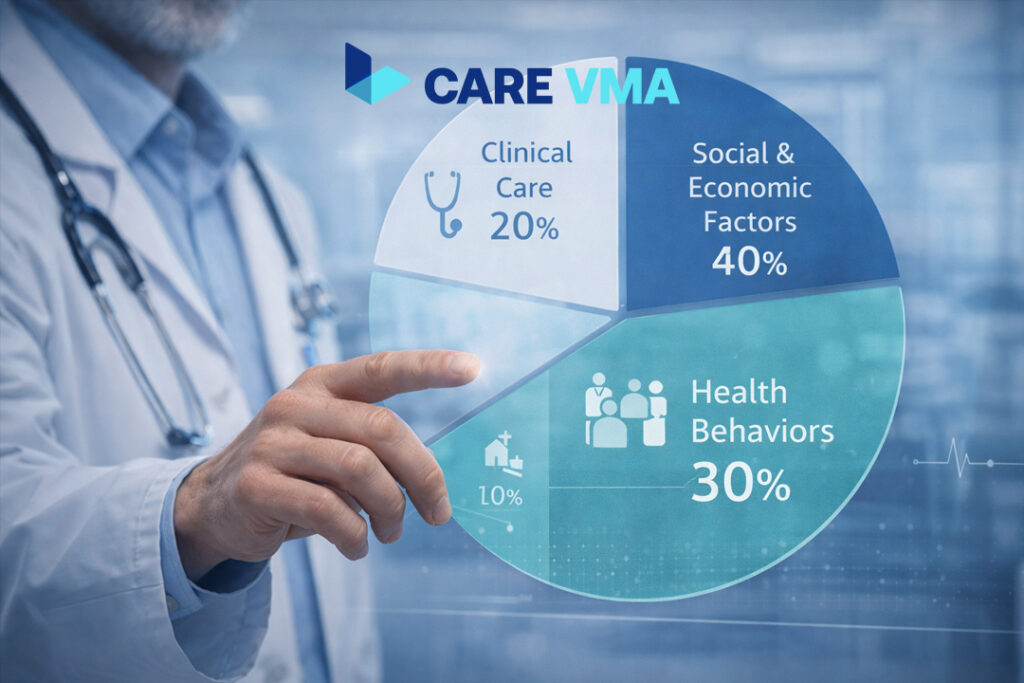
What most people don’t realize is that direct medical care accounts for only about 10-20% of modifiable contributors to health outcomes. The other 80-90% is determined by factors like socioeconomic status, education, and physical environment. Ignoring these upstream factors is like treating a patient for asthma while sending them back to a home filled with mold. It’s an uphill battle that leads to widening health inequities, lower life expectancy, and a higher prevalence of chronic conditions across our population health landscape.
The 5 Key Domains of SDOH: A Framework for Providers
Understanding these determinants isn’t about memorizing a list; it’s about seeing your patient’s life through a new lens. The Healthy People 2030 framework organizes SDOH into five key domains. Let’s break down what they mean in the context of your daily practice.
Economic Stability
This domain is about the connection between a patient’s financial resources and their health. It goes beyond simple poverty to include employment status, housing stability, and food security. For your patient, this might look like having to choose between paying the electricity bill and picking up their insulin prescription. Or it could be a patient with Type 2 diabetes who relies on cheap, processed foods because they can’t afford fresh produce.
Education Access and Quality
This covers everything from early childhood development to higher education and health literacy. A patient with low health literacy may struggle to understand prescription instructions or navigate the complexities of their health insurance. In many cases, higher educational attainment is directly linked to longer, healthier lives.
Health Care Access and Quality
This might seem obvious, but it’s more than just having insurance. Does your patient have transportation to get to your clinic? Can they find a specialist who speaks their language? Lack of access to quality primary care is a major driver of health disparities, preventing routine screenings and leading to poorly managed chronic conditions like heart disease and asthma.
Neighborhood and Built Environment
Where a person lives has a massive impact on their health. This domain includes the quality of their housing, their safety from violence, the quality of the air and water, and their access to healthy foods versus living in a “food desert.” A patient living in a high-crime area may experience chronic, toxic stress, which elevates cortisol and contributes to a high allostatic load, physically wearing down their body over time.
Social and Community Context
This refers to the relationships and social networks that shape our lives. It includes social cohesion, support systems, civic participation, and exposure to discrimination. A patient with a strong support system may have better resilience and mental health, while a patient facing systemic discrimination can experience chronic stress that directly harms their physical health.
From Theory to Triage: How to Screen for SDOH in Your Practice
Here’s where the rubber meets the road—and where most clinics get stuck. Knowing about SDOH is one thing, but integrating patient screening into your clinical workflow is another challenge entirely.
Validated screening tools exist, such as the Protocol for Responding to and Assessing Patients’ Assets, Risks, and Experiences (PRAPARE) or the 2-question Hunger Vital Sign for food insecurity. However, the operational hurdles are significant:
- Time Constraints: Manual screening can add several minutes per patient. In a busy clinic, this quickly adds up to hours of administrative work each week.
- Workflow Disruption: Handing out paper forms, manually entering the data into the EHR, and then figuring out what to do with that information disrupts the flow for both clinical and administrative staff.
- Resource Gaps: Even if you identify a need, your staff then has to spend time searching Google for local community resources, with no way to know if the information is current or if the patient ever followed through.
For providers already feeling the strain of administrative overload, adding another manual process can feel like an impossible task. If manual screening seems like an overwhelming addition to your packed schedule, you’re not alone. The key isn’t working harder; it’s optimizing your clinic’s workflow with integrated systems.
The Care VMA Advantage: Operationalizing SDOH with Technology 🔥
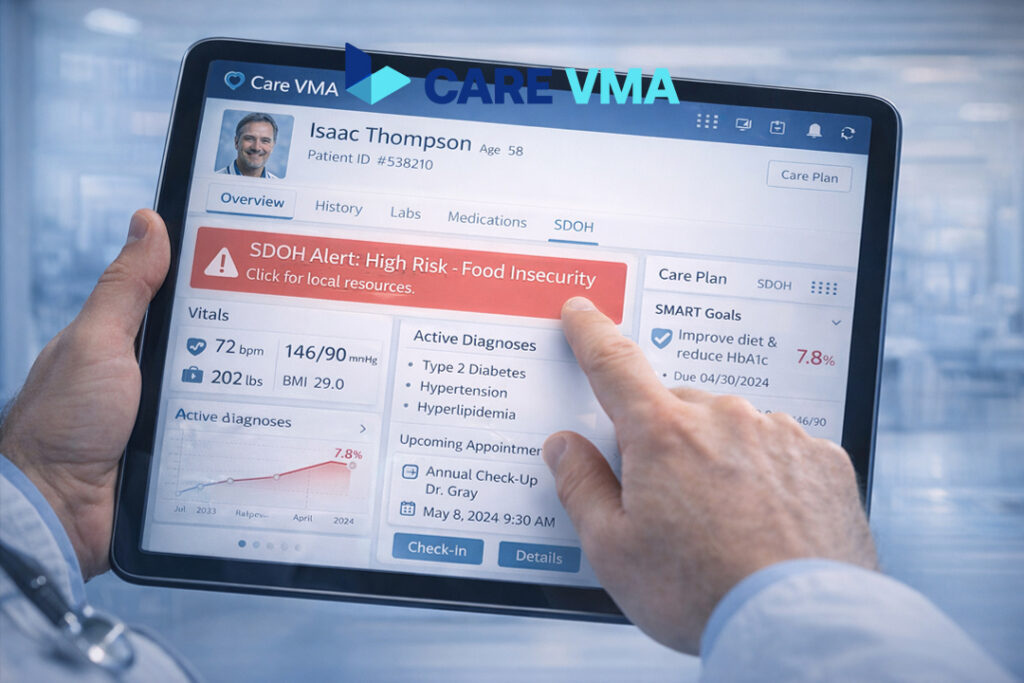
What if you could gather critical SDOH data, identify at-risk patients, and connect them to resources—all before you even walk into the exam room? This is no longer a hypothetical. This is where technology transforms a public health challenge into a manageable clinical process.
Care VMA’s platform is designed to solve the exact operational bottlenecks that make SDOH programs fail. Instead of adding to your team’s burden, our system of virtual medical assistants and integrated technology streamlines the entire process:
- It saves valuable time: Automated SDOH screening questionnaires are sent to patients through their portal before their appointment. They can fill it out on their own time, from their own device.
- It reduces administrative workload: The system automatically analyzes responses and flags at-risk patients directly within the EHR. This eliminates manual data entry and the need for staff to interpret raw survey data.
- It increases efficiency and closes care gaps: The platform includes an integrated, geolocated directory of community resources. With just a few clicks, you can refer a patient to a local food bank, transportation service, or housing assistance program, and the system can track that referral to ensure the loop is closed.
Imagine this scenario: A provider at a busy clinic gets an alert on their Care VMA dashboard. Their next patient, who has diabetes, has been flagged for ‘high risk of food insecurity.’ During the visit, the provider discusses this with the patient. With two clicks, they send a verified list of the three closest food pantries directly to the patient’s phone and the system automatically creates a follow-up task for a staff member to check in with the patient next week.
The ROI of Addressing SDOH: Better Outcomes, Better Reimbursements
Investing in SDOH isn’t just about altruism; it’s one of the smartest financial and clinical decisions a practice can make. By moving upstream to address root causes, you unlock a powerful return on investment that resonates with the goals of modern healthcare.
- Cost Savings: When you help a patient secure reliable transportation, you drastically reduce your no-show rate. When you connect a post-discharge cardiac patient with resources for healthy meals, you lower their risk of a costly 30-day readmission.
- Workflow Improvement: With a platform like Care VMA, SDOH screening transforms from a clunky administrative burden into a seamless, automated part of your patient intake. This frees up staff to focus on higher-value, patient-facing tasks.
- Enhanced Patient Care: Patients whose non-medical needs are acknowledged and addressed feel seen and cared for as whole people. This builds immense trust, leading to better medication adherence, higher patient satisfaction scores, and ultimately, better outcomes—a cornerstone of improving patient outcomes with effective chronic care management.
Traditional SDOH Workflow vs The Care VMA Method
The difference between trying to address SDOH and successfully addressing SDOH often comes down to the workflow. A visual comparison makes the advantage clear.
| Task | Traditional Method (Manual) | The Care VMA Method (Automated) |
|---|---|---|
| Screening | Paper forms during check-in; staff time required. | Digital questionnaires sent to patient pre-visit. |
| Documentation | Manual data entry into the EHR; risk of error. | Automated analysis and flagging in the EHR. |
| Referral | Staff googles resources; prints out info. | Integrated, verified directory; one-click referral. |
| Follow-up | Manual phone calls; difficult to track outcomes. | Automated task creation; closed-loop tracking. |
Frequently Asked Questions
Still have questions? Let’s tackle some of the most common ones providers ask about SDOH.
What are social drivers of health?
“Social drivers of health” is a term used interchangeably with SDOH. Many, including the Centers for Disease Control and Prevention (CDC), prefer “drivers” because it emphasizes that these factors are not fixed or deterministic. They are modifiable forces that can be changed through policy, investment, and community action.
How do you measure SDOH?
SDOH are measured using standardized screening tools, like the PRAPARE questionnaire, which asks patients about different domains like housing, transportation, and social support. This data can be collected at the individual patient level and then aggregated to identify trends across a patient population, helping to pinpoint widespread care gaps.
What is an example of addressing SDOH in a clinical setting?
A classic example is a primary care physician who screens a patient and discovers they have missed several specialist appointments due to a lack of reliable transportation. Using an integrated platform, the provider’s care coordinator schedules non-emergency medical transport for the patient’s next appointment, ensuring they receive the necessary follow-up care and closing a critical gap.
Conclusion: From Overwhelmed to Empowered
Addressing the Social Determinants of Health is no longer an academic exercise; it is an essential component of providing high-quality, effective care. To ignore these factors is to ignore the primary forces shaping your patients’ health. The challenge has never been why we should address SDOH, but how we can do it efficiently without overwhelming our practices.
Stop letting social barriers sabotage your clinical excellence. It’s time to consider how technology can empower your practice to move beyond the clinic walls and deliver the truly holistic care your patients deserve.
Ready to turn the SDOH challenge into an opportunity for better care? Schedule a personalized demo of Care VMA today and see how you can automate screening, simplify referrals, and truly close the care gaps for your patients.