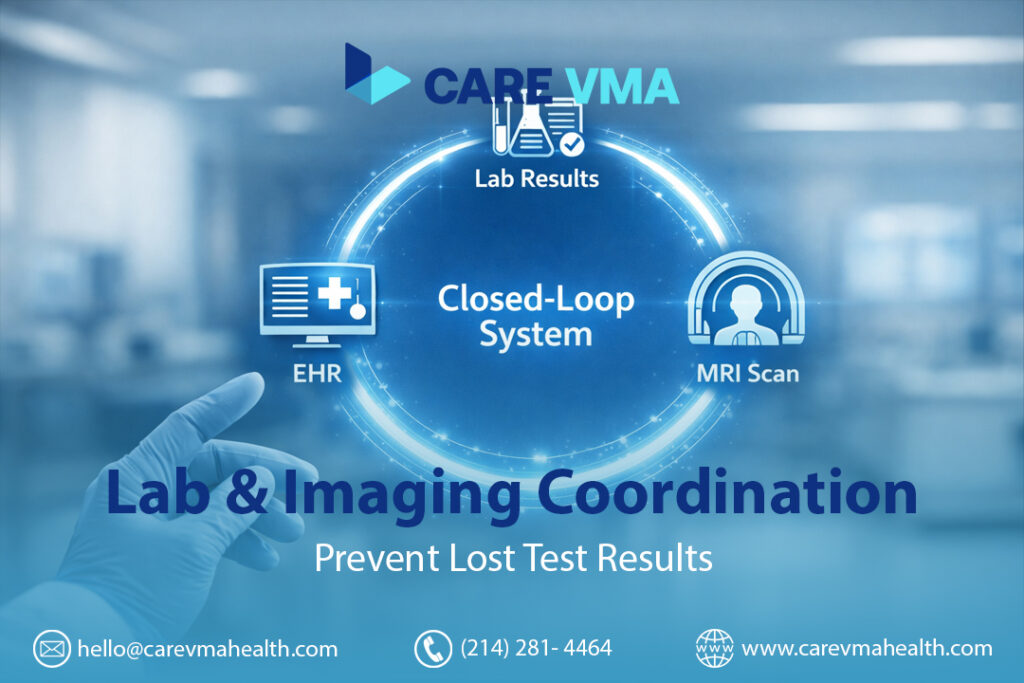
Every day, your clinic staff likely wastes hours tracking down lab results, chasing faxes, and making phone calls, while you carry the quiet fear that a critical finding might slip through the cracks. This isn’t just an administrative headache; it’s a direct threat to patient safety, a major cause of diagnostic error, and a significant source of both staff burnout and liability. In today’s healthcare landscape, the “no news is good news” approach isn’t a workflow—it’s a malpractice lawsuit waiting to happen.
Now, imagine a “closed-loop” system where every single test is tracked from order to action, managed by a dedicated specialist, all without you having to hire a new full-time employee.
Lab & Imaging Coordination is a systematic management service that ensures every diagnostic test—from the initial order and prior authorization to the final clinical follow-up—is executed within a documented, closed-loop workflow. The primary goal is to eliminate “lost” test results, reduce the risk of diagnostic errors, and guarantee that every actionable finding is reviewed and addressed by the responsible clinician. This methodology is not just a best practice; it aligns directly with patient safety standards established by leading organizations like The Joint Commission to mitigate medical risks.
The High Cost of Uncoordinated Diagnostics: More Than Just a Messy Workflow

The administrative chaos of tracking tests is obvious, but the true costs of a fragmented system run much deeper—and are far more dangerous for your practice and your patients. When there’s no formal system, you’re not just dealing with inefficiency; you’re actively accumulating risk.
What most people don’t realize is that these small, daily administrative failures are a leading contributor to serious clinical events. Here’s how the damage adds up:
- Clinical Risk: The “Failure to Follow-Up” Nightmare. According to research on medical malpractice, a significant portion of claims stem from diagnostic errors, with “failure to follow up” on an abnormal test result being a primary cause. Each unclosed loop is a potential patient safety incident and a severe liability risk.
- Financial Drain: The Hidden Costs of Redundancy. How many times has your practice ordered a repeat test simply because the original results couldn’t be located? This redundant testing not only doubles costs for payers and patients but also wastes valuable staff hours that could be spent on patient-facing activities.
- Reputational Damage: How Delays Erode Patient Trust. Patients today expect clear and timely communication. When results are delayed or “lost,” it creates immense patient anxiety and damages their trust in your practice’s ability to manage their care effectively.
What is a “Closed-Loop” Diagnostic System?
So, what’s the gold standard for preventing these dangerous failures? It’s a concept known as a “closed-loop” system, a framework designed to ensure no test order is left behind. It’s not about complex technology as much as it is about a reliable, repeatable process with clear accountability at every step.
Here’s the thing: a truly closed-loop system is a complete cycle covering four distinct phases. The loop is only considered “closed” when the final step is completed and documented.
Phase 1: Pre-Analytic (The Order & Prep)
This phase goes far beyond simply placing an order in the Electronic Health Record (EHR). It involves all the upfront administrative work, such as securing prior authorization from insurance, confirming patient eligibility, and providing the patient with clear preparation instructions (e.g., fasting requirements or medication holds).
Phase 2: Analytic (The Test)
Once the order is prepped, this phase focuses on the test itself. A key metric here is Turnaround Time (TAT)—the expected duration from sample collection or imaging to when a result should be available. Coordination in this phase means actively monitoring TAT and following up on any delays.
Phase 3: Post-Analytic (The Results)
This is where many manual systems break down. In a closed-loop system, coordination ensures results are successfully integrated back into the patient’s EHR. More importantly, it involves a process for flagging and escalating Critical Values—results that indicate a life-threatening condition—for immediate clinician notification.
Phase 4: Clinical Follow-up (Closing the Loop)
A result sitting in an inbox is not a closed loop. The final, crucial phase involves the clinician reviewing the result, creating an action plan, communicating that plan to the patient, and documenting the entire interaction. The loop is only truly closed once a documented action has been taken.
The Challenge for Independent Practices: Why Can’t We Just Do This In-House?
If a closed-loop system is the clear solution, why doesn’t every clinic already have one? For independent and small to mid-sized practices, the reality is a stark matter of limited resources. Large hospital systems like Mass General Brigham often have entire departments or dedicated “Diagnostic Coordinators” to manage this process, but that’s an unrealistic luxury for most.
The challenges for independent practices are significant:
- Staffing Constraints: Your medical assistants and nurses are already stretched thin. Hiring a dedicated, full-time coordinator to do nothing but track tests is often financially impossible and operationally impractical.
- Technology Gaps: Many practices work with a patchwork of external labs and imaging centers, each with its own portal. Poor interoperability between your EHR and these outside facilities means there is no single source of truth, forcing staff to rely on manual tracking, phone calls, and faxes.
- Administrative Overload: Adding a complex, high-stakes tracking responsibility onto an already overwhelmed administrative team is a recipe for burnout and human error.
You don’t need a system that costs millions or a dedicated IT team to achieve this level of patient safety. You need a more practical approach.
The Solution: How a Virtual Medical Assistant (VMA) Creates Your Closed-Loop System
At first glance, outsourcing such a critical clinical function might seem counterintuitive. But in reality, a specialized Virtual Medical Assistant (VMA) is the most efficient and cost-effective way to implement a robust closed-loop system, acting as your dedicated “Diagnostic Coordinator as a Service.”
This is the core of the Care VMA advantage. Our trained VMAs integrate into your existing workflow to proactively manage the entire diagnostic process, bridging the gaps your in-house team simply doesn’t have the bandwidth to fill.
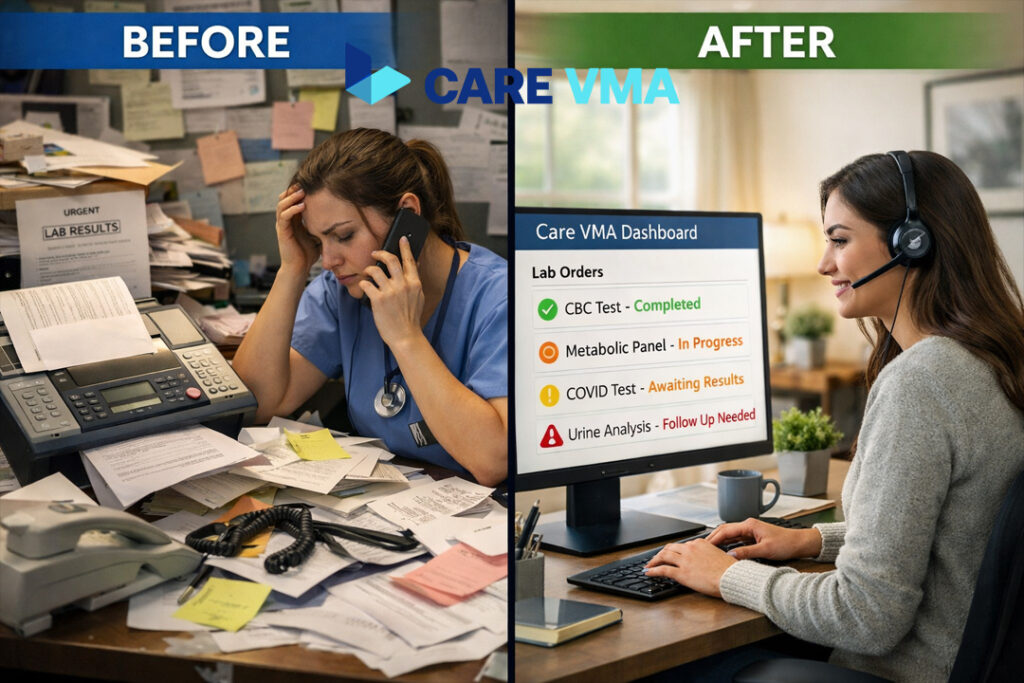
Here’s how a Care VMA builds and manages your clinic’s closed-loop system:
- Handles the Pre-Analytic Grind: Our VMAs proactively manage the time-consuming prior authorization process. They communicate directly with imaging facilities to schedule appointments, send prep instructions to patients, and ensure all prerequisites are met before the test.
- Actively Tracks Every Open Loop: Using our proprietary “tickler system,” your VMA monitors every outstanding order. They proactively chase down any results that exceed the standard Turnaround Time (TAT), becoming the single point of contact for all diagnostic tracking so your staff doesn’t have to.
- Ensures Results Get to the Right Eyes: The VMA confirms that results have been received and correctly filed in your EHR. They flag important or abnormal findings for immediate physician review, preventing critical information from being “marked as read” without a corresponding clinical action.
- Closes the Final Loop: Following your provider’s instructions, the VMA can help schedule necessary follow-up appointments, initiate referrals, and document patient communication, ensuring every diagnostic journey reaches a documented conclusion.
Use Case in Action:
Imagine a physician orders a CT scan to rule out a pulmonary embolism. A Care VMA immediately begins the insurance authorization, schedules the patient at a convenient radiology center, and sets a reminder to check for the result. They verify the report is received in the EHR within 24 hours, flag an incidental finding (a small lung nodule) for the doctor’s attention, and then, per the doctor’s protocol, initiate a referral to a pulmonologist for follow-up. The entire process is managed and documented without the in-house staff making a single phone call.
The Tangible Outcomes of VMA-Powered Coordination
Implementing a system like this isn’t just about gaining peace of mind. It delivers measurable improvements to your clinic’s clinical safety, financial health, and operational efficiency.
- Reduced Malpractice Risk: By creating a clear, documented audit trail for every test, you significantly lower your practice’s exposure to “failure to follow up” claims, one of the most preventable and costly forms of medical malpractice.
- Improved Financial Health: You stop the financial drain from redundant testing and free up hundreds of staff hours per month. This allows your in-house team to focus on higher-value, patient-centric tasks instead of administrative busywork.
- Enhanced Patient Experience: Patients feel better cared for when they receive results promptly and have their follow-up appointments scheduled without delay. This proactive communication builds immense trust and satisfaction.
- Increased Provider Capacity: With a reliable system in place, physicians and providers can focus on what they do best—diagnosing and treating patients—rather than spending their valuable time chasing down paperwork.
Traditional Tracking vs The Care VMA Method
Let’s break it down. Here’s a head-to-head comparison of the old, reactive way of managing diagnostics versus the new, proactive VMA-powered method. This simple shift in approach fundamentally changes your practice’s risk profile and efficiency.
| Aspect | Traditional Method (Manual) | The Care VMA Method |
|---|---|---|
| Tracking | Reactive (chasing results when they’re overdue) | Proactive (monitoring every order from the start) |
| Prior Auth | A constant burden on your internal staff | Professionally managed by a dedicated VMA |
| Follow-Up | Relies on memory, sticky notes, or manual logs | Systematic with a digital “tickler system” and reminders |
| Risk | High (human error, lost faxes, missed results) | Minimized (structured, documented, and audited workflow) |
| Cost | Hidden costs (wasted staff time, repeat tests) | A clear, predictable, and highly efficient service fee |
Explore Our Administrative Support Solutions
A closed-loop diagnostic system is a cornerstone of a well-run practice. It’s a key part of a broader strategy for optimizing your clinic’s workflow to cut errors and administrative tasks.
This process often begins with tackling time-consuming tasks like insurance verification and prior authorization.
To see how this fits into our full suite of services, explore our primary Lab & Imaging Coordination page.
Frequently Asked Questions
What is a closed-loop system in healthcare diagnostics?
A closed-loop system is a workflow designed to ensure that every diagnostic test ordered is completed, the results are reviewed by a clinician, the patient is notified, and a documented action plan is put in place. Its purpose is to prevent any test result from being lost, ignored, or otherwise falling through the cracks, which is a major patient safety concern highlighted by organizations like the National Institutes of Health (NIH).
Who is responsible for tracking lab and imaging results?
Ultimately, the ordering physician is clinically responsible for acting on test results. However, in a busy practice, the administrative task of tracking and ensuring results are received often falls to nurses, medical assistants, or front-office staff. A dedicated service, like one provided by a Virtual Medical Assistant, formalizes this process with clear accountability to ensure nothing is ever missed.
How do you prevent lost test results in a busy clinic?
The most effective method is to move from a reactive to a proactive process. This involves implementing a reliable tracking system (often called a “tickler” system) for all outstanding orders. This system should automatically flag any result that has not been received within its expected Turnaround Time (TAT), prompting an immediate, proactive follow-up by a designated person.
Stop Managing Chaos. Start Building a System of Safety.
In modern healthcare, implementing a closed-loop diagnostic process is non-negotiable for delivering safe, high-quality patient care and managing your practice’s risk. The good news is that you don’t need to hire more in-house staff or invest in a complex new software suite to achieve it. You just need a smarter, more efficient workflow.
Ready to see what a proactive, VMA-powered coordination system could look like for your practice? Understand how our VMAs integrate seamlessly with your EHR and your existing team to provide immediate relief and long-term security.
Stop worrying about lost results and give your staff the support they need. Schedule a free, no-obligation consultation with our workflow specialists today and discover how a Care VMA can build your clinic’s closed-loop system in a matter of days.