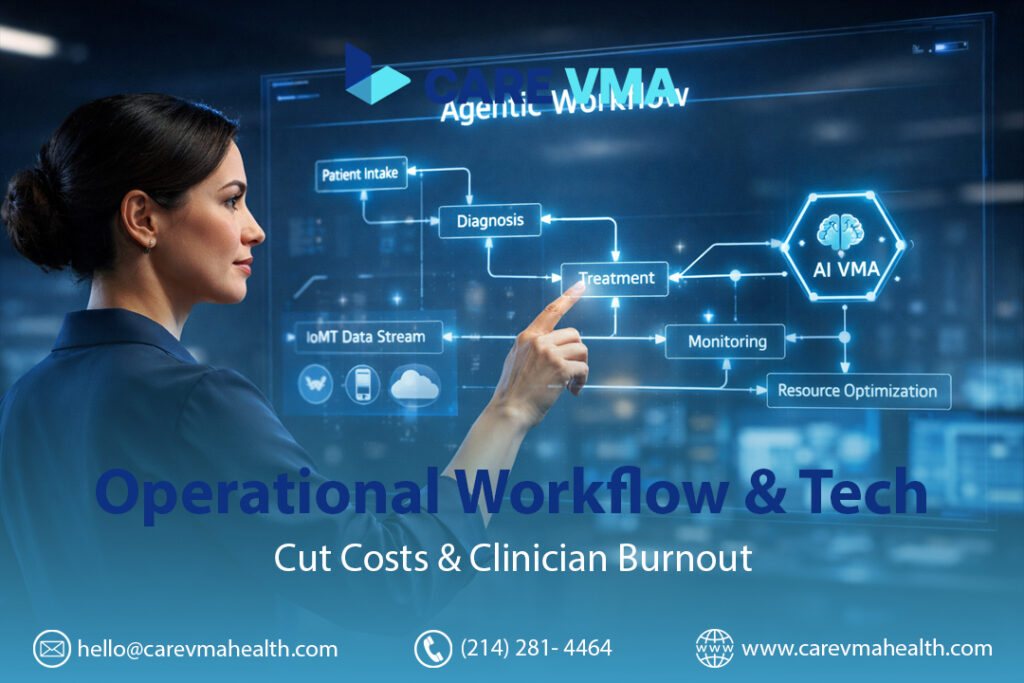
Healthcare operational workflow is an integrated system of technology, clinical processes, and human capital designed to streamline administrative and medical tasks. In 2026, the industry has shifted from basic task automation to agentic orchestration, focusing on reducing clinician burnout and optimizing patient throughput through real-time intelligence. By synchronizing digital tools with expert human oversight, practices can significantly lower overhead while improving the quality of patient care.
The Invisible Burden on Modern Medicine

Here is the reality most hospital administrators are facing today: your clinical team is drowning in a sea of clicks, alerts, and forms that have very little to do with actual healing.
- The Problem: Despite billions spent on digital transformation, the average physician still spends nearly two hours on administrative tasks for every one hour of patient interaction. This administrative tax is the primary driver of clinician burnout, leading to high staff turnover and dangerous operational bottlenecks.
- The Agitation: Every minute a nurse spends searching for an infusion pump or a doctor spends fighting with an EHR for prior authorization is a minute stolen from patient care. These inefficiencies leak revenue, increase the risk of medical errors, and leave your best talent feeling like glorified data entry clerks.
- The Solution: Imagine a practice where technology doesn’t just store data but orchestrates it. By combining Agentic AI with the precision of Virtual Medical Assistants, you can create a self-optimizing ecosystem that handles the heavy lifting of revenue cycle management and patient flow, leaving your team free to focus on medicine.
The Core Problem in 2026: Why Old Workflows are Failing
It is easy to assume that more software equals more efficiency, but in most cases, the opposite is happening.
The Administrative Tax and Burnout The burden of documentation and medical coding has reached a breaking point. Clinicians are no longer just providers; they are data managers. This shift has turned electronic health records (EHR) into a source of frustration rather than a tool for efficiency. When highly trained professionals spend 40 percent of their day on administrative tasks, the cost to the organization is astronomical, both financially and in terms of morale.
Operational Bottlenecks and Leaking Revenue Manual processes for prior authorization and referral management are silent profit killers. A single delayed approval can disrupt patient throughput and leave expensive bed capacity unused. These gaps in the revenue cycle management chain lead to denied claims and extended accounts receivable cycles that threaten the financial health of private practices and large systems alike.
The Disconnected Tech Stack Chaos Many practices suffer from a fragmented landscape of tools that do not talk to each other. You might have one system for scheduling, another for remote patient monitoring (RPM), and a third for telehealth administration. Without proper workflow orchestration, your staff becomes the bridge between these systems, manually moving data back and forth. This is not automation; it is a digital treadmill.
The 2026 Tech Revolution: 5 Key Technologies You Need to Know
At first glance, the rapid pace of tech innovation can feel overwhelming. However, 2026 has brought forward five specific tools that are actually moving the needle.
- Agentic AI and Autonomous Workflows: Unlike old if-this-then-that logic, agentic AI can reason. These agents monitor goals—like reducing no-shows—and autonomously navigate complex multi-day processes like patient intake and triage without human intervention for routine steps.
- Internet of Medical Things (IoMT): Real-time asset tracking has revolutionized hospital-at-home models. Sensors now track everything from infusion pumps to patient vitals, feeding data directly into predictive analytics engines.
- Remote Patient Monitoring (RPM) at Scale: RPM has evolved from a niche service to a standard of care. By using wearables that integrate with clinical decision-making tools, practices can manage chronic conditions proactively, reducing hospital readmissions.
- Predictive Analytics for Capacity Management: Systems now use historical data to forecast patient demand. This allows for smarter staff scheduling and bed management, ensuring that resources are aligned with actual needs before a bottleneck occurs.
- Low-Code/No-Code Platforms: Clinical leaders can now build custom intake forms or triage apps without a massive IT team. This democratizes innovation, allowing those on the front lines to fix specific workflow gaps in real-time.
The Implementation Trap: Why Tech Alone Is Not the Answer
We have seen it happen a thousand times: a practice invests in the latest AI-powered scribe or hyperautomation tool, only for it to sit unused or become another source of errors.
The truth is that technology is a multiplier, not a savior. If you automate a broken, manual process, you simply create a faster mess. Furthermore, healthcare is a high-stakes environment where HIPAA compliance and patient data security are non-negotiable. Fully autonomous systems often lack the clinical context needed for complex decision-making, and the “Governance Wall” requires that every automated action be auditable and explainable.
According to a 2024 report by Deloitte, many digital health initiatives fail because they lack a human-in-the-loop (HITL) to manage exceptions and ensure that the tech aligns with the messy reality of patient care.
Is your practice struggling with the implementation gap? Discover how to bridge the divide between advanced tech and clinical reality. Maximize Practice Potential with a Healthcare Virtual Assistant
The Hybrid Model: Combining Tech Orchestration with Virtual Medical Assistants

This is where the future of healthcare operations actually lives. At Care VMA Health, we don’t just give you a person; we give you an orchestrated solution.
Your Human-in-the-Loop for AI and Automation Our Virtual Medical Assistants (VMAs) act as the intelligence layer for your technology. While an AI agent might transcribe a visit, our VMAs verify the accuracy, ensuring that the medical documentation is perfect before it hits the EHR. This prevents the “hallucinations” common in standalone AI and maintains the highest standards of HIPAA compliance.
The Remote Operations Command Center A VMA can manage your entire RPM dashboard, escalating only the most critical alerts to your clinical team. They handle the administrative heavy lifting of telehealth administration, from patient education to post-visit care coordination. They are the human drivers of your digital tools.
Streamlining the Revenue Cycle By using hyperautomation tools and robotic process automation (RPA), our VMAs handle prior authorization and insurance verification with surgical precision. They end the manual, complex processes of referral management and medical coding, significantly reducing claim denials and accelerating your cash flow.
The Real-World Outcomes: Why It Matters
Implementing a tech-forward, VMA-supported workflow is not just about being “modern.” It is about survival and growth.
- Cost Savings: By outsourcing administrative roles, you reduce the need for full-time in-house admin staff and the overhead associated with them.
- Reduced Burnout: When you remove the “administrative tax,” you give doctors back their time. This leads to higher job satisfaction and lower turnover.
- Improved Patient Flow: Faster intake, quicker authorizations, and better bed management mean you can see more patients without increasing stress on your team.
- Enhanced Patient Satisfaction: Patients notice when a practice runs smoothly. Faster communication and easier scheduling lead to better engagement and retention.
Comparison: Traditional vs Care VMA Hybrid Model
| Feature | Traditional In-House Admin | Care VMA Hybrid Model |
|---|---|---|
| Cost | High (Salaries + Benefits + Office Space) | Scalable (Service-based, no overhead) |
| Tech Adoption | Slow (Requires internal IT and training) | Fast (We bring the tech stack to you) |
| Focus | Overwhelmed by admin vs clinical split | 100 percent dedicated to operations |
| Security | Variable (Depends on local IT) | High (HIPAA-trained with Zero-Trust) |
| Scalability | Difficult (Slow hiring/onboarding) | Instant (Add or remove support as needed) |
Explore more ways to optimize your practice:
- 10 Administrative Tasks Your Medical VAs Can Handle
- Virtual Medical Assistant Services: Advantages and Challenges
- Streamlining Your Practice with Healthcare Virtual Assistants
FAQ: Optimizing Healthcare Operations
How does a Virtual Medical Assistant differ from an AI chatbot?
An AI chatbot follows pre-programmed scripts. A VMA is a trained professional who uses critical thinking to manage complex workflows, understands clinical context, and handles exceptions that AI cannot solve alone.
Do I need to replace my existing EHR system?
No. Our VMAs are trained to work within your existing EHR and tech stack, acting as the bridge that makes your current systems more efficient.
Is patient data secure with a remote assistant?
Yes. All Care VMA professionals undergo rigorous HIPAA compliance training and operate through secure, encrypted platforms to ensure that patient data security is never compromised.
Conclusion: Empowering the Future of Care
The evolution of healthcare in 2026 is not about choosing between humans and robots; it is about creating a synergy that works for everyone. By embracing the hybrid model of advanced technology and expert Virtual Medical Assistants, you are not just cutting costs—you are reclaiming the heart of your practice.
You are moving from a state of reactive firefighting to one of proactive orchestration. This is how you beat burnout, protect your revenue, and ultimately, provide the level of care your patients deserve.
Ready to see how an orchestrated workflow can transform your practice?