Keeping up with the constant stream of updates from the Centers for Medicare & Medicaid Services (CMS) can feel like a full-time job. The new 2026 rules for combining Chronic Care Management (CCM) and Remote Patient Monitoring (RPM) are no exception. They promise a significant opportunity to increase practice revenue and improve patient care, but they also introduce a new layer of operational complexity and serious audit risks.
Your clinical staff is already stretched thin. The thought of adding more administrative tasks—like meticulously tracking separate, non-overlapping minutes for concurrent billing—is daunting. Every ten-minute interaction that goes unbilled is lost revenue, but every mistake in documentation could trigger an audit. Here’s the thing: there is a proven way to capture this new revenue and proactively manage your patients’ health without adding a single task to your team’s already overflowing plate. This guide breaks down exactly what you need to know to thrive in 2026.
Combining Chronic Care Management (CCM) with Remote Patient Monitoring (RPM) allows medical practices to use real-time patient data (RPM) to inform and guide monthly care coordination activities (CCM). As of 2026, new Medicare rules and CPT codes make this combination more flexible and profitable, enabling proactive patient care and significantly increasing monthly recurring revenue. This guide is based on a detailed analysis of the final 2026 Medicare Physician Fee Schedule and is designed to provide actionable, audit-ready strategies for practice managers and physicians.
The Synergy: Why Combining CCM & RPM is a Clinical and Financial Game-Changer
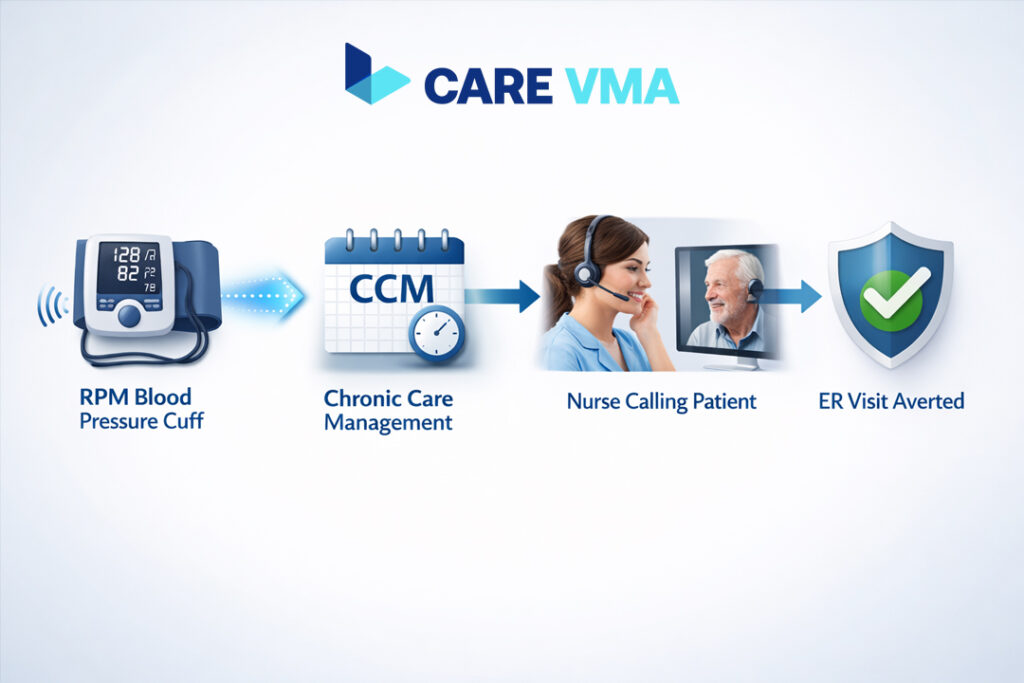
At first glance, CCM and RPM might seem like separate programs. But in reality, they are two sides of the same coin, creating a powerful loop of proactive care when used together. What most people don’t realize is that this combination transforms care from a reactive monthly check-in to a continuous, data-driven conversation.
Think of it this way: RPM provides the objective “eyes” on a patient’s daily health, while CCM acts as the thoughtful “hands” that intervene based on that data. RPM delivers critical physiologic data—like blood pressure, glucose levels, or weight—directly to your clinical team. This data then makes your CCM activities exponentially more effective. Instead of asking a patient with Hypertension “How have you been feeling?”, you can start the call with “I see your blood pressure was elevated yesterday morning; let’s talk about what happened.”
This synergy is particularly effective for managing conditions like Diabetes Mellitus and Congestive Heart Failure (CHF), where small daily changes can signal a major health event. By using RPM data to guide CCM interactions, you can update the Comprehensive Care Plan in real-time and prevent costly ER visits before they happen.
Decoding the 2026 Medicare Rules: New CPT Codes & Increased Reimbursement
The biggest changes from CMS in years are here, and they directly impact your practice’s bottom line. For 2026, the rules have become more flexible, finally acknowledging the real-world challenges of patient compliance and clinical workflows. The two most significant updates are the ability to bill for shorter monitoring periods and less time.
Previously, if a patient only transmitted 15 days of data, or if your staff only spent 19 minutes on care management, you couldn’t bill for your work. That changes now. These new codes are designed to help you capture revenue for the valuable care you’re already providing.
Here’s a clear breakdown of the key codes for 2026. For a complete and authoritative reference, always consult the official CMS Physician Fee Schedule.
| Service | CPT Code | 2026 Requirement | Avg. National Reimbursement | Key Takeaway |
|---|---|---|---|---|
| RPM Device | 99445 (NEW) | Device supply for 2-15 days of readings | ~$52 | You can now bill for less-compliant patients. |
| RPM Device | 99454 | Device supply for 16+ days of readings | ~$52 | The standard code for compliant patients. |
| RPM Time | 99470 (NEW) | First 10-19 minutes of clinical time | ~$26 | Captures revenue for shorter, high-value interactions. |
| RPM Time | 99457 | First 20 minutes of clinical time | ~$52 | The standard 20-minute time code. |
| CCM Time | 99490 | First 20 minutes of clinical time | ~$66 | The foundational CCM code with increased reimbursement. |
The Biggest Compliance Trap: The “No Double-Counting” Rule
This is the single rule that creates the most confusion, audit failures, and lost revenue for practices. When billing for both CCM and RPM in the same month, the time spent on each service must be separate, distinct, and independently documented. You cannot count the same 10-minute phone call toward both CPT 99490 and CPT 99457.
This “no double-counting” rule sounds simple in theory, but it’s an administrative nightmare in practice. Imagine a busy MA trying to manually log and segregate time for dozens of patients while juggling in-office duties. It’s a recipe for error.
Here are clear, real-world examples to distinguish the time:
- RPM Time (billed under 99457/99470): This is time spent engaging with the patient about the physiologic data. For example, “Reviewing a week of blood glucose logs from the patient’s glucometer and calling them to discuss why their morning readings are consistently high.”
- CCM Time (billed under 99490): This is time spent on general care coordination. For instance, “After that call about glucose logs, spending an additional 15 minutes arranging a telehealth consult with an endocrinologist and updating the patient’s comprehensive care plan to include the new appointment.”
Framing this correctly is the primary source of audit risk. This meticulous, separate time tracking is the headache that prevents most practices from maximizing reimbursement and makes staff burnout a near certainty.
The Operational Reality: How to Implement Without Staff Burnout (CARE VMA SECTION 🔥)
Knowing the rules is one thing. Executing them flawlessly across hundreds of patients every single month is another. The real challenge of combining CCM and RPM isn’t the clinical strategy; it’s the operational execution. How do you implement a program that is both profitable and audit-proof without overwhelming your staff?
This is where the model of care delivery makes all the difference. Instead of buying another piece of software for your team to learn or adding another checklist to their duties, a dedicated Virtual Medical Assistant from Care VMA lifts the entire operational burden.
- We save you time: Your in-house staff doesn’t spend a single minute on CCM/RPM tasks. Our expertly trained Virtual Medical Assistants handle 100% of patient onboarding, device education, monthly check-in calls, and daily data monitoring under General Supervision.
- We reduce your team’s workload: Instead of asking your MA to “log 12 minutes of CCM time,” our VMAs operate within a dedicated, audit-proof system. At the end of the month, we deliver a concise, compliant report for the billing physician to review and sign off on. That’s it.
- We guarantee efficiency & compliance: Our platform automatically segregates and timestamps every minute of work performed by our VMAs, making “double-counting” impossible. This system ensures you are always audit-proof while maximizing reimbursement for every eligible billing code.
A family practice in Ohio partnered with Care VMA for their 150 eligible Medicare patients. Within 60 days, they generated over $15,000 in new monthly recurring revenue. More importantly, their in-house MAs reported a 25% reduction in administrative tasks, allowing them to focus entirely on the patients in the office.
Thinking about the strain of these new operational demands? See how a dedicated Virtual Chronic Care Management team can handle everything for you.
The Financial Impact: Projecting Your 2026 Revenue
Let’s put some real numbers to this opportunity. The financial upside of a well-run, combined CCM and RPM program is substantial and creates a stable source of monthly recurring revenue.
You can create a simple projection for your own practice using this formula: (Number of Eligible Patients) x (Average Reimbursement of ~$110-$130/patient/month) = Potential New Monthly Recurring Revenue.
A practice with just 100 eligible Medicare patients could see over $120,000 in new annual revenue. However, this is revenue you can’t realistically capture without a dedicated resource. Piling this work onto existing staff leads to missed billing opportunities and compliance errors. Care VMA provides that dedicated resource, ensuring you capture the full financial benefit without the operational cost.
Further Reading & Resources
To build a successful remote care program, it’s essential to understand all the components. Explore these related topics to deepen your knowledge:
- For a deeper dive into the foundations of chronic care management, read our comprehensive CCM Revenue Strategy & Program Guide.
- Unsure about the clinical upsides? Learn more about the Benefits of Remote Patient Monitoring.
- Ready to see how our Virtual Medical Assistants can seamlessly integrate with your existing workflow? Explore the Care VMA Virtual Medical Assistant service page.
Frequently Asked Questions (FAQ)
Can you bill CPT 99490 and 99457 in the same month?
Yes, you can bill for both CCM (99490) and RPM (99457) in the same month for the same patient. However, the time spent for each service must be separate and independently documented to avoid “double-counting,” which is a key compliance requirement from Medicare.
What is the new RPM CPT code 99445 for 2026?
CPT code 99445 is a new code for 2026 that allows practices to bill for RPM device supply and data transmission when a patient provides as few as 2 to 15 days of readings in a month. This makes it easier to bill for patients who are less compliant with the traditional 16-day rule required for CPT 99454.
Who can perform CCM and RPM services?
Both CCM and RPM are designated as “general supervision” services by Medicare. This means they can be performed by qualified clinical staff, such as Medical Assistants (MAs) or nurses, without the billing physician needing to be physically present in the same building. This regulatory flexibility is what allows for the effective use of dedicated third-party teams like Care VMA. According to research from sources like PubMed Central, this model has been shown to improve patient outcomes.
Conclusion: Stop Reacting, Start Acting
The 2026 CMS updates are more than just new codes; they represent a clear endorsement of proactive, technology-enabled patient care. They offer a direct path to higher practice revenue and demonstrably better patient outcomes, but only for practices that can master the operational workload.
Don’t let the fear of compliance risks, documentation burdens, and staff burnout prevent you from capitalizing on this incredible opportunity.
Thinking about how your practice could implement a combined CCM and RPM program? Consider the real cost of tasking your current staff—in terms of burnout, mistakes, and lost focus on in-office patients—versus the immediate ROI of a dedicated, expert virtual team that handles it all for you.
Stop leaving money on the table and overwhelming your staff. Schedule a free, no-obligation Revenue Analysis with our team today. We’ll show you exactly how many of your patients are eligible and what your practice could be earning with Care VMA’s all-in-one virtual assistant service.