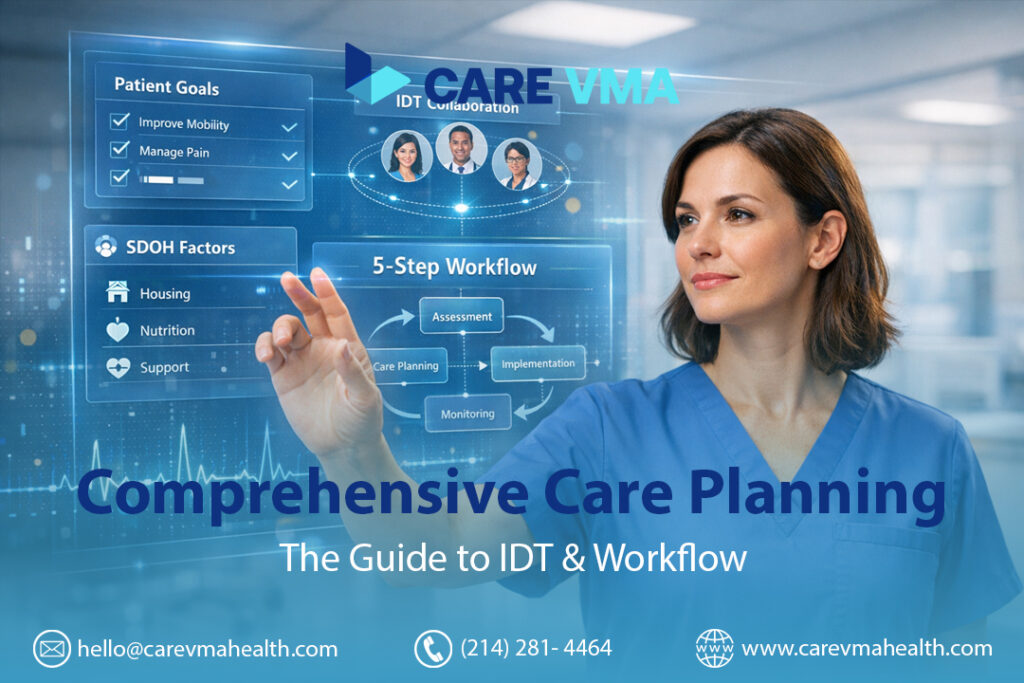
Comprehensive care plans are essential for quality outcomes, but let’s be honest—the documentation and coordination required can feel like a second full-time job. This mountain of administrative work often leads to staff burnout, takes valuable time away from patients, and creates a very real risk of falling behind. What’s worse, this burden can cause inconsistent plan updates, critical communication gaps between interdisciplinary team (IDT) members, and potential compliance issues with bodies like the Centers for Medicare & Medicaid Services (CMS). But what if you could build and maintain gold-standard care plans while actually reducing your team’s administrative workload? The key isn’t working harder; it’s implementing a smarter, more efficient workflow.
Comprehensive Care Planning (CCP) is a patient-centered, collaborative process that creates a dynamic roadmap for an individual’s health. Unlike a static treatment order, it integrates medical needs, patient goals, and social determinants of health (SDOH) into a single, actionable document for the entire interdisciplinary team (IDT). This guide moves beyond the textbook definitions, drawing on best practices from CMS requirements and the American Academy of Family Physicians (AAFP) to deliver a practical workflow for today’s demanding healthcare environment.
What Comprehensive Care Planning Is (and What It Isn’t)
At a glance, it’s easy to mistake a comprehensive care plan for just another set of doctor’s orders. But the difference is fundamental to modern, value-based care.
A CCP is a “living document” that guides proactive, long-term health management, not just reactive treatment for a single issue. Think of it as the central nervous system for patient care—a collaborative tool that ensures every member of the team, including the patient, is working from the same playbook. It’s not a top-down directive dictated by one physician; it’s a holistic approach that fosters true care coordination and continuity of care.
| Standard Treatment Plan | Comprehensive Care Plan (CCP) |
|---|---|
| Focus: Reactive, disease-specific | Focus: Proactive, holistic (whole-person) |
| Created by: Often a single provider | Created by: Interdisciplinary Team (IDT) with the patient |
| Timeline: Episodic, short-term | Timeline: Dynamic, long-term “living document” |
| Scope: Primarily clinical needs | Scope: Clinical, social, emotional, and patient goals |
| Goal: Treat the immediate problem | Goal: Improve long-term quality of life |
Anatomy of a CMS-Compliant Care Plan: The 6 Core Components
To be effective for both patient outcomes and compliance, a care plan needs a solid structure. Think of these six components as an actionable checklist for building a robust and compliant document.
1. Medical Summary & Risk Assessment
This goes beyond a simple list of diagnoses. It includes current medications, allergies, and a proactive assessment of risk factors. Here’s where you document tools like the Braden Scale for skin integrity or a standardized fall risk assessment to prevent future events before they happen.
2. Patient-Centered Goals & Preferences
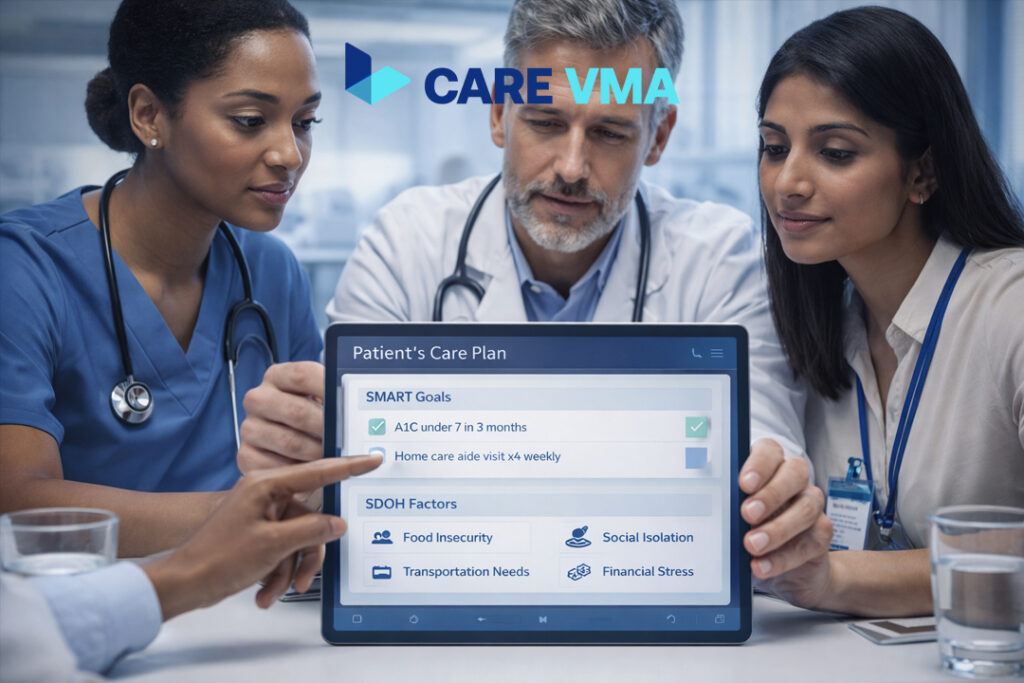
What most people don’t realize is that this is the heart of the plan. Using the SMART goals framework is key. Instead of a vague “improve mobility,” a strong goal is: “Patient will walk to their mailbox independently, 5 days a week, within 4 weeks.” This is also the section to document patient preferences and include critical documents like Advance Directives or a POLST/MOLST form.
3. The Interdisciplinary “Working” Plan
This section outlines the “who does what.” It lists specific interventions and assigns responsibility to a member of the interdisciplinary team. For example: “Nurse to provide weekly wound care education,” “Social worker to coordinate transportation for follow-up appointments,” or “Physical therapist to conduct strength exercises twice weekly.”
4. Medication Management
This isn’t just a list of prescriptions. A truly comprehensive plan includes a protocol for medication reconciliation, review for potential adverse interactions, and assessment of the patient’s ability to manage their regimen at home.
5. Social Determinants of Health (SDOH) Plan
A plan is only as good as the patient’s ability to follow it. This component explicitly addresses identified barriers found during the SDOH screening. If a patient has food insecurity, the plan details a referral to a local food bank. If they lack social support, it outlines steps to connect them with community resources.
6. Crisis & Emergency Plan
When a crisis occurs, clear instructions are vital. This section provides simple “if-then” directives (e.g., “If blood sugar drops below 70 mg/dL, consume 15g of fast-acting carbs and recheck in 15 minutes”) and lists emergency contacts and the preferred hospital.
The ADPIE Framework: A 5-Step Process for Effective CCP Workflow
Creating a care plan from scratch can seem daunting. The good news? There’s a proven, repeatable workflow that provides structure. The ADPIE framework, a cornerstone of the nursing process, offers a reliable cycle for any healthcare setting.
- Assessment: It all starts with data. This step involves gathering both objective information (lab results, vital signs from the EHR) and subjective data (what the patient and their family report during interviews). This holistic view is crucial for identifying the full scope of needs.
- Diagnosis: Based on the assessment, you identify the core health problems and potential risks. This isn’t just the medical diagnosis; it includes nursing diagnoses like “Risk for unstable blood glucose” or “Impaired social interaction,” which are critical for a whole-person approach.
- Planning: This is where you set the patient-centered SMART goals and choose the specific interventions needed to achieve them. The team, in collaboration with the patient, prioritizes the goals based on urgency and what matters most to the individual.
- Implementation: Action. This is where the “working plan” comes to life. Team members execute their assigned tasks, whether it’s administering medication, providing education, or coordinating with outside specialists. Clear communication during this phase is paramount, a process often streamlined by a dedicated care coordinator.
- Evaluation: A care plan is never “finished.” This final step is a continuous loop of reviewing the patient’s progress against their goals. Is the plan working? Does it need to be adjusted? This evaluation should happen regularly—often quarterly or after any significant change in health, like a hospitalization—as mandated by programs like CMS.
The Real Challenge: From Ideal Plan to Reality Without Drowning in Admin Work
Here’s the thing: The ADPIE framework is the undisputed gold standard. But in the real world, who truly has the time to execute it perfectly for every patient?
The reality of modern healthcare is that clinicians spend countless hours on administrative tasks—transcribing notes, entering data into the EHR, coordinating schedules for IDT meetings, and documenting every single interaction for compliance and billing. This isn’t just inefficient; it’s a direct cause of professional burnout and takes skilled clinicians away from their most important job: patient care. This is the gap where even the best-laid plans fall apart.
The Modern Solution: A Smarter Workflow
Forward-thinking practices are overcoming this administrative barrier by delegating the non-clinical components of Comprehensive Care Planning to specialized Medical Virtual Assistants (VMAs).
- Streamline Documentation: A trained Care VMA can listen in on patient encounters or IDT huddles (with consent) and transcribe relevant data directly into the care plan fields within the EHR. They can structure these notes according to the ADPIE framework, ensuring consistency and saving the clinician hours of typing.
- Enhance IDT Collaboration: VMAs handle the logistics that bog teams down. They can schedule IDT meetings, send plan updates to all stakeholders (including specialists and family members), flag action items, and ensure everyone has the latest information without having to hunt it down.
- Ensure Compliance & Billing: Our VMAs are trained on CMS guidelines for programs like Chronic Care Management (CCM). They ensure all required elements are documented correctly, supporting accurate billing and reducing compliance risks.
Imagine a nurse conducting a CCM check-in call. While the nurse focuses 100% on the patient’s needs, a Care VMA is simultaneously updating the medication list in the EHR, noting the patient’s progress towards their SMART goal, and scheduling the follow-up telehealth appointment—all in real time. This is the new school of CCP.
Feeling the pressure of this process? See how a dedicated virtual assistant can lift the administrative weight and let your team focus on patient care.
The ROI of a Streamlined Workflow: Key Benefits
Adopting a VMA-powered workflow isn’t just about convenience; it’s about delivering a tangible return on investment across your entire practice. The benefits are clear, measurable, and profound.
- For the Practice: Experience a drastic reduction in documentation time—often saving each clinician 8-10 hours per week. This leads to improved billing accuracy for value-based care programs like CCM, enhanced CMS compliance, and the ability to see more patients without increasing staff headcount.
- For the Team: The impact on morale is immediate. Clinicians report significantly reduced burnout and less “pajama time” spent catching up on charts after hours. IDT meetings become more efficient and focused on clinical strategy, not administrative updates. The constant chase for information ends.
- For the Patient: This is the ultimate outcome. Patients get more direct face-time with their providers. They experience better, more responsive care coordination, and their plans are always up-to-date, which is proven by organizations like the Agency for Healthcare Research and Quality (AHRQ) to lead to better health outcomes and fewer preventable emergency room visits.
Old School vs New School: A Quick Comparison
The difference between a traditional workflow and a VMA-powered one becomes obvious when you see them side-by-side.
| Traditional CCP Method | Care VMA-Powered Method |
|---|---|
| Documentation: Clinician-led, often after hours | Documentation: VMA-assisted, real-time data entry |
| Communication: Fragmented emails and phone tag | Communication: Centralized hub managed by VMA |
| Admin Burden: High, leading to burnout | Admin Burden: Minimal for clinicians |
| Plan Updates: Sporadic, often delayed | Plan Updates: Real-time, after every interaction |
Explore Further: Related Care Coordination Resources
Building a streamlined CCP workflow is a cornerstone of modern practice management. To learn more, explore these related guides:
- Learn more about optimizing your entire practice with our guide to Clinic Workflow Optimization.
- See how this workflow applies directly to our Virtual Chronic Care Management (CCM) services.
- Understand the financial benefits with our CCM Revenue Strategy Program Guide.
Frequently Asked Questions
What is the main purpose of a comprehensive care plan?
A CCP’s main purpose is to provide a single, centralized roadmap for a patient’s care. It ensures all providers (doctors, nurses, therapists), the patient, and their family are working towards the same health goals, promoting continuity of care and proactive health management.
Who is involved in comprehensive care planning?
It involves an interdisciplinary team (IDT) including the physician or NP, nurses, social workers, and specialists, as well as the patient and their family or caregivers. The patient is always considered the most important member of the team.
How often should a comprehensive care plan be updated?
A care plan is a “living document” and should be updated whenever there is a significant change in health status, after a hospitalization, or at minimum, on a quarterly or semi-annual basis as required by facility policy or CMS programs.
Conclusion
Excellent Comprehensive Care Planning is the bedrock of modern, value-based healthcare. The challenge has never been knowing what to do, but rather finding the time and resources to do it consistently and correctly. The solution isn’t adding more to your team’s plate. It’s unlocking efficiency through intelligent delegation and technology.
Don’t let administrative burdens compromise the quality of your care plans. It’s time to rethink your workflow and empower your clinical team to focus on what they do best: caring for patients.
Ready to Build Better Care Plans in Half the Time? Discover how Care VMA Health’s trained virtual assistants can integrate seamlessly into your EHR and team.