As a practice manager, you’re on the front lines of an impossible battle. Clinicians are buried under a mountain of administrative tasks, patient follow-ups are slipping through the cracks, and the promise of “efficiency” feels more distant than ever. This isn’t just frustrating; it’s a direct threat to your practice’s health. The constant pressure leads to staff burnout, missed revenue from valuable programs like Remote Patient Monitoring (RPM), and a decline in the very patient satisfaction scores you work so hard to improve. But what if there was a strategic role designed specifically to absorb this pressure? This is where the Virtual Care Coordinator (VCC) steps in, not just as another assistant, but as a central hub for clinical efficiency.
A Virtual Care Coordinator (VCC) is a specialized remote healthcare professional who acts as the operational core for patient care outside your clinic’s walls. They proactively manage everything from telehealth scheduling and RPM data analysis to ensuring patients adhere to their chronic care plans. In doing so, they directly reduce the administrative burden on your physicians and nurses, allowing them to focus on high-level clinical work. This guide, based on industry data and best practices for 2026, is built for practice managers who need a clear path to restoring operational sanity and driving growth.
What is a Virtual Care Coordinator? The Key Differences in 2026

It’s easy to lump a Virtual Care Coordinator in with other remote roles, but that’s a critical mistake. In 2026, the VCC is a highly specialized hybrid of clinical knowledge and administrative expertise.
What most people don’t realize is that a VCC is fundamentally different from a traditional Medical Assistant (MA) or a general Virtual Assistant (VA). While an MA handles in-person tasks and a VA might manage generic scheduling, a VCC operates at the intersection of technology and ongoing patient care. They are the engine behind your Telehealth programs, serving as the primary point of contact for patients enrolled in continuous care. Their work involves deep integration with your EHR, proactive Patient Navigation, and a relentless focus on Care Plan Adherence. This often requires a background as an experienced MA, a Licensed Practical Nurse (LPN), or even a Registered Nurse (RN), making it a key role in modern Healthcare Administration.
The Core Responsibilities That Directly Impact Your Practice’s Bottom Line
A VCC’s task list isn’t just about “helping out”—it’s a set of strategic functions that generate revenue, improve outcomes, and give time back to your most valuable assets: your clinicians. Let’s break down these responsibilities not by what they are, but by what they do for your practice.
Managing Remote Patient Monitoring (RPM) & Chronic Care Management (CCM) Programs
This is arguably the most significant financial impact a VCC can have. Instead of letting these high-value programs run on the side, a VCC takes full ownership. They onboard patients, monitor incoming data for red flags, conduct the required monthly check-ins, and meticulously document everything for billing. The result? You unlock new, consistent revenue streams that were previously too burdensome to manage effectively. For a deeper dive into these programs, our guides on the benefits of Remote Patient Monitoring and navigating Chronic Care Management codes are essential reading.
Proactive Patient Navigation & Triage
How many “no-shows” and last-minute panicked phone calls does your staff handle each week? A VCC gets ahead of this. They provide pre-appointment reminders, confirm transportation, and act as a first-line resource for non-emergency questions. This “webside manner” builds patient confidence and dramatically reduces the number of unnecessary calls and missed appointments that disrupt your clinic’s workflow.
Driving Care Plan Adherence & Education
A prescription or a post-visit summary is useless if the patient doesn’t understand or follow it. A VCC takes on the crucial burden of follow-up. They call patients to review medication instructions, explain the next steps in their care plan, and answer questions in simple terms. This consistent engagement is directly linked to better patient outcomes, which in turn boosts your quality scores under Value-Based Care models.
Streamlining Telehealth & Administrative Workflow
Your physicians’ time is best spent on diagnosis and treatment, not on administrative overhead. The VCC manages the entire telehealth workflow, from scheduling and sending links to ensuring all pre-visit documentation is complete within the EHR. This simple act of preparation can reclaim hours of your doctors’ time each week, fighting the burnout that drives so many from the profession.
The Ideal VCC Profile: Essential Skills & Qualifications for Success
Hiring the right person is critical, as this role demands a unique blend of clinical understanding, tech-savvy, and interpersonal skill. Here’s the thing: you’re not just looking for an administrator. You’re looking for a remote extension of your clinical team.
Clinical Foundation (The “Must-Haves”)
A strong VCC must speak the language of healthcare. They need to understand Medical Terminology and be competent in Vital Signs Monitoring to interpret RPM data accurately. This is why the most effective VCCs are often experienced Certified Medical Assistants (CMAs), LPNs, or RNs. According to industry analysis, the most successful VCCs typically bring 2-5 years of hands-on experience in a clinical setting.
Tech Stack Proficiency (The “Digital Native”)
Your VCC will live inside your technology. They need to be more than just “computer literate”—they must be proficient. This includes hands-on experience with major EHR systems (like Epic or Athenahealth), common Telehealth Platforms (like Doxy.me or Zoom for Healthcare), and ideally, specific RPM/CCM Care coordination software.
Soft Skills (The “Webside Manner”)
Perhaps the most overlooked skill is the ability to build trust and rapport through a screen or a phone call. An ideal VCC possesses exceptional empathy, patience, and clear communication skills. This “webside manner” is crucial for patient engagement, especially when dealing with elderly patients or those managing complex chronic conditions.
The Implementation Dilemma: In-House Hire vs A Managed VCC Service
Now for the big question every practice manager faces: do you build this capability yourself or partner with an expert? At first glance, hiring in-house seems like the default. But in reality, the hidden costs and operational drag can be staggering.
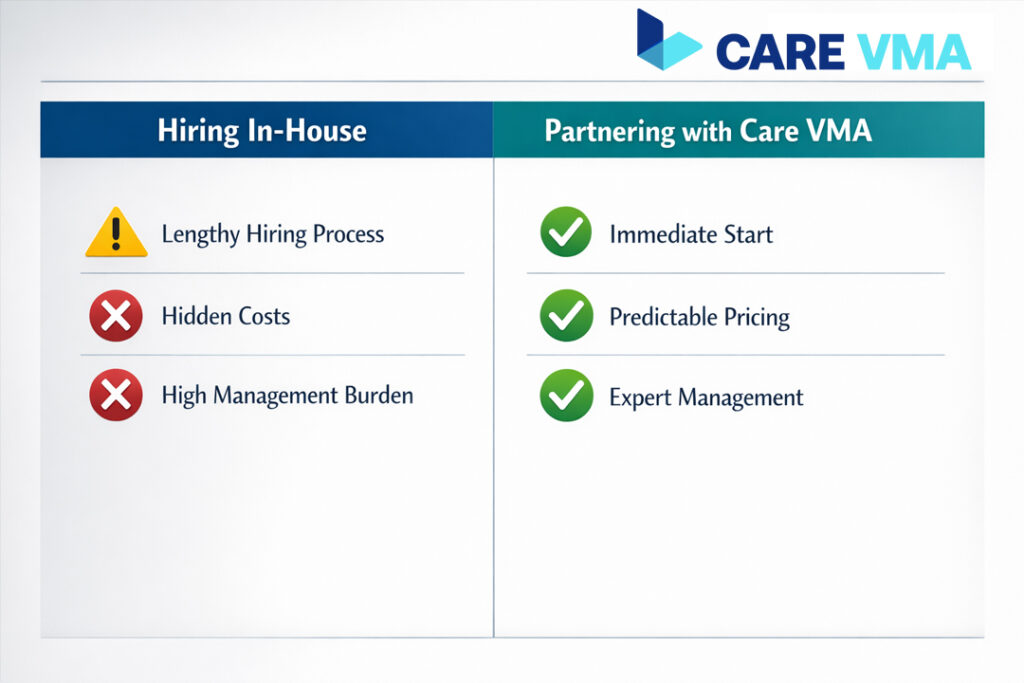
Hiring in-house means you’re responsible for a multi-month process of writing job descriptions, sourcing candidates, conducting interviews, and then onboarding, training, and managing the new hire. You absorb all the overhead: salary, benefits, payroll taxes, IT support, and ongoing management. What happens when they call in sick or go on vacation? The program stalls, and the burden falls right back on your already-strained team. This is precisely the gap most articles on this topic fail to address—they tell you what the role is, but not the smartest way to implement it.
This is where a managed service becomes a powerful strategic advantage.
The Care VMA Advantage: Your ROI-Focused Solution
Partnering with Care VMA for your Virtual Care Coordinator is not just outsourcing a task; it’s insourcing expertise and efficiency from day one.
- Save Months of Time: Forget the recruiting and training grind. Our VCCs are pre-vetted, HIPAA-certified, and already experts in the leading EHR and RPM platforms. They integrate with your team and start delivering value almost immediately.
- Eliminate Management Overhead: We handle all the HR, payroll, and technical support. You get a dedicated, high-performing team member without the administrative headache that comes with distinguishing virtual assistants from employees. Your job is to manage your practice, not more personnel.
- Maximize Efficiency & ROI: Our VCCs operate using proven, optimized workflows designed to maximize billing compliance and program effectiveness. They aren’t learning on the job; they are specialists executing a successful playbook, ensuring you see a faster and higher return on your investment.
Real-World Impact: Consider a 5-physician cardiology practice we worked with. They were struggling to manage their RPM program. Within 60 days of integrating a Care VMA VCC, they had offloaded over 8 hours of administrative work per physician, per week, and saw a 150% increase in their RPM billing.
Tangible ROI: Measuring the Impact of a Virtual Care Coordinator
A VCC isn’t a cost center; it’s a revenue and efficiency driver. The impact is measurable across three key areas that matter directly to you and the practice owners.
Financial ROI
This is the most direct measurement. It includes new revenue generated from fully optimized Chronic Care Management (CCM) and Remote Patient Monitoring (RPM) billing codes. Furthermore, by preventing escalations for chronic patients, VCCs contribute to a measurable reduction in costly ER visits and lower Hospital Readmission Rates, a critical metric in many value-based contracts. As confirmed by the National Institutes of Health (NIH), coordinated care programs are key to improving system-wide efficiency.
Operational Efficiency
Look at your practice’s key metrics. With a VCC, you should see an increase in the number of patients managed per clinician, a decrease in patient call-wait times, and a significant reduction in the time your physicians spend on administrative tasks. This reclaimed time is the single biggest factor in improving physician satisfaction and preventing burnout.
Clinical Outcomes & Patient Satisfaction
The impact on care is profound. Practices with dedicated VCCs report higher rates of Care Plan Adherence, better Medication Reconciliation post-discharge, and a noticeable increase in overall Patient Satisfaction Scores. Patients feel supported and heard, which builds loyalty and leads to better online reviews and word-of-mouth referrals.
FAQ: Common Questions from Practice Managers
What is the average salary for a Virtual Care Coordinator?
In the U.S., the salary can vary based on experience and credentials. According to data from the Bureau of Labor Statistics and market analysis, annual salaries typically range from $49,000–$55,000. However, for a VCC with a nursing license (RN) and specialized experience, compensation can exceed $65,000. This doesn’t include the additional costs of benefits and overhead when hiring in-house.
Does a VCC need to be a licensed nurse?
Ideally, yes—an RN or LPN is preferred, especially for managing RPM/CCM programs where clinical judgment is required to triage alerts. However, some practices find success with highly experienced CMAs or individuals with a Healthcare Administration degree, depending on the specific scope of duties.
How is a VCC different from a Virtual Medical Assistant?
A VCC is a more specialized role. While a Virtual Medical Assistant might handle a broad range of administrative tasks like scheduling and data entry, a VCC is laser-focused on managing long-term care programs (RPM/CCM) and complex Patient Navigation. They are proactive care managers, not just reactive administrative assistants.
Your Next Step Toward a More Efficient Practice
In 2026, the Virtual Care Coordinator is no longer a luxury—it’s an essential strategic asset for any medical practice aiming for growth, efficiency, and sustainability. It represents a direct investment in reducing physician burnout, improving patient outcomes, and strengthening your bottom line. By taking over the persistent, time-consuming tasks of remote patient management, a VCC frees your clinical team to do what they do best: care for patients.
Are you ready to lift the administrative weight from your clinicians’ shoulders and unlock the full potential of your virtual care programs?
Don’t spend another quarter trying to build a new system from scratch. Care VMA provides expertly trained, ready-to-deploy Virtual Care Coordinators who deliver a positive impact from day one. Let us show you what’s possible for your practice.
Schedule a Free, No-Obligation Consultation to Analyze Your Practice’s ROI Potential.