Your heart sinks. Standing at the pharmacy counter, you hear the words, “I’m sorry, your prescription can’t be refilled.” Immediately, a wave of panic sets in. Your mind races with questions. What if I run out of this essential medication? Why was it denied? Suddenly, you are confronted with a maze of unfamiliar terms like “renewal” and “prior authorization.” This frustrating scenario is a symptom of an inefficient healthcare administration system that places the burden of complex logistics squarely on the patient. This guide is designed to be your clear, logical roadmap. We will decode the process, provide a proactive system for managing your medications, and show you how modern solutions can eliminate this panic for good.
Medication management is a structured process to ensure you take the right medicine at the right dose and the right time. It encompasses everything from prescription refills and renewals to coordinating with your doctor, pharmacy, and insurance provider. A well-designed system can prevent gaps in your treatment and reduce the stress associated with healthcare logistics.
Understanding the Key Difference: Prescription Refill vs Renewal
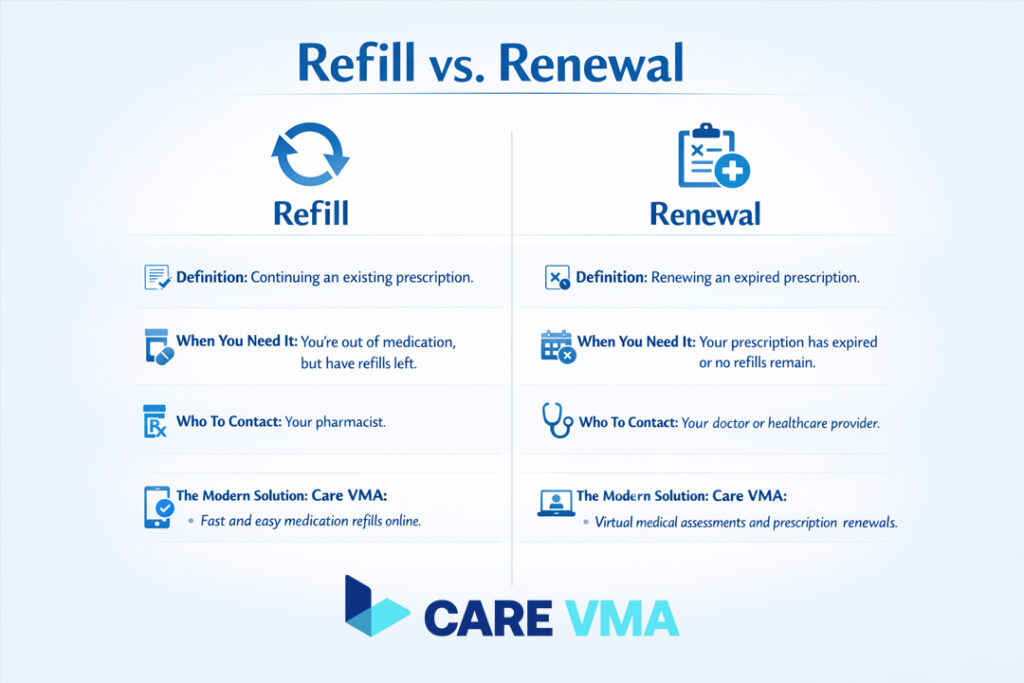
Much of the confusion at the pharmacy stems from two terms that sound similar but are operationally very different: refill and renewal. Understanding which you need is the first step toward a smoother experience. Think of it as the difference between getting a copy of an existing key and needing a locksmith to create a new one.
What is a Prescription Refill?
A refill is an authorization from your doctor, included in your original prescription, to obtain another supply of your medication without a new doctor’s visit. It is essentially a pre-approved repeat. The label on your medication bottle will always state how many refills you have remaining. If you have “3 Refills Left,” you can simply contact the pharmacy directly to get your next supply. This is a simple, direct transaction between you and your pharmacist.
What is a Prescription Renewal?
A renewal, or a new prescription, is required when your original prescription has zero refills left or has expired. Most prescriptions for non-controlled substances are valid for one year from the date they are written. In this case, the pharmacy cannot legally give you more medication. Your doctor must assess your condition and issue a completely new prescription. This requires you to contact your doctor’s office, not the pharmacy, to get the process started. Efficiently scheduling patient intake and follow-up appointments is key to preventing this issue.
4 Best Practices for Seamless Refill Management (A Proactive System)
Waiting for a problem to arise is a reactive strategy. A proactive system prevents “pharmacy panic” by building buffers and automating routines. Adopting these habits is like upgrading your personal health operating system for maximum efficiency.
Implement the “75 Percent Rule” for a Safety Buffer
Most insurance plans allow you to refill a prescription once you have used 75% of your current supply. For a 30-day prescription, this means you can request a refill around day 22 or 23. Doing this consistently creates a one-week safety net, giving you ample time to resolve any unexpected issues like insurance delays or stock shortages without risking a missed dose.
Synchronize Medications for a Single Pickup Day
If you take multiple medications, juggling different refill dates is an unnecessary complication. Ask your pharmacist about “medication synchronization.” They will work with you to align all your prescriptions to be refilled on the same day each month. This consolidates your pharmacy trips and simplifies your to-do list.
Commit to a Single Pharmacy for Maximum Safety
While it may be tempting to shop around for prices, using one pharmacy or pharmacy network is crucial for your safety. A single pharmacy has a complete record of all your medications, allowing the pharmacist’s software to automatically screen for potentially dangerous drug-drug interactions. This centralized data is a powerful safety feature.
Leverage Auto-Refill Programs for Routine Medications
For long-term maintenance medications, such as those for blood pressure or cholesterol, enroll in your pharmacy’s automatic refill program. The system will automatically process your refill when it’s due and notify you via text or call when it’s ready for pickup. This removes the mental load of remembering to call in your refills each month.
Emergency Scenarios: The Right Steps When Your Refill is Denied
Even with a perfect system, you may still face a denial at the counter. Do not panic. There is a logical reason for the rejection, and each reason has a clear solution.
Case 1: “Refill Too Soon”
This is the most common and easiest issue to solve. It means you are trying to refill before the 75% window allowed by your insurance. The solution is simply to wait a few more days. If you need the medication immediately due to travel or a lost dose, you can ask the pharmacist for a short-term partial supply, though you may have to pay for it out-of-pocket.
Case 2: “Prior Authorization Required”
This message means your insurance company needs more information from your doctor to confirm that a specific, often expensive, medication is medically necessary before they will cover it. This is not a final “no.” It is an administrative checkpoint. Your immediate action is to call your doctor’s office and state clearly: “My pharmacy said my prescription for [Medication Name] requires a Prior Authorization.” Your doctor’s office will then need to submit paperwork to your insurance company. This can be a time-consuming process involving multiple phone calls and faxes, a prime example of where physician burnout can occur from administrative overload.
Case 3: “Drug No Longer Covered by Insurance” (Formulary Change)
An insurance formulary is the list of drugs a plan covers. These lists can change, sometimes as often as every year. If your medication is no longer on the formulary, your doctor may need to prescribe a “preferred alternative” that is covered. Ask the pharmacist if there is a recommended alternative, then contact your doctor to request a new prescription for that drug.
Case 4: “Prescription Expired or No Refills Remaining”
This goes back to the difference between a refill and a renewal. If the prescription is over a year old or you have used all your allotted refills, the system will block the transaction. The only solution is to contact your doctor’s office to request a renewal and potentially schedule a follow-up appointment. A healthcare virtual assistant can manage these appointments to ensure they are booked well before your prescription lapses.
The Modern Solution: How Care VMA’s Virtual Medical Assistants Streamline Everything
The problems discussed above are not medical problems; they are administrative failures. They are caused by a fragmented system that requires patients to act as project managers for their own care. This is where technology and specialized support can fundamentally change the experience. Care VMA transforms this stressful, reactive process into a managed, proactive one.
Stop Waiting on Hold: Let a VMA Handle Calls to Doctors and Insurance
The single most frustrating part of a “Prior Authorization” denial is the series of phone calls and follow-ups required. A Virtual Medical Assistant from Care VMA takes on this entire workflow. They will contact the doctor’s office, ensure the correct paperwork is filed with the insurance company, and follow up until the approval is secured, freeing you from hours of hold music and phone tag.
Never Miss a Renewal: Automated Consultation Scheduling
A VMA integrates with your health calendar. They monitor your prescriptions and see when a renewal is approaching. Weeks in advance, they will contact you to schedule the necessary follow-up consultation with your doctor, ensuring you get a new prescription long before the old one runs out.
Optimize Time and Cost: A VMA Researches Alternatives
If a formulary change occurs, you do not have to do the legwork. A VMA can communicate with the pharmacy to identify covered alternatives and then coordinate with your doctor’s office to get the prescription switched. They can even help research pharmacy pricing and patient assistance programs to find the most cost-effective options, directly impacting your healthcare cost management.
Digital Tools for Managing Multiple Medications
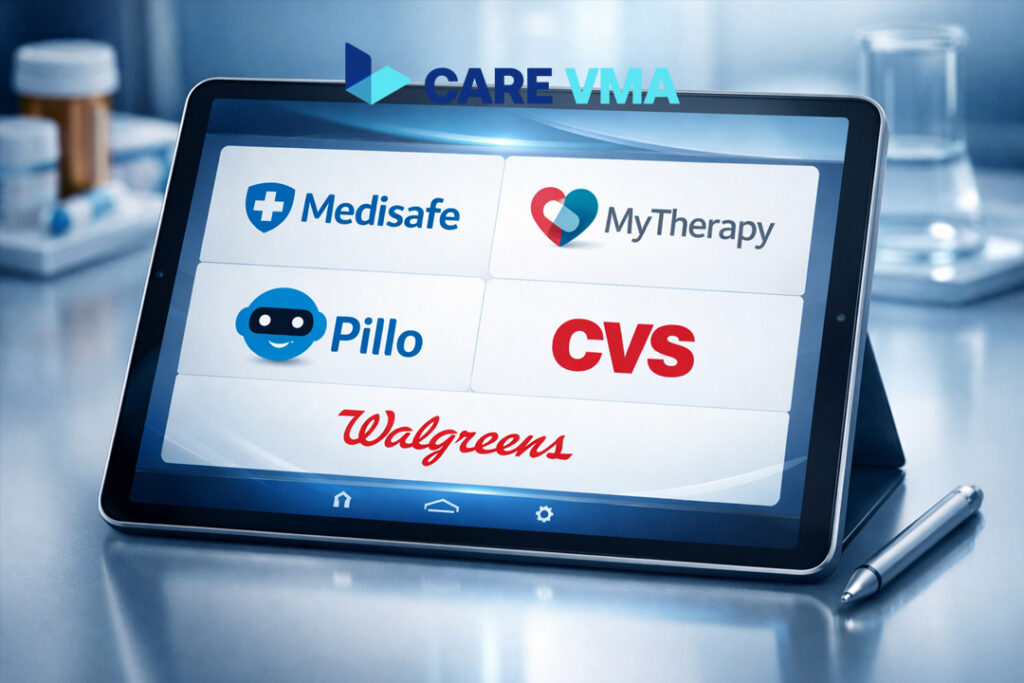
For daily management, several digital tools can help you stay organized. While these apps are excellent instruments, a service like Care VMA acts as the conductor, ensuring all parts of your healthcare orchestra are playing in harmony.
Medication Reminder Apps (Medisafe, MyTherapy, Pillo)
These applications are designed to provide persistent, unmissable reminders to take your medication. Apps like MyTherapy allow you to log each dose, track symptoms, and monitor measurements like blood pressure, creating a valuable health diary.
Pharmacy Logistics Apps (CVS, Walgreens, etc.)
The mobile apps for major pharmacy chains are excellent for the logistical side of refills. You can request refills with a single tap, check on the status of your order, and receive notifications when your prescription is ready for pickup, streamlining the process significantly.
FAQ (Frequently Asked Patient Questions)
What is Medication Therapy Management (MTM) and when do I need it?
MTM is an in-depth, one-on-one consultation with a pharmacist to review all your medications, including over-the-counter drugs and supplements. It is critical if you take more than five different medications or have multiple chronic conditions, as it helps prevent harmful side effects and interactions. This is a core component of effective virtual chronic care management.
How long is a doctor’s prescription typically valid?
Most prescriptions for non-controlled substances are valid for one year from the date they are written by your doctor. However, for controlled substances, the rules are much stricter under federal and state law, and the validity period can be significantly shorter, often just 30 to 90 days.
Can I get a 90-day supply of my medication?
Yes, and for maintenance medications, this is highly recommended. Many insurance plans encourage 90-day supplies as they reduce administrative costs and improve adherence. It also means fewer trips to the pharmacy for you. Ask your doctor to write your prescription for a “90-day supply with 3 refills” to take advantage of this efficiency.
Conclusion & Next Steps
Managing medication refills does not have to be a source of stress and panic. By understanding the system, adopting proactive habits, and leveraging modern technology, you can take complete control of your healthcare logistics. The friction you feel is a system problem, not a personal one, and you do not have to navigate it alone.
Feeling overwhelmed by your prescriptions and insurance paperwork? The team of Virtual Medical Assistants at Care VMA is ready to take over these complex tasks. Schedule a free consultation today to learn how we can simplify your medication management.