This article is for informational and career guidance purposes only. It does not constitute medical advice. Please consult with educational advisors and healthcare professionals for personalized career planning.
Are you considering a career in dermatology but feel overwhelmed by the job titles? You search for “dermatologist assistant,” and the results show wildly different salaries, education requirements, and responsibilities. This confusion is a common problem for aspiring healthcare professionals. Choosing the wrong path can lead to years of misdirected effort and financial investment, ultimately ending in a role that doesn’t match your long-term ambitions. This guide provides a clear, authoritative roadmap. We will dissect the two primary professions this title refers to, giving you the clarity needed to make a confident and informed decision about your future.
The term ‘dermatologist assistant’ often refers to two very different professions: a Dermatology Medical Assistant (MA), who focuses on clinical support, and a Dermatology Physician Assistant (PA), a licensed medical practitioner. This guide will break down both career paths so you can choose the one that best fits your goals.
Understanding the Core Roles: MA vs PA in Dermatology
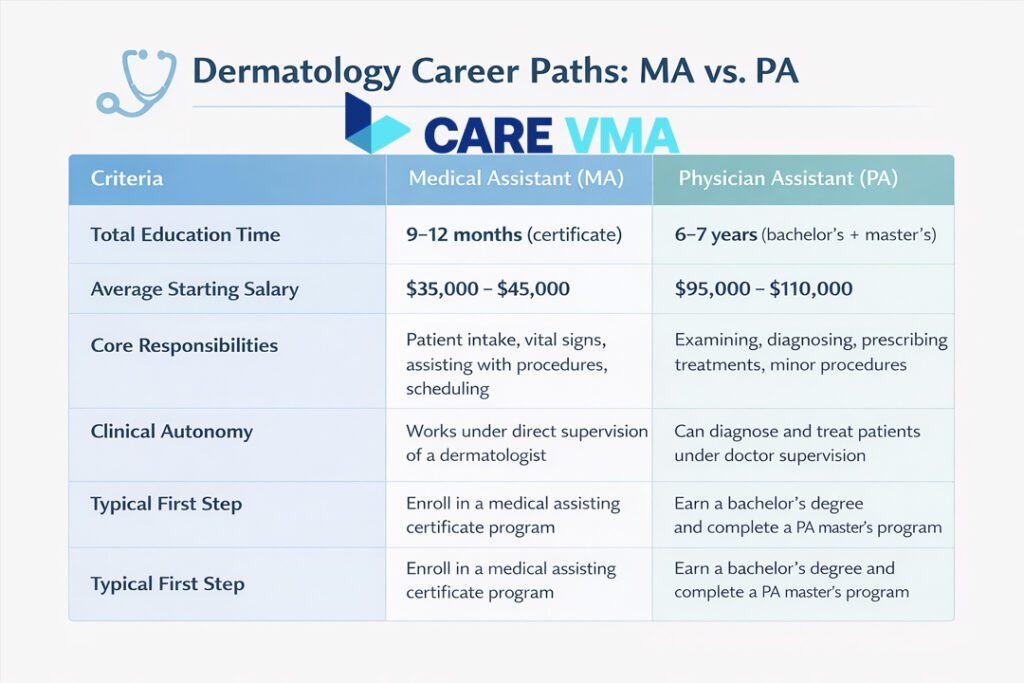
Before diving into the step-by-step process, it is crucial to understand the fundamental differences between a Medical Assistant and a Physician Assistant in a dermatology setting. The choice between these paths will define your daily tasks, level of autonomy, earning potential, and the time you need to invest in education.
A Dermatology Medical Assistant (MA) is a vital support professional who handles both clinical and administrative tasks. They work directly under the supervision of dermatologists and PAs, ensuring the clinic operates smoothly and patients are prepared for their appointments.
A Dermatology Physician Assistant (PA), on the other hand, is a licensed medical provider who diagnoses and treats patients. They have completed a master’s-level program and work with a high degree of autonomy, though they are supervised by a physician.
Here is a clear comparison of the two roles:
How to Become a Dermatology Medical Assistant (MA) – The Fast-Track to the Industry
This pathway is ideal for individuals who want to enter the healthcare field relatively quickly and play a hands-on support role in patient care. The journey to becoming a Derm MA is focused on efficiency and practical skills.
- Step 1: Education and Program Completion (9 months – 2 years) Your first step is to obtain a high school diploma or GED. Following that, you must enroll in a medical assisting program. These programs are offered at community colleges, vocational schools, and technical colleges. You can choose between a certificate or diploma program (around 9-12 months) or an associate’s degree program (around 2 years).
- Step 2: Achieving Essential Certification (CMA or RMA) While licensure is not required in every state, virtually all reputable dermatology practices require certification. It is the gold standard that demonstrates your competence and commitment to the profession. The two most recognized certifications are:
- Certified Medical Assistant (CMA) from the American Association of Medical Assistants (AAMA).
- Registered Medical Assistant (RMA) from American Medical Technologists (AMT). Passing one of these certification exams is a non-negotiable step for a competitive career.
- Step 3: Dermatology Specialization and On-the-Job Training After certification, you can seek out specialty training. Some MAs pursue additional certifications in dermatology, but much of your specialized knowledge will come from on-the-job training. You will learn dermatology-specific terminology, how to assist in procedures like biopsies and cryosurgery, and the protocols for various skin conditions.
The Day-to-Day: Duties and Responsibilities of a Derm MA A Derm MA’s role is dynamic. Tasks often include:
- Escorting patients to exam rooms and taking vital signs.
- Documenting patient history and the reason for the visit.
- Assisting the dermatologist or PA with minor procedures.
- Preparing and sterilizing instruments.
- Educating patients on post-procedure care.
- Handling administrative tasks like scheduling appointments and managing patient records.
This role requires a blend of clinical skill and administrative efficiency, making you an essential partner in healthcare operations.
How to Become a Dermatology Physician Assistant (PA) – The Medical Practitioner Route
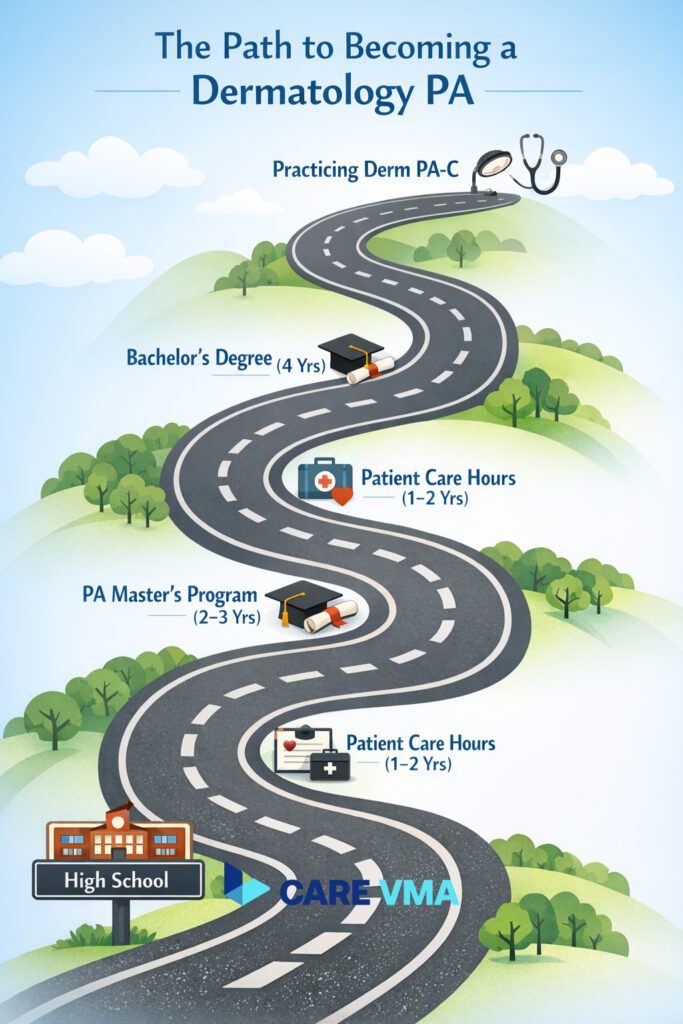
This path is for those who aspire to diagnose conditions, create treatment plans, and perform procedures with significant autonomy. It is a longer and more academically rigorous journey, culminating in a master’s degree and a license to practice medicine.
- Step 1: Earning a Bachelor’s Degree and Prerequisites (4 years) The foundation for PA school is a four-year bachelor’s degree, typically in a science-focused field like biology, chemistry, or health sciences. During your undergraduate studies, you must complete a series of prerequisite courses required by PA programs, which often include anatomy, physiology, microbiology, and organic chemistry.
- Step 2: Gaining Thousands of Patient Care Hours (Scribing is Key) PA schools require extensive hands-on patient care experience, often between 1,000 to 2,000 hours. This is a critical component of your application. Many pre-PA students gain this experience by working as a Medical Assistant, EMT, or a Certified Nursing Assistant. One of the most strategic roles to gain this experience is as a medical scribe. Understanding what a medical scribe does reveals how it provides direct exposure to clinical decision-making and terminology.
- Step 3: Completing a PA Master’s Program (2-3 years) Once you have your degree and clinical hours, you can apply to an accredited PA program. These highly competitive programs typically last 26 months and include intensive classroom instruction followed by clinical rotations across various medical specialties, including dermatology.
- Step 4: Passing the PANCE National Exam and Gaining Licensure After graduating from PA school, you must pass the Physician Assistant National Certifying Exam (PANCE) to earn the PA-C (Physician Assistant-Certified) credential. With this certification, you can then apply for a state license to practice. Many dermatology PAs also join the Society of Dermatology Physician Assistants (SDPA) for advanced training.
The Day-to-Day: Duties and Autonomy of a Derm PA A Dermatology PA’s responsibilities are extensive and mirror those of a dermatologist. They include:
- Performing comprehensive skin exams.
- Diagnosing skin conditions, from acne to skin cancer.
- Prescribing medications.
- Performing surgical procedures like biopsies, excisions, and laser treatments.
- Developing and managing patient treatment plans.
An Insider’s Guide: What Do Top Dermatology Clinics Look For?
Beyond degrees and certifications, top-tier clinics search for candidates with a specific blend of technical and personal skills. As a company that partners with healthcare practices, we have a clear view of what makes an applicant truly stand out from the rest.
The Non-Technical Skills That Make You Stand Out
- Empathy and Communication: Patients are often anxious about their skin conditions. The ability to listen, explain procedures clearly, and show genuine compassion is paramount for improving patient engagement.
- Meticulous Attention to Detail: In dermatology, small details matter, from documenting the exact size of a mole to ensuring correct instrument sterilization.
- Composure Under Pressure: Dermatology clinics can be fast-paced. The best assistants remain calm, efficient, and organized during busy periods.
The Power of Shadowing and Scribing on Your Resume A resume that lists shadowing experience shows initiative. It proves you have invested your own time to understand the profession. Experience as a medical scribe is even more valuable. It demonstrates to a hiring manager that you are already familiar with the clinic’s workflow, EMR systems, and the complex language of dermatology.
Career Progression: From MA to PA or Other Senior Roles A career as a Dermatology MA is often a fantastic stepping stone. Many MAs use their experience to build a strong application for PA school. Others advance into senior roles within the clinic, such as a clinical team lead, Mohs histotechnician, or practice administrator. The experience provides an invaluable foundation for future growth.
FAQ: Frequently Asked Questions About Dermatology Assistant Careers
How long does it take to become a dermatologist assistant?
This depends entirely on the path you choose. You can become a certified Dermatology Medical Assistant (MA) in as little as one to two years. Becoming a licensed Dermatology Physician Assistant (PA) is a much longer commitment, typically taking seven to eight years of education and training after high school.
Can I work as a dermatologist assistant without certification?
While it may be legally possible in some states for an MA to work without certification, it is highly discouraged. Reputable dermatology clinics almost universally require certification (CMA or RMA for MAs, PA-C for PAs) as a baseline standard for patient safety, trust, and professional competence.
What is the most practical first step I can take right now?
The two best first steps are action-oriented. First, contact local dermatology clinics and inquire about shadowing opportunities to see the roles firsthand. Second, actively search for entry-level positions as a medical scribe in dermatology. This is one of the most effective ways to get your foot in the door and confirm if this field is right for you.
Conclusion and Your Next Step
Both the Medical Assistant and Physician Assistant paths offer rewarding, stable, and essential careers within the dynamic field of dermatology. The right choice depends on your personal and professional goals. If you are eager to enter the workforce quickly and excel in a supportive role, the MA path is an excellent option. If your ambition is to diagnose, treat, and have a high degree of clinical autonomy, the rigorous PA journey is your calling.
For dermatology practices aiming to build a world-class team, optimizing your staff’s workflow is key. Care VMA provides expertly trained professionals to handle critical tasks, allowing your in-house team to focus on what matters most: patient care. Explore our Virtual Medical Scribe and Virtual Medical Assistant services to see how we can elevate your practice.