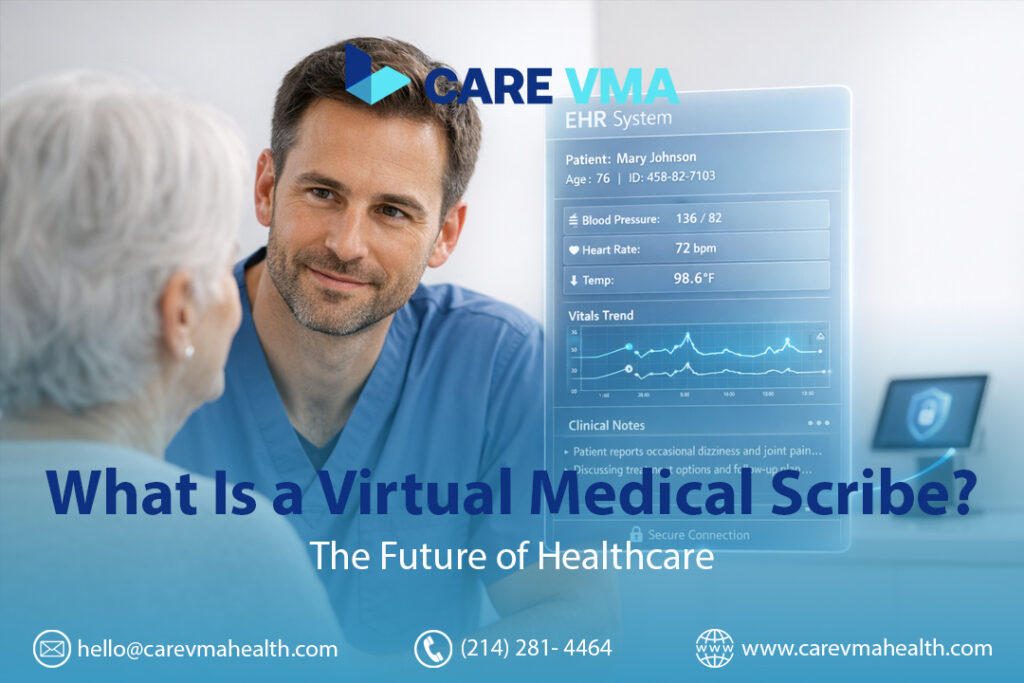
Tired of your physicians spending more time on keyboards than on patient care? The administrative burden of Electronic Health Records (EHRs) is a well-known drain on clinic resources, leading to physician burnout, operational bottlenecks, and a strained patient experience. This isn’t just a clinical problem; it’s an operational one that directly impacts your practice’s bottom line.
A Virtual Medical Scribe is a remote healthcare professional who connects to patient encounters via a secure, HIPAA-compliant platform to handle clinical documentation and administrative tasks in real-time. They act as a physician’s documentation partner, managing EHR charting, which reduces burnout and allows doctors to focus entirely on patient care.
For clinic operators, this isn’t just about faster typing. It’s a strategic solution to reclaim your team’s most valuable asset: time. This guide breaks down exactly how a virtual scribe integrates into your daily operations and transforms your workflow.
The Core Problem: Why Your Clinic Is Drowning in Administrative Work
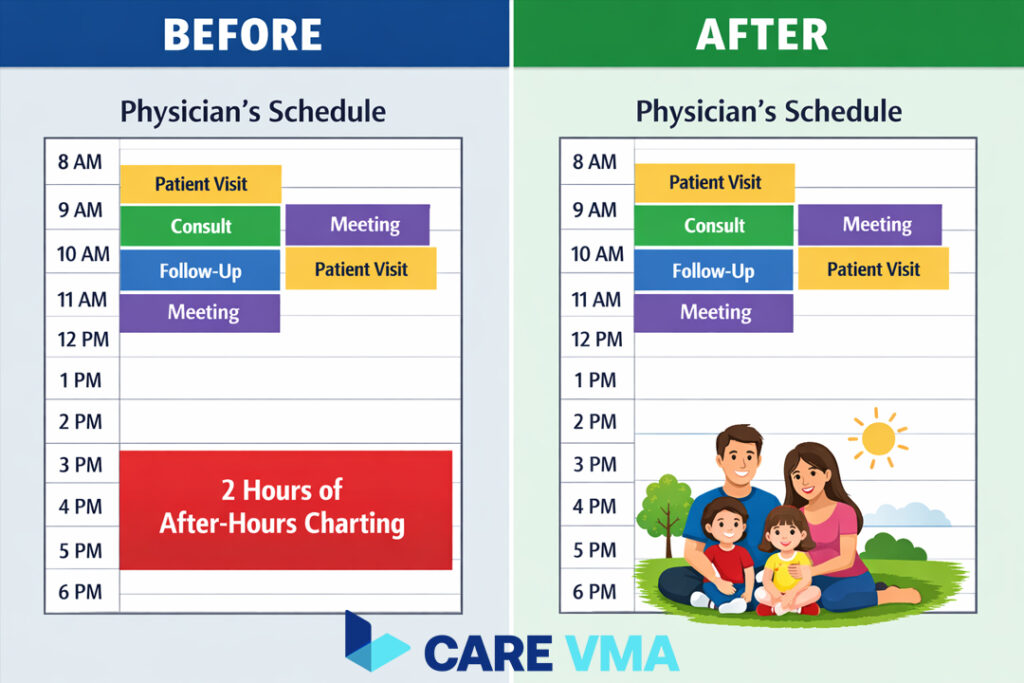
The promise of the EHR was efficiency, but the reality for most practices has been a mountain of data entry. For every hour of direct patient care, physicians now spend nearly two hours on EHR and desk work. This after-hours charting, often called “pajama time,” is a leading cause of burnout and a clear sign of an inefficient workflow.
This isn’t just a physician problem. It creates a ripple effect across the entire clinic:
- Chart backlogs slow down billing and the revenue cycle.
- Patient throughput decreases as doctors are tied to their computers.
- Administrative staff get bogged down chasing incomplete notes for referrals and orders.
This is where most practices struggle. The issue isn’t a lack of effort from your team; it’s a lack of a system designed to separate the clinical and clerical duties of a patient encounter.
What Does a Virtual Medical Scribe Actually Do?
A common misconception is that a virtual scribe is simply a remote transcriptionist. In reality, a skilled scribe doesn’t just type what they hear—they interpret and structure the clinical narrative directly into the EHR. They are trained in medical terminology and understand the flow of a patient visit, functioning as a true extension of your clinical team.
Here’s how they fit into your daily workflow:
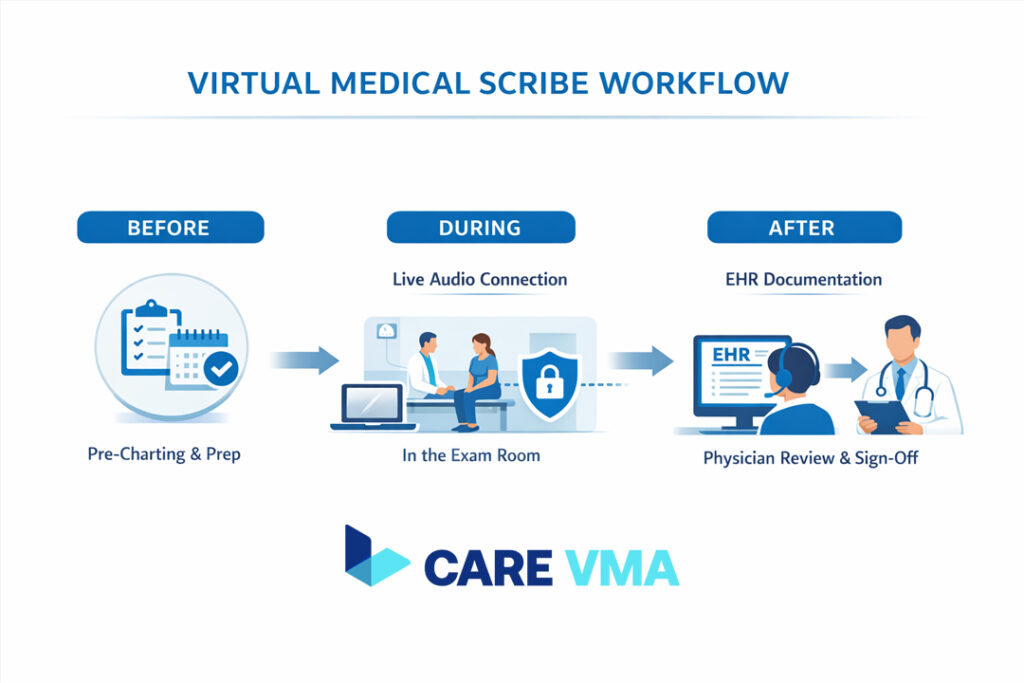
Before the Patient Arrives: Pre-Charting and Prep
The work starts before the physician even enters the exam room. The virtual scribe accesses the day’s schedule and prepares for each visit by:
- Reviewing the patient’s chart, recent lab results, and imaging reports.
- Teeing up the note in the EHR with the patient’s history and reason for visit.
- Noting any care gaps or health maintenance items that are due. This preparation saves the physician critical minutes at the start of every single appointment.
During the Patient Encounter: Real-Time Documentation
This is the core function. The physician connects with the scribe via a secure, ambient audio connection on a tablet or laptop in the exam room. As the physician speaks with the patient, the scribe documents the encounter directly into the correct fields of your EHR, including:
- History of Present Illness (HPI)
- Review of Systems (ROS)
- Physical Exam findings
- Assessment and Plan
Crucially, because the physician is free from typing, they can maintain eye contact and give the patient their undivided attention, significantly improving the patient experience.
After the Patient Leaves: Finalizing the Chart and Admin Tasks
By the time the physician walks out of the exam room, the patient’s chart is already 95% complete. The virtual scribe finalizes the note, ensures accuracy, and can even queue up referrals, lab orders, and prescriptions for the physician’s final review and signature. They can also help apply appropriate ICD-10 and CPT codes based on the documentation.
The result? The physician simply needs to do a quick review and sign off. The chart is closed in minutes, not hours. This level of support extends beyond simple scribing, often overlapping with the duties that Virtual Medical Assistants can handle, further streamlining clinic operations.
The Workflow in Action: Synchronous vs. Asynchronous Models
How does this remote connection actually work in a busy clinic? There are two primary models, and the right one depends on your practice’s pace and preferences.
The Synchronous (Real-Time) Model
This is the most common model. The virtual scribe is connected to the exam room via a live, secure audio/video stream.
- How it works: The scribe is “virtually” in the room, listening to the encounter and documenting as it happens. Charts are ready for sign-off almost immediately.
- Best for: Fast-paced environments like urgent care, high-volume specialty clinics, or any practice where immediate chart closure is a priority for the revenue cycle.
The Asynchronous (Recorded) Model
In this model, the physician uses a secure mobile app to record the patient encounter or their dictations after the visit.
- How it works: The recording is sent to the scribe, who then completes the documentation in the EHR. Turnaround time is typically a few hours.
- Best for: Practices with more predictable schedules or physicians who prefer to dictate their notes in batches between patients.
Is It Secure? A Look at the HIPAA-Compliant Technology
Handing over clinical documentation to a remote team member naturally raises questions about security. This is a valid and critical concern. A professional virtual scribe service is built on a foundation of security and strict adherence to HIPAA compliance and data security protocols.
The security is multi-layered:
- Technology: All connections use end-to-end encryption through secure platforms and VPNs. No patient data is ever stored on a scribe’s local computer.
- People: Scribes undergo rigorous background checks and comprehensive HIPAA training. They are dedicated professionals who understand the gravity of protecting patient health information (PHI).
- Process: Scribes operate from secure, private environments. Reputable companies have strict protocols and are covered by Business Associate Agreements (BAAs) to ensure full legal and procedural compliance.
The Tangible Benefits for Your Practice Operations
Implementing a virtual scribe service translates directly into measurable improvements for your clinic.
Reclaim Physician Time & Reduce Burnout
Eliminating 1-2 hours of nightly charting does more than just make for a better evening. It means your physicians arrive the next day more focused, less stressed, and better equipped to provide quality care. Reducing this administrative burden is one of the most effective physician burnout solutions a practice can implement.
Increase Patient Throughput and Revenue
When charting and administrative wrap-up for each patient is reduced from 10-15 minutes to just 1-2 minutes, the math is simple. That saved time allows for either seeing more patients per day or ensuring every appointment runs on time, boosting both revenue and patient satisfaction.
Improve Billing Accuracy and Speed
Incomplete or delayed charts are a primary cause of claim denials and slow reimbursement. With a trained scribe ensuring every note is detailed, accurate, and coded correctly, you create a cleaner, faster revenue cycle.
Enhance the Patient Experience
Patients notice when their doctor is distracted by a computer screen. By allowing physicians to engage in face-to-face conversation, you build stronger rapport and trust, which are foundational to better patient outcomes.
Virtual Human Scribe vs AI Scribe: Which is Right for Your Workflow?
The rise of AI has introduced a new option for documentation. While AI scribes are promising for simple note generation, a human virtual scribe is an administrative force multiplier. This is often an overlooked distinction.
An AI can transcribe a conversation into a SOAP note. However, a human scribe can interpret nuance, handle complex administrative requests, and manage the multi-step tasks that are part of a real clinical workflow.
| Feature | Human Virtual Scribe | AI Scribe | In-Person Scribe |
|---|---|---|---|
| Core Function | Documentation & Admin Support | Automated Note Generation | Documentation & Clinical Support |
| Task Complexity | High (Can manage referrals, calls, coding) | Low (Primarily transcription) | Highest (Can assist with patients) |
| Workflow Integration | Seamless remote team member | Software tool | Physical team member |
| Cost | Moderate | Low | High |
| HIPAA Compliance | High (Vetted professionals, BAA) | Variable (Depends on vendor) | High (Direct employee) |
| Ideal For | Practices needing to offload both documentation and complex admin tasks. | Practices needing basic note automation with low complexity. | Practices needing a full clinical assistant in the room. |
If your practice’s bottlenecks go beyond just charting—like managing referrals, following up on labs, or pre-authorizations—you need more than an AI tool. You need an intelligent human partner. The distinction between a medical scribe vs. a medical assistant is key; a virtual scribe often performs many assistant-level administrative tasks remotely.
Getting Started: How to Integrate a Virtual Scribe into Your Clinic
Bringing a virtual scribe onto your team is a straightforward process designed to minimize disruption.
- Workflow Assessment: We start by understanding your specialty, EHR system, and specific documentation and administrative pain points.
- Secure Setup: Our team guides you through the simple, HIPAA-compliant technology setup, ensuring all connections are secure.
- Scribe Matching & Training: You’re matched with a scribe who is trained not only on your EHR but also on your personal preferences and dictation style.
- Go-Live & Optimization: You begin with a pilot phase to ensure a smooth transition. We provide continuous support and optimize the workflow based on your feedback.
Is a Virtual Medical Scribe the Right Solution for Your Practice?
If your clinic is struggling with chart backlogs, physician burnout, or operational drag caused by EHR documentation, a virtual medical scribe is no longer a luxury—it’s essential infrastructure for a modern, efficient practice.
By offloading the clerical burden, you empower your physicians to work at the top of their license, focusing exclusively on what they do best: providing exceptional patient care. This simple change can unlock new levels of efficiency, profitability, and staff satisfaction.
Ready to eliminate the documentation burden and give your physicians their time back? Schedule a free, no-obligation consultation with our workflow specialists to see how a Care VMA Health Virtual Scribe can be integrated into your practice.