![What Does a Virtual Medical Assistant Do? [Practice Guide]](https://carevmahealth.com/wp-content/uploads/2026/03/What-Does-a-Virtual-Medical-Assistant-Do-1024x683.jpg)
Disclaimer: This article is for informational purposes only and does not constitute professional business management advice. We recommend consulting with a practice management specialist for decisions specific to your organization.
Are the endless stacks of EHR documents, relentless phone calls, and complex insurance verifications consuming the time you should be spending with patients? You are not alone. This crushing administrative burden is more than just frustrating; it is a leading cause of physician burnout, a drag on care quality, and a barrier to your practice’s growth. The time spent after hours finishing charts—what many call “pajama time”—is a clear symptom of an inefficient system.
A Virtual Medical Assistant (VMA) is a trained professional who provides administrative, clinical, and technical support for medical practices from a remote location. Using secure, HIPAA-compliant software, they manage a wide range of non-patient-facing tasks, which allows physicians, nurses, and other clinical staff to redirect their full attention to patient care. Imagine a practice where you leave on time, charts are complete, and your focus is entirely on diagnosis and treatment. This is the strategic solution a VMA is designed to deliver.
Four Core Categories of Virtual Medical Assistant Tasks
A VMA’s responsibilities are broad, but they typically fall into four essential pillars that support a modern medical practice. Understanding these roles reveals how they systematically dismantle operational bottlenecks.
Administrative and Front-Office Tasks (The Foundation of Practice Efficiency)
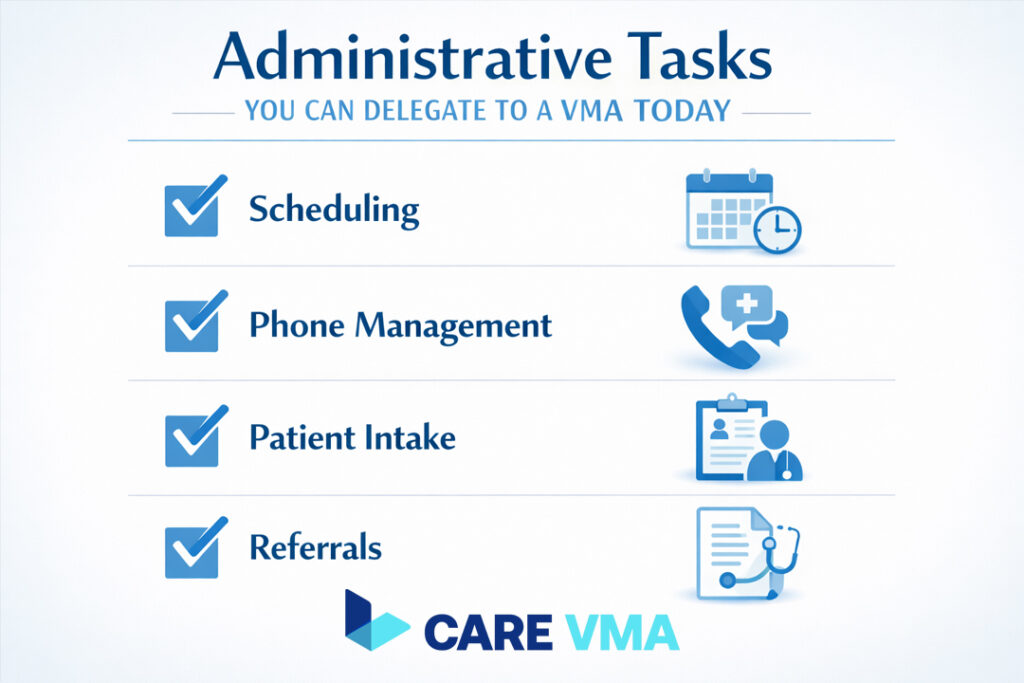
This is the operational backbone of your practice. A VMA ensures the patient journey begins smoothly and that daily operations run without interruption.
- Appointment Scheduling and Reminders: Managing the calendar, booking new appointments, handling cancellations, and sending automated reminders to drastically reduce no-show rates.
- Phone and Email Management: Acting as your virtual medical receptionist to answer patient inquiries, route urgent calls, and manage your practice’s inbox.
- Digital Patient Intake Process: Sending new patient forms digitally, ensuring completion before the visit, and uploading them directly into the EHR.
- Referral Coordination: Managing outgoing and incoming referrals to ensure continuity of care and close communication loops with specialists.
Clinical Support and Medical Scribing (Giving Time Back to Physicians)
Many VMAs have clinical backgrounds, allowing them to handle tasks that require medical knowledge and precision, directly freeing up physicians’ time.
- Real-Time Virtual Scribing: Securely listening into patient encounters (telehealth or in-person) and documenting the visit in the EHR as it happens. This eliminates after-hours charting.
- Prescription Refill Management: Processing refill requests from patients and pharmacies, verifying information, and preparing them for the physician’s final approval.
- Telehealth Technical Assistance: Helping patients connect to their virtual visit, troubleshooting technical issues, and ensuring a smooth experience for both patient and provider.
- Medical Transcription: Converting physician voice notes and dictations into accurately formatted clinical documents or referral letters.
Billing and Insurance Verification (Optimizing the Revenue Cycle)
Financial health is critical. A VMA streamlines the revenue cycle by handling time-consuming financial tasks that are prone to error when rushed.
- Insurance Eligibility Verification: Proactively verifying patient insurance coverage before appointments to prevent claim denials and surprise bills.
- Prior Authorization Submissions: Managing the entire prior authorization process for procedures and medications, a major administrative burden for in-house staff.
- Claims and Denial Management: Assisting with the tracking of submitted claims, identifying the root cause of denials, and managing the appeals process.
Patient Communication and Care Management (Enhancing Patient Engagement)
Consistent communication improves patient satisfaction and outcomes. A VMA acts as a reliable extension of your care team.
- Post-Procedure Follow-Up Calls: Checking in with patients after procedures to monitor their recovery and answer non-clinical questions.
- Communicating Normal Lab Results: Relaying normal and non-critical lab results to patients as directed by the provider, saving valuable clinical staff time.
- Chronic Care Management Support: Assisting with patient tracking, scheduling follow-ups, and ensuring patients adhere to their care plans.
The Strategic Advantages of a VMA for the Modern Practice
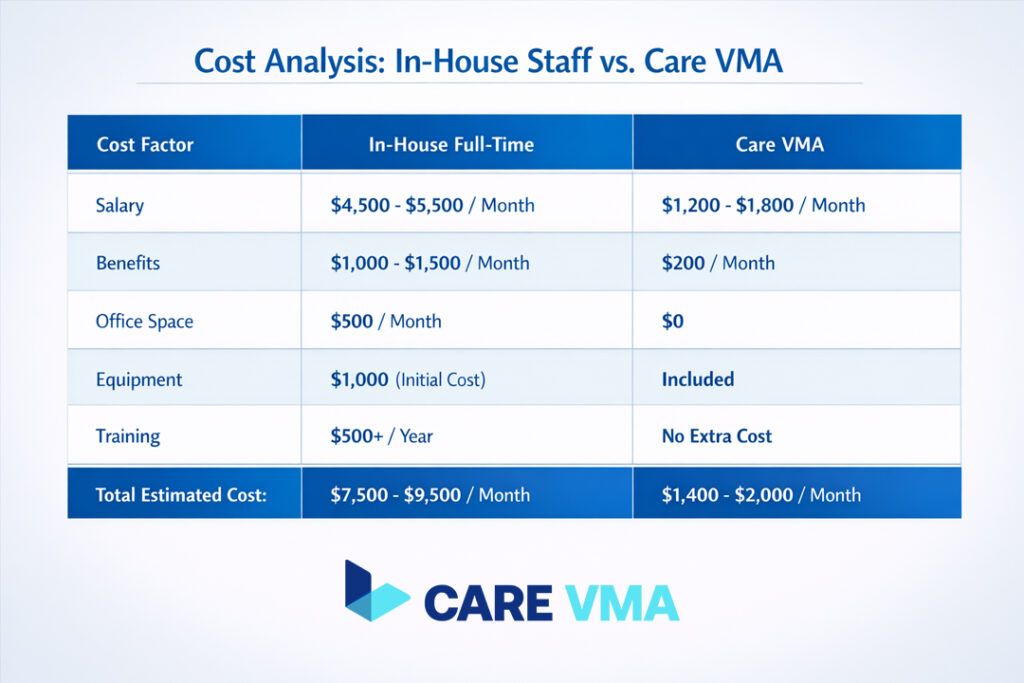
Viewing a VMA as a line-item expense misses the point. Integrating a VMA is a strategic investment in efficiency, staff well-being, and profitability.
Significant Cost Savings: More Than Just a Salary
Hiring a VMA is typically 40-70% more cost-effective than an in-house employee. This is because you eliminate overhead costs associated with a full-time staff member, including office space, equipment, utilities, payroll taxes, and benefits. This is a direct boost to your practice’s bottom line.
Reducing Burnout and Improving Staff Retention
By offloading the most repetitive and time-consuming administrative work, a VMA directly combats the primary causes of staff burnout. This eliminates “pajama time” charting for physicians and allows your entire team to work at the top of their license, leading to higher job satisfaction and lower turnover.
Scalability to Match Your Practice Needs
Your patient volume fluctuates. Unlike a rigid full-time hire, Care VMA offers a flexible model. You can hire a VMA for just 10, 20, or a full 40 hours per week, scaling support up or down as your practice grows or experiences seasonal peaks. This ensures you only pay for the support you need.
Care VMA’s Human Professionals: Empathy AI Cannot Replace
In an age of automation, many practices worry a VMA is just a chatbot. We want to be clear: our VMAs are highly trained human professionals. They provide the empathetic, personalized, and nuanced communication that builds strong patient relationships and trust—something a purely AI solution cannot replicate.
When Is Your Practice Ready for a Virtual Medical Assistant?
If you are experiencing any of the following, it is a strong signal that integrating a VMA could provide significant returns.
- You Continuously Work After Practice Hours: If “pajama time” is your normal, a VMA can reclaim your evenings by handling documentation and administrative follow-up.
- Your Administrative Staff Costs Are Too High: A VMA offers a more affordable and scalable alternative to hiring another full-time, in-office employee.
- Your Patient No-Show Rate Is High: A dedicated VMA managing appointment confirmations and reminders can significantly reduce missed appointments.
- Your Staff Is Overwhelmed with Admin Tasks: If your clinical team is bogged down with paperwork instead of patient care, a VMA can restore their focus and efficiency.
- You Want to Grow Without Adding Office Space: A VMA allows you to expand your practice’s capacity for patient care without the expense of a larger physical footprint.
Frequently Asked Questions from Medical Professionals
Are Virtual Medical Assistants secure and HIPAA-compliant?
Yes. Reputable agencies like Care VMA operate on encrypted, secure platforms. All our VMAs receive rigorous training on HIPAA compliance and data security and sign comprehensive confidentiality agreements to ensure patient information is protected.
What is the difference between a VMA and a Medical Scribe?
A Medical Scribe focuses exclusively on real-time documentation of clinical encounters. A VMA has a much broader role, encompassing all the duties of a scribe plus administrative, billing, and patient communication functions.
How is a VMA onboarded into our practice’s workflow?
The process is designed to be seamless. Care VMA works closely with your team to understand your specific workflows, EHR system, and communication preferences. Your VMA is then trained specifically for your practice’s needs before they begin, ensuring a smooth integration.
Conclusion: Reclaim Your Time and Refocus Your Practice
In 2026, adopting a Virtual Medical Assistant is no longer a luxury; it is a critical strategic step toward building an efficient, profitable, and sustainable medical practice. It is an investment in reducing physician burnout, enhancing the quality of patient care, and, most importantly, giving you back your time.
Ready to stop managing administration and start leading your practice? Schedule a free, no-commitment consultation with our workflow architects at Care VMA to discover how a Virtual Medical Assistant can be tailored to your unique needs.