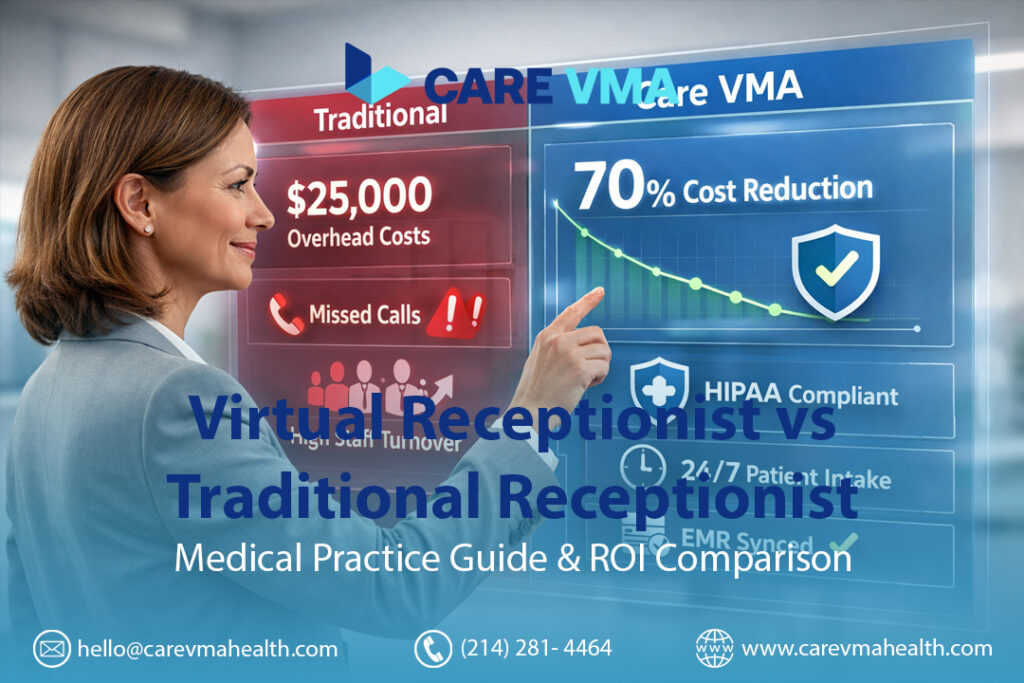
The relentless administrative burden is a silent contributor to physician burnout. Between managing patient care and the complexities of running a practice, the last thing you need is the revolving door of front-desk staff, the frustration of a constantly ringing phone, or the anxiety of a full voicemail inbox.
Here’s the thing many practice managers know too well. Problem: Hiring, training, and retaining qualified front-desk staff is a costly, time-consuming cycle, often with a high turnover rate. Agitate: Every call that goes to voicemail isn’t just a missed appointment; it’s lost revenue, a potential patient seeking care elsewhere, and in the worst-case scenario, a delayed response to an urgent medical need. Solution: The landscape is shifting. By understanding the operational and financial differences between traditional staff and a specialized, HIPAA-compliant Virtual Medical Assistant (VMA), you can reclaim control over your practice’s efficiency and profitability.
The primary difference between a virtual receptionist and a traditional receptionist in a medical practice lies in location, operational scope, and cost efficiency. A medical virtual receptionist is a remote, HIPAA-trained professional who handles patient intake, scheduling, and communications 24/7. In contrast, a traditional receptionist operates physically within the clinic, limited by standard business hours and carrying significantly higher overhead costs.
This guide isn’t about generic business advice. It’s a clinical and operational comparison grounded in the realities of healthcare, focusing on critical factors like HIPAA compliance, EMR/EHR integration, and the direct impact on patient care and your bottom line.
What is a Virtual Medical Receptionist vs a Traditional One?

This isn’t just about who answers the phone. In healthcare, your front desk is the first line of patient care, and the distinction between these two roles is critical.
A traditional receptionist is a physical presence in your office. They are the face of your practice, greeting patients, managing walk-ins, and handling in-office administrative tasks. Their role is defined by the four walls of your clinic and a 9-to-5 schedule.
A Virtual Medical Receptionist, or a VMA specializing in front-desk duties, is an extension of your clinical team operating remotely. They are not just a generic answering service; they are healthcare-trained professionals who manage the digital front door of your practice. This includes everything from initial Patient Intake and scheduling directly within your EMR Integration to ensuring every interaction meets strict HIPAA Compliance standards. They are specialists in communication, technology, and patient confidentiality.
Core Differences at a Glance
| Feature | Virtual Medical Receptionist | Traditional Receptionist |
|---|---|---|
| Location | Remote, secure environment | On-site at the clinic |
| Availability | 24/7/365, including after-hours | Standard business hours |
| Cost Model | Subscription-based (no overhead) | Full-time salary + benefits + overhead |
| Scalability | Instantly scalable for call volume | Limited to one person’s capacity |
| HIPAA Training | Specialized and mandatory | Varies; requires practice-led training |
| EMR/CRM Sync | Core function; real-time updates | Manual data entry; potential for delay |
The Hidden Costs of a Traditional Front-Desk Staff
The salary on the job offer is just the tip of the iceberg. What most practice owners don’t fully calculate is the true, loaded cost of an in-house receptionist, which creates a significant financial trap.
The primary issue isn’t just the salary, which often ranges from $35,000 to $50,000 annually. The real financial drain comes from the hidden costs:
- Payroll Taxes: FICA, federal, and state unemployment taxes add a significant percentage on top of the base salary.
- Benefits: Health insurance, paid time off, sick leave, and retirement contributions can increase total labor costs by 30% or more.
- Overhead: This includes the physical space, desk, computer, phone system, and utilities required for that employee.
- Recruitment & Training: The cost of job postings, background checks, and the non-billable hours you and your staff spend training a new hire is substantial.
But the most significant, often overlooked cost is the high Front-desk Turnover rate common in healthcare settings. The emotional layer here is the direct link between this administrative chaos and Physician Burnout. Every time a receptionist leaves, the burden of retraining, covering shifts, and managing front-desk gaps often falls back on the clinical staff or the physicians themselves, pulling them away from patient care. This cycle of hiring and retraining is not just expensive; it’s exhausting.
Why “9-to-5” Availability is a Liability in 2026?
Your patients’ health concerns don’t stop at 5 PM. Why should your practice’s accessibility? In today’s digitally connected world, limiting patient communication to traditional business hours is a direct path to losing patients to more responsive competitors.
Patients now expect convenience. They want to schedule appointments in the evening after work, on weekends, or early in the morning. When their call goes to voicemail, they don’t wait—they simply call the next practice on their list. This is where After-hours Coverage becomes a critical component of Patient Retention.
Furthermore, the rise of Telehealth Support means that patients need to communicate with your practice outside of a physical visit. A 9-to-5 receptionist cannot adequately support a modern, flexible healthcare model. Failing to provide 24/7 access means you are actively turning away new patients and creating friction for your existing ones.
The Modern Solution: The Care VMA Strategy for Practice Efficiency
What most people don’t realize is that a Medical Virtual Assistant is fundamentally different from a generic virtual receptionist. A general VA answers calls. A Care VMA integrates into your clinical workflow as a strategic partner.
This is where Care VMA closes the gaps left by both traditional staff and basic answering services. Our approach is built on three pillars designed for the high-stakes healthcare environment:
- Deep EMR/CRM Synchronization: Our VMAs don’t just take messages; they work directly within your systems. Whether you use Athena, Jane, or another EMR, our assistants handle scheduling, update patient records, and manage intake in real-time. This eliminates double data entry and reduces the risk of medical errors.
- HIPAA-Specific Workflows: We go beyond a simple compliance checkbox. Our team is trained on strict data security protocols and patient confidentiality, ensuring every interaction is secure. This is a level of specialization you can’t get from a standard service. An external source like the U.S. Department of Health & Human Services provides clear guidelines on the Security Rule that our VMAs are trained to uphold.
- Physician Burnout Mitigation: This is our core mission. By taking over the administrative “noise”—incessant phone calls, scheduling complexities, insurance verifications—Care VMA allows physicians to focus exclusively on patient care. We filter the interruptions so you can have uninterrupted, high-quality patient interactions.
Use Case: A multi-specialty clinic in Texas was losing an estimated 25% of new patient inquiries to voicemail. After implementing Care VMA’s 24/7 service, they captured 30% more new patients within the first quarter and saw a measurable decrease in administrative tasks reported by their clinical staff.
Is your practice losing revenue and stressing your staff with after-hours calls and administrative overload? Discover how a specialized Virtual Medical Receptionist can provide 24/7, HIPAA-compliant support.
ROI Analysis: Calculating Your “Cost-per-Patient-Intake”
Let’s move beyond feelings and talk numbers. Specifically, the one KPI that dictates your front-desk profitability: the Cost-per-Patient-Intake.
A traditional receptionist costs your practice money whether the phone is ringing or not. You pay a fixed salary plus benefits, regardless of how many new patients they bring in.
A Virtual Medical Assistant model flips the script. You pay for a service that is directly tied to performance and availability. The math is simple and compelling. By outsourcing to a service like Care VMA, practices can save 60-80% on the overhead costs associated with a full-time employee.
Consider this powerful calculation: for many specialties, the revenue from a single new patient captured by your VMA after hours is often enough to cover the entire monthly cost of the service. This transforms your front desk from a fixed cost center into a flexible, revenue-generating engine. This isn’t just about saving money; it’s about investing in a scalable solution with a clear Medical ROI.
Making the Right Choice: A Decision Matrix for Your Practice
There’s no one-size-fits-all answer, but there is a right answer for your specific clinical workflow. Use this matrix to guide your decision.
Choose a Traditional Receptionist if:
- Your practice has a very high volume of walk-in traffic that requires in-person management (e.g., greeting, paperwork, directing people).
- Your receptionist’s duties involve significant physical tasks, such as managing mail, stocking supply closets, or maintaining the lobby.
- The “in-person touch” is a central, non-negotiable part of your premium brand identity.
Choose a Virtual Medical Receptionist if:
- You want to drastically cut overhead costs and eliminate the financial burden of a full-time employee.
- You need 24/7 availability to capture every new patient opportunity and provide after-hours support.
- Your goal is to improve Practice Efficiency by automating scheduling and integrating directly with your EMR/CRM.
- You want to reduce the administrative load on your clinical team and combat physician burnout.
The Hybrid Solution: Many practices find a powerful balance by using both. An in-person staff member can manage the lobby and walk-in patients from 9-to-5, while Care VMA handles all phone traffic, overflow calls during peak hours, and provides complete after-hours and weekend coverage. This model ensures no call is ever missed without the cost of a second or third shift.

Optimizing Your Medical Workflow
Integrating a virtual assistant is the first step. The next is optimizing your entire workflow around this new efficiency. A VMA can handle more than just calls; they are your partner in streamlining operations.
To learn more about how this works in practice, you can explore how a healthcare virtual assistant can maximize your practice’s potential or dive into the 10 essential tasks you can offload to your VMA. Ultimately, this is about building a more resilient and efficient practice, freeing up your team to focus on what matters most—delivering exceptional patient care. For a deeper look, consider how VMAs are designed as one of the key physician burnout solutions.
Frequently Asked Questions (FAQ)
Are virtual medical receptionists secure for patient privacy?
Yes, provided the service is 100% HIPAA compliant. Reputable providers like Care VMA use end-to-end data encryption and rigorous training protocols to ensure all Patient Confidentiality is maintained to the highest standard.
Can a virtual receptionist access our EMR system?
Absolutely. A key function of a specialized VMA is direct, secure integration with your EMR/EHR system. This allows for real-time appointment scheduling, patient data entry, and streamlined communication, eliminating delays and manual work.
What is the average cost of a Virtual Receptionist compared to a traditional employee?
A virtual receptionist service typically costs between $200 and $2,000 per month, depending on the scope of services. In contrast, a traditional receptionist can cost a practice between $4,000 and $6,000 per month when salary, benefits, and overhead are included. Data from the Bureau of Labor Statistics can provide baseline salary information, but it doesn’t include these critical overhead costs.
Conclusion
In 2026 and beyond, operational agility is no longer a luxury for a medical practice; it is a requirement for survival and growth. Relying on a traditional, 9-to-5 front desk is a strategic vulnerability that costs you patients, revenue, and the well-being of your team. The modern healthcare practice must be as accessible and efficient as the patients it serves.
Don’t let your practice’s growth be limited by an outdated front-desk model. It’s time to evaluate the true cost of your current operations and explore a solution that offers scalability, 24/7 availability, and a significant return on investment.
Ready to see exactly how much your practice can save and how many more patients you can serve?