Every patient no-show in your telehealth clinic is a direct hit to your revenue. Every minute your clinical staff spends troubleshooting a patient’s webcam is a minute they’re not providing care, costing you hundreds of dollars in lost productivity. This administrative friction isn’t just inefficient; it creates a poor patient experience from the very first interaction and leads to staff burnout. Relying on AI bots feels impersonal, but a standard receptionist doesn’t understand the unique tech and compliance needs of modern telehealth.
A virtual receptionist for a telehealth clinic is a specialized remote professional or service that manages patient communications and administrative tasks optimized for virtual care. Unlike a traditional receptionist, they handle unique telehealth workflows like pre-call patient tech support, virtual waiting room management, and secure distribution of video consultation links. Imagine a seamless “virtual front desk” where every call is answered by a HIPAA-trained professional who not only schedules appointments directly in your EHR but also ensures every patient is technically ready for their virtual visit.
This guide breaks down how this specialized role stops revenue leaks and why a medically trained Virtual Assistant (VMA) is the key to scaling a telehealth practice effectively.
What a Telehealth Virtual Receptionist Actually Does (And Why It’s Not a Standard Answering Service)
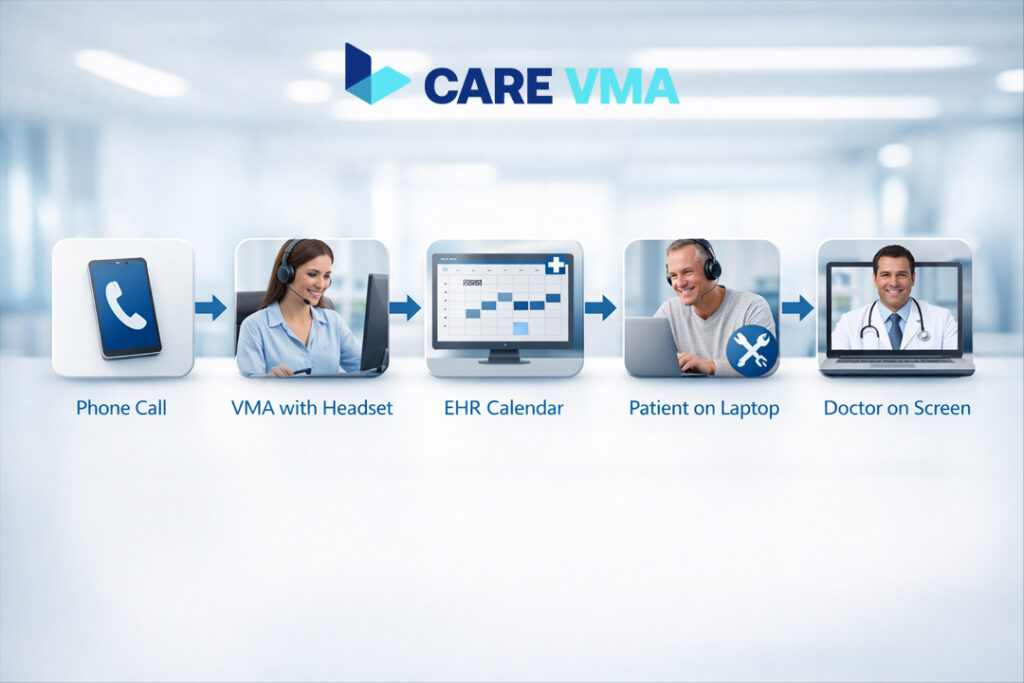
At first glance, the role seems simple: answering calls remotely. But in reality, the workflows for telehealth are fundamentally different from a physical clinic. A telehealth virtual receptionist is a highly integrated coordinator, not just a message taker.
Their role is to bridge the gap between the patient’s home and the clinician’s screen, managing the entire pre-visit experience. This involves a unique set of skills that a standard answering service simply doesn’t possess. They ensure that from the moment a patient reaches out, every step is smooth, secure, and ready for a successful clinical encounter.
Core telehealth-specific tasks include:
- End-to-End Patient Scheduling: They don’t just “take a message.” A VMA works directly within your Electronic Health Record (EHR) system—be it athenahealth, Epic, or Cerner—to manage schedules in real-time. This eliminates double-booking and manual data entry.
- HIPAA-Compliant Communications: Every interaction, from the initial call to appointment reminders, is handled with strict adherence to HIPAA protocols to protect Protected Health Information (PHI). This is secured through a Business Associate Agreement (BAA).
- Insurance Verification: Before an appointment is even confirmed, they handle insurance verification, ensuring the patient is covered for telemedicine services and reducing claim denials down the line.
- Pre-Appointment Tech-Triage: This is the game-changer. They proactively contact patients to ensure their camera and microphone work, guide them on using the platform (like Doxy.me or Zoom for Healthcare), and solve technical issues before the doctor’s valuable time is used.
The 3 Leaks Sinking Your Telehealth Revenue
If you’re managing a telehealth practice, you know that operational friction costs more than just time—it costs real money. What many clinics don’t realize is that these small, daily frustrations add up to significant financial losses.
Here are the three most common revenue leaks a specialized virtual receptionist is designed to plug.
Leak #1: Patient No-Shows & Last-Minute Cancellations
That dreaded empty slot in your calendar isn’t just an inconvenience; it’s lost income that you can never recover. According to the National Institutes of Health, medical appointment no-shows can cost the U.S. healthcare system over $150 billion a year. For telehealth, the problem is often amplified by technical anxiety or simple forgetfulness. A generic email reminder is easy to ignore. A proactive confirmation call that also walks a patient through their tech setup is not.
Leak #2: Wasted Clinician Time on Patient Tech Support
Think about the cost of a physician, NP, or therapist’s time. Now, picture them spending the first 5-10 minutes of a scheduled appointment saying, “Can you hear me now?” or “Try clicking the little camera icon at the bottom.” This isn’t just frustrating; it’s an incredibly expensive way to provide IT support. When clinicians are bogged down with patient tech support, it creates delays, reduces the number of patients they can see, and directly contributes to burnout.
Leak #3: Administrative Bottlenecks from EHR Data Entry
Fragmented communication channels—voicemails, emails, portal messages—create a mountain of administrative work. Transcribing messages, manually entering patient intake data into the EHR, and chasing down missing information are all non-billable tasks that drain resources. This is where a lack of deep EHR integration hurts the most, forcing your team to act as data couriers instead of care providers.
Human vs AI vs In-House: Choosing Your Front Desk Model
When deciding how to manage your telehealth front desk, you have three core options. It’s not about which one is “best” overall, but which is right for your specific needs, patient demographic, and budget.
Here’s the thing: each model comes with significant trade-offs in cost, capability, and patient experience.
| Feature | In-House Staff | AI Bot Receptionist | Human VMA (Care VMA) |
|---|---|---|---|
| Annual Cost | $50,000+ (salary, benefits) | $3,000 – $12,000 | Cost-effective, predictable pricing |
| HIPAA Compliance | Dependent on training | High (if designed for it) | Guaranteed (with BAA) |
| Patient Tech Support | Limited, often not their focus | None (can only send instructions) | Proactive & Empathetic |
| Direct EHR Integration | Yes | Yes (often rigid) | Yes (fluent & adaptable) |
| Patient Empathy | High | None | High (medically trained) |
| Scalability | Low (slow hiring process) | High (instant) | High (add staff as needed) |
| Availability | 8 Hours/Day | 24/7 | 24/7 Coverage Available |
An in-house receptionist offers a personal touch but comes with the highest overhead and limited hours. AI is scalable and cheap but lacks the empathy to handle an anxious patient struggling with technology. A dedicated medical virtual assistant offers the best of both worlds: the technical proficiency and scalability of a remote solution combined with the critical human element of patient care.
The Care VMA Advantage: The “Tech-Ready” Patient Workflow 🔥
What most virtual receptionist services miss is that telehealth success isn’t just about scheduling an appointment—it’s about ensuring the appointment happens smoothly. This is where our unique approach makes all the difference. We don’t just book the slot; we prepare the patient.
The Care VMA model is built around creating the “Tech-Ready Patient,” a workflow designed to eliminate technical friction entirely from the clinician’s plate.
Pre-Appointment Tech-Check
Here’s our secret weapon against no-shows and delays. Our VMAs proactively contact each patient before their appointment to:
- Confirm they have the correct consultation link.
- Walk them through logging into the platform, whether it’s Doxy.me, Zoom for Healthcare, or another provider.
- Test their camera and microphone to ensure they are working correctly.
- Answer any last-minute technical questions with patience and empathy.
For example, an elderly patient might be confused about enabling their camera on an iPad. Without a VMA, the doctor wastes 10 minutes of the session as an IT guide. With Care VMA, our VMA has already resolved this issue 15 minutes before the scheduled start time.
The Warm Handoff
Because of our pre-call prep, the patient enters the virtual waiting room calm, confident, and ready. This creates a “warm handoff” to the clinician. The physician can begin the consultation immediately, focusing 100% on care delivery from the first second. This simple-sounding step completely transforms the efficiency and professionalism of your telehealth administration.
Feeling the strain of administrative overload and lost revenue? See how a dedicated Virtual Medical Assistant can transform your practice. Explore Care VMA’s services.
The Tangible ROI: Beyond Just Answering Calls
Investing in a specialized telehealth virtual receptionist isn’t an expense; it’s a direct strategy for revenue growth and cost reduction. Let’s break down the quantifiable returns.
Slash No-Show Rates by up to 50%
Proactive, human-led appointment confirmations and tech-checks create accountability. Patients are far less likely to miss an appointment when they’ve had a personal conversation to prepare for it. This simple change can drastically reduce your no-show rate, directly recovering thousands in lost revenue each month.
Save $45,000+ Annually vs. In-House Staff
As shown in the comparison table, the fully-loaded cost of an in-house receptionist—including salary, benefits, payroll taxes, and office space—often exceeds $50,000 per year. A VMA service provides more specialized skills and flexible coverage for a fraction of that cost, offering immediate and significant savings.
Reclaim 5+ Hours of Clinical Time Per Week
By offloading all front-desk administrative tasks and, most importantly, all patient tech support, you give your clinicians their most valuable asset back: time. Five hours reclaimed per week per provider translates to more patient appointments, more time for complex cases, or simply a better work-life balance to combat burnout.
Checklist: 4 Non-Negotiables for Your Virtual Receptionist Service
As you evaluate different solutions, it’s crucial to look beyond the sales pitch. Use this checklist to ensure any service you consider is properly equipped to handle the sensitive and complex nature of a telehealth practice.
- Signed Business Associate Agreement (BAA): This is the most critical requirement. Without a signed BAA, a provider is not legally cleared to handle PHI and your practice is not HIPAA compliant. This is non-negotiable.
- Direct EHR/EMR Integration and Fluency: Don’t settle for a service that just “sends you an email.” True integration means the service works inside your EHR, managing schedules and patient data in real-time. Ask if they are fluent in your specific system.
- Telehealth Platform Expertise: Do they have experience with your video conferencing software? A team that already knows the common pitfalls of Doxy.me or Zoom for Healthcare will solve patient issues much faster.
- Clear Escalation Protocols: What happens in a clinical emergency? A professional service must have clear, documented protocols for identifying and immediately transferring urgent calls to your on-site clinical staff.
Explore Further With Care VMA
To deepen your understanding of practice optimization, explore these related resources:
- Learn the difference between a Virtual vs. In-Person Receptionist for a Medical Office.
- Discover the Benefits of a Virtual Medical Receptionist.
- See how VMAs can Streamline Patient Interactions.
Frequently Asked Questions (People Also Ask)
Is a virtual receptionist for telehealth HIPAA compliant?
Yes, provided you choose a specialized healthcare service that signs a Business Associate Agreement (BAA). This legal contract ensures they implement the required physical, technical, and administrative safeguards to protect patient data (PHI). Always verify this before signing up.
How much does a virtual receptionist for a clinic cost?
Costs vary widely. Basic AI services can start around a few hundred dollars per month, while human-led services often range from $1,200-$3,000. This is significantly more cost-effective than an in-house receptionist, which can cost $50,000+ annually with salary and benefits.
Can a virtual receptionist integrate with my EHR system?
Yes, leading providers offer direct integration with major EHRs like athenahealth, Cerner, and Epic. This is a crucial feature that allows for real-time appointment scheduling and patient data updates, eliminating the need for manual entry and reducing administrative errors.
Conclusion: Stop Managing Tech, Start Delivering Care
Managing a successful telehealth clinic is no longer just about the quality of clinical care; it’s about the efficiency of your operations and the seamlessness of the patient journey. Stopping revenue leaks from no-shows and freeing your highly-paid clinicians from the burden of being IT support are critical steps to scaling your practice.
By implementing a specialized virtual receptionist service, you’re not just outsourcing tasks—you’re investing in a system that enhances patient trust, improves staff morale, and builds a more profitable, resilient practice.
Ready to see how a perfectly smooth patient workflow could feel?
Stop Wasting Clinical Time on Tech Support. Get a Free Telehealth Workflow Audit from our team and pinpoint the exact gaps causing revenue loss and staff frustration.