Disclaimer: This article provides business information for healthcare practices and is not intended as financial or legal advice. Please consult with a qualified professional for decisions specific to your practice.
The main difference between a Virtual Medical Assistant (VMA) and a Medical Assistant (MA) is their physical location and the scope of their tasks. A VMA operates remotely to manage digital administrative duties, whereas an MA works on-site to perform both hands-on clinical and administrative functions. For practice managers and physicians feeling the pressure of operational costs and administrative burnout, understanding this distinction is key to building a more efficient and profitable practice.
The pile of digital paperwork, endless phone calls, and the after-hours “pajama time” spent catching up on EHR entries are more than just annoyances-they are barriers to patient care and a direct cause of physician burnout. While hiring an on-site Medical Assistant seems like a solution, the associated costs of salary, benefits, and office space can be prohibitive, especially as administrative demands continue to grow. This guide provides a clear, data-driven comparison to help you choose the right support model for your practice’s future.
Virtual Medical Assistant vs Medical Assistant: A Head-to-Head Comparison Table
To make an informed decision, it is crucial to see a direct comparison. This table breaks down the fundamental differences in roles, requirements, and cost structures, providing a clear snapshot for strategic planning.
| Feature | Virtual Medical Assistant (VMA) | Traditional Medical Assistant (MA) |
|---|---|---|
| Location | Remote (Anywhere with a secure connection) | On-site (Clinic, hospital, or practice office) |
| Core Tasks | Administrative, digital, and communication-based | Clinical hands-on tasks and in-person admin |
| Patient Interaction | Phone, email, secure patient portals, telehealth platforms | Face-to-face during intake, procedures, and checkout |
| Clinical Duties | None. Cannot perform physical tasks. | Patient vitals, injections, blood draws, assisting in procedures |
| Administrative Duties | EHR management, scheduling, billing, insurance verification | Front desk duties, room prep, inventory management |
| Cost Structure | Hourly rate, subscription-based. No overhead. | Full-time salary, benefits, insurance, office overhead |
| Typical Qualifications | HIPAA training, EHR software proficiency, medical terminology | Certified Medical Assistant (CMA), Registered Medical Assistant (RMA) |
Scope of Responsibilities and Daily Tasks
Understanding the specific tasks each role handles is essential to designing an efficient workflow. While there can be some overlap in administrative duties, the primary functions are distinct and complementary, especially in a hybrid model.
The Role of the Virtual Medical Assistant: Clearing Your Digital Workload
A VMA is your practice’s digital operations expert, focused on clearing the administrative bottlenecks that occur behind the scenes. They ensure the seamless flow of information so you can focus on your patients.
- Live Medical Scribing: Real-time documentation of patient encounters into the EHR during in-person or telehealth visits. This is one of the most effective ways to understand what a medical scribe does to combat physician burnout.
- Insurance Verification and Prior Authorization: Proactively confirming patient eligibility and benefits and managing the prior authorization process to prevent claim denials and delays in care.
- Patient Communication Management: Handling incoming patient calls, managing appointment scheduling, processing prescription refill requests, and communicating non-clinical information.
- Telehealth Administration: Managing the technical side of virtual visits, from scheduling on the platform to providing patients with instructions and troubleshooting connection issues.
The Role of the Traditional Medical Assistant: Optimizing In-Clinic Workflow
An MA is the backbone of the physical clinic, ensuring that the patient’s journey from the waiting room to the exam room is smooth, efficient, and safe. They are the hands-on extension of the physician.
- Patient Intake and Vitals: Greeting patients, escorting them to exam rooms, and recording essential vitals such as blood pressure, temperature, height, and weight.
- Hands-On Clinical Procedures: Performing tasks under physician supervision, such as administering injections, drawing blood (phlebotomy), and conducting EKGs.
- Exam Room and Facility Management: Preparing and sterilizing exam rooms and medical equipment between patient visits and managing the inventory of clinical supplies.
- In-Person Physician Support: Assisting providers during physical examinations or minor in-office procedures by handing them instruments and supplies.
Direct Cost Comparison and Financial Benefits for 2026
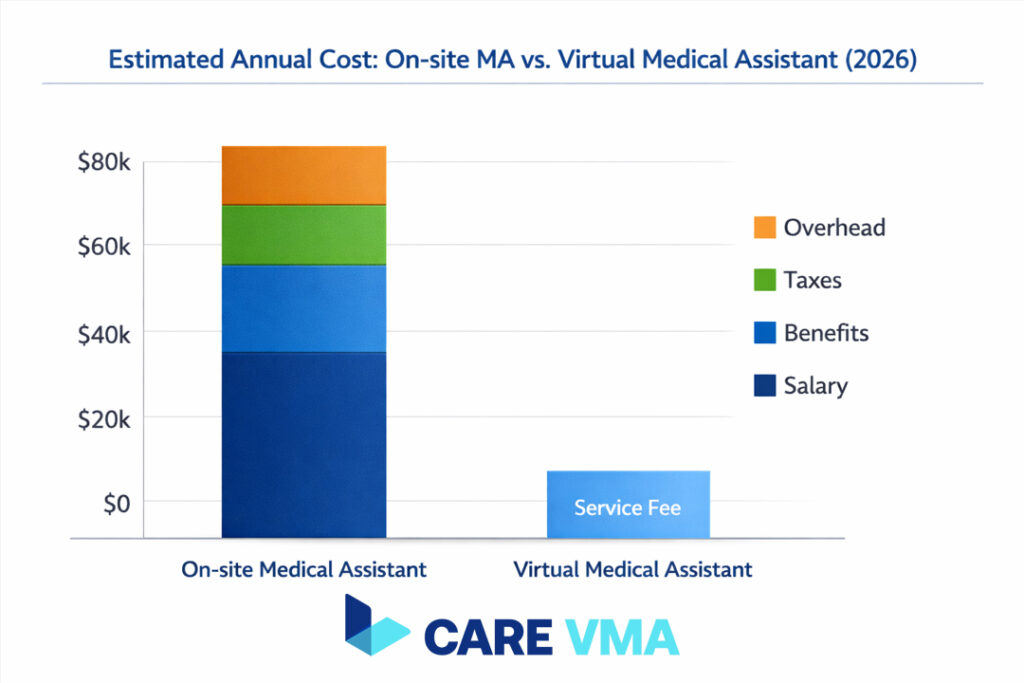
The financial argument for integrating a VMA is one of the most compelling factors for modern practices. The difference goes beyond salary to include a wide range of overhead costs associated with an on-site employee.
Cost Efficiency with a Virtual Medical Assistant
Hiring a VMA from a service like Care VMA can reduce staffing-related operational costs by 40-60%. This is not about paying lower wages but about eliminating the significant overhead tied to an in-house employee.
- No Overhead Costs: You do not pay for office space, a computer, utilities, or employee benefits like health insurance and paid time off.
- Flexible Payment Models: VMAs operate on a subscription or hourly basis. This allows your practice to scale support up or down based on patient volume, such as during flu season, without the complexity of hiring seasonal staff.
- Increased Productivity: By offloading administrative tasks, physicians can see more patients or spend more quality time with existing ones, directly boosting practice revenue.
The Full Cost of a Traditional Medical Assistant
The cost of an MA extends far beyond their salary. According to the U.S. Bureau of Labor Statistics, the median annual wage for medical assistants was $38,270 in May 2022, but the total cost to the employer is much higher.
- Salary and Benefits: Includes base pay, health insurance, retirement contributions, and paid leave.
- Taxes and Insurance: Employer-paid payroll taxes, workers’ compensation, and liability insurance.
- Overhead: The cost of a dedicated workstation, computer, phone line, and other office supplies and utilities.
The Hybrid Model: The Optimal Solution for a Growing Practice
For many practices, the ultimate solution is not an either/or choice but a strategic combination. The hybrid model uses an on-site MA for essential clinical duties while a virtual medical assistant handles the entire back-office administrative workload. This synergy creates maximum operational and financial efficiency, allowing each team member to excel in their specialized role.
Differing Qualifications, Training, and Certifications
The training paths for VMAs and MAs are designed to prepare them for their distinct work environments. Understanding these differences helps in appreciating the unique expertise each brings to your practice.
VMA Background and Training: The Digital Skillset
VMAs are specialists in healthcare administration technology. Many, including those at Care VMA, come from medical backgrounds like nursing and are then rigorously trained for the remote environment.
- HIPAA Compliance: All reputable VMAs undergo extensive training on the Health Insurance Portability and Accountability Act to ensure patient data is always secure. This focus on HIPAA compliance and data security is non-negotiable.
- EHR/EMR Proficiency: VMAs are trained to be experts on major Electronic Health Record systems, ensuring they can integrate into your practice’s workflow with minimal disruption.
- Medical Terminology and Communication: They possess a strong grasp of medical terminology and are trained in professional communication protocols for interacting with patients and insurance companies.
MA Education and Certification Pathways
Traditional MAs require formal education and certification that focuses on hands-on clinical skills. This training is critical for ensuring patient safety and quality of care in a physical setting.
- Formal Education: MAs typically complete a postsecondary certificate program or an associate’s degree.
- National Certification: Upon graduation, most MAs pursue certification to become a Certified Medical Assistant (CMA) or a Registered Medical Assistant (RMA). According to the American Association of Medical Assistants (AAMA), certification demonstrates a high level of knowledge and competence.
Quick Selection Guide: VMA, MA, or Both?
Making the right choice depends entirely on your practice’s primary bottlenecks and growth goals. Use this checklist to identify the best path forward.
Choose a Virtual Medical Assistant if…
- Your primary bottleneck is paperwork, charting, or phone calls.
- You want to reduce physician burnout from after-hours administrative work.
- Your practice is heavily focused on telehealth or is fully virtual.
- You need to reduce operational overhead without sacrificing support.
Choose a Traditional Medical Assistant if…
- Your clinic has a high volume of in-person patient traffic.
- The main delays in your workflow are related to rooming patients and clinical tasks.
- You require hands-on assistance during examinations and procedures.
- Your practice includes specialties that are procedure-heavy, like dermatology or surgery.
Implement a Hybrid Model with Care VMA if…
- You want the cost efficiency and administrative power of a VMA while retaining the essential hands-on support of an on-site MA.
- You are looking to scale your practice and need a flexible, efficient staffing model that grows with you.
- Your goal is to optimize every aspect of your practice, freeing physicians to focus entirely on patient care.
Frequently Asked Questions from Practice Managers
How is patient data security (HIPAA) maintained with a VMA?
Reputable VMA services like Care VMA operate on secure, encrypted platforms. Our VMAs undergo rigorous and continuous HIPAA compliance training to ensure all protected health information (PHI) is handled with the highest level of security.
How long does it take to integrate a VMA into our workflow?
Our onboarding process is designed for speed and efficiency. A VMA can typically be fully integrated with your EHR system and practice workflows within one to two weeks, with minimal disruption to your operations.
Can a VMA work outside of standard office hours to help reduce a doctor’s charting burden?
Absolutely. Flexibility is a core benefit of a VMA. We can arrange schedules to fit your practice’s specific needs, including after-hours support to manage documentation and ensure charts are complete for the next day.
Conclusion and Next Steps
You should not let administrative tasks dictate your work hours or limit your practice’s potential. Whether you choose a Virtual Medical Assistant, a traditional Medical Assistant, or the optimized hybrid model, making a strategic staffing decision is the most critical step toward reclaiming your time and refocusing on what matters most: your patients. By leveraging modern, flexible solutions, you can build a more resilient, efficient, and patient-centered practice.
Ready to reduce your administrative burden by up to 60%? Schedule a free 15-minute consultation with our specialists to analyze your practice’s needs and discover how a VMA from Care VMA can be your solution.