
Disclaimer: This article is for informational purposes only and does not constitute professional legal or business advice. Please consult with qualified experts for specific guidance regarding your practice.
In the rapidly evolving landscape of modern healthcare, practice owners face a relentless trilemma: managing an overwhelming volume of administrative tasks, contending with spiraling overhead costs, and battling the very real risk of physician burnout. When your staff is buried under paperwork, the primary mission of providing exceptional patient care often takes a backseat. This inefficiency leads to longer patient wait times, billing errors that hemorrhage revenue, and a chaotic work environment that threatens the sustainability of your clinic.
Virtual medical assistant services offer a strategic technological solution to these operational bottlenecks. However, integrating remote talent into a clinical setting is not a decision to be taken lightly. It requires a balanced analysis of the transformative efficiency gains against the rigorous demands of data security and workflow integration.
Virtual medical assistant services are professional remote support solutions designed to handle administrative, non-clinical, and operational tasks for medical practices. By leveraging secure digital platforms, these services aim to streamline clinic workflows, significantly reduce operational expenses, and empower healthcare providers to reclaim their time for direct patient interaction.
Key Advantages of Virtual Medical Assistant Services
The adoption of health-tech solutions like virtual assistants is driven by measurable data and tangible operational improvements. Below are the primary advantages that innovative practices are leveraging in 2026.
Operational Cost Savings Up to 70%
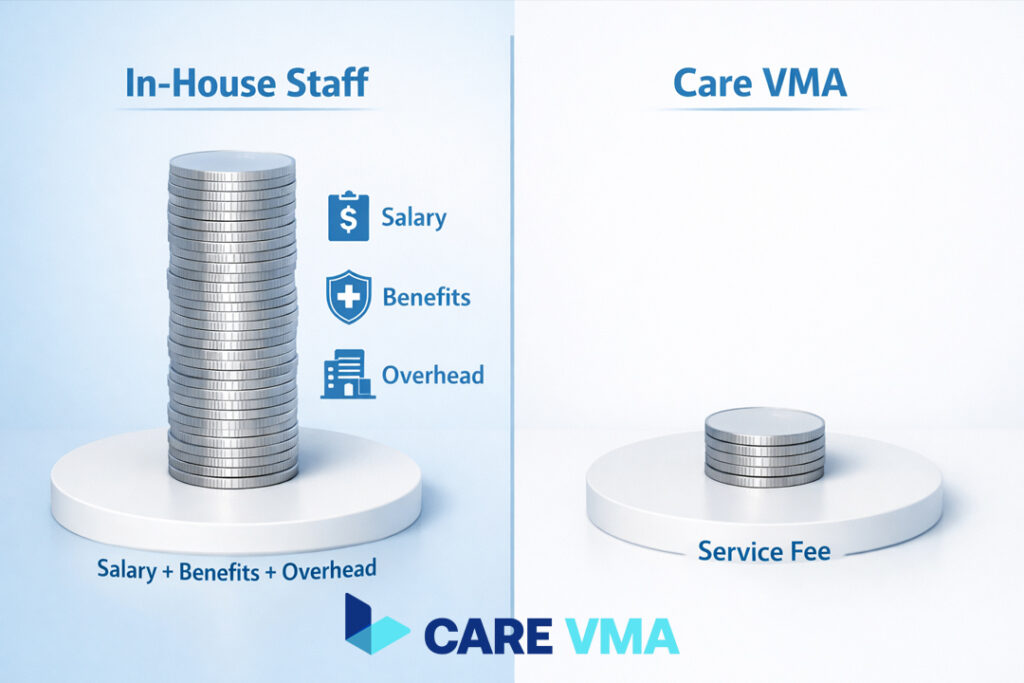
The financial argument for virtual staffing is compelling. Hiring in-house staff involves not just salaries, but also payroll taxes, benefits, insurance, paid time off, and the physical costs of office space and equipment. By transitioning to a Virtual Medical Assistant – Hire Top Talent at Care VMA, practices can eliminate these overheads. Data indicates that clinics can reduce their administrative labor costs by 40% to 70%, reallocating those funds toward medical technology upgrades or marketing.
Increased Staff Efficiency and Productivity
Your on-site clinical staff should focus on tasks that require a physical presence. Virtual assistants take over high-volume, repetitive tasks such as appointment scheduling, insurance verification, and EHR management. This division of labor allows your nurses and doctors to operate at the top of their license. For specialized needs, services like Medical Billing Virtual Assistant Services | Care VMA Health ensure that revenue cycles are managed meticulously without distracting the front-desk team.
Enhanced Patient Experience and Satisfaction
In the digital era, patients expect immediate responsiveness. A bottleneck at the front desk often leads to missed calls and frustrated patients. Virtual assistants can provide 24/7 coverage for phone lines and chat support. By utilizing a 24/7 Virtual Medical Receptionist | Care VMA Health, practices ensure that every patient inquiry is addressed promptly, reducing no-show rates and improving overall patient satisfaction scores.
Flexibility and Scalability to Match Practice Needs
Healthcare volume fluctuates. During flu season or marketing campaigns, patient influx spikes. Traditional hiring is too slow to react to these changes. Virtual services offer the agility to scale your workforce up or down instantly. This is particularly useful for specific programs like Virtual Chronic Care Management | Care VMA Health, where patient enrollment numbers may vary month-to-month.
Critical Challenges and How to Overcome Them
While the benefits are clear, the transition to a virtual model introduces specific challenges that must be managed with precision. Care VMA addresses these through a “Security-First” integration approach.
Data Security and HIPAA Compliance: Your Biggest Risk

The most significant concern for any medical practice is the security of Protected Health Information (PHI). Cybersecurity threats, such as phishing and ransomware, are evolving. Using a general freelancer for medical tasks poses a severe risk of HIPAA violations. According to the U.S. Department of Health and Human Services, unauthorized access is a leading cause of data breaches.
Solution: Compliance is not optional. At Care VMA, we mitigate this risk through mandatory Business Associate Agreements (BAA), end-to-end data encryption, and rigorous access controls. Our virtual assistants undergo regular HIPAA training and operate within secure environments to ensure your practice remains compliant. Read more about HIPAA compliance standards at HHS.gov.
Integration Challenges with Existing EHR Systems
Many practice owners worry that a remote assistant will not be able to navigate their specific Electronic Health Record (EHR) system, leading to data fragmentation. Incompatibility can indeed disrupt workflows if the VMA is not tech-literate.
Solution: We bridge this gap by conducting a technology audit during the onboarding phase. Whether you use Epic, Cerner, or a specialized platform, our professionals are trained to adapt quickly. This is crucial for roles like Remote Medical Coder Services | Care VMA Health, where precision in system navigation directly impacts reimbursement.
Physical Limitations and Virtual Communication
It is a fact that a virtual assistant cannot take a patient’s blood pressure or physically guide them to an exam room. Relying on them for the wrong tasks creates friction. Furthermore, communication gaps can occur without proper protocols.
Solution: We position VMAs as a strategic complement to your on-site team, not a total replacement. By establishing clear communication protocols using secure messaging apps and video conferencing, we minimize misunderstandings. This ensures that while the VMA handles the digital workload, your in-person staff enhances the human touch.
Ensuring Quality and Service Consistency
Without direct supervision, there is a fear that the quality of work may suffer. Managing a remote worker can feel like an additional burden if not structured correctly.
Solution: Care VMA utilizes a fully managed model. Unlike freelance platforms, our assistants are supervised by dedicated account managers who monitor performance metrics and ensure quality consistency. This enables you to treat the service as a turnkey solution rather than a management challenge.
Framework for Choosing the Right VMA for Your Practice
To move beyond the “Pro & Con” debate, use this strategic framework to select a partner that acts as a catalyst for your practice’s growth.
Step 1: Evaluate Your Administrative Needs
Before hiring, conduct a task audit. Identify processes that are high-volume but low-value for your clinical staff. Create a specific checklist of duties to delegate, such as inbox management, referral processing, or Remote Patient Monitoring Services | Care VMA Health.
Step 2: Verify Security and Compliance Credentials
Do not compromise on security. Ensure your provider signs a BAA. Ask for details on their IT infrastructure: Do they use VPNs? Are their terminals secure? Compliance should be their first talking point, not an afterthought.
Step 3: Inquire About Onboarding and Training Processes
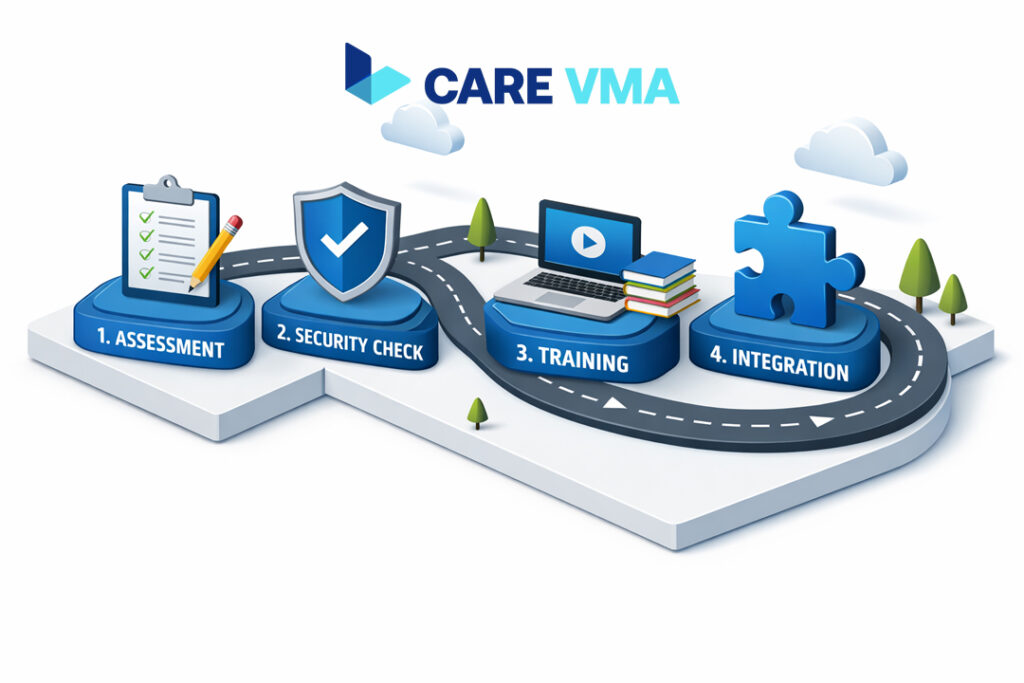
A smooth integration depends on onboarding. Ask potential partners about their training timeline. A robust provider will have a structured implementation plan that includes customization to your specific clinic protocols.
Step 4: Request Case Studies or Testimonials from Similar Clinics
Look for evidence of success in your specific specialty. A generalist VMA may struggle with the terminology required for specific fields like cardiology or dermatology.
FAQ (Common Questions from Clinic Owners)
Can VMAs use our EMR/EHR system?
Yes, professional VMA providers like Care VMA provide specialized training to assistants to adapt to various EMR/EHR platforms. This adaptability is a core part of our onboarding process to ensure seamless workflow integration.
How is patient data confidentiality (PHI) guaranteed when working with external parties?
We guarantee confidentiality through a triad of Legal, Technical, and Procedural safeguards. Legally, we sign a Business Associate Agreement (BAA). Technically, we use encrypted networks and secure devices. Procedurally, we enforce strict HIPAA compliance training and regular security audits. For a deeper understanding of health information privacy, refer to the Office for Civil Rights.
How long does it take for a VMA to start working effectively?
Generally, after a specific onboarding and training process lasting 1-2 weeks, a VMA can effectively take over administrative tasks. This period allows them to learn your specific protocols and integrate with your team.
Conclusion & Next Steps
Adopting virtual medical assistant services is no longer just a question of “if,” but “how” to select the right partner. By carefully evaluating the efficiency gains against the security requirements, and choosing a provider that prioritizes HIPAA compliance and seamless integration, your practice can transform its operations. A VMA is not just an outsourced worker; they are a strategic asset that frees you to focus on the most critical aspect of your profession: patient care.
Do not let administrative burdens stifle your practice’s growth. Discuss your clinic’s unique needs with our specialists. Schedule a risk-free consultation today to analyze your workflow and discover how a HIPAA-compliant VMA can transform your efficiency.