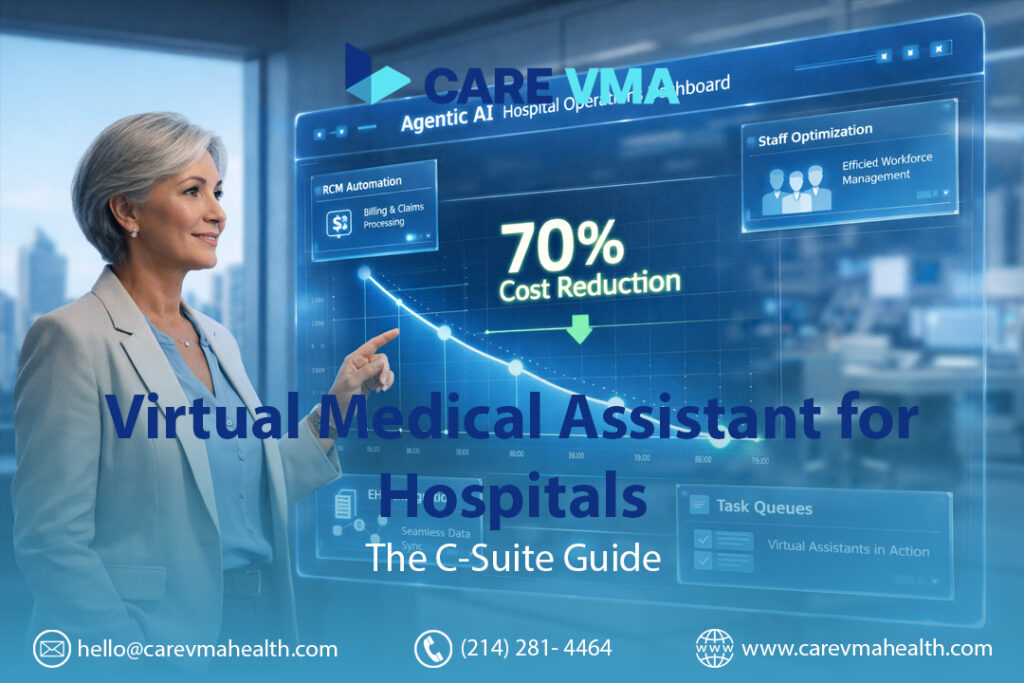
Clinician burnout has reached a breaking point, operational costs are spiraling, and unprecedented staffing shortages threaten your hospital’s capacity to deliver care. You’re caught in a difficult position, forced to find savings while simultaneously being expected to elevate the standard of patient outcomes. For years, the proposed solutions—aggressive recruitment cycles, fragmented software, traditional outsourcing—have felt like temporary fixes, failing to address the true root of the problem: the crippling administrative burden and hidden workflow inefficiencies bogging down your entire system.
Now, imagine an intelligent ecosystem that doesn’t just automate isolated tasks but proactively manages entire clinical and administrative workflows according to your hospital’s specific protocols. This isn’t a futuristic dream; it’s the reality of the Virtual Medical Assistant (VMA) in 2026, and it represents a strategic imperative for hospital leadership.
A Virtual Medical Assistant (VMA) for hospitals is an advanced solution, blending Agentic AI platforms and remote medical professionals, designed to autonomously manage complex clinical and administrative workflows. Unlike simple chatbots, modern VMAs integrate with EHR systems to handle tasks like revenue cycle management, ambient scribing, and patient triage, significantly reducing operational costs and clinician burnout. This guide, based on trend analysis from the American Hospital Association (AHA) and implementation studies from institutions like the National Institutes of Health (NIH), is designed to equip you with the strategic insights needed to navigate this transformation.
The 2026 Shift: From Basic Virtual Assistants to Agentic AI Teams
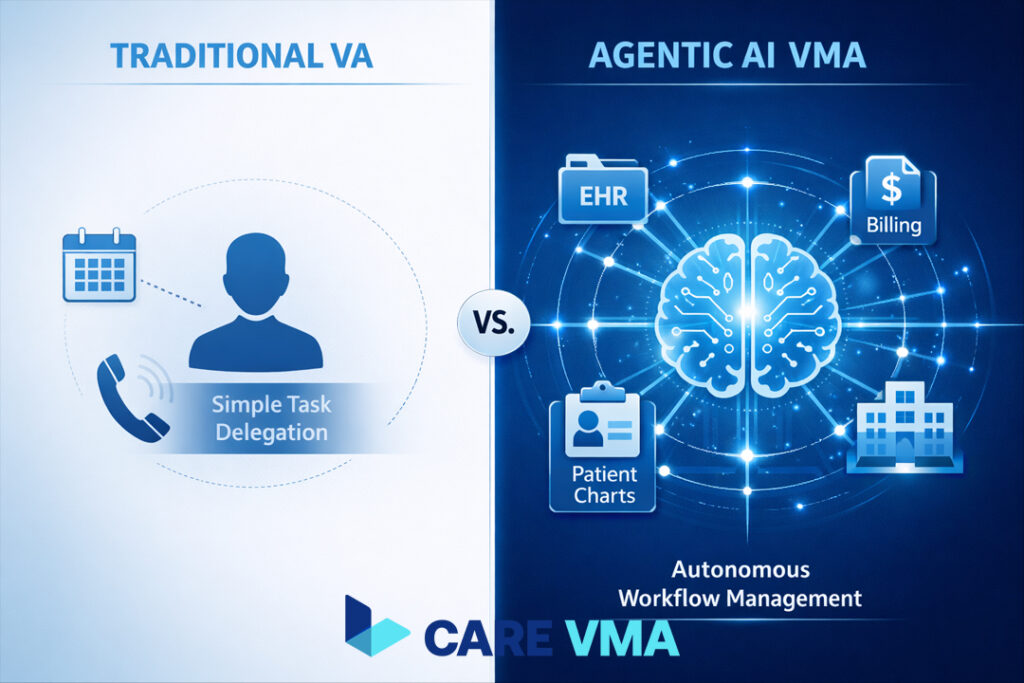
The term ‘virtual assistant’ often brings to mind a remote assistant handling basic scheduling. But what’s emerging in hospitals today is something fundamentally different, a leap in capability that redefines what’s possible for operational efficiency.
What most people don’t realize is that we’ve moved beyond the traditional BPO (Business Process Outsourcing) model of human-led assistants performing siloed tasks. The revolution is being driven by Agentic AI. Unlike older AI that simply responds to commands, an agentic system can reason, plan, and execute multi-step tasks autonomously to achieve a complex goal. Think of it as upgrading from a simple calculator to a full-fledged financial planning department that operates 24/7. These systems, powered by advanced Large Language Models (LLMs), are capable of managing entire hospital workflows, from patient intake to final billing, with minimal human intervention.
This shift marks the evolution from task-based delegation to true hospital workflow automation. While human-led services still offer value, the scalability and proactive nature of Agentic AI platforms are creating an entirely new category of solution for the modern hospital.
Why Hospitals Are Facing an Operational Crisis?
It’s not just one thing, is it? The pressure on hospital leaders is coming from multiple fronts, creating a perfect storm of operational challenges that threatens both financial stability and patient care. A VMA strategy directly targets the epicenter of this crisis.
Your Best Clinicians are Drowning in Paperwork
The epidemic of clinician burnout is no longer a secret. The primary driver isn’t the clinical work itself; it’s the relentless administrative burden. Physicians and nurses are spending hours after their shifts on documentation—a phenomenon known as “pajama time.” This constant data entry, charting, and paperwork not only crushes morale but also pulls your most valuable assets away from direct patient care, contributing directly to the ongoing physician shortage and high turnover rates.
Unprecedented Staffing Shortages Have Reached a Breaking Point
The national nurse shortage isn’t a future problem; it’s a present-day emergency. Hospitals are struggling to keep beds open and emergency departments staffed, leading to longer wait times, cancelled procedures, and compromised patient safety. Traditional recruitment can’t solve this because the available talent pool is shrinking, forcing a strategic shift towards technology that can augment and support the staff you already have.
Revenue Cycle Leakage is Silently Draining Your Budget
Small errors in your Revenue Cycle Management (RCM) process create significant financial losses. Every denied claim from a simple medical coding error, every delay waiting on prior authorizations, and every bottleneck in the billing cycle represents lost revenue. In many cases, these leaks are the result of manual, repetitive tasks that are prone to human error and are perfect candidates for automation.
The Patient Journey is Riddled with Inefficiency
From the moment a patient tries to schedule an appointment to their post-discharge follow-up, the journey is often fragmented. High call volumes overwhelm front-desk staff, leading to long hold times and frustrated patients. Inconsistent follow-up care after a procedure can lead to poor outcomes and higher readmission rates. These inefficiencies not only damage the patient experience but also create downstream work for your clinical teams.
The VMA Playbook: Key Functions in a Hospital Setting
So, how does a VMA actually function within the complex walls of a hospital? It’s less about replacing staff and more about supercharging workflows with a blend of intelligent automation and specialized remote talent.
Ambient Clinical Intelligence
Here’s the thing about clinical documentation: it’s a massive time sink. Ambient intelligence solutions, like Nuance DAX, are a game-changer. These platforms use Ambient Clinical Intelligence to listen securely to a doctor-patient conversation and automatically convert it into a structured, compliant note directly within the Electronic Health Record (EHR). This can reduce “pajama time” by up to 70%, giving physicians back hours in their day.
Smart Triage & Symptom Checking
Imagine a patient visiting your hospital’s website with chest pain. Instead of a generic contact form, an AI-powered VMA can guide them through a patient triage protocol, ask clarifying questions, and analyze their symptoms. It can then flag high-risk cases of potential sepsis or stroke and immediately escalate them for urgent human intervention, all before the patient even steps into the ER.
Automated Revenue Cycle Management (RCM)
This is where VMAs deliver a clear and immediate ROI. An automated RCM workflow can handle thousands of transactions flawlessly. VMAs autonomously perform insurance verifications, initiate prior authorization requests, and even suggest accurate medical codes based on clinical documentation, accelerating the billing cycle by up to 30% and drastically reducing claim denials.
Proactive Patient Engagement & Virtual Nursing
The period after discharge is critical for preventing readmissions. VMAs powered by platforms like Hippocratic AI can deploy generative AI nurses to make proactive follow-up calls. These virtual nurses can check on medication adherence, ask about symptoms, and provide approved educational resources for chronic care management, escalating to a human nurse only when a patient’s response indicates a potential issue.
Choosing Your Model: AI vs Human-Led vs The Hybrid Advantage
Not all VMA solutions are created equal. The choice you make here will define your ROI, your risk exposure, and your team’s adoption rate. While most vendors will push you towards one of two extremes, the optimal solution for a high-compliance environment like a hospital lies in the middle.
The Power and Pitfalls of Pure AI (SaaS Model)
Purely AI-driven platforms offer incredible scalability and 24/7 operation at a low marginal cost. They excel at high-volume, data-heavy tasks. However, they come with significant risks. AI model drift—where the AI’s accuracy degrades over time—can introduce clinical or financial errors if not constantly monitored. Furthermore, integrating these platforms with legacy EHR systems can be a complex and expensive puzzle, and they often lack the nuanced clinical judgment required for outlier cases.
The Reliability and Limits of Human-Led Services (BPO Model)
The traditional Human-Led VMA model, often run by BPO providers, offers the benefit of human empathy and contextual understanding. These professionals are adept at navigating complex social and clinical situations that an AI might misinterpret. The downside? This model is less scalable, significantly more expensive per task, and still subject to human error and limitations in working hours.
The Care VMA Hybrid Model: AI Efficiency with Human Oversight
This is the emerging best practice for hospitals in 2026. The hybrid model closes the critical “Governance Gap” by combining the best of both worlds. At Care VMA Health, we use Agentic AI to autonomously handle about 80% of routine, repetitive tasks—the heavy lifting. This AI is constantly overseen by a team of trained and certified medical professionals who step in for three key reasons:
- Validation: To quality-check the AI’s output on high-stakes tasks like complex medical coding.
- Escalation: To manage complex or sensitive patient interactions that require human empathy.
- Exception Handling: To resolve the outlier cases and EHR integration issues that would stump a pure AI system.
This AI-plus-human approach delivers the cost-efficiency of automation while providing the clinical safety net and governance that hospital leadership demands. If you’re looking for a deeper dive into this approach, our team often discusses how to leverage VMA services for better patient outcomes and efficiency.
Case Study: How St. Mary’s General Hospital Reduced Claim Denials by 45%
St. Mary’s was struggling with a high rate of RCM claim denials due to coding errors and missed prior authorizations. By implementing Care VMA’s Hybrid RCM Solution, their workflow was transformed. Our Agentic AI now processes thousands of insurance verifications automatically. It then pre-codes claims based on EHR data and flags any inconsistencies or high-risk denials. Before submission, our team of certified human billing experts reviews only the flagged items, corrects them, and ensures 99.9% accuracy. The result was a 45% reduction in denials within six months and a significant acceleration of their revenue cycle.
The C-Suite Bottom Line: Quantifiable ROI of VMA Implementation
Ultimately, any major investment comes down to the numbers. Let’s translate these operational improvements into the language of the C-suite: quantifiable ROI.
Reduce Staffing Costs by up to 70%
By automating administrative tasks or outsourcing them to a cost-effective hybrid VMA team, hospitals can dramatically reduce overhead. This isn’t about eliminating jobs, but rather reallocating your high-value clinical staff to top-of-license work. The savings on recruitment, benefits, and administrative overhead for roles that can be handled by a VMA are substantial, often reaching up to 70% compared to equivalent in-house hires.
Increase Operational Capacity by 40%
What would it mean if your hospital could handle 40% more patient inquiries without hiring a single new person? VMAs achieve this by taking over front-desk tasks like scheduling, answering FAQs, and patient intake. This frees up on-site staff to manage more complex patient needs, effectively increasing your hospital’s capacity without the need for capital-intensive physical expansion.
Boost Clinician Retention and Reduce Turnover
The cost of replacing a physician or nurse is enormous, both financially and in terms of institutional knowledge. By deploying VMAs to absorb the administrative burden that causes burnout, you are making a direct investment in staff well-being and retention. Happier, less-stressed clinicians are more likely to stay, creating a more stable and experienced care team. For more on this, exploring solutions for physician burnout is a critical first step.
Navigating the Hurdles: A Leader’s Guide to VMA Implementation & Compliance
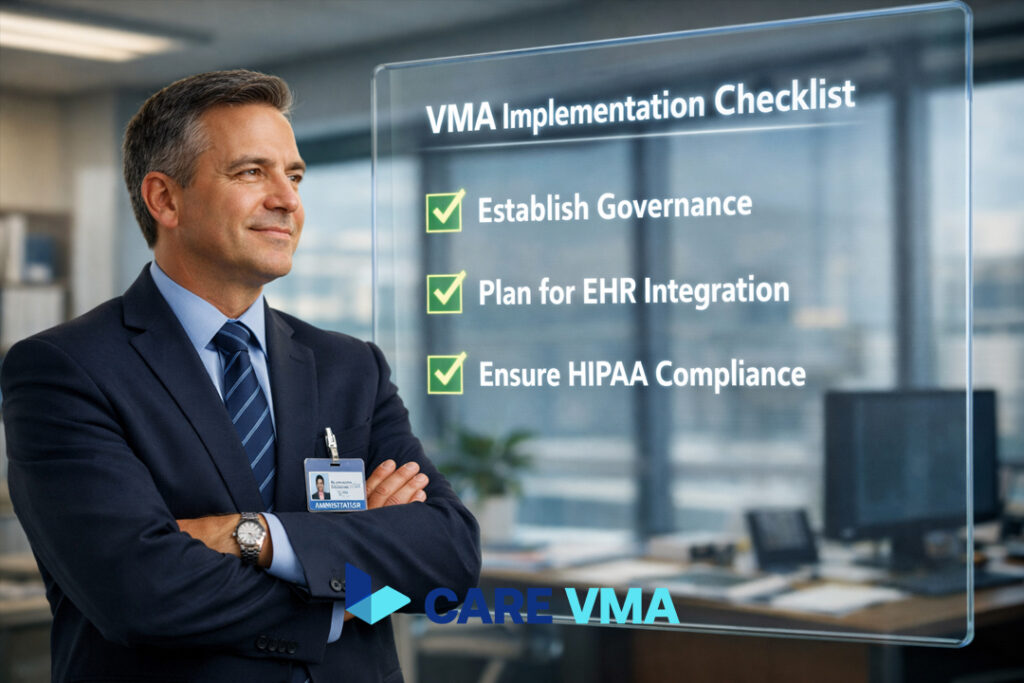
Implementing a VMA system isn’t without its challenges. Acknowledging and planning for these hurdles is what separates a successful launch from a failed pilot. As a strategic partner, we believe in transparency about the risks.
Overcoming the “Governance Gap”
You cannot simply “set and forget” an AI in a clinical environment. Strong governance is non-negotiable. This means having clear protocols for who is responsible for the AI’s output and a system for quality control. This is a core strength of the hybrid model, as the “human-in-the-loop” oversight provides a built-in governance framework from day one.
Solving the EHR Integration Puzzle
Your VMA is only as good as its ability to communicate with your core systems. Integrating with legacy EHRs like Epic and Cerner can be a major technical hurdle for pure-SaaS vendors. Look for a partner with proven experience and dedicated teams for EHR & EMR Management to ensure a seamless data flow, which is crucial for automating tasks like charting and billing.
Mitigating Security Risks: HIPAA, BAAs, and AI Model Drift
In a hospital setting, data security is paramount. Any VMA provider must be willing to sign a Business Associate Agreement (BAA) and demonstrate robust, HIPAA-compliant data handling and encryption. Furthermore, you need a plan to mitigate AI model drift. The Care VMA hybrid model includes continuous monitoring and retraining of our AI models to ensure their accuracy never degrades, protecting you from compliance and safety risks.
Frequently Asked Questions
What is the difference between a Virtual Medical Assistant and a medical scribe?
A medical scribe primarily documents clinical encounters in real-time. A Virtual Medical Assistant for a hospital has a broader scope, using Agentic AI and human expertise to manage entire workflows like patient scheduling, RCM, and clinical triage, which may include but is not limited to scribing.
How do Virtual Medical Assistants ensure HIPAA compliance?
Compliant VMAs operate under a Business Associate Agreement (BAA), use end-to-end data encryption, and are hosted on secure, HIPAA-compliant servers. AI models are trained on anonymized data, and access to patient health information (PHI) is strictly controlled and auditable through human oversight.
Can VMAs integrate with our hospital’s existing EHR like Epic or Cerner?
Yes, modern VMA platforms are designed for integration. Leading providers like Care VMA Health offer solutions with robust APIs and dedicated integration teams to securely connect with major EHR systems like Epic and Cerner, enabling seamless data flow for tasks like automated charting and billing.
Conclusion
The operational crisis facing hospitals is no longer a future threat; it is a present reality defined by staff shortages, clinician burnout, and immense financial pressure. In this environment, Virtual Medical Assistants have evolved from a simple efficiency tool into a strategic necessity.
However, the path forward is not through pure automation or traditional outsourcing alone. The most resilient, secure, and cost-effective solution is a hybrid model that intelligently blends the power of Agentic AI with the irreplaceable expertise and oversight of human professionals. This is the only approach that effectively solves the challenges of today while mitigating the risks of tomorrow. Adopting a hybrid VMA strategy is a decisive move to protect your clinicians, your revenue cycle, and your capacity to provide exceptional patient care.
Ready to see the real financial impact a hybrid VMA model could have on your facility? Don’t settle for a generic demo.
Request a complimentary, no-obligation ROI & Compliance Assessment for your hospital. Our team will analyze your current workflows and provide a tailored projection of cost savings and efficiency gains with Care VMA Health.