Are your telehealth appointments chaotic? Juggling patient tech issues, updating the EHR in real-time, and managing administrative follow-ups is a recipe for provider burnout and an inconsistent patient experience. The promise of virtual care efficiency often gets lost in a sea of clicks, paperwork, and after-hours charting.
But what if you had a digital co-pilot for every virtual visit?
A Telehealth Virtual Assistant (TVA) is a remote, HIPAA-trained professional who manages the administrative, technical, and clinical support tasks for virtual medical appointments. They integrate directly into your workflow to handle the operational details, allowing clinicians to dedicate their full attention to patient care—not the keyboard.
This isn’t just another administrative hire. A TVA is a system designed to restore order to your telehealth services, reduce administrative burden, and enhance the quality of every virtual encounter.
Is Your Practice Drowning in Telehealth Admin? The “Before & After” Reality
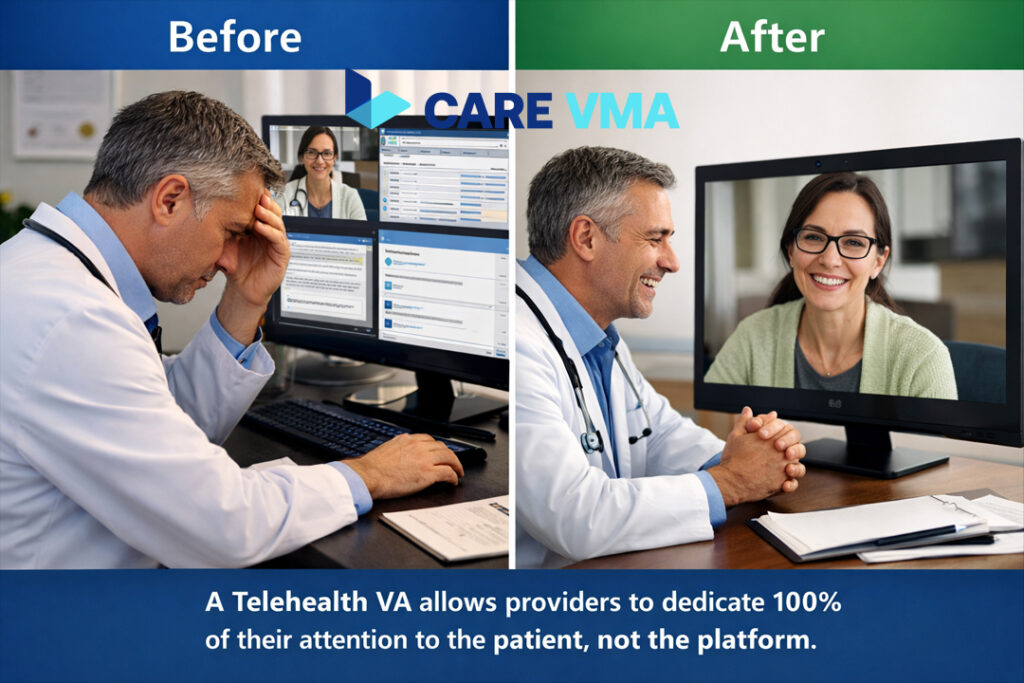
For many practices, the operational reality of telehealth doesn’t match the vision. Does this “before” scenario sound familiar?
Before: The Telehealth Juggle
Without a dedicated support system, a provider’s focus is constantly split, leading to inefficiency and frustration for everyone involved.
- Delayed Start Times: The provider logs in, only to spend the first 5-10 minutes troubleshooting the patient’s camera or microphone.
- Split Focus: During the consultation, the provider is constantly switching between looking at the patient, typing into the EHR, and managing chat messages.
- Missed Information: Critical intake questions are forgotten, and the provider has to circle back, disrupting the flow of the appointment.
- Extended Workdays: The provider spends an extra 1-2 hours after clinic on “pajama time,” catching up on charting and administrative tasks that piled up during the day.
This fractured workflow not only leads to physician burnout but also diminishes the patient experience, making virtual care feel disjointed and impersonal.
After: The Streamlined Workflow with a TVA
Now, imagine the same appointment with a Telehealth Virtual Assistant integrated into the process.
- Punctual & Prepared Starts: The TVA joins the call first, manages the virtual waiting room, and resolves all patient tech issues before the provider even logs on.
- 100% Provider Focus: The provider enters the call and gives the patient their undivided attention, building rapport and trust.
- Real-Time Support: As the provider speaks, the TVA acts as a virtual medical scribe, documenting the encounter in the EHR and queuing up orders for signature.
- Workday Ends on Time: The moment the call ends, the clinical note is 90% complete. The TVA handles all follow-up scheduling and administrative wrap-up, allowing the provider to move to the next patient or end their day on schedule.
This is where true telehealth efficiency is found—not in the platform itself, but in the operational system that supports it.
The Core Workflow: How a TVA Integrates into Your Daily Practice
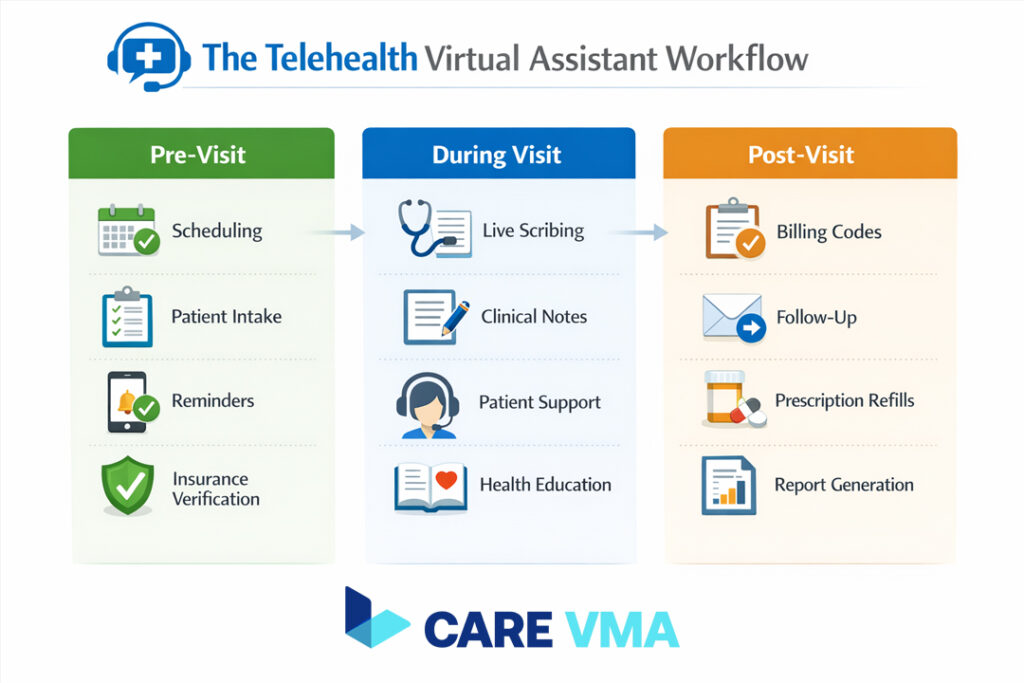
A Telehealth Virtual Assistant isn’t an outsider; they become a core part of your team’s daily operations. Their work is organized around the three phases of a patient encounter, ensuring a seamless experience from start to finish. This is how it works in a real clinic setting.
Step 1: Before the Visit (The Setup)
The TVA does all the prep work to ensure the appointment is clinically and technically ready for the provider.
- Scheduling & Calendar Management: Manages the provider’s calendar, books appointments, and sends confirmations and reminders.
- Insurance & Eligibility Verification: Proactively handles insurance verification and prior authorization, preventing billing issues and delays in care.
- Digital Intake Forms & Consents: Ensures all necessary patient paperwork is completed and signed electronically before the appointment time.
- Patient Tech Check & Communication: Reaches out to the patient 15 minutes before the call to test their audio/video, guide them through the telehealth platform, and answer any non-clinical questions.
Step 2: During the Visit (The Co-Pilot)
While the provider focuses on the patient, the TVA manages the digital environment in the background.
- Virtual Waiting Room Management: Greets the patient in the virtual waiting room, verifies their identity, and provides updates if the provider is running behind.
- Live Virtual Patient Intake: Conducts the initial patient intake, confirming symptoms, medication history, and the reason for the visit, entering the data directly into the EHR.
- Real-Time Medical Scribing: Silently documents the provider-patient interaction, capturing the HPI, exam findings, and plan of care with precise medical terminology.
- Queuing up Orders: Prepares prescriptions, lab requisitions, and referral orders in the EHR for the provider’s final review and signature.
Step 3: After the Visit (Closing the Loop)
Once the call ends, the TVA completes the administrative and clinical loop, ensuring no detail is missed.
- Finalizing Chart Notes: Cleans up the drafted note for the provider’s review and sign-off, dramatically reducing documentation time.
- Submitting Billing Codes: Assists the virtual medical billing team by ensuring the correct codes are documented and ready for submission.
- Scheduling Follow-up Appointments: Coordinates with the patient to schedule their next appointment as per the provider’s care plan.
- Patient Communication: Sends post-visit summaries, educational materials, or other resources to the patient portal.
Wondering which tasks you can delegate? See how a healthcare virtual assistant can streamline your specific practice needs.
What Can You Delegate? The 3 Core Roles of a Telehealth VA
A TVA is a versatile professional who can wear multiple hats. Their responsibilities typically fall into three distinct, yet interconnected, roles that cover the full spectrum of remote practice support.
1. Administrative & Operations Support
This role is the digital front desk and back office, ensuring the practice runs smoothly.
- Appointment Scheduling & Rescheduling
- Managing Prior Authorizations
- Handling Prescription Refill Requests from Pharmacies
- Patient Portal and Inbox Management
2. Patient-Facing Support
As the first point of contact, the TVA ensures a positive and frictionless patient experience.
- Virtual Receptionist & First Point of Contact
- Telehealth Platform Troubleshooting (e.g., “I can’t get my camera to work!”)
- Patient Follow-up Communication
- Collecting Patient Payments
3. Clinical Support (Under Provider Supervision)
This advanced role requires clinical knowledge and directly assists the provider with documentation and care coordination.
- Live Medical Scribing
- EHR/EMR Data Entry and Management
- Lab and Imaging Coordination
- Referral Management
The Must-Have Qualifications: Not Just Any VA is a Telehealth VA
Delegating tasks that involve Protected Health Information (PHI) requires an assistant with specialized training and a deep understanding of the healthcare environment. This is a critical distinction that many practices overlook. A generalist VA simply doesn’t have the necessary qualifications.
Here are the non-negotiable requirements for a true Telehealth Virtual Assistant:
- HIPAA Certification: A foundational, provable understanding of patient data privacy and security protocols is paramount for HIPAA compliance.
- Medical Terminology Proficiency: The ability to understand and accurately document clinical encounters, diagnoses, and treatments without constant correction.
- EHR & Telehealth Software Expertise: Hands-on experience with common platforms like Epic, Athenahealth, eClinicalWorks, Doxy.me, and Zoom for Healthcare.
- Professional Communication Skills: Empathy, clarity, and professionalism when interacting with anxious or technologically challenged patients.
Human Expertise vs AI Chatbots: Why Empathy Matters in Telehealth
While AI and chatbots can automate simple tasks like appointment reminders, they cannot replace the critical thinking and empathy of a human professional. A patient struggling to connect to their first-ever telehealth visit doesn’t need an automated script; they need a calm, reassuring voice to guide them through the process.
A human TVA provides:
- Complex Problem-Solving: Adapting to unique patient tech issues on the fly.
- Clinical Nuance: Understanding the context of a conversation, not just keywords.
- Empathy & Reassurance: Managing patient anxiety and building trust.
AI is a tool, but a human TVA is a partner in care delivery.
The Care VMA Difference: A System Built for Clinical Efficiency
At Care VMA Health, we provide more than just a person—we deliver a pre-trained, securely integrated system designed for clinical efficiency. Our Telehealth Virtual Assistants are not freelancers; they are dedicated professionals who operate within our secure, HIPAA-compliant framework.
We built our system to deliver concrete outcomes for your practice:
- End Provider Burnout: Eliminate hours of after-hours charting and administrative work, restoring work-life balance.
- Enhance Practice Revenue: See at least one more patient per day and reduce no-show rates through proactive patient engagement.
- Improve the Quality of Care: Allow your providers to build stronger patient relationships with 100% focused attention.
- Ensure Ironclad Security: Our entire platform and staff training are built on a foundation of HIPAA compliance and data security.
Ready to see this workflow in action? Stop juggling tasks and start streamlining care.
Schedule a free, no-obligation consultation to discover how a Care VMA Telehealth Assistant can transform your virtual operations in under 30 days.