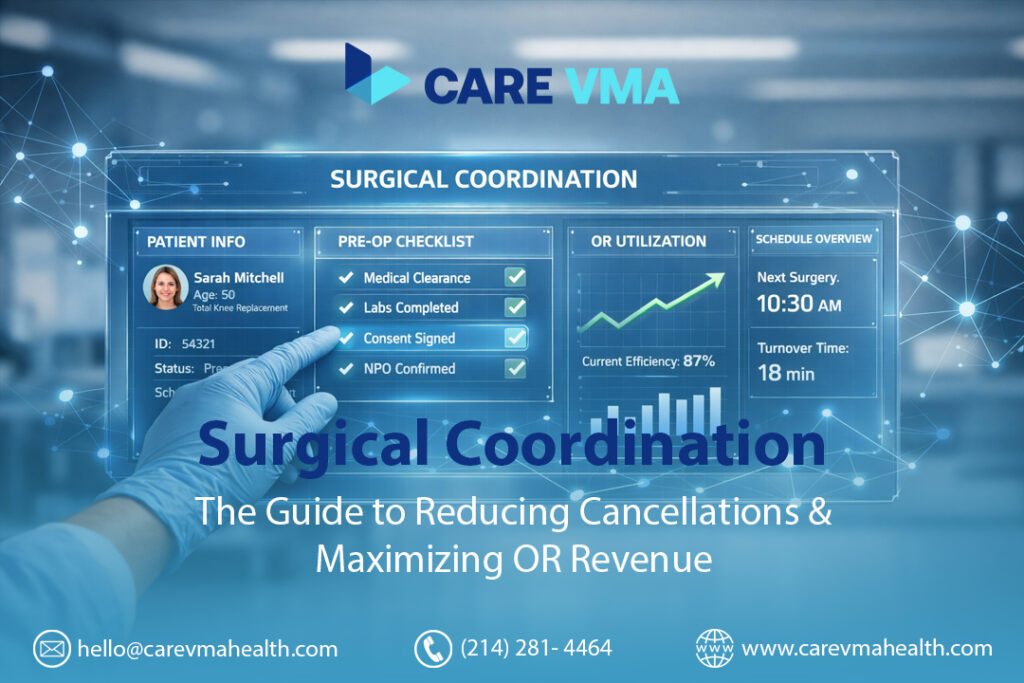
A surgery canceled at the last minute isn’t just a scheduling inconvenience; it’s a significant financial blow and a frustrating setback for patients and staff. The chaos of tracking down a missing pre-op clearance, an expired insurance authorization, or a patient who misunderstood their instructions creates a ripple effect of lost revenue, wasted staff time, and diminished patient trust. What if you could stop this cycle? The solution lies in a robust, precisely managed operational backbone.
Surgical coordination is the comprehensive operational process of managing all clinical, administrative, and logistical requirements—from insurance prior authorization to pre-operative clearances—to ensure a surgery proceeds without costly delays or cancellations. This system is the key to transforming a chaotic workflow into a predictable, profitable, and patient-centric machine. At its core, it’s about guaranteeing every single case is 100% ready, adhering to the highest standards of safety, including the WHO Surgical Safety Checklist and strict HIPAA compliance.
What is Surgical Coordination? More Than Just Scheduling
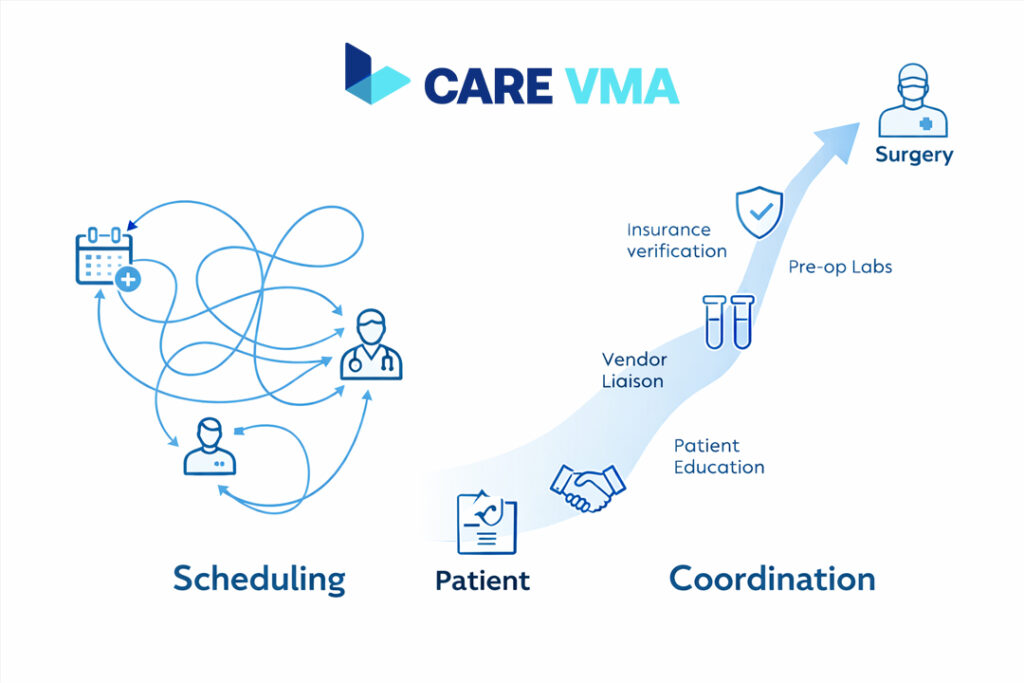
At first glance, surgical scheduling and coordination might seem interchangeable. But in reality, they are worlds apart. Simple scheduling is about filling a time slot on a calendar. True surgical coordination is about ensuring that the patient who fills that slot is clinically, financially, and logistically prepared for the procedure.
Think of it as the “connective tissue” of your entire perioperative workflow. It links the surgeon’s office, the hospital’s operating room, the insurance verification team, external labs, medical device vendors, and, most importantly, the patient. While a scheduler asks “when,” a coordinator asks “is everything in place for this to happen successfully?” This proactive approach moves a practice from being reactive to problems to preventing them entirely.
The 3-Phase Surgical Coordination Workflow
A successful surgery doesn’t start when the patient enters the OR. It’s the culmination of a meticulous, multi-stage process. What most people don’t realize is that failures in the first phase are the primary cause of stress and cancellations on the day of the procedure.
The entire journey can be broken down into three critical phases:
- Phase 1: Pre-Operative (The “Ready” State) This is the most labor-intensive and crucial phase. It involves gathering all necessary documentation and completing every prerequisite. Key tasks include managing the patient intake, confirming CPT codes for the procedure, completing rigorous insurance verification, and securing prior authorization. This is also where the coordinator ensures the patient’s History and Physical (H&P) is current and all necessary lab work is ordered and reviewed.
- Phase 2: Intra-Operative (Execution) On the day of surgery, the coordinator’s groundwork pays off. This phase focuses on seamless execution. It includes confirming the Anesthesia Briefing is complete, ensuring the correct staff are allocated, and acting as a communication hub if any unexpected needs arise. A well-coordinated pre-op phase means the intra-op phase runs with predictable efficiency.
- Phase 3: Post-Operative (Recovery & Billing) The process doesn’t end when the surgery is over. Effective post-op recovery coordination involves planning for discharge to the PACU or a rehabilitation facility, scheduling follow-up appointments, and ensuring all documentation is finalized for accurate surgical billing and revenue cycle management.
Why Surgical Coordination Fails: The “Failure Points”?
Even with a dedicated team, the surgical workflow is vulnerable to critical failure points. These aren’t just minor hiccups; they are revenue leaks that can cost a practice tens of thousands of dollars each month. Here’s the thing: most of these errors are entirely preventable.
The most common failure points include:
- Information Silos: This is the number one enemy of efficiency. It happens when the insurance team doesn’t know a surgery date was moved, leading to an expired authorization. Or when the surgeon’s office isn’t aware that a patient’s cardiac clearance came back with concerns. These communication gaps create last-minute emergencies.
- Vendor and Equipment Delays: Forgetting to schedule a medical device representative for a complex orthopedic implant or having a specialized instrument arrive late can bring an entire OR to a standstill. Poor vendor liaison is a frequent and costly point of failure.
- Patient Non-Compliance: A patient arriving for surgery having eaten breakfast because they weren’t properly reminded of their NPO instructions is a classic, frustrating reason for cancellation. This often stems from a lack of structured patient navigation and education.
Data from the National Institutes of Health (NIH) suggests that streamlined perioperative processes are key to improving outcomes. In fact, top-performing practices demonstrate that a well-oiled coordination system can push the rate of same-day cancellations below 2%, a critical benchmark for financial health.

The Care VMA Advantage: Human Intelligence for Surgical Success 🔥
Surgical orchestration platforms like Surgimate and ReadySet are powerful tools. But a tool is only as effective as the expert wielding it. This is the crucial gap where most practices falter—they have the software but lack the dedicated, highly-trained personnel to manage the complex, human-centric details that software alone cannot solve.
This is where Care VMA Health becomes your practice’s operational advantage. Our Virtual Medical Assistants are not just administrative support; they are trained surgical coordination specialists who provide the human intelligence layer needed for true success.
Here’s how a dedicated Care VMA transforms your surgical workflow:
- Eliminates Administrative Burden: Our VMAs take ownership of the entire pre-operative checklist, from chasing down lab results to confirming transportation for post-op care. This frees up your in-house staff to focus on direct patient care, reducing their administrative load by up to 60%.
- Breaks Down Information Silos: A Care VMA acts as a central communication hub, ensuring real-time updates are shared between all stakeholders. They provide double-verification on every critical step—from insurance to clinical clearances—to guarantee absolute Case Readiness.
- Manages Complex Cases with Precision: Consider a complex orthopedic surgery requiring a specific vendor implant, a cardiology clearance, and a multi-level insurance authorization. A Care VMA meticulously orchestrates all these moving parts, confirming every detail and flagging potential issues weeks in advance, not hours.
With Care VMA, you aren’t just buying software or hiring an assistant; you are integrating a proven system of expert human oversight that turns your surgical service line into a model of efficiency and profitability.
Feeling the strain of managing your surgical schedule? Evaluate your OR efficiency with our quick assessment to see where revenue might be leaking.
Key Metrics: Measuring Coordination Success
You can’t improve what you don’t measure. Shifting from a chaotic scheduling process to a data-driven coordination strategy allows you to track clear performance indicators that directly impact your bottom line.
The key metrics for successful surgical coordination are:
- OR Utilization Rate: This is the percentage of available operating room time that is used for surgery. Inefficient coordination leads to gaps and downtime. The industry benchmark for a high-performing OR is a utilization rate between 75-85%.
- First Case On-Time Starts: Delays in the first case of the day create a domino effect, pushing back every subsequent procedure. A high rate of on-time starts is a strong indicator of excellent pre-operative preparation.
- Cancellation Rate: This is the most direct measure of coordination failure. Tracking not just the rate, but the reasons for cancellation (e.g., insurance denial, missing clearance) provides actionable data to fix underlying process issues.
- Patient Satisfaction Scores: A smooth, well-communicated surgical journey significantly reduces patient anxiety and improves their overall experience, leading to better reviews and a stronger practice reputation.
Traditional In-House Coordination vs. Care VMA Outsourcing
Hiring a full-time, in-house surgical coordinator seems like the traditional solution, but it comes with significant overhead and limitations. You have to account for recruitment costs, training time, salary, benefits, and coverage for sick days or vacation.
In many cases, outsourcing to a specialized service like Care VMA Health offers a more scalable, flexible, and cost-effective model. Here’s a quick comparison:
| Feature | In-House Coordinator | Care VMA Specialist |
|---|---|---|
| Cost | High (salary, benefits, overhead) | Lower (fixed monthly fee, no overhead) |
| Scalability | Limited (hiring is slow and costly) | High (easily scale up or down as needed) |
| Training | Practice bears full training burden | Arrives fully trained and system-ready |
| Coverage | Gaps due to PTO or sick leave | Uninterrupted service and coverage |
| Expertise | Dependent on individual’s experience | Access to a team with broad expertise |
Mastering the pre-operative phase is essential, which is why understanding the Importance of Prior Authorization in Surgery is a non-negotiable first step for any practice. When you’re ready to see how a dedicated specialist can manage this entire process for you, explore our Care VMA Health Service Page: Surgical Coordination to learn more about our tailored solutions. Our team of virtual medical scribes can also assist with documentation to streamline the process further.
Frequently Asked Questions
What does a surgical coordinator do?
A surgical coordinator manages all non-clinical aspects of a surgery. Their primary responsibilities include scheduling the procedure, obtaining insurance prior authorizations, tracking pre-operative clearances (like lab work and medical consultations), and serving as the main point of communication for the patient.
How can I reduce surgical cancellations?
The most effective way is through proactive checklist management and robust patient education. This means verifying all clinical and financial requirements are met well in advance and using automated reminders and clear communication to ensure patients follow all pre-op instructions, such as NPO guidelines.
Is surgical coordination software enough?
While software is an excellent tool for tracking tasks, it is often not enough on its own. It cannot handle the nuanced communication, problem-solving, and clinical follow-up required for complex cases. An expert human operator, like a Virtual Medical Assistant, is crucial for managing exceptions and ensuring the system works flawlessly.
Conclusion
A disorganized surgical workflow is more than a headache—it’s a constant drain on your practice’s revenue and your staff’s morale. Last-minute cancellations and delays aren’t a cost of doing business; they are symptoms of a broken process. The modern, effective solution isn’t just another piece of software, but a strategic combination of technology and dedicated human expertise. By implementing a rigorous surgical coordination system, you reclaim control over your schedule, maximize your OR’s potential, and protect your bottom line.
Take a moment to evaluate the true cost of your current workflow. How many hours are lost each week to administrative chaos? How much revenue has vanished due to preventable cancellations?
Stop the chaos. It’s time to build a surgical workflow that is as precise and reliable as your clinical work.