
Every month, you see the reports. You feel the constant pressure of claim denials chipping away at your practice’s revenue and the looming anxiety of a potential payer audit. Every coding error feels like a ticking time bomb, and the industry benchmark of 95% accuracy seems less like a goal and more like a judgment. Falling below this number isn’t just a performance metric; it’s a direct threat to your financial stability, compliance standing, and the trust you’ve built with your patients. You know your team is stretched thin, yet persistent issues with upcoding, downcoding, or incorrect CPT modifiers continue to surface, creating a cycle of rework and frustration.
The good news? Achieving and consistently maintaining 95%+ medical coding accuracy isn’t about working harder; it’s about implementing a smarter system. It’s about having the right expert resources to diagnose and fix the root cause of these errors—without adding another complex project to your already overflowing plate.
Medical coding accuracy is the rate at which medical diagnoses, procedures, supplies, and services are correctly translated into universal alphanumeric codes, such as ICD-10 and CPT. The widely accepted industry standard for this accuracy is 95%, a critical benchmark that directly impacts a healthcare practice’s revenue integrity, legal compliance, and the quality of patient data. This guide, based on best practices from the American Health Information Management Association (AHIMA) and 2026 Revenue Cycle Management (RCM) standards, will show you how to get there.
What Is Medical Coding Accuracy and Why Is 95% the Magic Number?
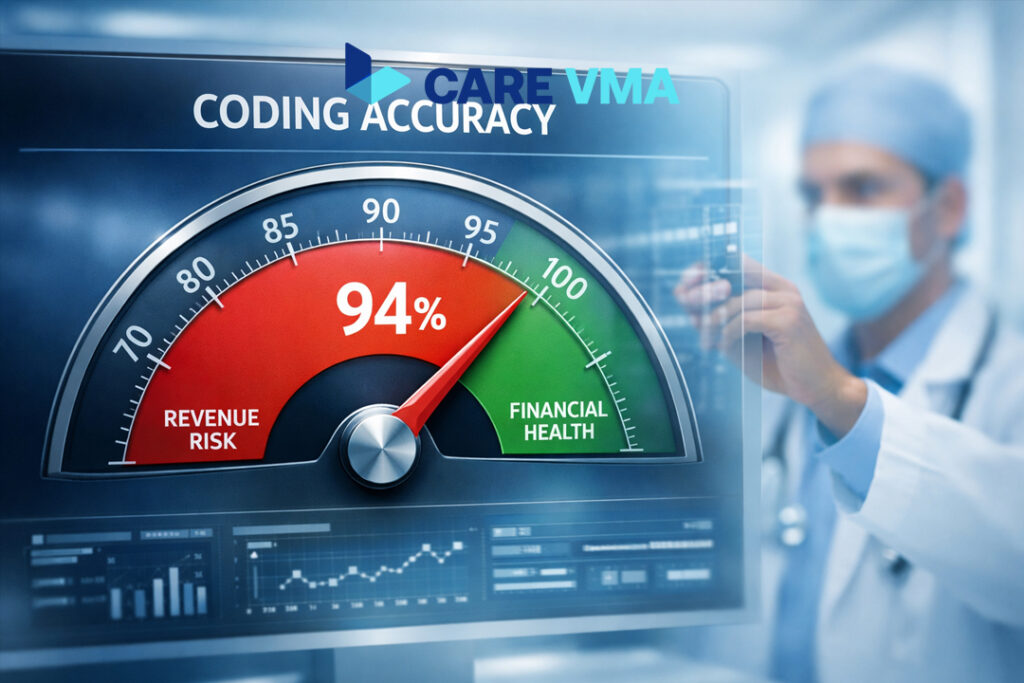
At first glance, the concept seems straightforward. But what most practice managers don’t realize is the immense financial weight carried by that 95% figure. It’s more than a passing grade; it’s the dividing line between a healthy revenue cycle and one that’s constantly struggling.
Established as the de facto industry benchmark by organizations like AHIMA, a 95% accuracy rate signifies that your coding processes are robust and reliable. When you dip below this threshold, it alerts payers that there may be systemic issues, increasing the likelihood of scrutiny and payer audits.
Here’s the thing: even a small drop has a massive impact. For a mid-sized practice, a 1-2% decrease in coding accuracy can translate into tens of thousands of dollars in lost or delayed reimbursement each month. It’s a slow leak that can sink a ship. This process involves the correct application of code sets including ICD-10, CPT, and HCPCS to ensure clean claims are submitted the first time.
The Domino Effect of Coding Errors: More Than Just Claim Denials
A single coding error doesn’t just trigger a denial. It sets off a chain reaction of negative consequences that can ripple through your entire practice, affecting everything from your cash flow to your patient relationships.
Financial Bleeding: Revenue Leaks and Swelling A/R Days
This is the most immediate and painful impact. Inaccurate codes are a primary driver of claim denials. Each denial requires your staff to spend valuable time investigating the issue, correcting the code, and resubmitting the claim. This administrative rework inflates your accounts receivable (A/R) days, strangling your practice’s cash flow. Errors like downcoding—intentionally or unintentionally using a code for a less expensive service—also cause you to leave earned money on the table, directly impacting your bottom line.
Compliance Nightmare: Audit Risks and False Claims Act Penalties
Here’s where the stakes get dangerously high. Consistent errors, especially those involving upcoding (billing for a more expensive service than was provided), can be flagged as fraudulent activity. This can trigger invasive audits from payers and even federal agencies. Under the False Claims Act, such practices can lead to staggering fines, exclusion from federal healthcare programs, and severe damage to your practice’s reputation. It’s a compliance nightmare that can have devastating legal and financial repercussions.
Patient Trust Erosion: Billing Confusion and Damaged Reputations
What many people don’t realize is that coding errors directly affect patients. An incorrect procedure code can lead to a patient being billed for a service they never received, creating confusion, frustration, and a breakdown of trust. Inaccurate diagnosis codes become part of a patient’s permanent medical history, which can potentially impact their future ability to get insurance coverage or even lead to clinical errors down the line.
The Usual Suspects: 4 Common Culprits Behind Low Accuracy
To fix the problem, you first have to identify the source. In many cases, the vast majority of coding errors stem from a handful of recurring issues. Understanding these common culprits is the first step toward building a defense.
- Upcoding and Downcoding: This is a classic error where the code submitted doesn’t match the clinical documentation. Upcoding to capture higher reimbursement is illegal, while downcoding to avoid scrutiny results in lost revenue. Both are symptoms of a disconnect between documentation and billing.
- Incorrect Use of CPT Modifiers: Modifiers are crucial for providing context. Misusing or omitting them is one of the leading causes of automated claim denials. For example, incorrectly applying modifier 25 (Significant, Separately Identifiable E/M Service) or modifier 59 (Distinct Procedural Service) is a frequent and costly mistake.
- Unbundling Services: This happens when procedures that should be billed under a single, comprehensive code are broken down and billed as separate components. While it may seem like a way to increase reimbursement, payers’ sophisticated software easily flags this as a compliance violation.
- Poor Clinical Documentation: Your coders can only be as accurate as the notes they work from. Ambiguous, incomplete, or illegible physician notes in the Electronic Health Record (EHR) force coders to make assumptions or use unspecified codes, which are magnets for denials and audits. A strong Clinical Documentation Improvement (CDI) program is essential to bridge this gap.
The 2026 Solution: How to Systematically Hit 95% Accuracy
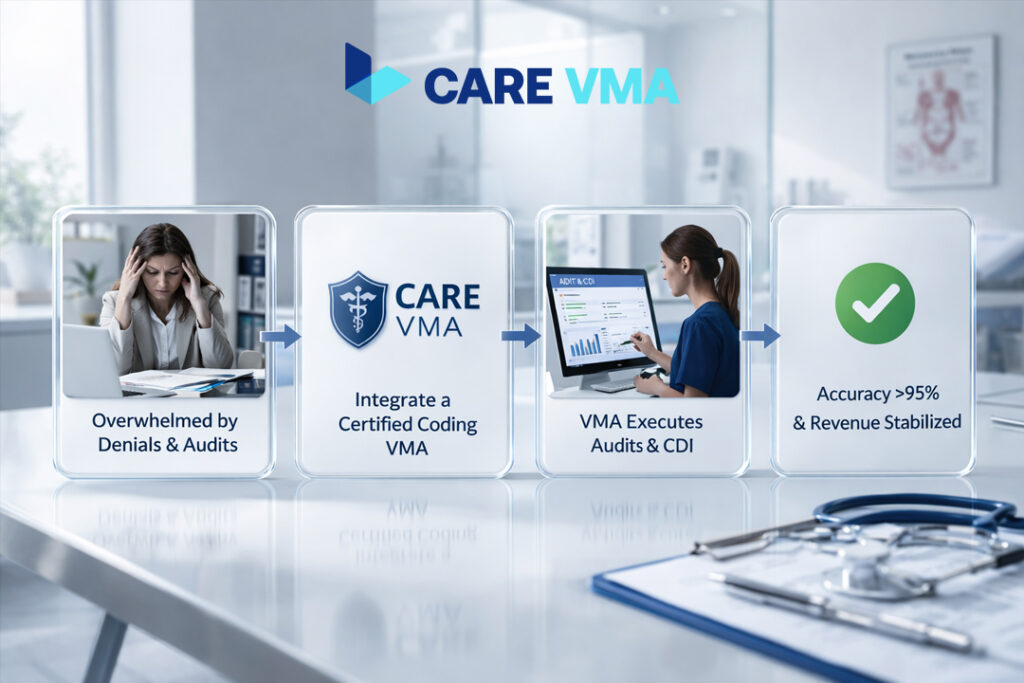
Knowing the problems is one thing; having the time and expert resources to fix them is another challenge entirely. Traditional solutions like hiring more full-time staff or launching a massive internal training program are often too costly and slow for a busy practice.
This is where the operational gap exists. It’s not just about what to do (audits, CDI, training), but who has the specialized bandwidth to execute it effectively.
Augment Your Team with a Certified Coding VMA
Instead of overhauling your entire workflow, a more modern and efficient approach is to augment your team with a certified Virtual Medical Assistant (VMA) specializing in medical coding from Care VMA Health. This isn’t about outsourcing your entire revenue cycle; it’s about surgically inserting an expert to solve a specific, high-impact problem.
Here’s how a Care VMA drives results:
- Saves Your Time: A certified coding VMA takes charge of conducting routine internal audits (monthly or quarterly), analyzing denial trends, and identifying error patterns. This frees you from the weeds of RCM and allows you to focus on leading your practice.
- Reduces Your Team’s Burden: The VMA acts as a dedicated CDI specialist, providing constructive, data-backed feedback to physicians on their documentation without creating internal friction. They handle complex denial management, taking the burden of appeals and follow-ups off your in-house team.
- Increases Expertise and Efficiency: Our VMAs are certified coders who are required to stay current with annual code changes and payer-specific rules. They bring a level of specialized expertise that can be difficult to maintain in-house, ensuring your revenue integrity and coding compliance are always up to date.
Use Case in Action:
Imagine an orthopedic clinic struggling with denials for minor procedures. They integrate a Care VMA for 20 hours a week. In the first 60 days, the VMA:
- Audits the last three months of denied claims.
- Identifies a consistent pattern of misuse of modifier -25.
- Holds a 30-minute virtual training session with the coding team and provides a one-page guide for physicians. Result? Their clean claim rate jumps by 12%, and A/R days are reduced by a week.
Tired of chasing down coding errors and watching revenue slip away? A dedicated Remote Medical Coder can be the expert resource you need to restore financial stability and peace of mind. Learn more about how Care VMA can help.
The Tangible ROI of High-Accuracy Coding
Achieving 95%+ accuracy isn’t just about compliance; it’s a powerful business strategy with a measurable return on investment. The benefits go far beyond simply getting paid.
- Accelerated Cash Flow: By dramatically increasing your clean claim rate, you reduce the time claims spend in A/R, directly improving your practice’s liquidity.
- Maximized Reimbursement: Accurate coding, particularly with proper modifier use and capturing medical necessity, ensures you are fully and fairly paid for every service provided.
- Mitigated Audit Risk: A consistent record of high accuracy and robust internal audit processes creates a defensible “paper trail” that shows good faith and protects you during payer audits. For more information on regulatory compliance, the Centers for Medicare & Medicaid Services (CMS) provides extensive resources.
- Peace of Mind: Knowing your revenue cycle is stable, compliant, and efficient allows you to shift your focus from financial fire-fighting to strategic growth and patient care.
Comparing Your Options: In-House vs. Full RCM vs. The Flexible VMA
| Feature | Hire In-House Coder | Outsource Full RCM | Augment with Care VMA |
|---|---|---|---|
| Cost | High (salary, benefits, overhead) | Very High (percentage of collections) | Moderate & Predictable (hourly rate) |
| Implementation Time | Slow (recruiting, hiring, training) | Moderate (complex transition) | Fast (often within days) |
| Flexibility | Low (fixed role) | Low (long-term contract) | High (scale hours up or down as needed) |
| Control Over Process | High | Low (you lose direct oversight) | High (VMA integrates into your team) |
The takeaway is clear: augmenting with a VMA offers the expertise of a seasoned professional without the cost and commitment of a full-time hire or the loss of control associated with full outsourcing. It’s the flexible, efficient middle ground.
Additional Resources for Your Practice
To continue strengthening your practice’s operations, explore these related topics:
- Learn how Revenue Cycle Management impacts the financial health of private practices.
- Discover how a remote medical biller can reduce claim denials.
- Understand the benefits of denial management and prevention strategies.
Ready to see how our certified coders can protect your revenue? Explore Care VMA Health’s Medical Billing and Coding Services.
FAQ (Frequently Asked Questions)
How do you calculate medical coding accuracy?
Accuracy is typically calculated by dividing the number of correctly coded items by the total number of items audited, then multiplying by 100. Audits can be performed on a “per-code” basis or a “per-record” basis, where one error makes the entire patient chart incorrect.
What is the difference between upcoding and downcoding?
Upcoding is billing for a more complex or expensive service than was actually provided and is considered fraud. Downcoding is billing for a less expensive service, often done to avoid audits, but it results in significant and unnecessary revenue loss for the practice.
How often should we conduct internal coding audits?
According to AHIMA, best practice is to conduct internal coding audits at least quarterly. However, if your practice is experiencing a high denial rate or has recently hired new coders, monthly audits are recommended to quickly identify and correct issues.
Stop Leaking Revenue and Start Building Stability
Reaching a 95% medical coding accuracy rate isn’t just an industry benchmark—it’s the foundation of a financially sound and compliant medical practice. By moving beyond reactive problem-solving and proactively addressing the common errors in documentation, modifier use, and unbundling, you can transform revenue leaks into reliable cash flow. You don’t have to let the complexity of coding drain your resources or your peace of mind.
Feeling overwhelmed and not sure where to start? The most effective first step is to get an expert assessment of your current processes.
Let our experts handle the complexity for you. Schedule a free 15-minute consultation to discover how a certified Virtual Medical Assistant can lift your coding accuracy above 95% in the next 90 days.