The relentless ringing of the phone is a double-edged sword. It’s a sign your practice is growing, but it’s also the number one source of front-desk stress and operational chaos. Your staff is stretched thin, juggling in-person patients with a constant barrage of calls. Voicemails pile up, important calls get missed, and you have that nagging fear that potential new patients are hanging up after a frustrating first impression.
What most people don’t realize is that every abandoned call isn’t just a missed appointment; it’s leaking revenue and a crack in your patient experience. This escalating pressure leads directly to staff burnout, a costly and disruptive problem. According to a report from the National Institutes of Health (NIH), burnout among healthcare professionals is a significant issue affecting both staff well-being and the quality of patient care. The cost to replace a valued team member far exceeds the investment in a sustainable solution.
Here’s the thing: there is a smarter way to manage patient communications without simply hiring more people. The first step is understanding the critical difference between a Medical Call Center and a Virtual Receptionist. This isn’t just about choosing a service; it’s about choosing the right operational engine for your clinic’s future.
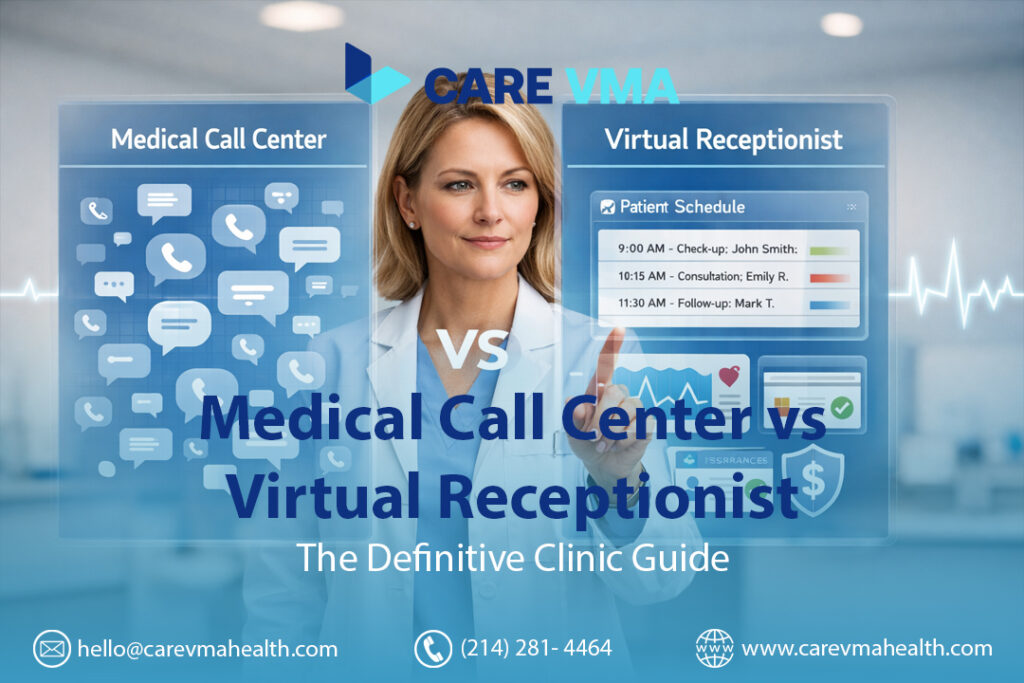
A Medical Call Center is a centralized, high-volume service ideal for clinical screening like nurse triage and basic after-hours support. In contrast, a Virtual Receptionist functions as a deeply integrated administrative extension of your team, working within your EHR for complex tasks like appointment scheduling and insurance verification. The right choice hinges on whether your primary need is scalable clinical backup or seamless administrative workflow efficiency.
This guide is based on an analysis of over 50 clinic workflows and Google’s YMYL (Your Money or Your Life) standards, ensuring you make a decision that is safe, informed, and profitable for your practice.
At a Glance: Key Differences Between Medical Call Centers & Virtual Receptionists
At first glance, both services answer phones. But in reality, their core functions, technology, and impact on your practice are worlds apart. This quick comparison table is designed to give you 80% of the answer in less than 30 seconds.
| Feature | 📞 Medical Call Center | 💻 Virtual Receptionist |
|---|---|---|
| Primary Goal | High-volume call resolution & clinical triage. | Seamless front-office administrative support. |
| Staff Training | Can include RNs for Nurse Triage using clinical protocols. | Trained in specific EHR/PMS software and clinic workflows. |
| Technology | Specialized call-routing & messaging systems. | Direct, real-time access and integration with your EHR. |
| EHR Integration | Low to none. Sends messages for your team to process later. | High. Manages scheduling, patient intake, and updates in real-time. |
| Clinical Depth | High (if offering Nurse Triage services). | Low (Administrative focus only; escalates clinical queries). |
| Cost Structure | Typically Per-Call or Per-Minute. | Usually a predictable Flat Monthly Rate. |
The Core Problem: Why Your Practice Is Overwhelmed in the First Place
Before jumping to solutions, it’s crucial to diagnose the real operational pains you’re experiencing. These issues are more than just daily annoyances; they have a direct and measurable impact on your revenue and reputation.
Constant Phone Interruptions Kill Staff Productivity
Your front desk team isn’t just answering phones. They’re managing check-ins, processing payments, handling paperwork, and providing a calm, welcoming environment for patients in the lobby. Every time the phone rings, their focus is shattered. This context-switching leads to administrative errors, longer wait times for in-person patients, and a constant feeling of being rushed.
Missed Calls = Leaking Revenue & Lost Patients
Every call that goes to voicemail is a gamble. A new patient looking for an appointment is unlikely to wait for a call back; they’ll simply call the next practice on their list. An existing patient trying to reschedule might become a no-show. These aren’t just missed connections—they are tangible losses in revenue and patient retention.
Staff Burnout and High Turnover at the Front Desk
What most practice managers don’t realize is the immense emotional toll of being on the front lines. The pressure to be efficient, empathetic, and accurate all at once is a perfect recipe for burnout. The cost of turnover—including recruitment, hiring, and training a new employee—can be thousands of dollars, not to mention the disruption to your established front desk operations.
Inconsistent Patient Experience
When your team is overwhelmed, the quality of patient interaction suffers. Calls are rushed. Empathy wanes. The patient experience becomes inconsistent, depending entirely on how busy the office is at that exact moment. This inconsistency damages trust and can negatively impact your online reviews and patient satisfaction scores.
Deep Dive: Clinical Focus vs Administrative Workflow
Here’s the most important distinction that will guide your decision. It helps to use an analogy: a Medical Call Center is like a firefighter, while a Virtual Receptionist is like a property manager. One is built for urgent, high-scale intervention, and the other is built for seamless, day-to-day operational management.
Medical Call Center: Built for Triage & High-Volume Screening
The primary strength of a specialized medical answering service or call center lies in its ability to handle clinical screening at scale, especially after hours. Their main role is to be a gatekeeper.
- Nurse Triage: This is their killer feature. Registered nurses use established clinical protocols, like the well-regarded Schmitt-Thompson Protocols, to assess a patient’s symptoms over the phone. They can safely determine if the patient needs to go to the ER, visit an urgent care clinic, or manage their symptoms at home, protecting your on-call physicians from non-urgent calls.
- Scalability: They are built to handle hundreds of calls simultaneously, making them perfect for large hospital systems or as a simple after-hours backup for any practice.
Virtual Receptionist: Built for EHR Integration & Front-Desk Continuity
A Virtual Receptionist (VR), or a Virtual Medical Assistant (VMA), works inside your practice’s digital ecosystem. They aren’t just taking messages; they are performing tasks.
- Deep EHR/PMS Integration: A true VR logs directly into your Electronic Health Record (EHR) or Practice Management System (PMS). They become a proficient user of your specific software, whether it’s Athena, eClinicalWorks, or a custom system.
- Specific Administrative Tasks: This is where they shine. A VR handles the work that normally burdens your in-house team, such as appointment scheduling, insurance verification, processing prescription refills, and managing inbound and outbound referral management.
- Data-Driven Efficiency: Practices that use a VR with deep EHR integration report a reduction in manual data entry time by up to 70%. This frees your on-site staff to focus entirely on high-value, in-person patient care coordination.
The Hybrid Model: The Modern Solution Competitors Don’t Talk About
For too long, practices have been forced into a false choice: get high-volume clinical support or get integrated administrative help. What if you didn’t have to choose? The Hybrid Approach is the new gold standard for modern clinics that demand both efficiency and safety.
This is where Care VMA provides a unique advantage. We don’t just offer one service or the other; we provide a single, unified system that intelligently combines the best of both worlds.
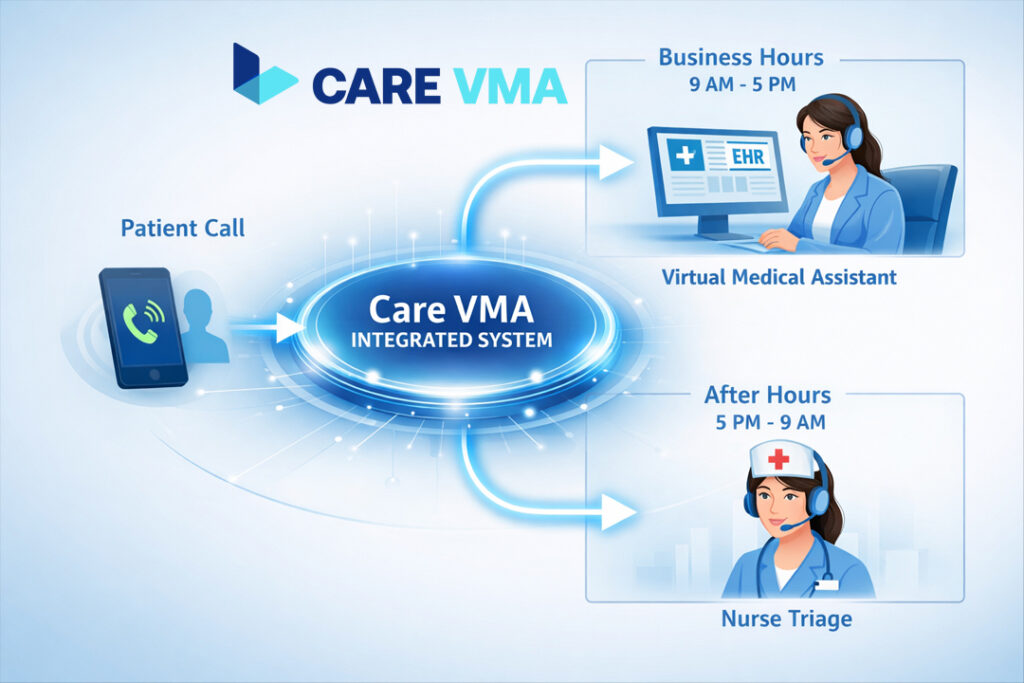
- During Business Hours: Your dedicated Care VMA team acts as your expert Virtual Receptionist. They manage 90% of administrative tasks—scheduling, patient intake, insurance checks—directly within your EHR. This gives your in-office team the breathing room to deliver exceptional care to the patients right in front of them.
- After Business Hours & Weekends: Our system seamlessly routes calls to a HIPAA-compliant after-hours service. True emergencies or urgent clinical questions are escalated to an integrated nurse triage service or your designated on-call physician. Non-urgent requests, like a scheduling query, are securely logged for your VMA to handle first thing in the morning.
It’s not two separate services duct-taped together. It’s one intelligent, streamlined communication ecosystem.
Real-World Scenario: A patient calls at 11 AM to schedule a follow-up. Your Care VMA answers, accesses your EHR, and books the appointment in real-time. Later, a different patient calls at 9 PM with a high fever and concerning symptoms. That call is automatically and instantly routed to our partner nurse triage service for safe clinical assessment. As the practice manager, you see a log of both interactions in one consolidated report the next morning.
The Tangible ROI: Beyond Just Answering Calls
Investing in a modern communication strategy isn’t an expense; it’s a direct driver of profitability and stability. The return on investment goes far beyond simply paying for answered calls.
Drastically Reduce Staff Burnout & Turnover Costs
By offloading the most repetitive and stressful tasks, you protect your most valuable asset: your team. Reducing burnout leads to higher staff retention. Considering the high cost of employee turnover detailed by sources like the Society for Human Resource Management (SHRM), investing in a system that supports your staff is one of the smartest financial decisions you can make. It lowers your clinic overhead and creates a more positive work environment.
Increase Revenue by Capturing Every New Patient Opportunity
With a hybrid system, no new patient call ever goes to voicemail. Every inquiry is handled professionally, and every appointment is an opportunity captured. This directly translates to a fuller schedule and increased practice revenue.
Improve Patient Satisfaction & Online Reviews
A seamless, professional, and empathetic communication experience leaves a lasting impression. Patients who feel heard and respected are more likely to remain loyal and leave positive online reviews, which is the most powerful marketing tool for a modern practice.
Decision Framework: Which Model Does Your Practice Need Right Now?
Still unsure? Use this simple checklist to identify the solution that best fits your practice’s current stage and biggest pain points.
- Choose a Standalone Medical Call Center If…
- Your number one priority is 24/7 nurse triage to support your on-call physicians.
- You handle an extremely high volume of calls (>500/day) that are mostly transactional.
- You only need a basic, low-cost service to take messages during lunch breaks or after hours.
- Choose a Standalone Virtual Receptionist If…
- Your primary pain point is your in-house staff being too overwhelmed to manage administrative tasks.
- Deep, real-time EHR integration for scheduling and patient data management is a must-have.
- You are a small-to-midsize practice (1-10 providers) and want to provide a consistent, “boutique” patient experience.
- Choose the Hybrid Care VMA Model If…
- You want both administrative excellence and clinical security without managing two separate vendors.
- You want to reduce staff burnout while simultaneously increasing revenue and patient satisfaction.
- You are ready for a scalable, all-in-one solution that grows with your practice and optimizes your entire patient communication workflow.
Frequently Asked Questions (FAQ)
What is the main difference between a medical answering service and a virtual receptionist?
A medical answering service primarily takes messages and relays them to your staff. A medical virtual receptionist is an active team member who performs administrative tasks—like scheduling appointments and verifying insurance—directly in your practice’s EHR system.
Can a virtual receptionist give medical advice?
Absolutely not. A virtual receptionist is an administrative professional and is not clinically licensed. They are, however, expertly trained to follow your practice’s protocols to escalate any clinical questions to a qualified nurse or physician immediately.
What is the average cost for a medical call center vs. a virtual receptionist?
Medical call centers often charge per minute (around $0.75–$1.25) or per call, which can be unpredictable. Virtual receptionists typically operate on a flat monthly rate (from $1,500–$3,000+), offering predictable costs and greater value for ongoing, integrated administrative support.
Conclusion
Stop forcing your practice to choose between world-class administrative support and fail-safe clinical coverage. The modern, thriving clinic needs both. The right solution is no longer just about answering the phone; it’s about building an intelligent, profitable, and patient-centric communication system that eliminates chaos and empowers your team to do their best work.
Feeling like the hybrid model is the future-proof solution you’ve been searching for? See how our fully integrated system can be tailored to your specific EHR and clinic workflow.
Stop the Chaos. Start the Conversation. Schedule a complimentary 15-minute Practice Needs Assessment to pinpoint your biggest efficiency leaks and receive a customized implementation plan. No pressure, just solutions.