Your newest patient called twice last week before they reached a human. The first call dropped into voicemail during the front-desk lunch rotation; the second sat on hold for nine minutes before the patient hung up. By the time your staff called back the next morning, that patient had already booked with the practice two blocks away. Nothing about your clinical care was ever in question — the patient simply never got far enough to experience it.
This is the part of patient care that almost never shows up in a quality report, and it’s exactly where a virtual medical assistant earns its place in your practice. Most discussions of VMAs stop at “they free up your time.” That’s true, but it badly undersells what actually happens day to day. A well-run VMA doesn’t only lighten your staff’s load behind the scenes — it touches the patient directly: the call that gets answered on the first ring, the reminder that prevents a missed visit, the post-procedure follow-up that closes the loop instead of leaving a patient wondering.
In the next few minutes, you’ll see precisely how a virtual medical assistant directly improves patient care — touchpoint by touchpoint, with the operational specifics that separate a real lift in patient experience from a vague promise. Drawing on what we see working with independent practices across the country, we’ll show you where the direct impact comes from, the mistake that quietly cancels it out, and how to push from reactive support toward measurably better outcomes.
Your Patients Experience Your Admin Problems Before They Ever See You
Here’s the uncomfortable truth most practices don’t measure: a patient forms their first judgment of your care long before they meet you. It happens on the phone that rings out, in the portal message that goes three days without a reply, in the rescheduling request that no one acknowledges. To the patient, that is your care. They can’t separate “the front desk was swamped today” from “this practice doesn’t have its act together.”
That gap is where patients churn, and it widens precisely when your team is busiest. A receptionist juggling a full waiting room, three ringing lines, and a fax tray cannot also be warm, fast, and thorough on every patient interaction — not because they’re not capable, but because the workload makes it impossible. The patient on hold doesn’t see the chaos. They just feel ignored.
A virtual medical assistant changes the math by carrying the patient-facing load that your in-house team can’t absorb in real time. The result is felt directly by the patient: shorter waits, faster answers, and the sense that someone is actually paying attention. If you want to see how those everyday interactions shape loyalty, our breakdown of how VMAs influence day-to-day patient interactions and engagement goes deeper on the mechanics.
What “Directly Improves Patient Care” Actually Means for a VMA
It’s worth being precise, because the term gets used loosely. There are two ways a VMA improves care, and most articles blur them together:
- Indirect impact — the VMA absorbs administrative work, which gives your providers more time and mental bandwidth for the exam room.
- Direct impact — the VMA itself owns specific patient touchpoints, so the patient’s experience improves at the point of contact, regardless of what the physician is doing.
Both matter, but the direct impact is the one that’s usually missed. When a virtual medical assistant directly improves patient care, it shows up at concrete, nameable moments:
- Answered calls — inbound calls picked up quickly, every business hour, with no patient stranded in voicemail.
- Appointment reminders and confirmations — proactive outreach that keeps patients on schedule.
- Follow-up after visits and procedures — checking that instructions were understood and referrals were booked.
- Refill and prescription requests — routed and processed without the days-long lag patients dread.
- Portal and message response — timely, clear replies to non-clinical questions.
- Intake and pre-visit prep — collecting history and insurance details before the patient arrives.
Each of those is a moment the patient feels. For the wider view of how these add up across a practice, our overview of the ways VMAs enhance patient care end to end is a useful companion to this guide.
Why Administrative Overload Quietly Erodes Patient Care
To fix the problem you have to understand its root, not just its symptoms. The symptom is a missed call or a slow portal reply. The root is that patient-facing communication is the first thing to collapse when an in-house team is over capacity — because it’s interruptible, and clinical work isn’t.
When the day gets busy, your staff triages instinctively: the patient physically in the room comes first, then the urgent clinical task, then billing deadlines. Patient communication — the callback, the follow-up, the reminder — drifts to the bottom of the list and often falls off entirely. None of that is negligence. It’s the predictable result of asking a fixed number of people to do a variable, spiking workload.
The cost compounds. Frequently cited industry estimates put missed appointments at roughly a $150 billion annual drain on the U.S. healthcare system, and a large share of no-shows trace back to something as simple as patients forgetting. When reminders are the task that gets skipped on busy days, your no-show rate isn’t a patient-behavior problem — it’s a capacity problem wearing a disguise. That distinction matters, because capacity is exactly what a VMA adds.
What We See Across Practices: Patients Judge Care by Responsiveness
What we consistently see when practices come to Care VMA is a quiet mismatch: the clinical care is genuinely excellent, but patient-satisfaction scores and retention don’t reflect it. The reason is almost always responsiveness. Patients can’t independently evaluate your diagnostic accuracy — but they absolutely judge how fast you answered, how clearly you followed up, and whether they felt forgotten between visits.
That’s the lever a virtual medical assistant pulls directly. The pattern we’ve observed across independent practices is that the moment patient communication becomes consistent — answered reliably, followed up predictably — perceived quality of care rises even when nothing clinical has changed. Patients describe the practice as “on top of things” and “easy to deal with,” and those are the exact phrases that drive referrals and reviews.
Most physicians don’t realize how much of their reputation is built in these administrative moments rather than in the exam room. The clinical skill earns trust once a patient is in front of you. The responsiveness is what determines whether they get there, stay, and recommend you. Maintaining a dependable standard for patient communication and service is often the single highest-leverage change a busy practice can make.
The Patient Journey, Touchpoint by Touchpoint — Where a VMA Makes Direct Contact
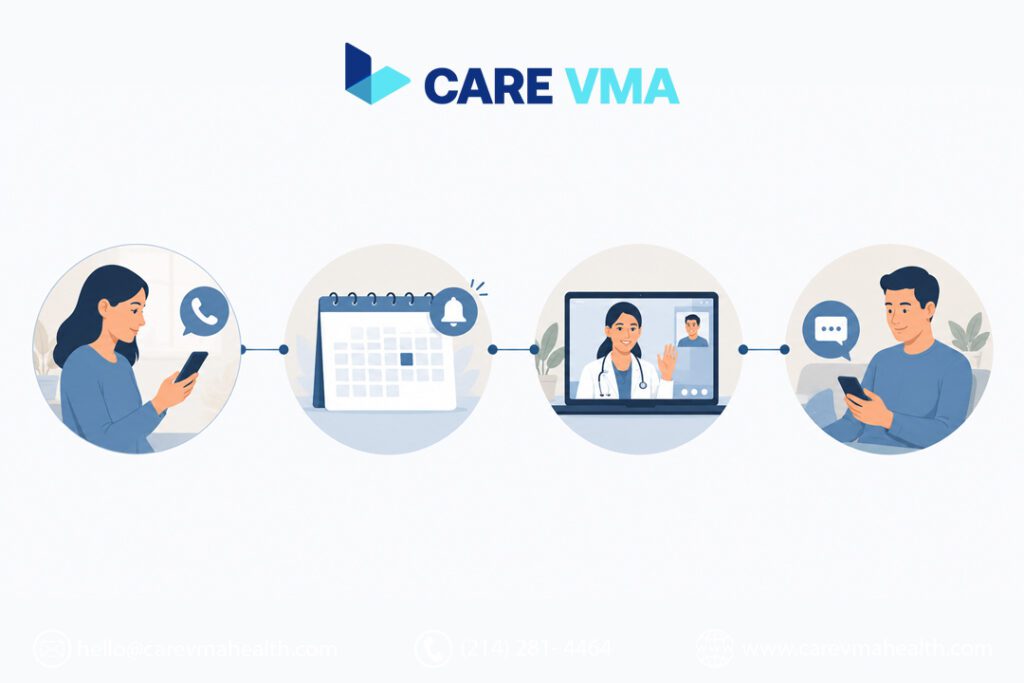
Here’s a practical way to see the direct impact: walk your patient journey and mark every point where a VMA touches the patient. This is the framework we use when we map a practice’s workflow.
1. Before the visit
The patient calls or messages. A VMA answers promptly, books accurately, verifies insurance, and collects intake details — so the patient arrives prepared and the visit starts on time. This stage alone removes the “I couldn’t get through” failure that loses patients before they’re patients.
2. The reminder and confirmation
A day or two out, the VMA sends a reminder by the patient’s preferred channel and confirms attendance, freeing up slots when someone can’t make it. Practices that hand reminders and confirmations to a VMA — instead of squeezing them between front-desk tasks — typically see their no-show rate fall, because the task finally gets done every single time rather than only on quiet days.
3. The handoff to clinical care
While the provider focuses on the patient, the VMA keeps the schedule, documentation queue, and messages moving in the background — so the visit isn’t rushed to catch up on admin.
4. After the visit
The VMA follows up: confirming the patient understood instructions, that referrals were booked, that labs were scheduled. This is where care quality is silently won or lost. A patient who leaves confused and hears nothing assumes they’re on their own; a patient who gets a follow-up feels cared for.
5. Between visits
Refills, results questions, rescheduling, and portal messages get handled in a timely way instead of piling up.
For practices that want this stitched together rather than scattered across whoever is free, a dedicated Virtual Patient Care Coordinator owns the journey end to end — so no patient slips between the cracks during a referral, a follow-up, or a transition of care. That continuity is exactly what turns “we answered the phone” into “this practice has a system.”
The Mistake Most Practices Make: Treating a VMA as Back-Office Only
The most common mistake we see is hiring a VMA purely as overflow — a place to dump faxes, data entry, and paperwork — and never letting them touch the patient at all. Practices do this out of caution, assuming a remote assistant should stay invisible to patients. It’s an understandable instinct, and it quietly throws away most of the value.
When a VMA is walled off from patient contact, you capture the indirect benefit (a little time saved) but forfeit the direct one (a better patient experience). The phone still rings out. The follow-ups still don’t happen. You’ve added support behind the scenes while the patient-facing failures that actually cost you patients go untouched.
A second, related mistake is a sloppy handoff — patients sensing they’re being bounced between people with no continuity. The fix isn’t to hide the VMA; it’s to integrate them properly: a clear scope, access to your scheduling and EHR workflows, scripts that match your practice voice, and a defined handoff to in-house staff for anything clinical. Done right, patients don’t experience a “remote assistant.” They experience a practice that answers fast and follows through. The difference between those two outcomes is entirely in how you deploy the VMA — not in the VMA itself.
From Reactive to Proactive: Advanced Ways a VMA Improves Outcomes
Once the basics are reliable, the practices that pull furthest ahead use a VMA to shift from reactive to proactive patient care — and this is where direct impact moves from experience to genuine outcomes.
Instead of waiting for patients to call, a VMA can run structured outreach: checking in on patients with chronic conditions, confirming medication adherence, flagging patients overdue for follow-up, and closing care gaps before they become complications. For practices managing diabetes, hypertension, or other ongoing conditions, this proactive cadence is the difference between a patient who drifts and a patient who stays engaged in their own care. The connection between consistent outreach and results is well documented in our look at improving patient outcomes through effective chronic care management.
This is also where remote patient monitoring and chronic care management programs change the equation. A VMA can manage the daily flow — reviewing incoming readings, surfacing the ones that need a clinician’s eye, and keeping patients connected between appointments — so your providers spend their time on the patients who actually need intervention. The result is a care model where no patient is “out of sight, out of mind” after they walk out the door. For practices ready to scale, this proactive layer is what turns a VMA from a cost-saver into a measurable driver of patient outcomes.
A Direct, Measurable Lift in Patient Care
The case is simple once you separate the two kinds of impact. Yes, a virtual medical assistant gives your providers time back — but its more important effect is the one your patients feel directly: calls answered, reminders sent, follow-ups completed, and continuity maintained from the first contact through every visit in between. That responsiveness is what patients actually judge your practice on, and it’s the difference between a patient who churns and one who refers.
The practices that win with VMAs are the ones that stop treating them as back-office overflow and start treating them as the patient-facing backbone of the practice — properly scoped, integrated into your workflows, and pointed at the touchpoints that matter. Reliable communication first, proactive outreach next.
If you’d like to see what this would look like in your practice specifically — which touchpoints to hand off first, and how a HIPAA-compliant Virtual Medical Assistant would fit your existing workflow — book a free consultation with the Care VMA team. We’ll map your patient journey with you and show you where the direct impact will come from.
Frequently Asked Questions
How does a virtual medical assistant directly improve patient care? A VMA owns specific patient touchpoints — answering calls, sending reminders, handling follow-ups, processing refills, and replying to portal messages — so the patient’s experience improves at the point of contact. That’s separate from the time it frees up for your providers; the patient feels the difference directly in faster, more consistent communication.
Can a VMA actually reduce no-shows? Yes. No-shows are largely a capacity problem — reminders are the task that gets skipped when the front desk is overwhelmed. When a VMA owns reminders and confirmations and runs them consistently, practices typically see missed appointments drop, because the outreach finally happens every time rather than only on slow days.
Is patient data safe with a remote virtual medical assistant? With a HIPAA-compliant provider, yes. Care VMA’s assistants work within secure systems and defined access protocols, handling protected health information under the same compliance standards as your in-house staff. Data security should be confirmed in writing before any VMA touches patient records.
Will patients know they’re dealing with a remote assistant? When a VMA is integrated properly — using your practice’s scripts, scheduling, and workflows — patients experience a practice that answers quickly and follows through, not a disconnected “outside” service. The continuity matters more than the location; a well-deployed VMA feels like part of your team.
How quickly do practices see an impact on patient experience? The communication improvements — answered calls, faster responses, consistent reminders — are usually felt within the first few weeks, because they start the moment the VMA takes over those touchpoints. Outcome-level results from proactive outreach build over the following months as the cadence becomes routine.
Does a VMA replace my front-desk staff? Usually no — it relieves them. Most practices use a VMA to absorb the patient-facing overflow their in-house team can’t keep up with in real time, so on-site staff can focus on the patients in front of them. The two work together, with a clear handoff for anything clinical or in-person.