![How Virtual Assistants Are Different From Employees [Cost Guide]](https://carevmahealth.com/wp-content/uploads/2024/09/How-Virtual-Assistants-Are-Different-From-Employees-1024x683.jpg)
The relentless pace of a modern medical practice leaves little room for inefficiency. You are constantly balancing the highest standards of patient care with the crushing weight of administrative tasks. This operational drag is more than just an inconvenience-it leads to physician burnout, strains your staff, and can directly impact your practice’s financial health and patient satisfaction. The thought of hiring more help is appealing, but the staggering cost and commitment of a traditional employee can feel like an insurmountable barrier.
This guide is the solution. We provide a clear, strategic breakdown of how a virtual assistant is different from an employee, allowing you to make a data-driven decision for the future of your practice. A virtual assistant (VA) is an independent professional providing administrative services remotely, unlike a traditional employee who works on-site with a fixed employment status. The core differences lie in their cost structure, operational flexibility, and the specialized skills they bring to your healthcare environment.
Fundamental Differences: Virtual Assistant vs In-House Employee
Understanding the foundational distinctions between a VA and an in-house employee is the first step toward optimizing your practice. While both can perform administrative duties, their relationship with your business is fundamentally different.
Key Comparison: VA vs Employee
To illustrate the differences, consider this direct comparison:
- Employment Status: A VA is an independent contractor. An employee is a direct hire (W-2 in the U.S.), making you responsible for employment taxes and legal compliance.
- Cost Structure: With a VA, you pay for productive hours or a pre-defined scope of work. With an employee, you pay a fixed salary plus mandatory overhead costs like benefits, insurance, and office space.
- Location and Tools: A VA operates remotely using their own equipment. An employee works in your office, requiring you to provide a workstation, computer, and other necessary utilities.
- Flexibility: VAs offer immense flexibility. You can scale their hours up or down based on patient volume and seasonal demands. Employee schedules are typically fixed, making it harder to adjust to fluctuating workloads.
- Onboarding: VAs, especially specialized ones, often come with a streamlined onboarding process focused on integrating into your specific workflows. Employees require a more extensive and costly recruitment, hiring, and training period.
In-depth Cost Analysis: Why a VA is More Cost-Effective for Your Medical Practice
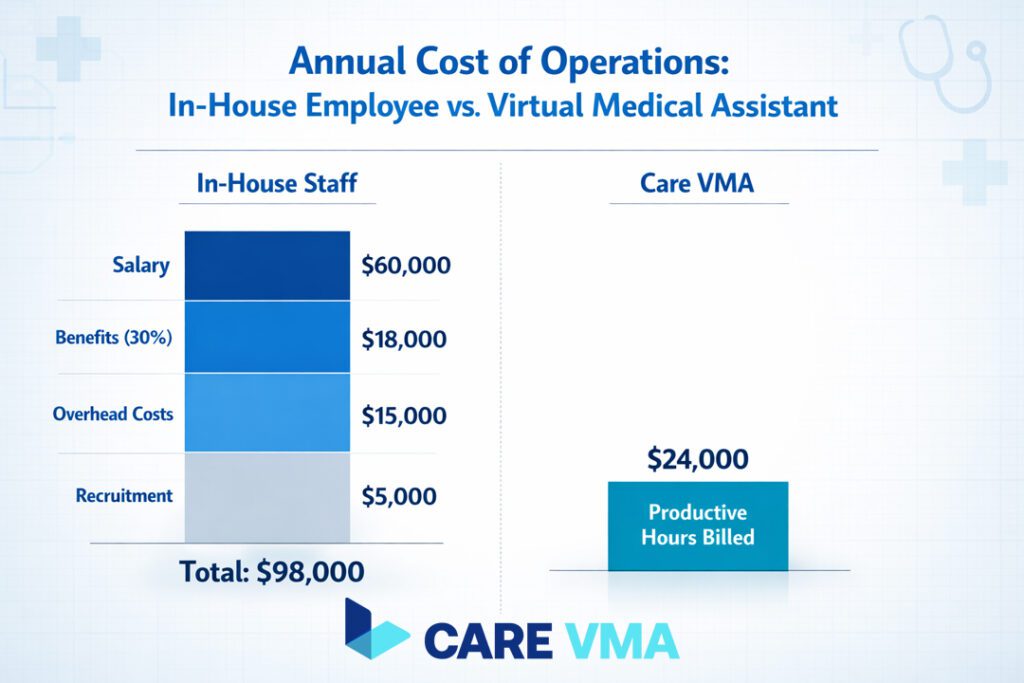
The label “[Cost Guide]” in our title is a promise. Let’s move beyond generalities and dissect the true financial impact of each option. The sticker price of a salary is only the beginning of an employee’s total cost.
The Hidden Costs of Hiring an In-House Medical Employee
When you hire a full-time administrative employee, the financial commitment extends far beyond their hourly wage or annual salary. These are the costs you must factor in:
- Salary and Benefits: On top of the base salary, you can expect to pay an additional 20-30% for mandatory benefits. This includes health insurance, retirement plans, paid time off, and payroll taxes, as noted by the U.S. Bureau of Labor Statistics.
- Overhead Expenses: An on-site employee requires physical space. This translates to costs for rent, utilities, office furniture, a computer, software licenses, and office supplies.
- Recruitment and Training: The process of finding, interviewing, and hiring a qualified candidate is time-consuming and expensive. Once hired, you then invest significant time and resources into training them on your practice’s specific procedures and systems.
The Virtual Assistant Cost Model: Transparency and Efficiency
The VA model eliminates nearly all of those hidden costs, offering a transparent and efficient alternative.
- Pay for Productivity: You only pay for the hours a VA is actively working on your tasks. You are not paying for coffee breaks, downtime, or idle periods. This model ensures every dollar you spend is directly converted into productive output.
- No Overhead or Benefits: Since VAs are independent contractors working remotely, you are not responsible for their benefits, office space, or equipment. This alone can result in savings of thousands of dollars per year.
- Streamlined Onboarding: A professional VA service handles the recruitment, vetting, and initial training. This significantly reduces your time and cost investment, allowing you to integrate a skilled professional into your workflow much faster.
The Modern Solution: The Virtual Medical Assistant (VMA) Advantage for Your Practice
For a medical practice, the choice is not just between a general VA and an employee. The optimal solution is a specialist: a Virtual Medical Assistant (VMA). Generic VAs lack the industry-specific knowledge required to handle sensitive patient data and complex clinical workflows. This is where Care VMA provides a decisive advantage.
Beyond Admin: The Specialist Skills Your Practice Demands
A VMA is an upgrade, not just a cost-effective alternative. Our professionals are trained specifically for the healthcare environment, addressing critical needs that general VAs cannot.
Guaranteed HIPAA Security and Compliance
Patient privacy is non-negotiable. Our VMAs undergo rigorous training on HIPAA regulations to ensure all patient data is handled with the highest level of security and confidentiality. This protects your practice from costly violations and builds patient trust. Understanding the full scope of HIPAA Compliance & Data Security: The Complete Guide [2026] is critical for any modern practice.
Speaking Your Language: Fluency in Medical Terminology and EMR/EHR Systems
A VMA from Care VMA speaks the language of your practice. They are proficient in medical terminology and trained to integrate seamlessly with your existing Electronic Medical Record (EMR) or Electronic Health Record (EHR) systems. This ensures accuracy in patient charting, scheduling, and communications, forming a core part of an effective EHR & EMR Management: A Best Practice Guide [2026 Update].
Optimizing Your Revenue: Medical Billing and Insurance Verification Support
Administrative errors in billing and insurance verification can lead to claim denials and severely impact your revenue cycle. Our VMAs can assist with these critical financial tasks, ensuring claims are clean and authorizations are secured. Proper Insurance Verification & Prior Authorization [RCM Guide 2026] is essential for maintaining a healthy cash flow.
Frequently Asked Questions
Making the shift to a virtual team can bring up questions. Here are answers to the most common inquiries we receive from healthcare professionals.
How do VMAs maintain patient data confidentiality while working remotely?
We use secure, encrypted platforms for all communications and data transfer. Every VMA signs a strict non-disclosure agreement (NDA) and, most importantly, is fully trained in HIPAA protocols as defined by the U.S. Department of Health & Human Services.
Can a VMA handle patient phone calls?
Absolutely. Our VMAs are trained to act as professional front-desk representatives. A skilled Virtual Assistant Receptionist to Reduce Call Wait Time and Build Patient Trust can manage appointment scheduling, answer common patient inquiries, and escalate urgent calls according to your practice’s specific protocols.
How long does it take for a VMA to become effective?
Our structured onboarding process is designed for rapid integration. While a traditional employee can take weeks or months to become fully productive, a Care VMA professional can be onboarded and start adding value to your practice within days.
Conclusion and Next Steps
The difference between a virtual assistant and an employee is clear: one is a fixed, high-overhead cost, while the other is a flexible, efficient, and strategic investment in your practice’s growth. For healthcare providers, a specialized Virtual Medical Assistant is not just about reducing expenses-it’s about reclaiming your time, optimizing your revenue cycle, and refocusing your energy on what matters most: your patients.
Ready to transform your administrative workflow and elevate your patient care? It’s time to move beyond the limitations of traditional hiring.
Schedule a free 15-minute consultation with our specialists to discover how our Virtual Medical Assistant Services can be tailored to the unique needs of your practice.