This article is for informational and career guidance purposes only and does not constitute medical advice.
You need a significant number of clinical hours to build a competitive medical school application. The pressure is immense, and while volunteering is valuable, it often lacks the direct exposure to clinical decision-making you crave. Becoming a medical scribe is the most efficient and immersive solution to gain that experience, and this guide provides the exact roadmap to get you there. A medical scribe is a clinical documentation assistant who works directly with physicians to record patient encounters in real-time into the Electronic Health Record (EHR).
What Does a Medical Scribe Actually Do?
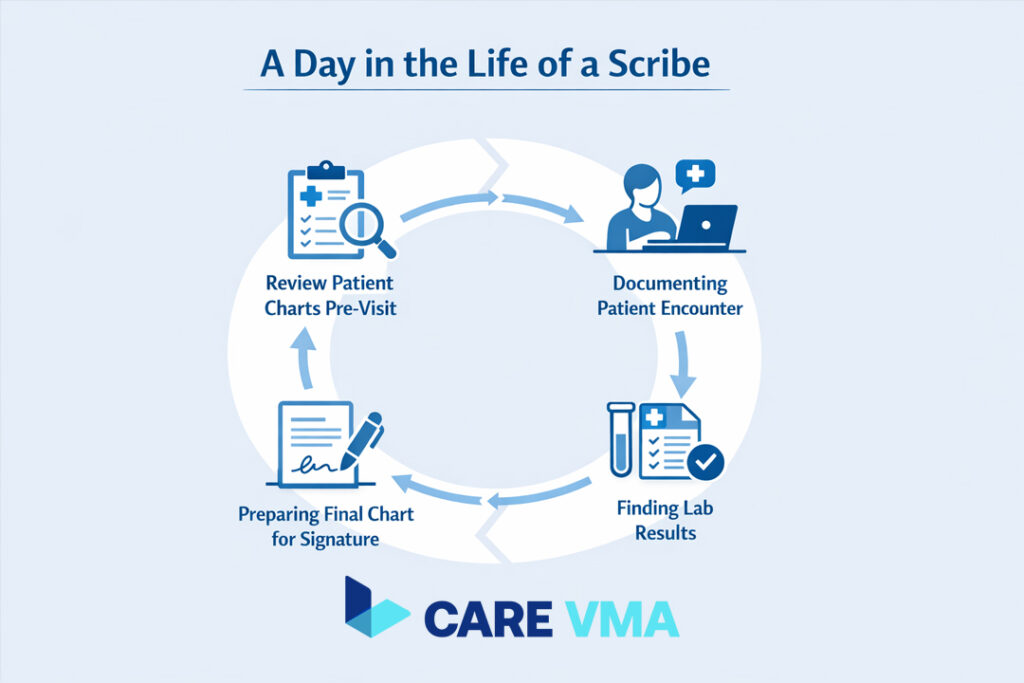
The core role of a medical scribe is to unburden clinicians from administrative tasks, allowing them to focus entirely on patient care. By managing documentation, scribes directly combat one of the leading causes of physician burnout solutions, which is excessive time spent on clerical work.
A scribe listens to the physician-patient interaction and captures the entire story in the EHR. This includes the patient’s history, the physical exam findings, the doctor’s assessment, and the treatment plan. This process enhances clinic efficiency, improves the accuracy of medical records, and gives you a front-row seat to the practice of medicine.
Step 1: Meeting the Basic Requirements
While the role is complex, the entry requirements are designed for motivated pre-health students. Companies look for a strong foundation they can build upon during training.
- Educational Qualifications A high school diploma or GED is the minimum requirement. However, employers strongly prefer candidates who are currently enrolled in or have graduated from a pre-health university program, such as pre-med, pre-PA, or nursing.
- Typing Speed: The Gold Standard of 60+ WPM This is the single most important technical skill. A fast and accurate typing speed is non-negotiable. While some companies may test for a minimum of 40-50 words per minute (WPM), the most competitive candidates type at 60 WPM or faster, as this is essential for keeping up in a fast-paced environment like an emergency department.
- Time Commitment Scribe companies invest significantly in your training. In return, they typically require a commitment of at least six months to one year, often working two to three shifts per week. Be prepared to discuss your availability and long-term commitment during the interview.
Step 2: Preparing Key Skills Before You Apply
Proactively learning these skills will make you a standout applicant and significantly ease your transition into the role.
- Learning Basic Medical Terminology You don’t need to be an expert, but understanding common prefixes (e.g., hyper- for high, hypo- for low) and suffixes (e.g., -itis for inflammation) is crucial. Familiarize yourself with basic anatomical terms and common conditions.
- Understanding the SOAP Note Structure Nearly all clinical documentation follows the SOAP format. Learning its components is a huge advantage:
- S (Subjective): What the patient tells you (e.g., “I have chest pain”).
- O (Objective): What the physician observes and measures (e.g., vital signs, physical exam findings).
- A (Assessment): The diagnosis or differential diagnoses.
- P (Plan): The treatment and next steps (e.g., prescriptions, referrals, follow-up).
- Knowing Patient Privacy Basics (HIPAA) The Health Insurance Portability and Accountability Act (HIPAA) governs patient data privacy. A foundational understanding of its principles is essential. According to the U.S. Department of Health & Human Services, protecting patient information is a legal and ethical requirement for everyone in healthcare. You can mention your awareness of HIPAA to show your professionalism.
Step 3: Where to Apply – Leading Scribe Companies
The most common path to becoming a scribe is through large national companies that contract with hospital systems and clinics.
- ScribeAmerica: The Industry Giant As the largest scribe company in the United States, ScribeAmerica offers the most opportunities across various specialties and locations.
- ProScribe: Known for Quality Training ProScribe is another major player, often praised for its thorough and supportive training programs that prepare scribes for complex medical environments.
- Aquity Solutions & Scribe-X: The Rise of the Virtual Scribe These companies are major players in the growing field of remote and virtual scribing. This is an excellent alternative if you need more flexibility or live in an area with fewer on-site opportunities. The responsibilities of a virtual medical scribe mirror those of an in-person one but are performed remotely via a secure telehealth platform.
Step 4: Conquering the Interview and Mock Charting Test
The interview process is designed to test your core competencies under pressure.
- The Live Typing Test Expect to take a timed typing test to verify your WPM and accuracy. Practice beforehand using free online tools to ensure you meet the required speed.
- Patient Encounter Simulation This is the most challenging part for many. You will listen to a recording of a mock doctor-patient visit and be asked to type out a medical note in real-time. The goal is not just speed, but your ability to filter clinically relevant information from conversational filler. They want to see if you can identify the key details a doctor would need for the medical record.
Step 5: The Paid Training Process
Once hired, you will enter a comprehensive, paid training program, typically split into two phases.
- Classroom Phase: Terminology and EHR Software This initial phase, which can be online or in-person, involves intensive learning of advanced medical terminology and mastering the specific Electronic Health Record (EHR) system used by your assigned hospital, such as Epic or Cerner. Effective EHR and EMR management is a critical skill for any modern healthcare professional.
- Clinical Phase: On-the-Floor Shadowing After passing your classroom exams, you will be paired with an experienced scribe trainer for several shifts. You will shadow them, then gradually take over documentation responsibilities under their direct supervision until you are cleared to work independently.
Care VMA Strategy: Maximizing Your Scribe Experience for Medical Applications
This job is more than just clinical hours; it’s a strategic asset for your medical school application if you know how to leverage it.
- From Documentation to Diagnosis: Building a Clinical Mindset As a scribe, you are not just typing. You are actively listening to a physician’s thought process as they move from a patient’s story to a differential diagnosis and treatment plan. This experience trains you to think like a clinician long before you start medical school.
- Turning Daily Tasks into Powerful Essay and Interview Points Don’t just say “I was a medical scribe.” In your application essays and interviews, articulate how the experience prepared you. For example, explain how documenting in a high-pressure ER taught you to stay calm and organized, or how charting for a primary care doctor showed you the importance of longitudinal patient relationships.
- Is Scribe Certification (CMSP) Necessary for You? For most pre-med students working for a large company, a certification like the Certified Medical Scribe Professional (CMSP) is not required, as the company’s training is the credential that matters. However, if you plan to work directly for a small private practice, a certification can add to your credibility and demonstrate a formal level of expertise.
FAQ (Frequently Asked Questions for Aspiring Scribes)
What is the average pay for a medical scribe?
The pay is typically at an entry-level hourly rate. The primary value of the role is the unparalleled clinical experience and exposure it provides for your future career, not the salary itself.
Can I become a scribe with no prior medical experience?
Absolutely. The major scribe companies design their training programs for individuals with no prior experience. They prioritize hiring candidates who are reliable, fast typers, and eager to learn.
How stressful is working as a medical scribe?
The stress level depends heavily on the environment. An emergency department shift will be more fast-paced and unpredictable than a shift in a specialty outpatient clinic. However, this exposure is invaluable for understanding the real pressures of a medical career before you fully commit.
Conclusion & Your Next Step
Becoming a medical scribe is not just another job to list on your resume. It is a strategic, immersive step into the world of medicine. It will test your resolve, expand your knowledge, and provide you with a competitive edge that confirms your calling and strengthens your application for medical school. The skills you learn in documentation, efficiency, and clinical reasoning are foundational for the future of healthcare.
If you are a practitioner looking to implement these efficiencies in your own practice, consider the benefits of a modern workforce. Discover how Care VMA’s Virtual Medical Scribe services can reduce administrative burden and allow you to focus on what matters most: your patients.