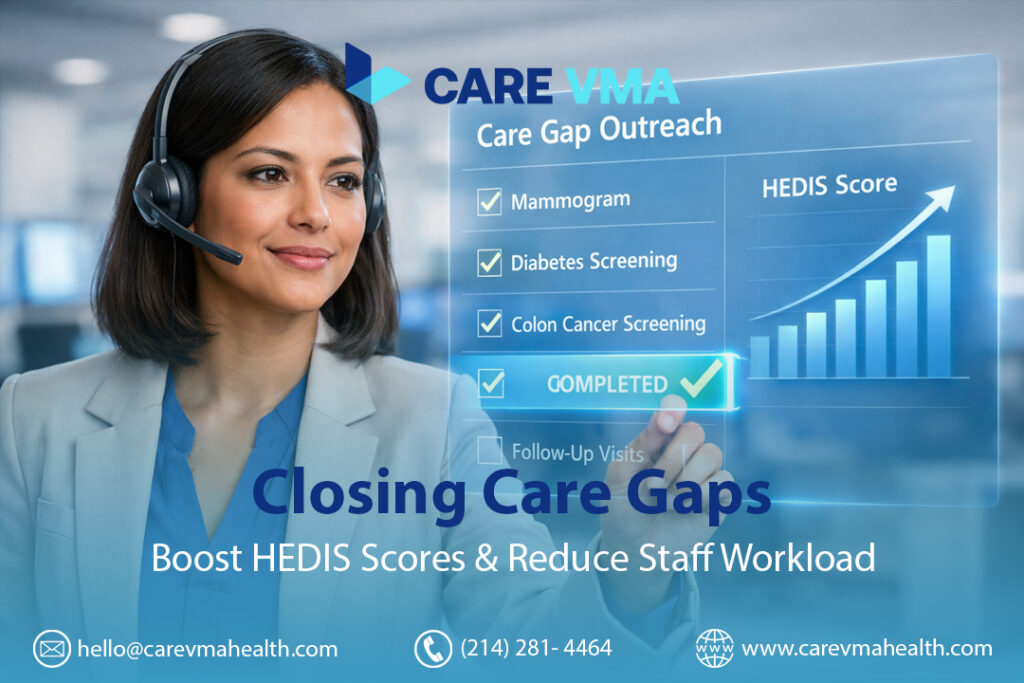
Closing care gaps in population health is the process of identifying and remedying the discrepancy between recommended clinical guidelines and the actual care a patient receives. It is critical for improving patient outcomes, reducing long-term costs, and maximizing performance in value-based care models. For healthcare leaders, the pressure to close these gaps and improve HEDIS scores is immense.
The problem? You already have the patient data. You know which screenings are overdue. But your clinical team—nurses and MAs—are spending countless hours on non-clinical, administrative tasks. They’re making hundreds of outreach calls, navigating complex schedules, and chasing down records instead of providing the top-of-license care they were trained for.
This administrative grind isn’t just inefficient; it’s a direct path to staff burnout, high turnover, and stagnant quality metrics. Every minute a nurse spends trying to schedule a mammogram is a minute they can’t spend with a complex diabetic patient, jeopardizing both outcomes and revenue. But what if you could scale your care gap closure efforts without hiring more full-time staff or deploying yet another expensive software platform? There is a better way to empower your existing team by offloading the administrative burden for good.
What Are Care Gaps and Why Do They Matter for Your Bottom Line?
At first glance, ‘care gaps’ sounds like a purely clinical term. But for any practice leader or population health director, it’s a financial one. These gaps are the missed opportunities that directly impact your performance metrics, reimbursements, and long-term viability under value-based care.
In essence, a care gap represents a patient who has not received a recommended service within a defined period. Successfully managing a patient population means systematically identifying and closing these gaps before they lead to poor health outcomes and higher costs. This proactive approach is the cornerstone of modern Population Health Management and is essential for thriving in today’s healthcare landscape. According to the Centers for Medicare & Medicaid Services (CMS), effective care management is a key driver of quality scores.
The 5 Key Types of Care Gaps Impacting Your HEDIS Scores
While care gaps can vary, most fall into a few key categories that are heavily weighted in HEDIS (Healthcare Effectiveness Data and Information Set) and CMS Star Ratings measures.
- Preventive Care: These are the most common gaps, including missed annual wellness visits, mammograms, colonoscopies, and essential vaccinations.
- Chronic Disease Management: This involves patients with conditions like hypertension or diabetes who miss crucial monitoring tests, such as an annual HbA1c test or regular blood pressure checks.
- Medication Adherence: Occurs when patients fail to refill or take their prescriptions as directed, a major driver of preventable hospitalizations.
- Transitional Care Management: These critical gaps appear when a patient is discharged from the hospital but fails to have a follow-up appointment, increasing the risk of readmission.
- Diagnostic Follow-up: A gap created when a patient has an abnormal lab result but there is no documented follow-up to address it.
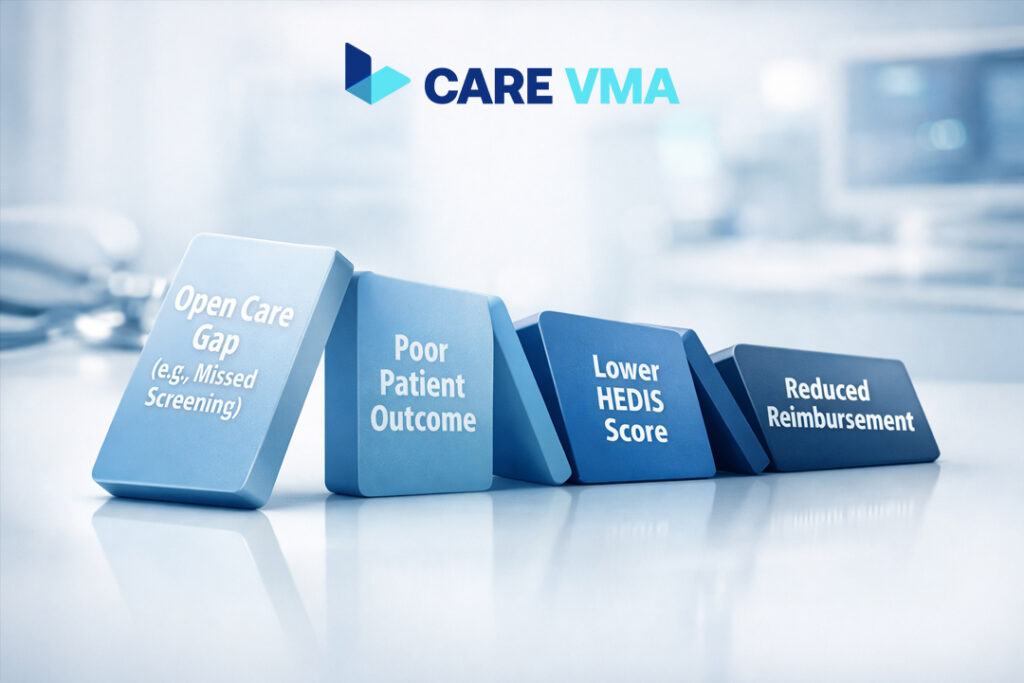
The Financial Domino Effect: How Gaps in Care Impact Value-Based Contracts
Under value-based care models, your organization is financially rewarded for keeping patients healthy, not just for treating them when they are sick. Open care gaps trigger a negative financial chain reaction.
A missed cancer screening can lead to a late-stage diagnosis, resulting in exponentially higher treatment costs. A patient with unmanaged diabetes is more likely to end up in the emergency room. These events not only represent poor patient outcomes but also lead to lower quality scores, reduced shared savings bonuses, and financial penalties in your value-based contracts.
The Hidden Barrier to Closing Gaps: Why Your Current Strategy Is Causing Staff Burnout
You’ve invested in the data analytics. Your Electronic Health Record (EHR) generates detailed gap lists. So why are your quality metrics still stalling and your staff so exhausted? Here’s the thing: technology is great at identifying the problem, but it often worsens the human-powered work required to solve it.
What most people don’t realize is that your “automated” system creates an immense administrative workload that falls squarely on your clinical staff. A care coordinator or MA might start their day with a list of 200 patients overdue for care, but that list doesn’t dial itself. They are tasked with a relentless, manual process of phone calls, voicemails, scheduling conflicts, and meticulous documentation for every single patient.
Beyond the Dashboard: The Manual Work Your “Automated” System Creates
This is where well-intentioned strategies break down. The operational reality of patient outreach is a time-consuming, repetitive cycle that prevents nurses and MAs from performing clinical duties.
Consider the journey of closing just one gap:
- Generate the call list from the EHR.
- Manually dial the first number; it goes to voicemail.
- Leave a message and document the attempt in the system.
- Dial the next patient; the line is busy. Document the attempt.
- Dial a third; the patient answers but can’t talk now. Schedule a callback. Document it.
- This cycle repeats dozens, if not hundreds, of times a day.
This is not a clinical task, yet it consumes a massive portion of your clinical team’s day, leading directly to frustration and inefficiency.
The True Cost of Staff Burnout: Turnover, Errors, and Declining Patient Experience
When skilled clinical staff are relegated to the role of a call center agent, staff burnout is inevitable. This isn’t just a morale issue; it has tangible costs. According to the National Institutes of Health, burnout is a significant factor in healthcare professional turnover.
High turnover means continuously spending resources on hiring and training new staff. Overworked, exhausted employees are also more prone to making documentation errors, which can compromise your quality reporting. Finally, a rushed, stressed-out team simply cannot provide the empathetic, high-quality patient engagement that builds trust and loyalty.
The Modern Solution: Augmenting Your Team with Virtual Medical Assistants
What if the solution to closing more care gaps isn’t another software platform, but a smarter way to manage the human workload? This is where a hybrid model, powered by trained Virtual Medical Assistants (VMAs), becomes a game-changer.
Instead of replacing your team, VMAs augment it. They act as a specialized, remote extension of your practice, laser-focused on executing the non-clinical administrative tasks that are currently draining your in-house staff. By delegating this work, you restore your clinical team’s capacity to focus on direct patient care.
How Care VMA Solves the Burnout Problem
Care VMA’s trained assistants are designed to seamlessly integrate into your workflow and tackle the administrative bottleneck head-on.
- Reduces Workload: Our VMAs take ownership of the entire patient outreach and scheduling process. From initial calls and sending reminders to confirming appointments and documenting every step, they manage the end-to-end workflow, freeing your nurses and MAs from the phone.
- Increases Efficiency: A VMA isn’t juggling outreach with rooming patients or drawing blood. They are experts in systematic, high-volume communication. This specialized focus means they clear care gap lists faster and more consistently than an overburdened clinical team ever could. Learn more about how a Healthcare Virtual Assistant can boost efficiency.
- Improves Documentation: Clean data is crucial for HEDIS reporting. Our VMAs are trained to handle meticulous documentation of outreach attempts, patient responses, and appointment statuses directly within your EHR or management system, ensuring your data is accurate and audit-ready.
Use Case: Closing the Annual Wellness Visit & Mammogram Gap
Let’s see how this works in practice.
- Identify: Your EHR identifies 500 female patients over 40 who are overdue for their annual wellness visit and/or a mammogram.
- Assign: Instead of handing this list to your nursing staff, it is securely assigned to your dedicated Care VMA team.
- Execute: The VMAs conduct personalized outreach using practice-approved scripts. They educate patients on the importance of the screenings, navigate scheduling with local imaging centers, send appointment reminders, and meticulously document the outcome of every call.
- Elevate: Your in-house clinical team is now free from this process. They only step in to manage clinical questions or handle complex patient cases escalated by the VMA, allowing them to operate at the top of their license.
Feeling overwhelmed by the sheer volume of administrative work needed to close care gaps? It might be time to rethink who handles these non-clinical tasks. Many practices find immediate relief and improved outcomes by integrating virtual medical assistants to manage this critical part of the workflow.
The Tangible Outcomes: Better Scores, Higher Revenue, and a Happier Team
Operational efficiency is great, but what does it mean for your key performance indicators? Implementing a VMA-powered outreach strategy translates directly into the results that matter most to healthcare leaders.
Boost HEDIS & Star Ratings
The math is simple: the faster and more consistently you close preventive and chronic care gaps, the better you perform on key quality measures. By ensuring systematic follow-up, VMAs directly contribute to higher scores for metrics like cancer screenings and A1c control.
Increase Practice Revenue
Every scheduled Annual Wellness Visit, screening, or chronic care follow-up is a captured billable service. By converting a lengthy “to-do” list into scheduled appointments, VMAs don’t just improve quality; they create a significant and predictable new revenue stream, maximizing the value of your patient panel. Our guide on Chronic Care Management explores this further.
Reduce Staff Turnover
When you alleviate the primary sources of administrative burnout, you create a more sustainable and rewarding work environment. Your clinical staff feels valued for their skills, not for their ability to make phone calls. This leads to higher job satisfaction, better team morale, and a dramatic reduction in costly staff turnover.
This strategic delegation is a powerful tool for reducing burnout in healthcare practices.

How VMA-Powered Outreach Compares to Other Solutions
When faced with care gap challenges, most organizations see only two options: burden their existing staff or purchase an expensive, all-in-one software platform. But there’s a third, more flexible and effective path.
The Care VMA hybrid model provides the human touch and execution that software lacks, without the high cost and burnout potential of a purely in-house approach.
| Feature | In-House Staff Only | All-in-One Software Platform | Care VMA Hybrid Model |
|---|---|---|---|
| Cost | High (Salaries, Benefits, Turnover Costs) | High (Licensing Fees, Implementation) | Cost-Effective (Fraction of FTE cost, no overhead) |
| Implementation Time | N/A (Uses existing, overloaded staff) | Long (Months of IT integration and training) | Fast (Can be operational in days or weeks) |
| Impact on Workload | Increases clinical staff burnout | Often creates new data management tasks for staff | Directly Reduces administrative burden on staff |
| Scalability | Limited (Hiring is slow and expensive) | Scalable, but at a high cost | Highly Scalable (Easily add VMA support as needed) |
| Flexibility | Low (Staff tied to specific roles) | Low (Locked into a single vendor’s ecosystem) | High (Integrates with your existing EHR and workflow) |
Get Started with Care VMA
Integrating a Virtual Medical Assistant is more than just an operational tweak; it’s a strategic decision to build a more resilient, efficient, and profitable practice. It’s about empowering your team to do their best work.
- Ready to see what a VMA can do? Explore our Virtual Medical Assistant services.
- Discover the foundation of our approach by reading our Ultimate Guide to Healthcare Virtual Assistants.
Frequently Asked Questions
How do you measure the success of closing care gaps?
Success is measured primarily through improved quality metrics. This includes tracking the percentage of eligible patients who complete a required action (like a screening), which is directly reflected in higher HEDIS measure scores, better CMS Star Ratings, and, ultimately, a reduction in preventable emergency visits and hospitalizations.
What is the most significant barrier to closing gaps in care?
While data and patient engagement are challenges, the most significant operational barrier is staff burnout. This is caused by the immense administrative workload of manual patient outreach, follow-up, scheduling, and documentation required to act on the care gap data provided by EHRs.
Can a Virtual Assistant handle patient outreach compliantly?
Absolutely. HIPAA-trained Virtual Medical Assistants, like those at Care VMA, operate under strict security protocols and use practice-approved scripts and workflows. They manage the non-clinical, administrative components of outreach, such as scheduling and providing reminders, ensuring full HIPAA compliance and data security.
Stop Trading Patient Care for Paperwork
Stop treating staff burnout as an unavoidable cost of quality improvement. Closing care gaps is a financial and clinical necessity, but it doesn’t have to break your team. By strategically delegating the administrative grind of patient outreach, scheduling, and coordination, you empower your skilled clinical staff to get back to what they do best: caring for patients.
Imagine your team starting each day with a clear focus on clinical priorities, confident that the relentless, time-consuming outreach is already being handled with precision and care. This isn’t a future ideal; it’s the operational reality for practices that embrace a modern, augmented staffing model.
Reduce Your Team’s Workload and Boost Your HEDIS Scores. Schedule a free, no-obligation discovery call with our workflow experts to build a custom plan for offloading your administrative tasks to our trained VMAs.