The US healthcare landscape is undergoing a seismic shift. As private practices face the dual pressures of rising real estate costs and a shortage of qualified administrative labor, the traditional brick-and-mortar operational model is reaching its breaking point. For many physicians, the solution isn’t just “hiring more help”—it is the wholesale adoption of a Virtual Medical Office.
This strategic transition allows practices to offload the administrative burden, reduce fixed overhead, and return their focus to where it belongs: the patient.
The Sustainable Practice Model: Why Traditional Medical Office Overhead is Failing US Physicians
For years, US physicians have operated under a high-fixed-cost model. Between expensive office leases and the rising wages of local administrative staff, profit margins are thinner than ever.
- The Breaking Point: Many practices are transitioning from rigid staffing models to variable, scalable operational models. A virtual medical office allows you to pay for the productivity you need, rather than for hours spent sitting at a desk.
- The Hidden “Pajama Time” Cost: Administrative burdens often follow doctors home, leading to significant burnout. By leveraging a virtual medical assistant, physicians can effectively eliminate the “pajama time” spent on charting and paperwork.
- Market Reality: With US real estate and local administrative wages rising, private practices must find ways to reduce burnout in US healthcare practices to remain competitive and solvent.
What is a Virtual Medical Office and How Does It Scale Your Practice?
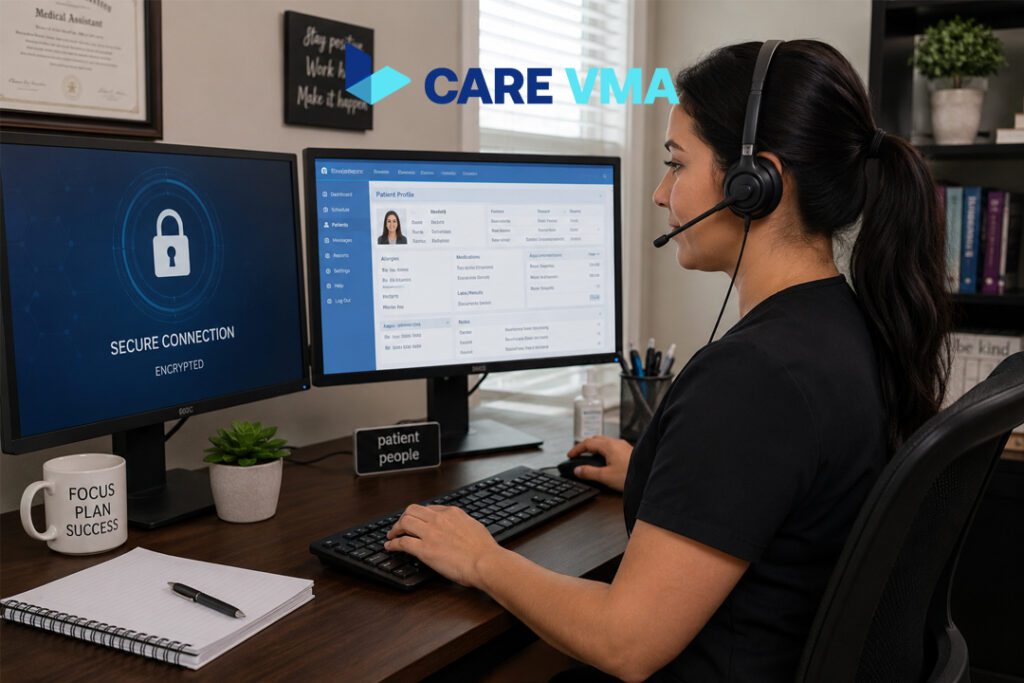
A Virtual Medical Office is not just a remote worker; it is a centralized, remote operational hub. Here, HIPAA-compliant professionals manage all non-clinical tasks via secure EMR/EHR integration. At Care VMA, we provide the infrastructure that allows this hub to function as a seamless extension of your local clinic.
Core Functions Include:
- Synchronized Patient Scheduling: Managing calendars across multiple providers without double-bookings.
- Real-time EMR Data Entry: Ensuring charts are updated as the patient encounter happens.
- Strategic Revenue Cycle Management: Utilizing a medical billing virtual assistant to handle complex claims and coding.
- Front-Desk Management: Every patient call is handled by a professional virtual medical receptionist, ensuring no lead or patient inquiry goes unanswered.
Top Benefits of a Virtual Medical Office: Transforming Clinical Efficiency into Growth
Drastic Reduction in Operational Overhead (The 60% ROI Factor)
Transitioning to a virtual model allows practices to eliminate the costs associated with physical desk space, expensive office equipment, and the massive tax/benefit burden (401k, health insurance) of local employees. Most practices see a 50% to 70% reduction in administrative costs almost immediately.
Recovering “Lost” Revenue Through Specialized Workflow Optimization
Revenue leakage is a silent killer for private practices. Dedicated specialists can close the gap on denied claims by focusing specifically on the insurance verification and prior authorization landscape of US Medicare, Medicaid, and private payers. Proactive virtual engagement also significantly reduces “No-Show” rates, ensuring your schedule remains optimized.
Improving the “Patient Experience” Without Increasing On-Site Staff
Patients today expect immediate responses. A virtual medical office ensures that every call is answered by a US-trained VMA who maintains the “personal touch” of a local clinic while operating virtually. This increases patient satisfaction scores without requiring you to hire more on-site personnel.
The Frictionless Workflow: Mapping the Patient Journey in a Virtual Environment
The key to a successful virtual office is Frictionless Operational Transformation. Here is how the patient journey looks with Care VMA:
- Secure Intake: A patient calls your office. The call is routed through an encrypted VOIP system to your Care VMA professional.
- Real-Time EMR Update: The VMA accesses your clinic’s EMR (Epic, AthenaHealth, etc.) via a secure medical VPN to update charts, verify insurance, or schedule appointments.
- Clinical Continuity: When the patient arrives, you are ready. The intake is done, the insurance is verified, and you can focus 100% on pure patient care.
This transition from “Administrative Chaos” to “Automated Autopilot” is the hallmark of clinic workflow optimization.
Security First: Why Care VMA Prioritizes Institutional-Grade HIPAA Compliance
Security is the primary concern for any healthcare decision-maker considering a virtual shift. Care VMA addresses this through a “Security First” architecture:
- The Business Associate Agreement (BAA): We provide legal accountability as the foundation of our partnership.
- Data Protection Protocols: We implement end-to-end encryption, multi-factor authentication (MFA), and secure remote access that eliminates data leakage risks.
- Continuous Monitoring: Our staff undergoes rigorous, ongoing training on HIPAA compliance and data security and OIG guidelines to ensure your practice remains audit-proof.
Strategic Comparison: Virtual Medical Office Assistant vs In-Person Staff ROI
When comparing a local admin earning $25/hr (plus benefits and overhead) to a high-tier Care VMA solution, the choice becomes clear. Beyond the hourly rate, the Scalability on Demand is unmatched. You can add or reduce virtual staffing hours based on seasonal patient volume without the friction of local hiring or firing.
Implementing Change: How to Transition to a Virtual Office Model Without Disruption
Transitioning doesn’t have to be disruptive. We recommend starting with a Workflow Audit to identify which tasks—such as billing, front-desk management, or intake—are best suited for immediate virtualization. Our team ensures a zero-downtime hand-off from your local staff to your new virtual team.
Ready to reclaim your time and scale your practice? Schedule a 15-Minute Efficiency Consultation with Care VMA today.
FAQ: Decision-Maker Insights
Are virtual medical offices really HIPAA compliant?
Absolutely. At Care VMA, compliance is built into our DNA through BAA agreements, secure medical VPNs, and strict staff training on PHI handling protocols.
How does a virtual assistant access my office EMR?
Access is granted through secure, encrypted remote desktop protocols or direct EMR logins with restricted permissions, ensuring they only access data necessary for their specific tasks.
How much can a clinic save by going virtual?
Most US-based private practices report a 50% to 70% reduction in administrative overhead by eliminating physical space requirements and local employee benefit costs.
What equipment is needed for a virtual medical office?
The clinic only needs a stable internet connection and access to existing EMR software. Care VMA provides all necessary hardware and secure communication tools for the remote staff.
How do you train virtual staff for US healthcare regulations?
Care VMA handles all training. Our assistants undergo rigorous education in US medical terminology, specific insurance workflows, and HIPAA regulations before being assigned to a practice.